Thank you for visiting SNEWPapers!
Sign up free
Story
April 7, 1796
Gazette Of The United States
Philadelphia, Philadelphia County, Pennsylvania
What is this article about?
An observer from Augusta defends companies involved in Western Territory sales against bribery charges, arguing the supplementary act was a post-session compromise they accepted later, invoking contract principles and citing Pennsylvania's bank charter precedent.
Clipping
OCR Quality
98%
Excellent
Full Text
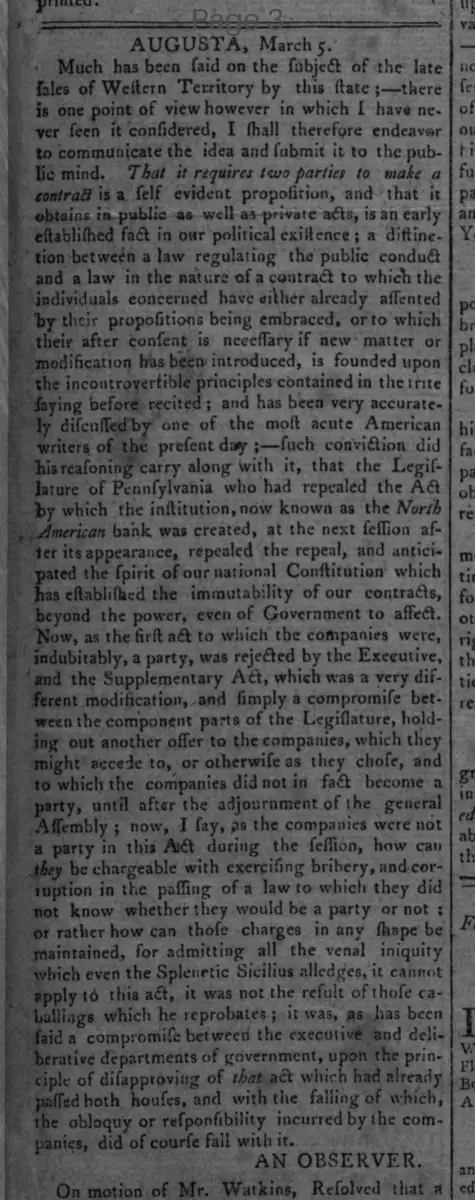
AUGUSTA, March 5.
Much has been said on the subject of the late sales of Western Territory by this state;—there is one point of view however in which I have never seen it considered, I shall therefore endeavor to communicate the idea and submit it to the public mind. That it requires two parties to make a contract is a self-evident proposition, and that it obtains in public as well as private acts, is an early established fact in our political existence; a distinction between a law regulating the public conduct and a law in the nature of a contract to which the individuals concerned have either already assented by their propositions being embraced, or to which their after consent is necessary if new matter or modification has been introduced, is founded upon the incontrovertible principles contained in the trite saying before recited; and has been very accurately discussed by one of the most acute American writers of the present day;—such conviction did his reasoning carry along with it, that the Legislature of Pennsylvania who had repealed the Act by which the institution, now known as the North American bank was created, at the next session after its appearance, repealed the repeal, and anticipated the spirit of our national Constitution which has established the immutability of our contracts, beyond the power, even of Government to affect.
Now, as the first act to which the companies were, indubitably, a party, was rejected by the Executive, and the Supplementary Act, which was a very different modification, and imply a compromise between the component parts of the Legislature, holding out another offer to the companies, which they might accede to, or otherwise as they chose, and to which the companies did not in fact become a party, until after the adjournment of the general Assembly; now, I say, as the companies were not a party in this Act during the session, how can they be chargeable with exercising bribery, and corruption in the passing of a law to which they did not know whether they would be a party or not: or rather how can those charges in any shape be maintained, for admitting all the venal iniquity which even the Spleenetic Silicius alleges, it cannot apply to this act, it was not the result of those caballings which he reprobates; it was, as has been said a compromise between the executive and deliberative departments of government, upon the principle of disapproving of that act which had already passed both houses, and with the falling of which, the obloquy or responsibility incurred by the companies, did of course fall with it.
AN OBSERVER.
Much has been said on the subject of the late sales of Western Territory by this state;—there is one point of view however in which I have never seen it considered, I shall therefore endeavor to communicate the idea and submit it to the public mind. That it requires two parties to make a contract is a self-evident proposition, and that it obtains in public as well as private acts, is an early established fact in our political existence; a distinction between a law regulating the public conduct and a law in the nature of a contract to which the individuals concerned have either already assented by their propositions being embraced, or to which their after consent is necessary if new matter or modification has been introduced, is founded upon the incontrovertible principles contained in the trite saying before recited; and has been very accurately discussed by one of the most acute American writers of the present day;—such conviction did his reasoning carry along with it, that the Legislature of Pennsylvania who had repealed the Act by which the institution, now known as the North American bank was created, at the next session after its appearance, repealed the repeal, and anticipated the spirit of our national Constitution which has established the immutability of our contracts, beyond the power, even of Government to affect.
Now, as the first act to which the companies were, indubitably, a party, was rejected by the Executive, and the Supplementary Act, which was a very different modification, and imply a compromise between the component parts of the Legislature, holding out another offer to the companies, which they might accede to, or otherwise as they chose, and to which the companies did not in fact become a party, until after the adjournment of the general Assembly; now, I say, as the companies were not a party in this Act during the session, how can they be chargeable with exercising bribery, and corruption in the passing of a law to which they did not know whether they would be a party or not: or rather how can those charges in any shape be maintained, for admitting all the venal iniquity which even the Spleenetic Silicius alleges, it cannot apply to this act, it was not the result of those caballings which he reprobates; it was, as has been said a compromise between the executive and deliberative departments of government, upon the principle of disapproving of that act which had already passed both houses, and with the falling of which, the obloquy or responsibility incurred by the companies, did of course fall with it.
AN OBSERVER.
What sub-type of article is it?
Historical Event
What themes does it cover?
Justice
Deception
What keywords are associated?
Western Territory Sales
Bribery Allegations
Contract Law
State Legislature
Supplementary Act
What entities or persons were involved?
Silicius
An Observer
Where did it happen?
Augusta
Story Details
Key Persons
Silicius
An Observer
Location
Augusta
Event Date
March 5
Story Details
The author argues that companies cannot be accused of bribery in the supplementary act for Western Territory sales, as they were not parties during the legislative session; it was a post-adjournment compromise, drawing on contract law principles and the Pennsylvania bank charter precedent.