Thank you for visiting SNEWPapers!
Sign up free
Editorial
September 29, 1893
The Globe Republican
Dodge City, Ford County, Kansas
What is this article about?
Editorial criticizes Kansas Governor Lewelling for violating the state constitution by using militia to obstruct the legislature and supreme court, asserting that law is the ultimate authority over the governor.
Clipping
OCR Quality
95%
Excellent
Full Text
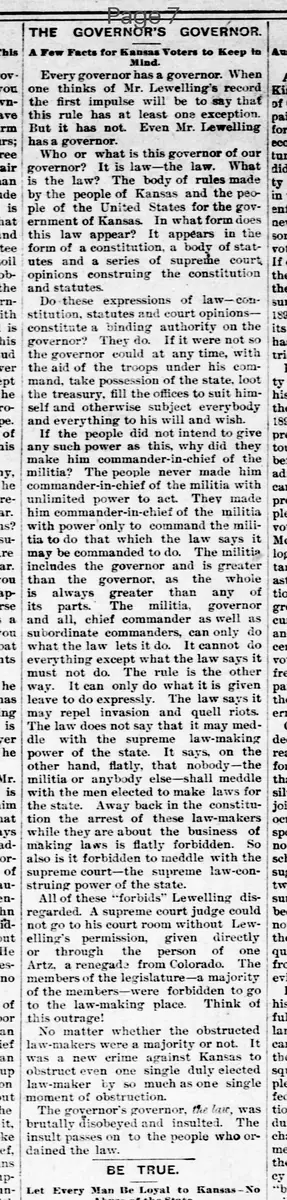
THE GOVERNOR'S GOVERNOR.
A Fast for Kansas Voters to Keep to Middle.
Every governor has a governor. When one thinks of Mr. Lewelling's record the first impulse will be to say that this rule has at least one exception. But it has not. Even Mr. Lewelling has a governor.
Who or what is this governor of our governor? It is law—the law. What is the law? The body of rules made by the people of Kansas and the people of the United States for the government of Kansas. In what form does this law appear? It appears in the form of a constitution, a body of statutes and a series of supreme court opinions construing the constitution and statutes.
Do these expressions of law—constitution, statutes and court opinions—constitute a binding authority on the governor? They do. If it were not so the governor could at any time, with the aid of the troops under his command, take possession of the state, loot the treasury, fill the offices to suit himself and otherwise subject everybody and everything to his will and wish.
If the people did not intend to give any such power as this, why did they make him commander-in-chief of the militia? The people never made him commander-in-chief of the militia with unlimited power to act. They made him commander-in-chief of the militia with power only to command the militia to do that which the law says it may be commanded to do. The militia includes the governor and is greater than the governor, as the whole is always greater than any of its parts. The militia, governor and all, chief commander as well as subordinate commanders, can only do what the law lets it do. It cannot do everything except what the law says it must not do. The rule is the other way. It can only do what it is given leave to do expressly. The law says it may repel invasion and quell riots. The law does not say that it may meddle with the supreme law-making power of the state. It says, on the other hand, flatly, that nobody—the militia or anybody else—shall meddle with the men elected to make laws for the state. Away back in the constitution the arrest of these law-makers while they are about the business of making laws is flatly forbidden. So also is it forbidden to meddle with the supreme court—the supreme law-construing power of the state.
All of these "forbids" Lewelling disregarded. A supreme court judge could not go to his court room without Lewelling's permission, given directly or through the person of one Artz, a renegade from Colorado. The members of the legislature—a majority of the members—were forbidden to go to the law-making place.
Think of this outrage!
No matter whether the obstructed law-makers were a majority or not. It was a new crime against Kansas to obstruct even one single duly elected law-maker by so much as one single moment of obstruction.
The governor's governor, the law, was brutally disobeyed and insulted. The insult passes on to the people who ordained the law.
BE TRUE.
A Fast for Kansas Voters to Keep to Middle.
Every governor has a governor. When one thinks of Mr. Lewelling's record the first impulse will be to say that this rule has at least one exception. But it has not. Even Mr. Lewelling has a governor.
Who or what is this governor of our governor? It is law—the law. What is the law? The body of rules made by the people of Kansas and the people of the United States for the government of Kansas. In what form does this law appear? It appears in the form of a constitution, a body of statutes and a series of supreme court opinions construing the constitution and statutes.
Do these expressions of law—constitution, statutes and court opinions—constitute a binding authority on the governor? They do. If it were not so the governor could at any time, with the aid of the troops under his command, take possession of the state, loot the treasury, fill the offices to suit himself and otherwise subject everybody and everything to his will and wish.
If the people did not intend to give any such power as this, why did they make him commander-in-chief of the militia? The people never made him commander-in-chief of the militia with unlimited power to act. They made him commander-in-chief of the militia with power only to command the militia to do that which the law says it may be commanded to do. The militia includes the governor and is greater than the governor, as the whole is always greater than any of its parts. The militia, governor and all, chief commander as well as subordinate commanders, can only do what the law lets it do. It cannot do everything except what the law says it must not do. The rule is the other way. It can only do what it is given leave to do expressly. The law says it may repel invasion and quell riots. The law does not say that it may meddle with the supreme law-making power of the state. It says, on the other hand, flatly, that nobody—the militia or anybody else—shall meddle with the men elected to make laws for the state. Away back in the constitution the arrest of these law-makers while they are about the business of making laws is flatly forbidden. So also is it forbidden to meddle with the supreme court—the supreme law-construing power of the state.
All of these "forbids" Lewelling disregarded. A supreme court judge could not go to his court room without Lewelling's permission, given directly or through the person of one Artz, a renegade from Colorado. The members of the legislature—a majority of the members—were forbidden to go to the law-making place.
Think of this outrage!
No matter whether the obstructed law-makers were a majority or not. It was a new crime against Kansas to obstruct even one single duly elected law-maker by so much as one single moment of obstruction.
The governor's governor, the law, was brutally disobeyed and insulted. The insult passes on to the people who ordained the law.
BE TRUE.
What sub-type of article is it?
Constitutional
Partisan Politics
What keywords are associated?
Governor Lewelling
Kansas Law
Militia Limits
Constitutional Violation
Legislative Obstruction
Supreme Court Interference
What entities or persons were involved?
Mr. Lewelling
Artz
Kansas Legislature
Kansas Supreme Court
Editorial Details
Primary Topic
Criticism Of Governor Lewelling's Disregard For Kansas Law And Constitution
Stance / Tone
Strongly Critical Of Governor Lewelling
Key Figures
Mr. Lewelling
Artz
Kansas Legislature
Kansas Supreme Court
Key Arguments
Every Governor Has The Law As Its Superior Authority
Law Appears As Constitution, Statutes, And Supreme Court Opinions
Governor's Power Over Militia Is Limited To What Law Permits
Militia Cannot Interfere With Legislature Or Supreme Court
Arrest Of Lawmakers While Making Laws Is Forbidden By Constitution
Lewelling Obstructed Legislature And Supreme Court