Thank you for visiting SNEWPapers!
Sign up free
Alexandria Daily Advertiser
Alexandria, Virginia
What is this article about?
Court martial of Captain James Barron aboard USS Chesapeake in Norfolk, Virginia, January 4 to February 8, 1808, for the 1807 incident with HMS Leopard. Acquitted of negligent duty and failing to encourage fighting; guilty of not clearing ship for action upon probable engagement.
Merged-components note: Continuation of the court martial story across pages 2 and 3; the text flows directly from the end of the page 2 component to the start of the page 3 component, ending with '[To be continued]'.
Clippings
1 of 2
OCR Quality
Full Text
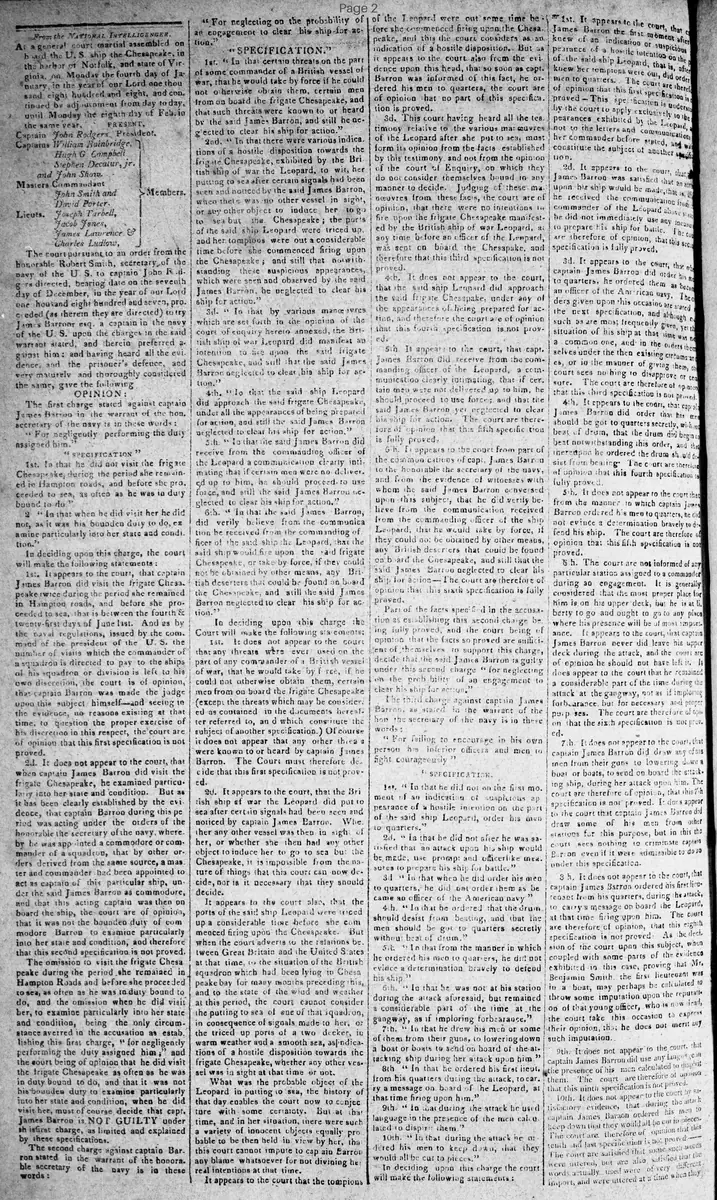
At a general court martial assembled on board the U. S. ship the Chesapeake, in the harbor of Norfolk, and state of Virginia, on Monday the fourth day of January, in the year of our Lord one thousand eight hundred and eight, and continued by adjournment from day to day, until Monday the eighth day of February, in the same year.
PRESENT,
Captain John Rodgers, President.
Captains William Bainbridge,
Hugh G. Campbell,
Stephen Decatur, jr.
and John Shaw.
Masters Commandant
John Smith and
Members.
David Porter.
Lieuts.
Joseph Tarbell,
Jacob Jones,
James Lawrence &
Charles Ludlow,
The court pursuant to an order from the honorable Robert Smith, secretary of the navy of the U. S. to captain John Rodgers directed, bearing date on the seventh day of December, in the year of our Lord one thousand eight hundred and seven, proceeded (as therein they are directed to try James Barron, esq. a captain in the navy of the U. S. upon the charge in the said warrant stated, and therein preferred against him: and having heard all the evidence, and the prisoner's defence, and very maturely and thoroughly considered the same, gave the following
OPINION:
The first charge stated against captain James Barron in the warrant of the hon. secretary of the navy is in these words:
… For negligently performing the duty assigned him.
"SPECIFICATION"
1st. In that he did not visit the frigate Chesapeake, during the period she remained in Hampton Roads, and before she proceeded to sea, as often as he was in duty bound to do."
2
"In that when he did visit her he did not, as it was his bounden duty to do, examine particularly into her state and condition."
In deciding upon this charge, the court will make the following statements:
1st. It appears to the court, that captain James Barron did visit the frigate Chesapeake twice during the period she remained in Hampton Roads, and before she proceeded to sea, that is between the fourth & twenty-first days of June last. And as by the naval regulations, issued by the command of the president of the U. S. the number of visits which the commander of a squadron is directed to pay to the ships of his squadron or division is left to his own discretion, the court is of opinion, that captain Barron was made the judge upon this subject himself—and seeing in the evidence, no reasons existing at that time, to question the proper exercise of his discretion in this respect, the court are of opinion that this first specification is not proved.
2d. It does not appear to the court, that when captain James Barron did visit the frigate Chesapeake, he examined particularly into her state and condition. But as it has been clearly established by the evidence, that captain Barron during this period was acting under the orders of the honorable the secretary of the navy, wherein he was appointed a commodore or commander of a squadron, that by other orders derived from the same source, a master and commander had been appointed to act as captain of this particular ship, under the said James Barron as commodore, and that this acting captain was then on board the ship, the court are of opinion, that it was not the bounden duty of commodore Barron to examine particularly into her state and condition, and therefore that this second specification is not proved.
The omission to visit the frigate Chesapeake during the period she remained in Hampton Roads and before she proceeded to sea, as often as he was in duty bound to do, and the omission when he did visit her, to examine particularly into her state and condition, being the only circumstances averred in the accusation as establishing this first charge, "for negligently performing the duty assigned him;" and the court being of opinion that he did visit the frigate Chesapeake as often as he was in duty bound to do, and that it was not his bounden duty to examine particularly into her state and condition, when he did visit her, must of course decide that capt. James Barron is NOT GUILTY under this first charge, as limited and explained by these specifications.
The second charge against captain Barron stated in the warrant of the honorable secretary of the navy is in these words:
"For neglecting on the probability of an engagement to clear his ship for action."
SPECIFICATION.
1st. "In that certain threats on the part of some commander of a British vessel of war, that he would take by force if he could not otherwise obtain them, certain men from on board the frigate Chesapeake, and that such threats were known to or heard by the said James Barron, and still he neglected to clear his ship for action."
2d. "In that there were various indications of a hostile disposition towards the frigate Chesapeake, exhibited by the British ship of war the Leopard, to wit, her putting to sea after certain signals had been seen and noticed by the said James Barron, when there was no other vessel in sight, or any other object to induce her to go to sea but the Chesapeake; the ports of the said ship Leopard were triced up, and her gun-ports were out a considerable time before she commenced firing upon the Chesapeake; and still that notwithstanding these suspicious appearances, which were seen and observed by the said James Barron, he neglected to clear his ship for action."
3d. "In that by various manoeuvres which are set forth in the opinion of the court of enquiry hereto annexed, the British ship of war Leopard did manifest an intention to fire upon the said frigate Chesapeake, and still that the said James Barron neglected to clear his ship for action."
4th. "In that the said ship Leopard did approach the said frigate Chesapeake, under all the appearances of being prepared for action, and still the said James Barron neglected to clear his ship for action."
5th. "In that the said James Barron did receive from the commanding officer of the Leopard a communication clearly intimating that if certain men were not delivered up to him, he should proceed to use force, and still the said James Barron neglected to clear his ship for action."
6th. "In that the said James Barron, did verily believe from the communication he received from the commanding officer of the said ship the Leopard, that the said ship would fire upon the said frigate Chesapeake, or take by force, if they could not be obtained by other means, any British deserters that could be found on board the Chesapeake, and still the said James Barron neglected to clear his ship for action."
In deciding upon this charge the Court will make the following statements:
1st. It does not appear to the court that any threats were ever used on the part of any commander of a British vessel of war, that he would take by force, if he could not otherwise obtain them, certain men from on board the frigate Chesapeake—(except the threats which may be considered as contained in the documents hereafter referred to, and which constitute the subject of another specification.) Of course it does not appear that any other threats were known to or heard by captain James Barron. The Court must therefore decide that this first specification is not proved.
2d. It appears to the court, that the British ship of war the Leopard did put to sea after certain signals had been seen and noticed by captain James Barron. Whether any other vessel was then in sight of her, or whether she then had any other object to induce her to go to sea but the Chesapeake, it is impossible from the nature of things that this court can now decide, nor is it necessary that they should decide.
It appears to the court also, that the ports of the said ship Leopard were triced up a considerable time before she commenced firing upon the Chesapeake. But when the court adverts to the relations between Great Britain and the United States at that time, to the situation of the British squadron which had been lying in Chesapeake bay for many months preceding this, and to the state of the wind and weather at this period, the court cannot consider the putting to sea of one of that squadron, in consequence of signals made to her, or the triced up ports of a two decker, in warm weather and a smooth sea, as indications of a hostile disposition towards the frigate Chesapeake, whether any other vessel was in sight at that time or not.
What was the probable object of the Leopard in putting to sea, the history of that day enables the court now to conjecture with some certainty. But at that time, and in her situation, there were such a variety of innocent objects equally probable to be then held in view by her, that this court cannot impute to captain Barron any blame whatsoever for not divining her real intentions at that time.
It appears to the court that the gun-ports of the Leopard were out some time before she commenced firing upon the Chesapeake, and this the court considers as an indication of a hostile disposition. But as it appears to the court also from the evidence upon this head, that so soon as capt. Barron was informed of this fact, he ordered his men to quarters, the court are of opinion that no part of this specification is proved.
3d. This court having heard all the testimony relative to the various manoeuvres of the Leopard after she put to sea, must form its opinion from the facts established by this testimony, and not from the opinion of the court of Enquiry, on which they do not consider themselves bound in any manner to decide. Judging of these manoeuvres from these facts, the court are of opinion, that there were no intentions to fire upon the frigate Chesapeake manifested by the British ship of war Leopard, at any time before an officer of the Leopard, was sent on board the Chesapeake, and therefore that this third specification is not proved.
4th. It does not appear to the court, that the said ship Leopard did approach the said frigate Chesapeake, under any of the appearances of being prepared for action, and therefore the court are of opinion that this fourth specification is not proved.
5th. It appears to the court, that capt. James Barron did receive from the commanding officer of the Leopard, a communication clearly intimating, that if certain men were not delivered up to him, he should proceed to use force; and that the said James Barron yet neglected to clear his ship for action. The court are therefore of opinion that this fifth specification is fully proved.
6th. It appears to the court from part of the communications of capt. James Barron to the honorable the secretary of the navy, and from the evidence of witnesses with whom the said James Barron conversed upon this subject, that he did verily believe from the communication received from the commanding officer of the ship Leopard, that he would take by force, if they could not be obtained by other means, any British deserters that could be found on board the Chesapeake, and still that the said James Barron neglected to clear his ship for action. The Court are therefore of opinion that this sixth specification is fully proved.
Part of the facts specified in the accusation as establishing this second charge being fully proved, and the court being of opinion that the facts so proved are sufficient of themselves to support this charge, decide that the said James Barron is guilty under this second charge "for neglecting on the probability of an engagement to clear his ship for action."
The third charge against captain James Barron, as stated in the warrant of the hon. the secretary of the navy is in these words:
"For failing to encourage in his own person his inferior officers and men to fight courageously"
SPECIFICATION.
1st, "In that he did not on the first moment of an indication of suspicious appearance of a hostile intention on the part of the said ship Leopard, order his men to quarters."
2d, "In that he did not after he was satisfied that an attack upon his ship would be made, use proper and officerlike measures to prepare his ship for battle."
3d "In that when he did order his men to quarters, he did not order them as became an officer of the American Navy"
4th. "In that he ordered that the drum should desist from beating, and that the men should be got to quarters secretly without beat of drum."
5th. "In that from the manner in which he ordered his men to quarters, he did not evince a determination bravely to defend his ship."
6th. "In that he was not at his station during the attack aforesaid, but remained a considerable part of the time at the gangway, as if imploring forbearance."
7th. "In that he drew his men or some of them from their guns, to lowering down a boat or boats to send on board of the attacking ship during her attack upon him."
8th "In that he ordered his first lieutenant from his quarters during the attack, to carry a message on board of the Leopard, at that time firing upon him."
9th. "In that during the attack he used language in the presence of the men calculated to dispirit them."
10th. "In that during the attack he ordered his men to keep down, that they would all be cut to pieces."
In deciding upon this charge the court will make the following statements:
1st. It appears to the court, that captain James Barron the first moment after he knew of an indication or suspicious appearance of a hostile intention on the part of the said ship Leopard, that is, after he knew her gun-ports were out, did order his men to quarters. The court are therefore of opinion that this first specification is not proved. This specification is understood by the court to apply exclusively to the appearances exhibited by the Leopard, not to the letters and communications from her commander before stated, and which constitute the subject of another specification.
2d. It appears to the court, that captain James Barron was satisfied that an attack upon his ship would be made, that is, when he received the communication from the commander of the Leopard above stated, he did not immediately use any measures to prepare his ship for battle. The court are therefore of opinion, that this second specification is fully proved.
3d. It appears to the court, that when captain James Barron did order his men to quarters, he ordered them as became an officer of the American navy. The orders given upon this occasion are stated in the next specification, and although such as are most frequently given, yet the situation of his ship at that time was not a common one, and in the orders themselves under the then existing circumstances, or in the manner of giving them, the court sees nothing to disapprove or censure. The court are therefore of opinion that this third specification is not proved.
4th. It appears to the court, that captain James Barron did order that his men should be got to quarters secretly, without beat of drum, that the drum did begin to beat notwithstanding this order, and that thereupon he ordered the drum should desist from beating: The court are therefore of opinion that this fourth specification is fully proved.
5th. It does not appear to the court that from the manner in which captain James Barron ordered his men to quarters, he did not evince a determination bravely to defend his ship. The court are therefore of opinion that this fifth specification is not proved.
6th. The court are not informed of any particular station assigned to a commander during an engagement. It is generally considered that the most proper place for him is on his upper deck, but he is at liberty to go and ought to go to any place where his presence will be of most importance. It appears to the court, that captain James Barron never did leave his upper deck during the attack, and the court are of opinion he should not have left it. It does appear to the court that he remained a considerable part of the time during the attack at the gangway, not as if imploring forbearance, but for necessary and proper purposes. The court are therefore of opinion that the sixth specification is not proved.
7th. It does not appear to the court, that captain James Barron did draw any of his men from their guns to lowering down a boat or boats, to send on board the attacking ship, during her attack upon him. The court are therefore of opinion, that this 7th specification is not proved. It does appear to the court that captain James Barron did draw some of his men from other stations for this purpose, but in this the court sees nothing to criminate captain Barron even if it were admissible to do so under this specification.
8th. It does not appear to the court, that captain James Barron ordered his first lieutenant from his quarters, during the attack, to carry a message on board the Leopard, at that time firing upon him. The court are therefore of opinion, that this eighth specification is not proved: As the decision of the court upon this subject, when coupled with some parts of the evidence exhibited in this case, proving that Mr. Benjamin Smith, the first lieutenant was in a boat, may perhaps be calculated to throw some imputation upon the reputation of that young officer, who is now dead, the court take this occasion to express their opinion, that he does not merit any such imputation.
9th. It does not appear to the court, that captain James Barron did use any language in the presence of his men calculated to dispirit them. The court are therefore of opinion that this ninth specification is not proved.
10th. It does not appear to the court by satisfactory evidence, that during the attack captain James Barron ordered his men to keep down that they would all be cut to pieces. The court are therefore of opinion that the tenth and last specification is not proved.
The court are satisfied that some such words were uttered, but are also satisfied that the words actually used were of very different import, and were uttered at a time when they,
could not have produced any improper effect upon the crew.
The only two specifications annexed to this charge which are proved, are not such as in the opinion of the court establish the proposition that the accused failed to encourage in his own person his inferior officers and men to fight courageously. His not using immediate measures to prepare his ship for battle after he was satisfied an attack upon her would be made, was certainly great neglect of duty but this does not support any charge against the personal spirit of captain Barron. His ordering that his men should be got to quarters quietly without beat of drum, and his order to the drummer to desist from beating when it was contrary to his orders, so far from proving him deficient in courage, are considered by the court as strong evidences of his coolness and reflection at that moment.
Indeed it would require very strong evidence to satisfy this court, that an officer who exposed himself at an open gangway, under a heavy and close fire who being wounded still remained on his deck during the whole attack, giving his orders cooly and distinctly, and who neither by his words or actions discouraged his crew or any part of it, could be guilty of this charge. Such the court are satisfied was captain James Barron's conduct and situation, and however they may think of his activity or judgment, they feel themselves bound to declare that he is not guilty under this third charge, "for failing to encourage in his own person his inferior officers and men to fight courageously."
[To be continued]
What sub-type of article is it?
What themes does it cover?
What keywords are associated?
What entities or persons were involved?
Where did it happen?
Story Details
Key Persons
Location
On Board The U. S. Ship The Chesapeake, In The Harbor Of Norfolk, Virginia
Event Date
January 4, 1808 To February 8, 1808
Story Details
The court martial acquits Captain James Barron of negligently performing duty and failing to encourage courageous fighting, but finds him guilty of neglecting to clear the USS Chesapeake for action despite probable engagement with HMS Leopard over British deserters.