Thank you for visiting SNEWPapers!
Sign up free
National Gazette
Philadelphia, Philadelphia County, Pennsylvania
What is this article about?
On May 18, 1792, the Society for Constitutional Information in London received a letter from Thomas Paine announcing a cheaper edition of 'Rights of Man' amid rumors of prosecution. The society passed resolutions supporting Paine, freedom of the press, and appointed a committee to investigate. They also addressed sentiments to the Jacobins in Paris on international amity and political principles.
Clipping
OCR Quality
Full Text
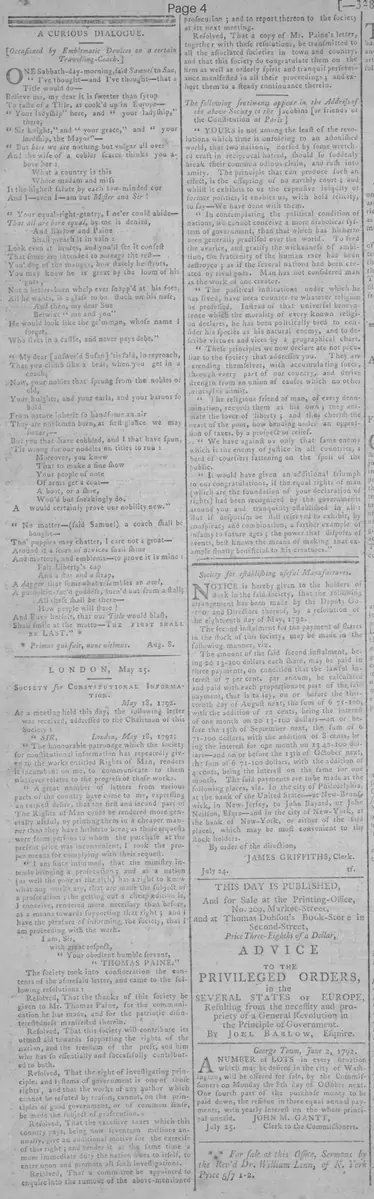
Society for Constitutional Information.
May 18, 1792.
At a meeting held this day, the following letter
was received, addressed to the Chairman of this
Society:
"SIR,
London, May 18, 1792:
"The honourable patronage which the Society
for constitutional information has repeatedly giv-
en to the works entitled Rights of Man, renders
it incumbent on me, to communicate to them
whatever relates to the progress of those works.
"A great number of letters from various
parts of the country have come to me, expressing
an earnest desire, that the first and second part of
The Rights of Man could be rendered more gen-
erally useful, by printing them in a cheaper man-
ner than they have hitherto been; as those requests
were from persons to whom the purchase at the
present price was inconvenient, I took the pro-
per means for complying with their request.
"I am since informed, that the ministry in-
tends bringing a prosecution; and as a nation
(as well the poor as the rich) has a right to know
what any works are, that are made the subject of
a prosecution; the getting out a cheap edition is,
I conceive, rendered more necessary than before,
as a means towards supporting that right; and I
have the pleasure of informing, the society, that I
am proceeding with the work.
I am, Sir,
with great respect,
"Your obedient humble servant,
"THOMAS PAINE."
The society took into consideration the con-
tents of the aforesaid letter, and came to the fol-
lowing resolutions:
Resolved, That the thanks of this society be
given to Mr. Thomas Paine, for the communi-
cation he has made, and for the patriotic disin-
terestedness manifested therein.
Resolved, That this Society will contribute its
utmost aid towards supporting the rights of the
nation, and the freedom of the press, and him
who has so essentially and successfully contribut-
ed to both.
Resolved, That the right of investigating prin-
ciple and systems of government is one of those
rights, and that the works of any author which
cannot be refuted by reason, cannot, on the prin-
ciples of good government, or of common sense,
be made the subject of prosecution.
Resolved, That the excessive taxes which this
country pays, being now seventeen millions an-
nually, give an additional motive for the exercise
of this right; and render it at the same time a
more immediate duty the nation owes to itself, to
enter upon and promote all such investigations.
Resolved, That a committee be appointed to
enquire into the rumour of the above-mentioned
prosecution; and to report thereon to the society
at its next meeting.
Resolved, That a copy of Mr. Paine's letter,
together with these resolutions, be transmitted to
all the associated societies in town and country,
and that this society do congratulate them on the
firm as well as orderly spirit and tranquil perseve-
riance manifested in all their proceedings; and ex-
hort them to a steady continuance therein.
The following sentiments appear in the Address of
the above Society to the Jacobins or friends of
the Constitution at Paris
Yours is not among the least of the revo-
lutions which time is unfolding to an astonished
world, that two nations, nursed by some wretch-
ed craft in reciprocal hatred, should so suddenly
break their common odious chain, and rush into
amity. The principle that can produce such an
effect, is the offspring of no earthly court; and
whilst it exhibits to us the expensive iniquity of
former politics, it enables us, with bold felicity,
to say—We have done with them.
"In contemplating the political condition of
nations, we cannot conceive a more diabolical sys-
tem of government, than that which has hitherto
been generally practised over the world. To feed
the avarice, and gratify the wickedness of ambi-
tion, the fraternity of the human race has been
destroyed; as if the several nations had been cre-
ated by rival gods. Man has not considered man
as the work of one creator.
"The political institutions under which he
has lived, have been counter to whatever religion
he professed. Instead of that universal benevo-
lence which the morality of every known religi-
on declares, he has been politically bred to con-
sider his species as his natural enemy, and to de-
scribe virtues and vices by a geographical chart.
"These principles we now declare are not pecu-
liar to the society that addresses you. They are
xrending themselves, with accumulating force,
through every part of our country, and derive
strength from an union of causes which no other
principles admit.
"The religious friend of man, of every deno-
mination, records them as his own; they ani-
nate the lover of liberty; and they cherish the
heart of the poor, now bending under an oppres-
sion of taxes, by a prospect of relief.
."We have against us only that same enemy
which is the enemy of justice in all countries, a
herd of courtiers fattening on the spoil of the
public.
"It would have given an additional triumph
to our congratulations, if the equal rights of man
(which are the foundation of your declaration of
rights) had been recognized by the governments
around you and tranquility established in all:
But if despotism be still reserved to exhibit, by
conspiracy and combination, a farther example of
infamy to future ages; the power that disposes of
events, best knows the means of making that ex-
ample finally beneficial to his creatures."
What sub-type of article is it?
What keywords are associated?
What entities or persons were involved?
Where did it happen?
Foreign News Details
Primary Location
London
Event Date
May 18, 1792
Key Persons
Outcome
society passes resolutions supporting thomas paine and freedom of the press; appoints committee to investigate rumored prosecution; transmits letter and resolutions to associated societies; addresses sentiments to jacobins in paris on international amity and political principles.
Event Details
Society for Constitutional Information receives letter from Thomas Paine announcing cheaper edition of 'Rights of Man' due to public demand and in response to rumored ministry prosecution; society resolves to support Paine, rights of nation, freedom of press, investigation of government principles, criticizes excessive taxes, and exhorts associated societies; includes address to Jacobins in Paris praising Franco-British amity, condemning past politics, and aspiring to universal benevolence and equal rights.