Thank you for visiting SNEWPapers!
Sign up free
Literary
April 12, 1827
Phenix Gazette
Alexandria, Virginia
What is this article about?
Satirical essay from the London Magazine depicting the 'Blue Man,' the male counterpart to the 'blue stocking,' as a pretentious, flattery-dependent literary poseur who frequents ladies' drawing rooms, exaggerates his talents and connections, and derives his identity from female admiration. Narrated through the author's observations of a cousin exemplifying this type.
Clipping
OCR Quality
95%
Excellent
Full Text
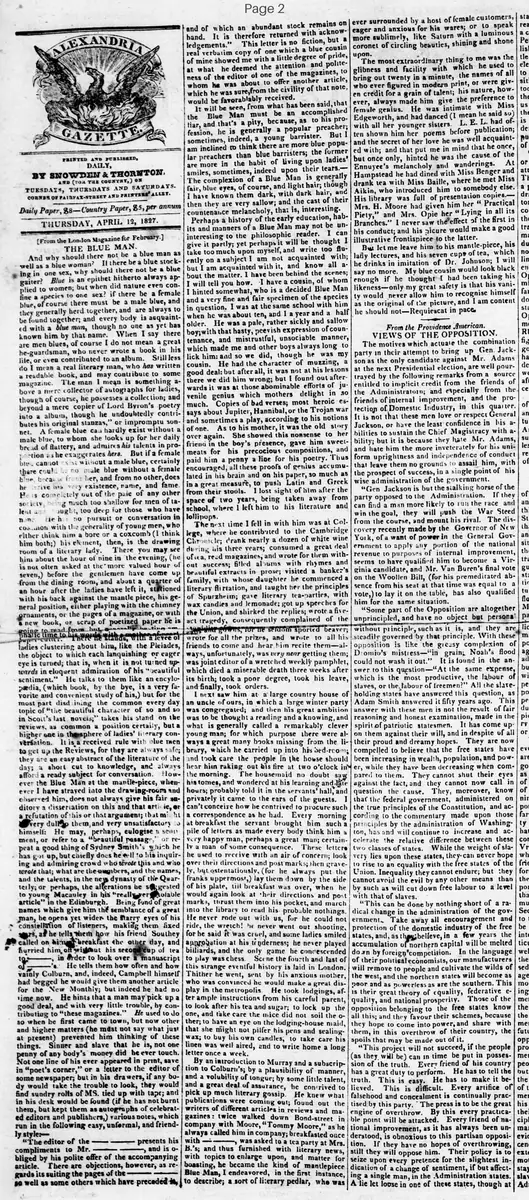
(From the London Magazine for February.)
THE BLUE MAN.
And why should there not be a blue man as well as a blue woman? If there be a blue stocking in one sex, why should there not be a blue gaiter? Blue is an epithet hitherto always applied to women; but when did nature even confine a species to one sex? If there be a female blue, of course there must be a male blue, and fine a species to one sex? They generally herd together, and are always to be found together; and everybody is acquainted with a blue man, though no one as yet has known him by that name. When I say there are men blues, of course I do not mean a great he-guardsman, who never wrote a book in his life, or even contributed to an album. Still less do I mean a real literary man, who has written a readable book, and may contribute to some magazine. The man I mean is something above a mere collector of autographs for ladies, though of course, he possesses a collection; and beyond a mere copier of Lord Byron's poetry into an album, though he undoubtedly contributes his original stanzas, or impromptu sonnet. A female blue can hardly exist without a male blue, to whom she looks up for her daily bread of flattery, and admires his talents in proportion as he exaggerates hers. But if a female blue cannot exist without a male blue, certainly there could be no male blue without a female blue, because from her, and from no other, does he derive his very existence, name, and fame. He is completely out of the pale of any other society, being much too shallow for men of talent, and ought, too deep for those who have none. He has no pursuit or conversation in common with the generality of young men, who either think him a bore or a coxcomb (I think him both); his element, then, is the drawing room of a literary lady. There you may see him about the hour of nine in the evening, (he is not often asked at the more valued hour of seven,) before the gentlemen have come up from the dining room, and about a quarter of an hour after the ladies have left it, stationed with his back against the mantle piece, his general position, either playing with the chimney ornaments, or the pages of a magazine, or new book, or scrap of poetized paper he is going to read from his phallic tune to his young ladies clustering about him, like the Pleiades, the object to which each languishing or eager eye is turned; that is, when it is not turned upwards in eloquent admiration of his "beautiful sentiment." He talks to them like an encyclopædia, (which book, by the bye, is a very favorite and convenient study of his,) but for the most part disdaining the common every day topic of "the beautiful character of so and so in Scott's last novels;" takes his stand on the reviews, as common a position certainly, but a higher one in the sphere of ladies' literary conversation. It is a received rule with blue men to get up the Reviews, for they are always safe; they are an easy abstract of the literature of the day; a short cut to knowledge, and always afford a ready subject for conversation. However the Blue Man at the mantle-piece, whenever I have strayed into the drawing-room and observed him, does not always give his fair auditory a dissertation on this and that article, or a refutation of this or that argument; that might be very dull to them, and very unsatisfactory to himself: He may, perhaps, eulogise a sentiment, or refer to a "beautiful passage," or repeat a good thing of Sydney Smith's which he has got up, but chiefly does he reel to his inquiring and admiring crowd who wrote this and who wrote that; what are the numbers, and the names, and the talents, in the new dynasty of the Quarterly; or perhaps, the alterations he suggested to young Macaulay in his "really very tolerable article" in the Edinburgh. Being fond of great names which give him the semblance of a great man, he opens yet wider the starry eyes of his constellation of listeners, making them fixed stars, as he tells them how his friend Southey called on him breakfast the other day, and hurried him off without his second cup of tea in order to look over a manuscript. He tells them how often and how vainly Colburn, and, indeed, Campbell himself had begged he would give them another article for the New Monthly; but indeed he had no time now. He hints that a man may pick up a good deal, and with very little trouble, by contributing to these magazines. He used to do so when he first came to town, but now other and higher matters (he must not say what just at present) prevented him thinking of these things. Sinner and slave that he is, not one penny of anybody's money did he ever touch. Not one line of his ever appeared in print, save in "poet's corner," or a letter to the editor of some newspaper; but in his drawers, if anybody would take the trouble to look, they would find sundry rolls of MS. tied up with tape; and in his desk would be found (if he has not burnt them, but kept them as autographs of celebrated editors and publishers,) various notes, which run in the following easy, unformal, and friendly style:
"The editor of the [magazine name] presents his compliments to Mr. [name] and is obliged by his polite offer of the accompanying article. There are objections, however, as regards its suiting the pages of the [magazine] so well as some others which have preceded it and of which an abundant stock remains on hand. It is therefore returned with acknowledgements."
This letter is no fiction, but a real verbatim copy of one which a blue cousin of mine showed me with a little degree of pride, at what he deemed the attention and politeness of the editor of one of the magazines, to whom he was about to offer another article, which he was sure, from the civility of that note, would be favorably received.
It will be seen, from what has been said, that the Blue Man must be an accomplished liar, and that's a pity, because, as to his profession, he is generally a popular preacher; sometimes, indeed, a young barrister. But I am inclined to think there are more blue popular preachers than blue barristers; the former are more in the habit of living upon ladies' smiles, sometimes, indeed upon their tears. The complexion of a Blue Man is generally fair, blue eyes, of course, and light hair; though I have known them dark, with dark hair, and then they are very sallow; and the cast of their countenance melancholy, that is, interesting. Perhaps a history of the early education, habits and manners of a Blue Man may not be uninteresting to the philosophic reader. I can give it partly; yet perhaps it will be thought I take too much upon myself, and write too fluently on a subject I am not acquainted with; but I am acquainted with it, and know all about the matter. I have been behind the scenes; I will tell you how. I have a cousin, of whom I hinted somewhat, who is a decided Blue Man and a very fine and fair specimen of the species in question. I was at the same school with him when he was about ten, and I a year and a half older. He was a pale, rather sickly and sallow boy; with that hasty, peevish expression of countenance, and mistrustful, unsociable manner, which made me and other boys always long to lick him: and so we did, though he was my cousin. He had the character of musing a great deal: but after all, it was not at his lessons there we did him wrong; but I found out afterwards it was at those abominable efforts of juvenile genius which mothers delight in so much. Copies of bad verses; most heroic essays about Jupiter, Hannibal, or the Trojan war and sometimes a play, according to his notions of one. As to his mother, it was the old story over again. She showed this nonsense to her friends in the boy's presence, gave him sweetmeats for his precocious compositions, and paid him a penny a line for his poetry. Thus encouraged, all these proofs of genius accumulated in his brain and on his paper, so much as in a great measure, to push Latin and Greek from their stools. I lost sight of him after the space of two years, being taken away from school, where I left him to his literature and lollipops.
The next time I fell in with him was at College, where he contributed to the Cambridge Chronicle; drank nearly a dozen of white wine during his three years; consumed a great deal of tea, read magazines, and wrote for them without success; filled albums with rhymes and beautiful extracts in prose; visited a banker's family, with whose daughter he commenced a literary flirtation, and taught her the principles of Spurzheim; gave literary tea-parties, with wax candles and lemonade; got up speeches for the Union, and shirked the replies; wrote a five-act tragedy, consequently complained of the ague; "for ne seldome sported beaver:" wrote for all the prizes, and wrote to all his friends to come and hear him recite them—always, unfortunately, was very near getting them; was joint editor of a wretched weekly pamphlet, which died a miserable death three weeks after its birth; took a poor degree, took his leave, and finally, took orders.
I next saw him at a large country house of an uncle of ours, in which a large winter party was congregated; and then his great ambition was to be thought a reading and a knowing, and what is generally called a remarkably clever young man; for which purpose there were always a great many books missing from the library, which he carried up into his bed-room: and took care the people in the house should hear him raking out his fire at two o'clock in the morning. The housemaid no doubt saw his tomes, and wondered at his learning and late hours; probably told it in the servants' hall, and privately it came to the ears of the guests. I can't conceive how he contrived to procure such a correspondence as he had. Every morning at breakfast the servant brought him such a pile of letters as made everybody think him a very happy man, perhaps a great man; certainly a man of some consequence. These letters he used to receive with an air of concern; look over their directions and post-marks; then gravely, but ostentatiously, (for he always put the franks uppermost,) lay them down by the side of his plate, til breakfast was over, when he would again look at their directions and post marks, thrust them into his pocket, and march into the library to read his probable nothings. He never rode out with us, for he could not ride. The wretch! he never went out shooting, for he said it was cruel, and so some ladies smiled approbation at his tenderness; he never played billiards, and the only game he condescended to play was chess. Scene the fourth and last of this strange eventful history is laid in London. Thither he went, sent by his anxious mother, who was convinced he would make a great display in the metropolis. He took lodgings, after ample instructions from his careful parent, to look after his tea and sugar; to lock up the one, and take care the mice did not soil the other; to have an eye on the lodging-house maid, that she might not pilfer his pens and sealing-wax; to buy his own candles, to take care his linen was well aired, and to write home a long letter once a week.
By an introduction to Murray and a subscription to Colburn's; by a plausibility of manner, and a volubility of tongue; by some little talent, and a great deal of assurance, he contrived to pick up much literary gossip. He knew what publications were coming out; found out the writers of different articles in reviews and magazines: twice walked down Bond-street in company with Moore, "Tommy Moore," as he always called him in company; breakfasted once with [someone]; was asked to a tea party at Mrs. B.'s; and thus furnished with literary news, with topics to enlarge upon, and matter for boasting, he became the kind of mantlepiece Blue Man, I endeavored, in the first instance, to describe; a sort of literary pedlar, who was ever surrounded by a host of female customers, eager and anxious for his wares; or to speak more sublimely, like Saturn with a luminous coronet of circling beauties, shining and shone upon.
The most extraordinary thing to me was the glibness and facility with which he used to bring out twenty in a minute, the names of all who ever figured in modern print, or were given en credit for a grain of talent; his nature, however, always made him give the preference to female genius. He was intimate with Miss Edgeworth, and had danced (I mean he said so) with all her younger sisters. L. E. L. had often shown him her poems before publication; and the secret of her love he was well acquainted with; and that put me in mind that he once, but once only, hinted he was the cause of the Ennuyee's melancholy and wanderings. At Hampstead he had dined with Miss Benger and drank tea with Miss Baillie, where he met Miss Aikin, who introduced him to somebody else. His library was full of presentation copies.—Mrs. H. Moore had given him her "Practical Piety," and Mrs. Opie her "Lying in all its Branches." I never saw the effect of the first in his conduct; and his picture would make a good illustrative frontispiece to the latter.
But let me leave him to his mantle-piece, his lady lectures, and his seven cups of tea, which he drinks in imitation of Dr. Johnson; I will say no more. My blue cousin would look black enough if he thought I had been taking his likeness—only my great safety is that his vanity would never allow him to recognise himself as the original of the picture, and I am content he should not—Requiescat in pace.
THE BLUE MAN.
And why should there not be a blue man as well as a blue woman? If there be a blue stocking in one sex, why should there not be a blue gaiter? Blue is an epithet hitherto always applied to women; but when did nature even confine a species to one sex? If there be a female blue, of course there must be a male blue, and fine a species to one sex? They generally herd together, and are always to be found together; and everybody is acquainted with a blue man, though no one as yet has known him by that name. When I say there are men blues, of course I do not mean a great he-guardsman, who never wrote a book in his life, or even contributed to an album. Still less do I mean a real literary man, who has written a readable book, and may contribute to some magazine. The man I mean is something above a mere collector of autographs for ladies, though of course, he possesses a collection; and beyond a mere copier of Lord Byron's poetry into an album, though he undoubtedly contributes his original stanzas, or impromptu sonnet. A female blue can hardly exist without a male blue, to whom she looks up for her daily bread of flattery, and admires his talents in proportion as he exaggerates hers. But if a female blue cannot exist without a male blue, certainly there could be no male blue without a female blue, because from her, and from no other, does he derive his very existence, name, and fame. He is completely out of the pale of any other society, being much too shallow for men of talent, and ought, too deep for those who have none. He has no pursuit or conversation in common with the generality of young men, who either think him a bore or a coxcomb (I think him both); his element, then, is the drawing room of a literary lady. There you may see him about the hour of nine in the evening, (he is not often asked at the more valued hour of seven,) before the gentlemen have come up from the dining room, and about a quarter of an hour after the ladies have left it, stationed with his back against the mantle piece, his general position, either playing with the chimney ornaments, or the pages of a magazine, or new book, or scrap of poetized paper he is going to read from his phallic tune to his young ladies clustering about him, like the Pleiades, the object to which each languishing or eager eye is turned; that is, when it is not turned upwards in eloquent admiration of his "beautiful sentiment." He talks to them like an encyclopædia, (which book, by the bye, is a very favorite and convenient study of his,) but for the most part disdaining the common every day topic of "the beautiful character of so and so in Scott's last novels;" takes his stand on the reviews, as common a position certainly, but a higher one in the sphere of ladies' literary conversation. It is a received rule with blue men to get up the Reviews, for they are always safe; they are an easy abstract of the literature of the day; a short cut to knowledge, and always afford a ready subject for conversation. However the Blue Man at the mantle-piece, whenever I have strayed into the drawing-room and observed him, does not always give his fair auditory a dissertation on this and that article, or a refutation of this or that argument; that might be very dull to them, and very unsatisfactory to himself: He may, perhaps, eulogise a sentiment, or refer to a "beautiful passage," or repeat a good thing of Sydney Smith's which he has got up, but chiefly does he reel to his inquiring and admiring crowd who wrote this and who wrote that; what are the numbers, and the names, and the talents, in the new dynasty of the Quarterly; or perhaps, the alterations he suggested to young Macaulay in his "really very tolerable article" in the Edinburgh. Being fond of great names which give him the semblance of a great man, he opens yet wider the starry eyes of his constellation of listeners, making them fixed stars, as he tells them how his friend Southey called on him breakfast the other day, and hurried him off without his second cup of tea in order to look over a manuscript. He tells them how often and how vainly Colburn, and, indeed, Campbell himself had begged he would give them another article for the New Monthly; but indeed he had no time now. He hints that a man may pick up a good deal, and with very little trouble, by contributing to these magazines. He used to do so when he first came to town, but now other and higher matters (he must not say what just at present) prevented him thinking of these things. Sinner and slave that he is, not one penny of anybody's money did he ever touch. Not one line of his ever appeared in print, save in "poet's corner," or a letter to the editor of some newspaper; but in his drawers, if anybody would take the trouble to look, they would find sundry rolls of MS. tied up with tape; and in his desk would be found (if he has not burnt them, but kept them as autographs of celebrated editors and publishers,) various notes, which run in the following easy, unformal, and friendly style:
"The editor of the [magazine name] presents his compliments to Mr. [name] and is obliged by his polite offer of the accompanying article. There are objections, however, as regards its suiting the pages of the [magazine] so well as some others which have preceded it and of which an abundant stock remains on hand. It is therefore returned with acknowledgements."
This letter is no fiction, but a real verbatim copy of one which a blue cousin of mine showed me with a little degree of pride, at what he deemed the attention and politeness of the editor of one of the magazines, to whom he was about to offer another article, which he was sure, from the civility of that note, would be favorably received.
It will be seen, from what has been said, that the Blue Man must be an accomplished liar, and that's a pity, because, as to his profession, he is generally a popular preacher; sometimes, indeed, a young barrister. But I am inclined to think there are more blue popular preachers than blue barristers; the former are more in the habit of living upon ladies' smiles, sometimes, indeed upon their tears. The complexion of a Blue Man is generally fair, blue eyes, of course, and light hair; though I have known them dark, with dark hair, and then they are very sallow; and the cast of their countenance melancholy, that is, interesting. Perhaps a history of the early education, habits and manners of a Blue Man may not be uninteresting to the philosophic reader. I can give it partly; yet perhaps it will be thought I take too much upon myself, and write too fluently on a subject I am not acquainted with; but I am acquainted with it, and know all about the matter. I have been behind the scenes; I will tell you how. I have a cousin, of whom I hinted somewhat, who is a decided Blue Man and a very fine and fair specimen of the species in question. I was at the same school with him when he was about ten, and I a year and a half older. He was a pale, rather sickly and sallow boy; with that hasty, peevish expression of countenance, and mistrustful, unsociable manner, which made me and other boys always long to lick him: and so we did, though he was my cousin. He had the character of musing a great deal: but after all, it was not at his lessons there we did him wrong; but I found out afterwards it was at those abominable efforts of juvenile genius which mothers delight in so much. Copies of bad verses; most heroic essays about Jupiter, Hannibal, or the Trojan war and sometimes a play, according to his notions of one. As to his mother, it was the old story over again. She showed this nonsense to her friends in the boy's presence, gave him sweetmeats for his precocious compositions, and paid him a penny a line for his poetry. Thus encouraged, all these proofs of genius accumulated in his brain and on his paper, so much as in a great measure, to push Latin and Greek from their stools. I lost sight of him after the space of two years, being taken away from school, where I left him to his literature and lollipops.
The next time I fell in with him was at College, where he contributed to the Cambridge Chronicle; drank nearly a dozen of white wine during his three years; consumed a great deal of tea, read magazines, and wrote for them without success; filled albums with rhymes and beautiful extracts in prose; visited a banker's family, with whose daughter he commenced a literary flirtation, and taught her the principles of Spurzheim; gave literary tea-parties, with wax candles and lemonade; got up speeches for the Union, and shirked the replies; wrote a five-act tragedy, consequently complained of the ague; "for ne seldome sported beaver:" wrote for all the prizes, and wrote to all his friends to come and hear him recite them—always, unfortunately, was very near getting them; was joint editor of a wretched weekly pamphlet, which died a miserable death three weeks after its birth; took a poor degree, took his leave, and finally, took orders.
I next saw him at a large country house of an uncle of ours, in which a large winter party was congregated; and then his great ambition was to be thought a reading and a knowing, and what is generally called a remarkably clever young man; for which purpose there were always a great many books missing from the library, which he carried up into his bed-room: and took care the people in the house should hear him raking out his fire at two o'clock in the morning. The housemaid no doubt saw his tomes, and wondered at his learning and late hours; probably told it in the servants' hall, and privately it came to the ears of the guests. I can't conceive how he contrived to procure such a correspondence as he had. Every morning at breakfast the servant brought him such a pile of letters as made everybody think him a very happy man, perhaps a great man; certainly a man of some consequence. These letters he used to receive with an air of concern; look over their directions and post-marks; then gravely, but ostentatiously, (for he always put the franks uppermost,) lay them down by the side of his plate, til breakfast was over, when he would again look at their directions and post marks, thrust them into his pocket, and march into the library to read his probable nothings. He never rode out with us, for he could not ride. The wretch! he never went out shooting, for he said it was cruel, and so some ladies smiled approbation at his tenderness; he never played billiards, and the only game he condescended to play was chess. Scene the fourth and last of this strange eventful history is laid in London. Thither he went, sent by his anxious mother, who was convinced he would make a great display in the metropolis. He took lodgings, after ample instructions from his careful parent, to look after his tea and sugar; to lock up the one, and take care the mice did not soil the other; to have an eye on the lodging-house maid, that she might not pilfer his pens and sealing-wax; to buy his own candles, to take care his linen was well aired, and to write home a long letter once a week.
By an introduction to Murray and a subscription to Colburn's; by a plausibility of manner, and a volubility of tongue; by some little talent, and a great deal of assurance, he contrived to pick up much literary gossip. He knew what publications were coming out; found out the writers of different articles in reviews and magazines: twice walked down Bond-street in company with Moore, "Tommy Moore," as he always called him in company; breakfasted once with [someone]; was asked to a tea party at Mrs. B.'s; and thus furnished with literary news, with topics to enlarge upon, and matter for boasting, he became the kind of mantlepiece Blue Man, I endeavored, in the first instance, to describe; a sort of literary pedlar, who was ever surrounded by a host of female customers, eager and anxious for his wares; or to speak more sublimely, like Saturn with a luminous coronet of circling beauties, shining and shone upon.
The most extraordinary thing to me was the glibness and facility with which he used to bring out twenty in a minute, the names of all who ever figured in modern print, or were given en credit for a grain of talent; his nature, however, always made him give the preference to female genius. He was intimate with Miss Edgeworth, and had danced (I mean he said so) with all her younger sisters. L. E. L. had often shown him her poems before publication; and the secret of her love he was well acquainted with; and that put me in mind that he once, but once only, hinted he was the cause of the Ennuyee's melancholy and wanderings. At Hampstead he had dined with Miss Benger and drank tea with Miss Baillie, where he met Miss Aikin, who introduced him to somebody else. His library was full of presentation copies.—Mrs. H. Moore had given him her "Practical Piety," and Mrs. Opie her "Lying in all its Branches." I never saw the effect of the first in his conduct; and his picture would make a good illustrative frontispiece to the latter.
But let me leave him to his mantle-piece, his lady lectures, and his seven cups of tea, which he drinks in imitation of Dr. Johnson; I will say no more. My blue cousin would look black enough if he thought I had been taking his likeness—only my great safety is that his vanity would never allow him to recognise himself as the original of the picture, and I am content he should not—Requiescat in pace.
What sub-type of article is it?
Satire
Essay
What themes does it cover?
Social Manners
What keywords are associated?
Blue Man
Blue Stocking
Literary Pretender
Satire
Drawing Room
Flattery
Reviews
Female Genius
Literary Details
Title
The Blue Man
Subject
Satire On The Male Counterpart To The Blue Stocking
Form / Style
Satirical Prose Essay
Key Lines
And Why Should There Not Be A Blue Man As Well As A Blue Woman? If There Be A Blue Stocking In One Sex, Why Should There Not Be A Blue Gaiter?
He Is Completely Out Of The Pale Of Any Other Society, Being Much Too Shallow For Men Of Talent, And Ought, Too Deep For Those Who Have None.
It Will Be Seen, From What Has Been Said, That The Blue Man Must Be An Accomplished Liar, And That's A Pity, Because, As To His Profession, He Is Generally A Popular Preacher; Sometimes, Indeed, A Young Barrister.