Thank you for visiting SNEWPapers!
Sign up free
Letter to Editor
May 31, 1851
Weekly National Intelligencer
Washington, District Of Columbia
What is this article about?
On May 26, 1851, in Hoboken, NJ, German immigrants celebrating a festival at Elysian Fields clashed with 'Rock Boys' rowdies, leading to a riot involving beatings, property destruction, reinforcements from Irish laborers, arrests of fifty, and one death. No New York police aid; military from Jersey City assisted later.
Clipping
OCR Quality
95%
Excellent
Full Text
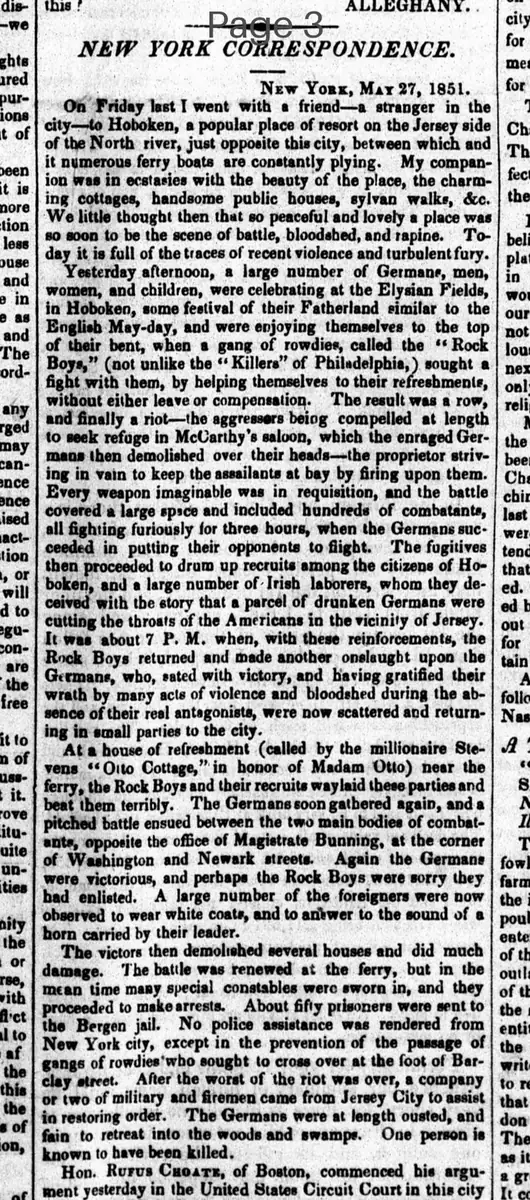
NEW YORK CORRESPONDENCE.
New York, May 27, 1851.
On Friday last I went with a friend--a stranger in the city--to Hoboken, a popular place of resort on the Jersey side of the North river, just opposite this city, between which and it numerous ferry boats are constantly plying. My companion was in ecstasies with the beauty of the place, the charming cottages, handsome public houses, sylvan walks, &c. We little thought then that so peaceful and lovely a place was so soon to be the scene of battle, bloodshed, and rapine. To-day it is full of the traces of recent violence and turbulent fury.
Yesterday afternoon, a large number of Germans, men, women, and children, were celebrating at the Elysian Fields, in Hoboken, some festival of their Fatherland similar to the English May-day, and were enjoying themselves to the top of their bent, when a gang of rowdies, called the "Rock Boys," (not unlike the "Killers" of Philadelphia,) sought fight with them, by helping themselves to their refreshments without either leave or compensation. The result was a row, and finally a riot--the aggressors being compelled at length to seek refuge in McCarthy's saloon, which the enraged Germans then demolished over their heads--the proprietor striving in vain to keep the assailants at bay by firing upon them. Every weapon imaginable was in requisition, and the battle covered a large space and included hundreds of combatants, all fighting furiously for three hours, when the Germans succeeded in putting their opponents to flight. The fugitives then proceeded to drum up recruits among the citizens of Hoboken, and a large number of Irish laborers, whom they deceived with the story that a parcel of drunken Germans were cutting the throats of the Americans in the vicinity of Jersey.
It was about 7 P. M. when, with these reinforcements, the Rock Boys returned and made another onslaught upon the Germans, who, sated with victory, and having gratified their wrath by many acts of violence and bloodshed during the absence of their real antagonists, were now scattered and returning in small parties to the city.
At a house of refreshment (called by the millionaire Stevens "Otto Cottage," in honor of Madam Otto) near the ferry, the Rock Boys and their recruits waylaid these parties and beat them terribly. The Germans soon gathered again, and a pitched battle ensued between the two main bodies of combatants, opposite the office of Magistrate Bunning, at the corner of Washington and Newark streets. Again the Germans were victorious, and perhaps the Rock Boys were sorry they had enlisted. A large number of the foreigners were now observed to wear white coats, and to answer to the sound of a horn carried by their leader.
The victors then demolished several houses and did much damage. The battle was renewed at the ferry, but in the mean time many special constables were sworn in, and they proceeded to make arrests. About fifty prisoners were sent to the Bergen jail. No police assistance was rendered from New York city, except in the prevention of the passage of gangs of rowdies who sought to cross over at the foot of Barclay street. After the worst of the riot was over, a company or two of military and firemen came from Jersey City to assist in restoring order. The Germans were at length ousted, and fain to retreat into the woods and swamps. One person is known to have been killed.
New York, May 27, 1851.
On Friday last I went with a friend--a stranger in the city--to Hoboken, a popular place of resort on the Jersey side of the North river, just opposite this city, between which and it numerous ferry boats are constantly plying. My companion was in ecstasies with the beauty of the place, the charming cottages, handsome public houses, sylvan walks, &c. We little thought then that so peaceful and lovely a place was so soon to be the scene of battle, bloodshed, and rapine. To-day it is full of the traces of recent violence and turbulent fury.
Yesterday afternoon, a large number of Germans, men, women, and children, were celebrating at the Elysian Fields, in Hoboken, some festival of their Fatherland similar to the English May-day, and were enjoying themselves to the top of their bent, when a gang of rowdies, called the "Rock Boys," (not unlike the "Killers" of Philadelphia,) sought fight with them, by helping themselves to their refreshments without either leave or compensation. The result was a row, and finally a riot--the aggressors being compelled at length to seek refuge in McCarthy's saloon, which the enraged Germans then demolished over their heads--the proprietor striving in vain to keep the assailants at bay by firing upon them. Every weapon imaginable was in requisition, and the battle covered a large space and included hundreds of combatants, all fighting furiously for three hours, when the Germans succeeded in putting their opponents to flight. The fugitives then proceeded to drum up recruits among the citizens of Hoboken, and a large number of Irish laborers, whom they deceived with the story that a parcel of drunken Germans were cutting the throats of the Americans in the vicinity of Jersey.
It was about 7 P. M. when, with these reinforcements, the Rock Boys returned and made another onslaught upon the Germans, who, sated with victory, and having gratified their wrath by many acts of violence and bloodshed during the absence of their real antagonists, were now scattered and returning in small parties to the city.
At a house of refreshment (called by the millionaire Stevens "Otto Cottage," in honor of Madam Otto) near the ferry, the Rock Boys and their recruits waylaid these parties and beat them terribly. The Germans soon gathered again, and a pitched battle ensued between the two main bodies of combatants, opposite the office of Magistrate Bunning, at the corner of Washington and Newark streets. Again the Germans were victorious, and perhaps the Rock Boys were sorry they had enlisted. A large number of the foreigners were now observed to wear white coats, and to answer to the sound of a horn carried by their leader.
The victors then demolished several houses and did much damage. The battle was renewed at the ferry, but in the mean time many special constables were sworn in, and they proceeded to make arrests. About fifty prisoners were sent to the Bergen jail. No police assistance was rendered from New York city, except in the prevention of the passage of gangs of rowdies who sought to cross over at the foot of Barclay street. After the worst of the riot was over, a company or two of military and firemen came from Jersey City to assist in restoring order. The Germans were at length ousted, and fain to retreat into the woods and swamps. One person is known to have been killed.
What sub-type of article is it?
Informative
What themes does it cover?
Social Issues
Crime Punishment
What keywords are associated?
Hoboken Riot
German Festival
Rock Boys
Ethnic Clash
Rowdy Violence
Arrests
Property Damage
Letter to Editor Details
Notable Details
Rock Boys Gang
Elysian Fields Festival
Mccarthy's Saloon Demolished
Otto Cottage
Magistrate Bunning
White Coats And Horn For Germans
Fifty Prisoners To Bergen Jail
One Person Killed