Thank you for visiting SNEWPapers!
Sign up free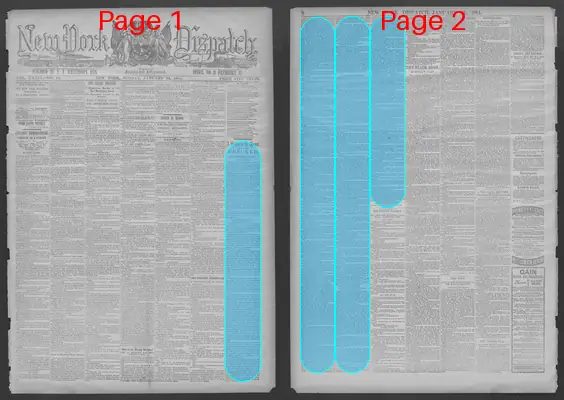
Literary
January 13, 1884
New York Dispatch
New York, New York County, New York
What is this article about?
In this romantic prose fiction excerpt, sisters Cecily and Margie Deane navigate affections and jealousies toward Sir Martin Granville during a dinner at his estate. Cecily's diary records innocent flirtations and family dynamics, while Margie's continuation reveals her bitter rivalry and unrequited love, ending on a note of emotional turmoil.
Merged-components note: Continuation of the same serial story 'WRECKED.' from page 1 reading order 11 to page 2 reading order 13.
Clippings

1 of 2
OCR Quality
95%
Excellent
Full Text
A Story of the heart.
WRECKED.
BY A FAVORITE AUTHOR.
CECILY'S DIARY,
June 21, 18—. For the first time, I have really something in the shape of an event to record in this little book. Our lives—Marguerite's and mine—have gone on so monotonously in their simple happiness that I have never found anything to "make a note of." Now I cannot help wondering whether these new interests will be for still greater happiness or for ultimate loss? Alas for us indeed if the latter! Margie would say it was just like me to indulge in gloomy forebodings. Indeed I know not why I should, for we could not have a truer, nobler friend than Martin Granville. Brave and bold as Lancelot, pure-hearted as Galahad, courteous as King Arthur himself—yes, he is all this! If only Margie liked him better! At first she did seem to do so; but lately she is bent on being perverse and contradictory, and he bears with her so kindly—never seeming to be put out by her sharp or ungracious speeches, never moved to retaliate, never offended. I know he remembers she is but a child, with all a child's whims. I said as much to him—excusing her—one day when she had left us beneath the beech tree on Amber Hill. He asked me playfully what I considered myself—a woman of the world perhaps?
I answered, "No." Nevertheless I was years older than Margie in all that really makes age.
He smiled half sadly, murmuring those words of Longfellow's:
"Standing, with reluctant feet,
Where the brook and river meet,
Womanhood and childhood fleet."
I do not know why I should have blushed so much when he looked at me, there was no reason in the world for it; but then Margie and I are given to blushing—a foolish habit he pretends to admire, though it makes one feel wretchedly uncomfortable!
I could hardly believe Lady Granville and her daughter to be Martin's mother and sister, they are so different in every way. Her ladyship hinted of a marriage he is likely to make with some beautiful girl after his own heart. Whoever she may be, she has a happy, happy future before her; his wife will be a queen among women. How Meg would laugh me to scorn if she read this! I had better stop.
June 23.—Yesterday a grand event took place We went in state to dine at the hall. I shall never forget how beautiful the place looked as we drove through the grounds in our lumbering village cab, the brilliant golden sunshine lying in broad patches on the terrace, flaming through the western windows, making the wreathed roses burn like balls of fire. There were such deep cool shadows on the velvet grass, such a twinkling of light leaves in the wind, such delicious flower scents, and warblings of birds! Certainly I never remember a more exquisite Summer than this: every day seems only more radiant and life-full than the other.
Margie and I—in spite of our new white India muslins—felt very shy as we were ushered into the large gorgeous drawing-room where the same amber-tinted twilight we had before noticed reigned supreme—with the same oppressive foreign perfumes. Although it was broad daylight outside, lighted tapers twinkled here and there in shadowy corners, like stars at dawn.
The Grays had already arrived, and looked almost as shy as ourselves. Lucy was not with them, to my regret; of course she had to give place to her two elder sisters. Lady Granville greeted us with a kindness which bordered on the patronizing. She graciously called Margie to her side, bidding her share the lounge she occupied, and Willie Gray took possession of me, as he generally does. The visitors of whom her ladyship had spoken consisted of one or two very fine London ladies, whose sleeveless dresses and prodigious trains were a sight to behold, and half a dozen bored-looking men, mostly young, whose manners—if, as I have always supposed, it is bad manners to stare fixedly at a lady—were far from being perfect.
Sir Martin, so noble-looking in his plain evening dress—cut after quite a different style from Willie Gray's—seemed to have a great deal to say to a tall elegant girl with whom he stood at a distant window. Evidently his baby sweet heart! At dinner she sat on his left side. She—he calls her "Sissy"—looked white and languid as a hot-house lily, with satin-smooth dark hair and half-closed eyes of heavy slumberous black.
Her dress was a picture in itself—satin of the color called old gold, with which she wore gold circlets on neck and arms, and deep yellow flowers. Sir Martin was very attentive to her, although he never for a moment neglected any one of his guests. His courtesy is perfect. Willie Gray, whom I used to consider such a fine gentleman, seemed quite gauche and country-fied by contrast with him.
I could not help noticing too how fresh and sweet Margie looked among the London belles. Indeed her beauty was like a new revelation to me. Somehow I had never before noticed how blue and full of light her eyes were, how lovely her hair, how delicate the flickering bloom of her cheeks! Her only adornment was a bunch of marguerites—her namesake flowers—in the bosom of her dress, but they suited her better than any jewels would have done. Dear, beautiful Margie, I felt so proud of the admiration she excited; for it was evident others ever agreed with the verdict of mine
After the long dinner, at which I have not the smallest idea what sort of "baked meats" were those of which I partook, we had a dull time in the drawing-room—so dull that, being temptingly near a window opening on to the terrace, I persuaded Margie to go into the garden with me. The sun had set, but a delicious glow of rose and gold suffused the whole sky, painting with transfiguring touch every blade of grass and every quivering leaf. The air was odorous with the breath of flowers growing around in splendid profusion. We wandered aimlessly about, glad to be free again, glorifying in the perfect beauty of the evening. Gradually getting farther from the house, the murmur of the fountain lured us into a bosky glade. We sat down on the wide brim which guarded it, too happy to talk—at least I was; the beauty of this lovely earth always does fill me with intense pleasure, and somehow I never felt so keenly alive to the rare influences of nature as now.
As for Margie, she dipped her round white arm and little ringless hand into the cold, trembling water, playing with the lilies that floated on its surface, the restlessness on her face deepening, until she got up with an impatient sigh and flitted away, "a ghost amid the entombing trees."
How long I sat alone I do not know; but when Sir Martin's voice, close by my ear, woke me from my reverie, I saw the moon and one large star shining between the reflected trees down in the pearly water. I rose up with a start, but he gently put me back again.
"Do not run away the very moment I have found you!" he implored. "Let me have a moment's rest and calm before rejoining the maddening crowd. Your influence is always a soothing one, Cecily."
He had never called me "Cecily" before, and a quick feeling of pleasure thrilled through me; perhaps I ought to have rebuked the liberty, but I did not.
"I'm afraid I have been very rude to have remained here so long," I said; "but it is so beautiful!"
"Of what or of whom were you dreaming?" he inquired, scanning my face—or as much of it as he could see—for I was bending over the fountain playing with the lilies, as Margie had done, and watching the glittering drops fall from their smooth white petals.
"How can I tell?" I answered lightly, very much absorbed in my occupation. Then, hastily, as he did not speak: "Who can catalogue the stray thoughts that go to make up day-dreams?"
"Dreaming of angels, so lovely, so bright!" he sang softly. "If ever those happy beings visit our dull earth, they are near us now—near you, Cecily—you look so akin to them in your white dress that I have a foolish fear lest you should show me your wings! You know the beautiful song, 'Annabel Lee'?"
"'So that her high-born kinsman came And took her away from me.'"
"I think those high-born kinsmen are relatives of yours too; but we cannot let them love you too much—they must spare you to us for a long time yet. The poor sordid earth needs some angels, lest we should forget there is such a place as heaven!"
"Oh, I am of the earth, earthy!" I returned, blushing beneath his gaze.
"I wonder what has become of Marguerite?"
My companion started perceptibly, a reflection of Marguerite's own restlessness came into his eyes.
"Has she been with you?" he said.
"Yes; we came out together, but she left me a long time ago. I suppose she has found her way back to the house."
"How glad she would be if she knew she had escaped the infliction of my presence!" he went on, a new bitterness in his pleasant voice. "Why does Marguerite hate me so, I wonder?"
He waited for an answer, but I could find none. He did not notice my confusion, for his eyes were fixed upon the flower-gemmed sward at his feet. Presently he moved nearer to me, and took the hand which lay on the edge of the fountain—all wet as it was—into his own.
"Cecily," he said, his tones very sad and tender—"dear little Cecily! You are my friend? Yes; your true eyes, innocent of the hard world's evasions, tell me so. Oh, if you knew how few friends I have, how few who really care for me, your gentle heart would pity me, I know!"
Ready tears rushed to my eyes; my heart beat fast with a pain that was full of some wonderful subtle pleasure.
"Tears, Cecily?" he went on, still more tenderly. "But there must be none for me; indeed I do not need them now, not now; I shall never feel friendless again. I know you are wondering at my words. Yes; you see me wealthy, with plenty of so-called friends, plenty of leisure, and all things men generally desire; but there is hardly a poor destitute beggar in the streets who has known less real love than I have!" His voice trembled; but in a moment he went on cheerfully—"So you see how I shall value my little friend!"
"You have a work to do in the world," I said after a pause, "that which is the best panacea for all heart-loneliness, a work for others—your tenants, your poor. First of all, what true friends you can make of them, what a power of good you may be among men," and I paused, flushed by my enthusiasm.
"You are right; I have been an idler long enough—far too long; and yet I fear—oh, Cecily, I fear there are some kinds of heart-loneliness no amount of work can cure."
A long pause. Night—her faint summer stars all set on her wan brows—drew nearer to us; the breeze stirred gently, and shook some perfumed petals to the ground. Presently Martin spoke again in his old gay way.
"What do you think of our London belles?"
"Miss Courtney is very handsome—you have known her from babyhood, have you not?"
"Yes"—laughing—"Did you gather it from our conversation?"
"No, of course not! Your mother was telling us about her."
"Telling you about her? Whatever did she find to say? I was not aware of any romantic history connected with her."
"No?"—the incredulity I felt finding its way to my voice.
"Certainly not!" emphatically. "Sissie Courtney always looks like a heroine of romance, with her sombre eyes and languid movements, but she is one of the most matter-of-fact women I ever knew."
"But"—forgetting my manners in my surprise—"Lady Granville told us you—she—you were going to—used to be"
And here I came to an utter, confused stop, bending my hot face over the cool, wet lilies.
"You are a little vague, my child," he said gently; "but I gather that my mother has been airing her pet idea of our past intimacy and future marriage—am I not right?"
How inquisitive he must think me! Bending my head still lower, until one of my curls sought and found a watery bed, I uttered a faint "Yes."
"An idea without a shadow of foundation," he remarked gravely; then: "See what it is to have such long hair, St. Cecilia!" and he drew the shining tress from its inadvertent bath, smoothing its wet length in his hand.
"Ought to put up my hair now," I said hastily, growing hotter than ever. "You see we are so out of the world we don't even know the fashionable style of coiffure."
"The modest Eulalie's most humble and careless curl," quoted Martin, twisting the long lock round his fingers. "Another poet says
Fair tresses man's imperial race ensnare"
"How poetical you are to-night!" I exclaimed in confusion, yet amused too.
"Who would not be on such a night as this," he returned, "and with such a companion?"
"Oh, don't!" I implored, rising to my feet. "If you knew how I hate those stock phrases!"
"Stock phrases, as you call them, sometimes convey one's feelings most truthfully. Do you think I should feel like quoting poetry if Sissie Courtney were in your place?"
"Give me back my curl, please," I demanded, taking no notice of the last question.
Before he could give it into my playfully outstretched hand, there was a slight stir among the leaves, and Margie came within sight—one of her new admirers in attendance. In the moonlight, I could see the angry flash of Margie's eyes as they fell upon my companion.
What can make her hate him as she does? I should have thought that it was impossible to hate him, however hard one might try; but my little sister seems to do so. In her long, close, white draperies, she looked like the naiad of the fountain—the ruffled hair falling round her like cloud, the widely-open sapphire eyes shining like stars, the crimson deepening in her cheeks.
There would have been an awkward silence—for Sir Martin did nothing but stare at this lovely vision, as if it were indeed something unearthly—had not Mr. Skeffington stepped into the breach with some gay remark to me, and presently we all sauntered on together.
Mr. Skeffington kept me engaged in conversation, so I could not hear what the other two found to say to each other; but afterward, when we reached the house, and I saw Margie's face more plainly in the gleaming taper-light, the anger had died out of her eyes. Sir Martin, his cup of tea in his hand, was bending over the back of her chair, talking to her in soft tones while she looked up at him pleased and happy.
I wondered how he had managed to effect such transformation! I should be so glad if she could learn to care a little more for him—since he longs so much for love and friendship.
Surely she cannot help caring for him; no woman on this earth could, if he chose to try to win her.
The room looked pretty and picturesque in the delicate light, well-dressed women flitting about among the glowing flowers, jewels glittering, bright eyes flashing, graceful fans disturbing the stillness of the perfumed air. The men, too, were a study in their way; at least to my ignorant eyes, which had never beheld any such specimens of the fashionable world before. But how inferior they all were to him!
Miss Courtney, half lying on a velvet fauteuil, was a centre of attraction. Her neck and arms are certainly exquisite as those of a Grecian statue, and her eyes are wonderful with "lashes like to rays of darkness."
I felt a vague surprise, as I saw Sir Martin still engrossed by my little wayward sister, that he could keep away from those fire-lit eyes, those lustrous gold draperies, those flower-crowned wreaths of purple-black hair. Yet he never once even glanced at them.
By-and-by Lady Granville—dressed in blue and white, like a girl—after asking me to sing, and smiling most graciously on Willie Gray who insisted on hovering round me, approached her son. I do not know what she said; but shade gathered on his face and a frown on Margie's. With her false laugh she rustled away from them, her long train glistening like a serpent's tail—whatever makes me use so horrible a simile?—but she had broken up their tete-a-tete. With a last word that made Margie smile, Sir Martin went over to Miss Courtney's shrine. Very soon a hush fell on the room, as, settling her dress and ostentatiously laying aside her jingling bracelets, the lady began to sing, looking up languishingly into the face of Sir Martin, who stood by the piano turning over the music.
There was plenty of applause when she finished; but I suppose she sang "excellent well;" there I know, though the song was pretty enough, my heart was untouched, and Martin did not ask her to sing again. Instead of doing so, he came over to my quiet corner, and I am ashamed to say I forgot all about poor disconsolate Willie Gray—hearing and seeing nothing but his voice, his eyes, whose proximity made my heart beat faster than its wont.
It is time I wound up this record, though it has been very sweet to me to linger over it; but it is true, as Jean Ingelow says:
"Happiness, thou dost not leave a trace So well defined as sorrow!"
And already some of that evening's precious memories have gone from me; but that I am his friend, his "dear little friend" that he confided to me something of his longings and loneliness—this I shall never forget!
Last, there came his parting smile, his lingering glance, the long warm pressure of his hand, as he stood in the moonlight outside of our cab door, bidding us "not good-by, but au revoir!"
Poor Margie was very tired and overwrought. When we got into our bedroom she sank down upon a chair and burst into tears. I was quite frightened; but she pushed me from her when I would have taken her into my arms and soothed her, so I judged it best to leave her alone. I heard her sighing in her sleep too. It has been such an unusual excitement for the child, she must have a day of perfect rest to-morrow; I cannot have my darling little sister upset!
MARGIE'S STORY CONTINUED.
The morning after the dinner was one exactly in accordance with my mood—dull and colorless, full of gray mist and the moaning of the wind. I did not get up when Cecily did—she rose early as usual—but pretended to be asleep. My head ached, my eyes felt as if they were pressed together by a leaden weight; all youth and gladness had gone from me, I deemed, forever.
I went to the window when my sister had gone down, and wearily leaned my head on my arms among the thick vine leaves, gazing listlessly out at the gray lowering sky, the gray hueless earth, all whose summer flowers had lost their bright color just as my life had done—feeling, like one in a dream, the damp air move the curls on my forehead.
What a miserable evening I had had, and what a wretched night! To think how blithely I had donned my new dress—so proud of its spotless frills and folds, so proud of the fair face that had smiled into my own from the glass the face he once told me was like a briar-rose, dewy and fresh! And then to think of the bitter end, the dreary laying off of that festal finery, the joyful anticipations dead and withered like the Marguerites I had worn in my bosom—now despicable in my eyes—as I was in Martin's. My youth, my beauty, what good were they? Since they could not win me his love. I might as well have been old and ugly. Nay, I had better have been old and ugly, for then I should never have thought of or longed for his love!
Yes, if sometimes I had fancied he cared for me, if sometimes I had fancied my light words had power to wound, power to gladden him—having in my foolishness used them for the purpose—now I was undeceived, now I knew the bitter truth.
Sir Martin had hardly spoken to me all the evening. Before and during dinner he had been engrossed with Miss Courtney, whose big sleepy eyes had been shooting their arrows into his all the time; but afterward it was Cecily to whom he devoted himself. He never looked at the other with the reverent tenderness he showed for Cecily.
Mr. Skeffington and I came suddenly upon them in the dusk by the fountain, where I had left my sister alone an hour before. My companion—who had been doing his best to engage me in the game of flirtation—whispered hastily to me:
"Lorenzo and Jessica! Do not let us disturb them."
"They would not thank us, I am sure."
But I could not move. The sight of their faces—hers, so flushed and shy, his so gay and happy—the sight of them standing side by side as they had just risen, he fondling one of her long fair curls—held me with a resistless fascination. Oh, I could have borne it better if it had been any other woman who stood there with him! I could have borne it better if he had chosen any other woman to love and caress; but that my own sister should be the one to win him from me—that own sister should be my successful rival—should tear my crown from my brow and rifle me of life's one bliss—that I could not, would not bear! Thus did the evil serpent of hate and jealousy enclose me in his deadly coils, and pour his venom into my inmost soul.
For all my pride I could not keep some of the bitterness I felt out of my voice as, in the irony of fate, Sir Martin and I followed the other two—who should have been our respective partners—through the green box-bordered paths, brushing by the fragrant roses and myrtles that caught at our garments as we passed.
"I am sorry we interrupted you," I remarked with a laugh that even in my own ears sounded harsh and constrained. "It was cruel to destroy so romantic a tableau! But why you should have allowed that man to take possession of your prize I cannot conceive."
"That man!" he echoed, taking no notice of the rest of my speech. "Poor fellow, how charmed he would be if he could hear you! He is doing his best to make an impression on Miss Margie's hard heart, is he not?"
For all answer I laughed, still more harshly.
"What sort of pretty things has he been saying to you among the flowers?" he inquired with irritating amusement. "Ah, I saw you loitering in the Fairy Dell. Skeffington's own mother wouldn't have known him—he looked so animated!"
"What nonsense you talk," I blurted out crimson with anger "and I detest nonsense!"
"You mean you detest me, Margie," he said, all the amusement gone from his voice, deep sadness having replaced it.
I was very young, and so, I suppose, easily touched. I know the sadness pierced me like a pain. His eyes were fixed upon me, burning down to my soul, but I would not meet them. I was busy keeping the train of my dress from the rose-bushes.
"What if I do?" I returned defiantly, hardening myself with a great effort. "It would not disturb your peace, I presume."
For a moment there was silence; then he spoke, and I could tell by the sound of his voice how deeply he was moved.
"It does disturb it cruelly—most cruelly. Heaven knows! But I have vowed if possible to win something more from you than hatred: all things come round to him who can wait. How am I to set about getting what I want, Marguerite?"
"You speak in enigmas!" I said, with a grand air, though my pulses were throbbing wildly.
Suddenly he took the hand that was next him in his own. I tried indignantly to withdraw it, but in vain. He stopped, and I stopped perforce.
Cecily and Mr. Skeffington had disappeared in the soft silence of the scented starlit dusk we were alone. The wind sighed faintly round us, and one or two white petals fell upon my uncovered head.
Martin stood looking into my face, holding my unwilling hand close prisoner. There was a dreadful silence then; compelled by some influence I was powerless to withstand, I raised my eyes to his. Sorrow, yearning, steady resolution: ay, something more—far more—than all these. I thought I read there: something that thrilled me with a quick warm glow of the purest happiness. A moment, and I had forcibly withdrawn my hand and hurried on.
"I can wait," said Martin very gently, keeping pace easily with my rapid steps. "I am in a mood for quoting poetry to-night, and some sweet words of one of our modern poets haunt me—do you know them, Marguerite?
"You'll love me yet, and I can tarry Your love's protracted growing; June rear'd that bunch of flowers you carry From seeds of April's sowing.'"
Fortunately we entered the drawing-room before the foolish verse was well finished, so nothing was required from me by way of answer.
After all I was going to be happy! How could the passion and fervor of his voice—the meaning of his eyes, be all feigned? Absolute truth has a force of its own, in spite of the most obstinate and wilful self-deception, and this force shook my resolution now; beside I was glad—oh, so glad!—to let the sweet truth in.
He was not long by my side, for Lady Granville called her son away under the pretense of some attention being due to other guests—notably Miss Courtney—then when he might have returned to me, he chose, instead to go over to Cecily! Yet I was alone, and there was no reason why he should not have rejoined me.
No reason save want of will; no reason save that he preferred Cecily's society to mine. He had been flirting with me, and that was all; and, oh, fool that I had been to listen and believe his idle words! Doubtless he had been but laughing at me all the time. His last look, his last smile, were for Cecily. I saw how long he held her hand, though he only just touched mine. My heart grew heavy as lead, as I bent forward, myself unseen, and watched him—my hero, my idol!—leaning, tall and handsome, against one of the pillars of the porch, his eyes shining with happiness—a happiness which I beheld reflected in Cecily's when we reached home.
By the time we gained the shelter of our own room I was wound up to such a pitch, with an agony of love and hate which seemed to rend my heart between them, that I could no longer keep my misery to myself, child that I was, and burst out into the loud bitter crying of which Cecily's diary tells—weeping tears that scorched but did not heal.
When I got down-stairs Cecily, her hand full of freshly-gathered flowers, was coming in from the garden. She looked blithe and bright as ever—nay, far more so. The light of a great new happiness shone round her like a halo, glorifying her beauty, until even my unwilling spirit owned its perfection. She came forward with some gay speech to kiss me; but I turned my face away, shivering with sudden cold.
"Don't bother me; I'm tired," I said despondently.
Cecily shrank back almost as if she had received a blow.
"May I not even kiss you, Margie?" Then, before I had time to answer "Never mind, darling! I know how you feel; dissipation does not suit my wise girl."
The kind, loving words vexed and chafed me beyond endurance.
"I wish you would give me some coffee, and not stare at me so?" I exclaimed irritably.
In silence she filled and brought me my cup, and when I saw how much of the brightness had faded from her face I felt better. I wanted her to suffer. I had absolutely withered under the joy that illuminated her eyes. Why should I have to bear the misery, and she have all the pleasure of life and love? I would not have it; it should not be! If I must suffer, at least I would make her share those sufferings in some degree. Her day should not be all bright, her sky not all cloudless.
Oh, how quickly we go down the road to ruin when once our feet are over the brink! How soon our sense of right is obliterated when once the will has consented to wrong! It appeared to my perverted instincts only justice that Cecily should suffer; and not one word, not one look did I spare her, that could wound her sensitive, loving nature.
An hour or two later I was sauntering down toward the sea-shore, languid, heavy-eyed, miserable, at war with myself and all the world, when I heard a footstep behind me. At first, though I heard, I did not heed it; but as it came nearer something in that quick firm tread roused my sluggish brain. It was Sir Martin Granville's step. The hot blood rushed into my face and back again, leaving me white as a ghost. My knees trembled, my heart beat suffocatingly: I tried vainly to regain my self-control by asking myself what he must think when he reached me and saw—as he could not choose but see—my utter confusion. Nearer he came—nearer. I did not look up even when his shadow touched me. He was by my side; a voice unmistakably glad exclaimed—
"Miss Deane! I am indeed fortunate!"
It was Mr. Skeffington. The first feeling of relief was followed by one of bitterest disappointment. Angry tears rushed to my eyes. The blank forlornness of my expression must have been anything but flattering to my companion as I returned his greeting.
There was a decidedly crestfallen accent in his voice as he asked anxiously if I were ill.
"A little tired," I replied, making a violent effort to speak as usual, although the three words were all that I could get out.
"The effects of that awful salmi, I expect—eh? I saw you taking some, and oh, ye immortal gods!"—making a grimace expressive of dire distress. I smiled faintly. "Not a bad dinner, though, on the whole," he went on; "a fine old place too, and some rather nice girls. I left 'em all in bed, I assure you. No one was down to breakfast but Granville, and he had been tramping about the lanes ever since six o'clock."
"Yes," I murmured, remembering with a pang that this had been exactly Cecily's employment.
"Yes—positively. The correct country squire—going to improve his tenantry, build model cottages and that sort of thing. Can't think what has happened to the fellow; he has altered very much since we were at Christ's together."
"Yes," I said again, feeling capable of explaining the mystery had I wished.
"It can't be Sissy Courtney's doing," pursued the gilded youth by my side, seeing I was bent on being monosyllabic. "There is nothing about her to stir a man up to duty and all that kind of thing—very pretty girl, though!"
"Very," I returned, as he paused for an answer. "And they are old friends."
"Yes: too old—I mean too old for an affaire de cour to come off between them. But, ha—talk of an angel! Who would have thought of meeting you here, dear boy?"
"Or you?" rejoined Sir Martin, for he it was indeed this time. Vaulting lightly over a gate close to the path, he raised his hat in formal greeting—"Good morning, Miss Deane!"
"Good morning," I returned, as coldly as he had spoken, while I felt my stupid cheeks growing white, and was aware I looked miserable to the last degree.
"You are going to the beach?" he asked next, more I thought, by way of saying something than from any interest in the answer.
"The desert were a paradise if thou wert there," murmured Mr. Skeffington, looking languishingly at me.
"I think you had better come back with me, Miss Deane," said Sir Martin, knitting his brows. "You look anything but fit for a long walk. What makes you so pale?"
"I am not pale," I answered defiantly, with flagrant untruth.
"Yes, you are—pardon me. Let me persuade you to return. I am sure your sister will be anxious about you; she told me this morning you were not well."
This was enough. I had been on the verge of giving way, ill as I really was, but now no rock could be harder. I would go if I died for it.
"Thanks: but I do not choose to return. Mr. Skeffington, we will continue our walk, if you please."
"If you really are able?"—with pleased alacrity.
"May I be permitted to make the fatal third?" asked Sir Martin, half-imploringly, half-angrily.
So he could put up with me when Cecily was not to be had!
"Certainly not," I said quickly. "Two are company, but three are none. I am surprised at your thinking of such a thing!"
Without reply he stood aside, and we went on, but not before I caught a look of pain and reproach from those dark eyes which had spoiled my life—a look which haunted me, which ached in my heart through all that dreary, weary morning, while I dragged my tired limbs along, listening to Mr. Skeffington's uninteresting conversation and inane flatteries, but—
"Be the day weary and never so long, A length it ringeth to evensong."
And this endless day came to a close at last.
(To be Continued.)
WRECKED.
BY A FAVORITE AUTHOR.
CECILY'S DIARY,
June 21, 18—. For the first time, I have really something in the shape of an event to record in this little book. Our lives—Marguerite's and mine—have gone on so monotonously in their simple happiness that I have never found anything to "make a note of." Now I cannot help wondering whether these new interests will be for still greater happiness or for ultimate loss? Alas for us indeed if the latter! Margie would say it was just like me to indulge in gloomy forebodings. Indeed I know not why I should, for we could not have a truer, nobler friend than Martin Granville. Brave and bold as Lancelot, pure-hearted as Galahad, courteous as King Arthur himself—yes, he is all this! If only Margie liked him better! At first she did seem to do so; but lately she is bent on being perverse and contradictory, and he bears with her so kindly—never seeming to be put out by her sharp or ungracious speeches, never moved to retaliate, never offended. I know he remembers she is but a child, with all a child's whims. I said as much to him—excusing her—one day when she had left us beneath the beech tree on Amber Hill. He asked me playfully what I considered myself—a woman of the world perhaps?
I answered, "No." Nevertheless I was years older than Margie in all that really makes age.
He smiled half sadly, murmuring those words of Longfellow's:
"Standing, with reluctant feet,
Where the brook and river meet,
Womanhood and childhood fleet."
I do not know why I should have blushed so much when he looked at me, there was no reason in the world for it; but then Margie and I are given to blushing—a foolish habit he pretends to admire, though it makes one feel wretchedly uncomfortable!
I could hardly believe Lady Granville and her daughter to be Martin's mother and sister, they are so different in every way. Her ladyship hinted of a marriage he is likely to make with some beautiful girl after his own heart. Whoever she may be, she has a happy, happy future before her; his wife will be a queen among women. How Meg would laugh me to scorn if she read this! I had better stop.
June 23.—Yesterday a grand event took place We went in state to dine at the hall. I shall never forget how beautiful the place looked as we drove through the grounds in our lumbering village cab, the brilliant golden sunshine lying in broad patches on the terrace, flaming through the western windows, making the wreathed roses burn like balls of fire. There were such deep cool shadows on the velvet grass, such a twinkling of light leaves in the wind, such delicious flower scents, and warblings of birds! Certainly I never remember a more exquisite Summer than this: every day seems only more radiant and life-full than the other.
Margie and I—in spite of our new white India muslins—felt very shy as we were ushered into the large gorgeous drawing-room where the same amber-tinted twilight we had before noticed reigned supreme—with the same oppressive foreign perfumes. Although it was broad daylight outside, lighted tapers twinkled here and there in shadowy corners, like stars at dawn.
The Grays had already arrived, and looked almost as shy as ourselves. Lucy was not with them, to my regret; of course she had to give place to her two elder sisters. Lady Granville greeted us with a kindness which bordered on the patronizing. She graciously called Margie to her side, bidding her share the lounge she occupied, and Willie Gray took possession of me, as he generally does. The visitors of whom her ladyship had spoken consisted of one or two very fine London ladies, whose sleeveless dresses and prodigious trains were a sight to behold, and half a dozen bored-looking men, mostly young, whose manners—if, as I have always supposed, it is bad manners to stare fixedly at a lady—were far from being perfect.
Sir Martin, so noble-looking in his plain evening dress—cut after quite a different style from Willie Gray's—seemed to have a great deal to say to a tall elegant girl with whom he stood at a distant window. Evidently his baby sweet heart! At dinner she sat on his left side. She—he calls her "Sissy"—looked white and languid as a hot-house lily, with satin-smooth dark hair and half-closed eyes of heavy slumberous black.
Her dress was a picture in itself—satin of the color called old gold, with which she wore gold circlets on neck and arms, and deep yellow flowers. Sir Martin was very attentive to her, although he never for a moment neglected any one of his guests. His courtesy is perfect. Willie Gray, whom I used to consider such a fine gentleman, seemed quite gauche and country-fied by contrast with him.
I could not help noticing too how fresh and sweet Margie looked among the London belles. Indeed her beauty was like a new revelation to me. Somehow I had never before noticed how blue and full of light her eyes were, how lovely her hair, how delicate the flickering bloom of her cheeks! Her only adornment was a bunch of marguerites—her namesake flowers—in the bosom of her dress, but they suited her better than any jewels would have done. Dear, beautiful Margie, I felt so proud of the admiration she excited; for it was evident others ever agreed with the verdict of mine
After the long dinner, at which I have not the smallest idea what sort of "baked meats" were those of which I partook, we had a dull time in the drawing-room—so dull that, being temptingly near a window opening on to the terrace, I persuaded Margie to go into the garden with me. The sun had set, but a delicious glow of rose and gold suffused the whole sky, painting with transfiguring touch every blade of grass and every quivering leaf. The air was odorous with the breath of flowers growing around in splendid profusion. We wandered aimlessly about, glad to be free again, glorifying in the perfect beauty of the evening. Gradually getting farther from the house, the murmur of the fountain lured us into a bosky glade. We sat down on the wide brim which guarded it, too happy to talk—at least I was; the beauty of this lovely earth always does fill me with intense pleasure, and somehow I never felt so keenly alive to the rare influences of nature as now.
As for Margie, she dipped her round white arm and little ringless hand into the cold, trembling water, playing with the lilies that floated on its surface, the restlessness on her face deepening, until she got up with an impatient sigh and flitted away, "a ghost amid the entombing trees."
How long I sat alone I do not know; but when Sir Martin's voice, close by my ear, woke me from my reverie, I saw the moon and one large star shining between the reflected trees down in the pearly water. I rose up with a start, but he gently put me back again.
"Do not run away the very moment I have found you!" he implored. "Let me have a moment's rest and calm before rejoining the maddening crowd. Your influence is always a soothing one, Cecily."
He had never called me "Cecily" before, and a quick feeling of pleasure thrilled through me; perhaps I ought to have rebuked the liberty, but I did not.
"I'm afraid I have been very rude to have remained here so long," I said; "but it is so beautiful!"
"Of what or of whom were you dreaming?" he inquired, scanning my face—or as much of it as he could see—for I was bending over the fountain playing with the lilies, as Margie had done, and watching the glittering drops fall from their smooth white petals.
"How can I tell?" I answered lightly, very much absorbed in my occupation. Then, hastily, as he did not speak: "Who can catalogue the stray thoughts that go to make up day-dreams?"
"Dreaming of angels, so lovely, so bright!" he sang softly. "If ever those happy beings visit our dull earth, they are near us now—near you, Cecily—you look so akin to them in your white dress that I have a foolish fear lest you should show me your wings! You know the beautiful song, 'Annabel Lee'?"
"'So that her high-born kinsman came And took her away from me.'"
"I think those high-born kinsmen are relatives of yours too; but we cannot let them love you too much—they must spare you to us for a long time yet. The poor sordid earth needs some angels, lest we should forget there is such a place as heaven!"
"Oh, I am of the earth, earthy!" I returned, blushing beneath his gaze.
"I wonder what has become of Marguerite?"
My companion started perceptibly, a reflection of Marguerite's own restlessness came into his eyes.
"Has she been with you?" he said.
"Yes; we came out together, but she left me a long time ago. I suppose she has found her way back to the house."
"How glad she would be if she knew she had escaped the infliction of my presence!" he went on, a new bitterness in his pleasant voice. "Why does Marguerite hate me so, I wonder?"
He waited for an answer, but I could find none. He did not notice my confusion, for his eyes were fixed upon the flower-gemmed sward at his feet. Presently he moved nearer to me, and took the hand which lay on the edge of the fountain—all wet as it was—into his own.
"Cecily," he said, his tones very sad and tender—"dear little Cecily! You are my friend? Yes; your true eyes, innocent of the hard world's evasions, tell me so. Oh, if you knew how few friends I have, how few who really care for me, your gentle heart would pity me, I know!"
Ready tears rushed to my eyes; my heart beat fast with a pain that was full of some wonderful subtle pleasure.
"Tears, Cecily?" he went on, still more tenderly. "But there must be none for me; indeed I do not need them now, not now; I shall never feel friendless again. I know you are wondering at my words. Yes; you see me wealthy, with plenty of so-called friends, plenty of leisure, and all things men generally desire; but there is hardly a poor destitute beggar in the streets who has known less real love than I have!" His voice trembled; but in a moment he went on cheerfully—"So you see how I shall value my little friend!"
"You have a work to do in the world," I said after a pause, "that which is the best panacea for all heart-loneliness, a work for others—your tenants, your poor. First of all, what true friends you can make of them, what a power of good you may be among men," and I paused, flushed by my enthusiasm.
"You are right; I have been an idler long enough—far too long; and yet I fear—oh, Cecily, I fear there are some kinds of heart-loneliness no amount of work can cure."
A long pause. Night—her faint summer stars all set on her wan brows—drew nearer to us; the breeze stirred gently, and shook some perfumed petals to the ground. Presently Martin spoke again in his old gay way.
"What do you think of our London belles?"
"Miss Courtney is very handsome—you have known her from babyhood, have you not?"
"Yes"—laughing—"Did you gather it from our conversation?"
"No, of course not! Your mother was telling us about her."
"Telling you about her? Whatever did she find to say? I was not aware of any romantic history connected with her."
"No?"—the incredulity I felt finding its way to my voice.
"Certainly not!" emphatically. "Sissie Courtney always looks like a heroine of romance, with her sombre eyes and languid movements, but she is one of the most matter-of-fact women I ever knew."
"But"—forgetting my manners in my surprise—"Lady Granville told us you—she—you were going to—used to be"
And here I came to an utter, confused stop, bending my hot face over the cool, wet lilies.
"You are a little vague, my child," he said gently; "but I gather that my mother has been airing her pet idea of our past intimacy and future marriage—am I not right?"
How inquisitive he must think me! Bending my head still lower, until one of my curls sought and found a watery bed, I uttered a faint "Yes."
"An idea without a shadow of foundation," he remarked gravely; then: "See what it is to have such long hair, St. Cecilia!" and he drew the shining tress from its inadvertent bath, smoothing its wet length in his hand.
"Ought to put up my hair now," I said hastily, growing hotter than ever. "You see we are so out of the world we don't even know the fashionable style of coiffure."
"The modest Eulalie's most humble and careless curl," quoted Martin, twisting the long lock round his fingers. "Another poet says
Fair tresses man's imperial race ensnare"
"How poetical you are to-night!" I exclaimed in confusion, yet amused too.
"Who would not be on such a night as this," he returned, "and with such a companion?"
"Oh, don't!" I implored, rising to my feet. "If you knew how I hate those stock phrases!"
"Stock phrases, as you call them, sometimes convey one's feelings most truthfully. Do you think I should feel like quoting poetry if Sissie Courtney were in your place?"
"Give me back my curl, please," I demanded, taking no notice of the last question.
Before he could give it into my playfully outstretched hand, there was a slight stir among the leaves, and Margie came within sight—one of her new admirers in attendance. In the moonlight, I could see the angry flash of Margie's eyes as they fell upon my companion.
What can make her hate him as she does? I should have thought that it was impossible to hate him, however hard one might try; but my little sister seems to do so. In her long, close, white draperies, she looked like the naiad of the fountain—the ruffled hair falling round her like cloud, the widely-open sapphire eyes shining like stars, the crimson deepening in her cheeks.
There would have been an awkward silence—for Sir Martin did nothing but stare at this lovely vision, as if it were indeed something unearthly—had not Mr. Skeffington stepped into the breach with some gay remark to me, and presently we all sauntered on together.
Mr. Skeffington kept me engaged in conversation, so I could not hear what the other two found to say to each other; but afterward, when we reached the house, and I saw Margie's face more plainly in the gleaming taper-light, the anger had died out of her eyes. Sir Martin, his cup of tea in his hand, was bending over the back of her chair, talking to her in soft tones while she looked up at him pleased and happy.
I wondered how he had managed to effect such transformation! I should be so glad if she could learn to care a little more for him—since he longs so much for love and friendship.
Surely she cannot help caring for him; no woman on this earth could, if he chose to try to win her.
The room looked pretty and picturesque in the delicate light, well-dressed women flitting about among the glowing flowers, jewels glittering, bright eyes flashing, graceful fans disturbing the stillness of the perfumed air. The men, too, were a study in their way; at least to my ignorant eyes, which had never beheld any such specimens of the fashionable world before. But how inferior they all were to him!
Miss Courtney, half lying on a velvet fauteuil, was a centre of attraction. Her neck and arms are certainly exquisite as those of a Grecian statue, and her eyes are wonderful with "lashes like to rays of darkness."
I felt a vague surprise, as I saw Sir Martin still engrossed by my little wayward sister, that he could keep away from those fire-lit eyes, those lustrous gold draperies, those flower-crowned wreaths of purple-black hair. Yet he never once even glanced at them.
By-and-by Lady Granville—dressed in blue and white, like a girl—after asking me to sing, and smiling most graciously on Willie Gray who insisted on hovering round me, approached her son. I do not know what she said; but shade gathered on his face and a frown on Margie's. With her false laugh she rustled away from them, her long train glistening like a serpent's tail—whatever makes me use so horrible a simile?—but she had broken up their tete-a-tete. With a last word that made Margie smile, Sir Martin went over to Miss Courtney's shrine. Very soon a hush fell on the room, as, settling her dress and ostentatiously laying aside her jingling bracelets, the lady began to sing, looking up languishingly into the face of Sir Martin, who stood by the piano turning over the music.
There was plenty of applause when she finished; but I suppose she sang "excellent well;" there I know, though the song was pretty enough, my heart was untouched, and Martin did not ask her to sing again. Instead of doing so, he came over to my quiet corner, and I am ashamed to say I forgot all about poor disconsolate Willie Gray—hearing and seeing nothing but his voice, his eyes, whose proximity made my heart beat faster than its wont.
It is time I wound up this record, though it has been very sweet to me to linger over it; but it is true, as Jean Ingelow says:
"Happiness, thou dost not leave a trace So well defined as sorrow!"
And already some of that evening's precious memories have gone from me; but that I am his friend, his "dear little friend" that he confided to me something of his longings and loneliness—this I shall never forget!
Last, there came his parting smile, his lingering glance, the long warm pressure of his hand, as he stood in the moonlight outside of our cab door, bidding us "not good-by, but au revoir!"
Poor Margie was very tired and overwrought. When we got into our bedroom she sank down upon a chair and burst into tears. I was quite frightened; but she pushed me from her when I would have taken her into my arms and soothed her, so I judged it best to leave her alone. I heard her sighing in her sleep too. It has been such an unusual excitement for the child, she must have a day of perfect rest to-morrow; I cannot have my darling little sister upset!
MARGIE'S STORY CONTINUED.
The morning after the dinner was one exactly in accordance with my mood—dull and colorless, full of gray mist and the moaning of the wind. I did not get up when Cecily did—she rose early as usual—but pretended to be asleep. My head ached, my eyes felt as if they were pressed together by a leaden weight; all youth and gladness had gone from me, I deemed, forever.
I went to the window when my sister had gone down, and wearily leaned my head on my arms among the thick vine leaves, gazing listlessly out at the gray lowering sky, the gray hueless earth, all whose summer flowers had lost their bright color just as my life had done—feeling, like one in a dream, the damp air move the curls on my forehead.
What a miserable evening I had had, and what a wretched night! To think how blithely I had donned my new dress—so proud of its spotless frills and folds, so proud of the fair face that had smiled into my own from the glass the face he once told me was like a briar-rose, dewy and fresh! And then to think of the bitter end, the dreary laying off of that festal finery, the joyful anticipations dead and withered like the Marguerites I had worn in my bosom—now despicable in my eyes—as I was in Martin's. My youth, my beauty, what good were they? Since they could not win me his love. I might as well have been old and ugly. Nay, I had better have been old and ugly, for then I should never have thought of or longed for his love!
Yes, if sometimes I had fancied he cared for me, if sometimes I had fancied my light words had power to wound, power to gladden him—having in my foolishness used them for the purpose—now I was undeceived, now I knew the bitter truth.
Sir Martin had hardly spoken to me all the evening. Before and during dinner he had been engrossed with Miss Courtney, whose big sleepy eyes had been shooting their arrows into his all the time; but afterward it was Cecily to whom he devoted himself. He never looked at the other with the reverent tenderness he showed for Cecily.
Mr. Skeffington and I came suddenly upon them in the dusk by the fountain, where I had left my sister alone an hour before. My companion—who had been doing his best to engage me in the game of flirtation—whispered hastily to me:
"Lorenzo and Jessica! Do not let us disturb them."
"They would not thank us, I am sure."
But I could not move. The sight of their faces—hers, so flushed and shy, his so gay and happy—the sight of them standing side by side as they had just risen, he fondling one of her long fair curls—held me with a resistless fascination. Oh, I could have borne it better if it had been any other woman who stood there with him! I could have borne it better if he had chosen any other woman to love and caress; but that my own sister should be the one to win him from me—that own sister should be my successful rival—should tear my crown from my brow and rifle me of life's one bliss—that I could not, would not bear! Thus did the evil serpent of hate and jealousy enclose me in his deadly coils, and pour his venom into my inmost soul.
For all my pride I could not keep some of the bitterness I felt out of my voice as, in the irony of fate, Sir Martin and I followed the other two—who should have been our respective partners—through the green box-bordered paths, brushing by the fragrant roses and myrtles that caught at our garments as we passed.
"I am sorry we interrupted you," I remarked with a laugh that even in my own ears sounded harsh and constrained. "It was cruel to destroy so romantic a tableau! But why you should have allowed that man to take possession of your prize I cannot conceive."
"That man!" he echoed, taking no notice of the rest of my speech. "Poor fellow, how charmed he would be if he could hear you! He is doing his best to make an impression on Miss Margie's hard heart, is he not?"
For all answer I laughed, still more harshly.
"What sort of pretty things has he been saying to you among the flowers?" he inquired with irritating amusement. "Ah, I saw you loitering in the Fairy Dell. Skeffington's own mother wouldn't have known him—he looked so animated!"
"What nonsense you talk," I blurted out crimson with anger "and I detest nonsense!"
"You mean you detest me, Margie," he said, all the amusement gone from his voice, deep sadness having replaced it.
I was very young, and so, I suppose, easily touched. I know the sadness pierced me like a pain. His eyes were fixed upon me, burning down to my soul, but I would not meet them. I was busy keeping the train of my dress from the rose-bushes.
"What if I do?" I returned defiantly, hardening myself with a great effort. "It would not disturb your peace, I presume."
For a moment there was silence; then he spoke, and I could tell by the sound of his voice how deeply he was moved.
"It does disturb it cruelly—most cruelly. Heaven knows! But I have vowed if possible to win something more from you than hatred: all things come round to him who can wait. How am I to set about getting what I want, Marguerite?"
"You speak in enigmas!" I said, with a grand air, though my pulses were throbbing wildly.
Suddenly he took the hand that was next him in his own. I tried indignantly to withdraw it, but in vain. He stopped, and I stopped perforce.
Cecily and Mr. Skeffington had disappeared in the soft silence of the scented starlit dusk we were alone. The wind sighed faintly round us, and one or two white petals fell upon my uncovered head.
Martin stood looking into my face, holding my unwilling hand close prisoner. There was a dreadful silence then; compelled by some influence I was powerless to withstand, I raised my eyes to his. Sorrow, yearning, steady resolution: ay, something more—far more—than all these. I thought I read there: something that thrilled me with a quick warm glow of the purest happiness. A moment, and I had forcibly withdrawn my hand and hurried on.
"I can wait," said Martin very gently, keeping pace easily with my rapid steps. "I am in a mood for quoting poetry to-night, and some sweet words of one of our modern poets haunt me—do you know them, Marguerite?
"You'll love me yet, and I can tarry Your love's protracted growing; June rear'd that bunch of flowers you carry From seeds of April's sowing.'"
Fortunately we entered the drawing-room before the foolish verse was well finished, so nothing was required from me by way of answer.
After all I was going to be happy! How could the passion and fervor of his voice—the meaning of his eyes, be all feigned? Absolute truth has a force of its own, in spite of the most obstinate and wilful self-deception, and this force shook my resolution now; beside I was glad—oh, so glad!—to let the sweet truth in.
He was not long by my side, for Lady Granville called her son away under the pretense of some attention being due to other guests—notably Miss Courtney—then when he might have returned to me, he chose, instead to go over to Cecily! Yet I was alone, and there was no reason why he should not have rejoined me.
No reason save want of will; no reason save that he preferred Cecily's society to mine. He had been flirting with me, and that was all; and, oh, fool that I had been to listen and believe his idle words! Doubtless he had been but laughing at me all the time. His last look, his last smile, were for Cecily. I saw how long he held her hand, though he only just touched mine. My heart grew heavy as lead, as I bent forward, myself unseen, and watched him—my hero, my idol!—leaning, tall and handsome, against one of the pillars of the porch, his eyes shining with happiness—a happiness which I beheld reflected in Cecily's when we reached home.
By the time we gained the shelter of our own room I was wound up to such a pitch, with an agony of love and hate which seemed to rend my heart between them, that I could no longer keep my misery to myself, child that I was, and burst out into the loud bitter crying of which Cecily's diary tells—weeping tears that scorched but did not heal.
When I got down-stairs Cecily, her hand full of freshly-gathered flowers, was coming in from the garden. She looked blithe and bright as ever—nay, far more so. The light of a great new happiness shone round her like a halo, glorifying her beauty, until even my unwilling spirit owned its perfection. She came forward with some gay speech to kiss me; but I turned my face away, shivering with sudden cold.
"Don't bother me; I'm tired," I said despondently.
Cecily shrank back almost as if she had received a blow.
"May I not even kiss you, Margie?" Then, before I had time to answer "Never mind, darling! I know how you feel; dissipation does not suit my wise girl."
The kind, loving words vexed and chafed me beyond endurance.
"I wish you would give me some coffee, and not stare at me so?" I exclaimed irritably.
In silence she filled and brought me my cup, and when I saw how much of the brightness had faded from her face I felt better. I wanted her to suffer. I had absolutely withered under the joy that illuminated her eyes. Why should I have to bear the misery, and she have all the pleasure of life and love? I would not have it; it should not be! If I must suffer, at least I would make her share those sufferings in some degree. Her day should not be all bright, her sky not all cloudless.
Oh, how quickly we go down the road to ruin when once our feet are over the brink! How soon our sense of right is obliterated when once the will has consented to wrong! It appeared to my perverted instincts only justice that Cecily should suffer; and not one word, not one look did I spare her, that could wound her sensitive, loving nature.
An hour or two later I was sauntering down toward the sea-shore, languid, heavy-eyed, miserable, at war with myself and all the world, when I heard a footstep behind me. At first, though I heard, I did not heed it; but as it came nearer something in that quick firm tread roused my sluggish brain. It was Sir Martin Granville's step. The hot blood rushed into my face and back again, leaving me white as a ghost. My knees trembled, my heart beat suffocatingly: I tried vainly to regain my self-control by asking myself what he must think when he reached me and saw—as he could not choose but see—my utter confusion. Nearer he came—nearer. I did not look up even when his shadow touched me. He was by my side; a voice unmistakably glad exclaimed—
"Miss Deane! I am indeed fortunate!"
It was Mr. Skeffington. The first feeling of relief was followed by one of bitterest disappointment. Angry tears rushed to my eyes. The blank forlornness of my expression must have been anything but flattering to my companion as I returned his greeting.
There was a decidedly crestfallen accent in his voice as he asked anxiously if I were ill.
"A little tired," I replied, making a violent effort to speak as usual, although the three words were all that I could get out.
"The effects of that awful salmi, I expect—eh? I saw you taking some, and oh, ye immortal gods!"—making a grimace expressive of dire distress. I smiled faintly. "Not a bad dinner, though, on the whole," he went on; "a fine old place too, and some rather nice girls. I left 'em all in bed, I assure you. No one was down to breakfast but Granville, and he had been tramping about the lanes ever since six o'clock."
"Yes," I murmured, remembering with a pang that this had been exactly Cecily's employment.
"Yes—positively. The correct country squire—going to improve his tenantry, build model cottages and that sort of thing. Can't think what has happened to the fellow; he has altered very much since we were at Christ's together."
"Yes," I said again, feeling capable of explaining the mystery had I wished.
"It can't be Sissy Courtney's doing," pursued the gilded youth by my side, seeing I was bent on being monosyllabic. "There is nothing about her to stir a man up to duty and all that kind of thing—very pretty girl, though!"
"Very," I returned, as he paused for an answer. "And they are old friends."
"Yes: too old—I mean too old for an affaire de cour to come off between them. But, ha—talk of an angel! Who would have thought of meeting you here, dear boy?"
"Or you?" rejoined Sir Martin, for he it was indeed this time. Vaulting lightly over a gate close to the path, he raised his hat in formal greeting—"Good morning, Miss Deane!"
"Good morning," I returned, as coldly as he had spoken, while I felt my stupid cheeks growing white, and was aware I looked miserable to the last degree.
"You are going to the beach?" he asked next, more I thought, by way of saying something than from any interest in the answer.
"The desert were a paradise if thou wert there," murmured Mr. Skeffington, looking languishingly at me.
"I think you had better come back with me, Miss Deane," said Sir Martin, knitting his brows. "You look anything but fit for a long walk. What makes you so pale?"
"I am not pale," I answered defiantly, with flagrant untruth.
"Yes, you are—pardon me. Let me persuade you to return. I am sure your sister will be anxious about you; she told me this morning you were not well."
This was enough. I had been on the verge of giving way, ill as I really was, but now no rock could be harder. I would go if I died for it.
"Thanks: but I do not choose to return. Mr. Skeffington, we will continue our walk, if you please."
"If you really are able?"—with pleased alacrity.
"May I be permitted to make the fatal third?" asked Sir Martin, half-imploringly, half-angrily.
So he could put up with me when Cecily was not to be had!
"Certainly not," I said quickly. "Two are company, but three are none. I am surprised at your thinking of such a thing!"
Without reply he stood aside, and we went on, but not before I caught a look of pain and reproach from those dark eyes which had spoiled my life—a look which haunted me, which ached in my heart through all that dreary, weary morning, while I dragged my tired limbs along, listening to Mr. Skeffington's uninteresting conversation and inane flatteries, but—
"Be the day weary and never so long, A length it ringeth to evensong."
And this endless day came to a close at last.
(To be Continued.)
What sub-type of article is it?
Prose Fiction
Epistolary
What themes does it cover?
Love Romance
Friendship
Social Manners
What keywords are associated?
Diary Entries
Romantic Jealousy
Sister Rivalry
Dinner Party
Unrequited Love
Social Flirtation
English Countryside
What entities or persons were involved?
By A Favorite Author.
Literary Details
Title
A Story Of The Heart. Wrecked.
Author
By A Favorite Author.
Form / Style
Diary Entries And First Person Narrative
Key Lines
Standing, With Reluctant Feet, Where The Brook And River Meet, Womanhood And Childhood Fleet.
Dreaming Of Angels, So Lovely, So Bright! If Ever Those Happy Beings Visit Our Dull Earth, They Are Near Us Now—Near You, Cecily—You Look So Akin To Them In Your White Dress That I Have A Foolish Fear Lest You Should Show Me Your Wings!
You'll Love Me Yet, And I Can Tarry Your Love's Protracted Growing; June Rear'd That Bunch Of Flowers You Carry From Seeds Of April's Sowing.
Happiness, Thou Dost Not Leave A Trace So Well Defined As Sorrow!
Be The Day Weary And Never So Long, A Length It Ringeth To Evensong.