Thank you for visiting SNEWPapers!
Sign up free
Story
November 2, 1898
The Central Presbyterian
Richmond, Virginia
What is this article about?
Rev. Dr. W. U. Murkland's sermon in Baltimore laments failed Episcopal-Presbyterian unity talks at Washington convention, praises Episcopal traditions, contrasts church propagation views (preaching vs. hierarchy), and urges rejection of apostolic succession for potential union.
Clipping
OCR Quality
100%
Excellent
Full Text
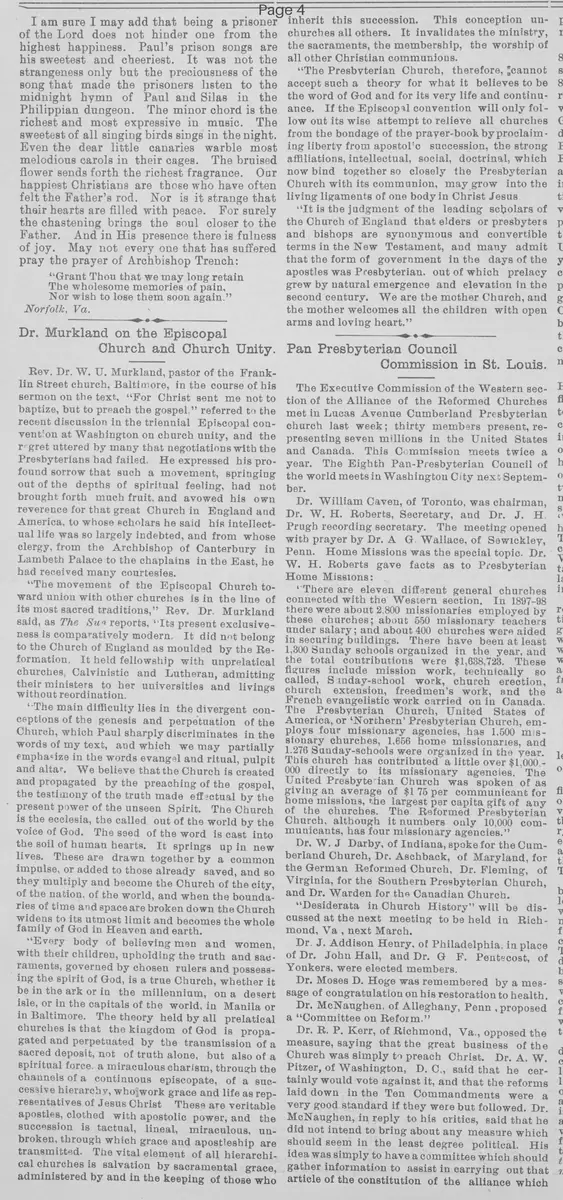
Dr. Murkland on the Episcopal Church and Church Unity.
Rev. Dr. W. U. Murkland, pastor of the Franklin Street church, Baltimore, in the course of his sermon on the text, "For Christ sent me not to baptize, but to preach the gospel." referred to the recent discussion in the triennial Episcopal convention at Washington on church unity, and the regret uttered by many that negotiations with the Presbyterians had failed. He expressed his profound sorrow that such a movement, springing out of the depths of spiritual feeling, had not brought forth much fruit, and avowed his own reverence for that great Church in England and America, to whose scholars he said his intellectual life was so largely indebted, and from whose clergy, from the Archbishop of Canterbury in Lambeth Palace to the chaplains in the East, he had received many courtesies.
"The movement of the Episcopal Church toward union with other churches is in the line of its most sacred traditions," Rev. Dr. Murkland said, as The Sun reports. "Its present exclusiveness is comparatively modern. It did not belong to the Church of England as moulded by the Reformation. It held fellowship with unprelatical churches, Calvinistic and Lutheran, admitting their ministers to her universities and livings without reordination.
"The main difficulty lies in the divergent conceptions of the genesis and perpetuation of the Church, which Paul sharply discriminates in the words of my text, and which we may partially emphasize in the words evangel and ritual, pulpit and altar. We believe that the Church is created and propagated by the preaching of the gospel, the testimony of the truth made effectual by the present power of the unseen Spirit. The Church is the ecclesia, the called out of the world by the voice of God. The seed of the word is cast into the soil of human hearts. It springs up in new lives. These are drawn together by a common impulse, or added to those already saved, and so they multiply and become the Church of the city, of the nation, of the world, and when the boundaries of time and space are broken down the Church widens to its utmost limit and becomes the whole family of God in Heaven and earth.
"Every body of believing men and women, with their children, upholding the truth and sacraments, governed by chosen rulers and possessing the spirit of God, is a true Church, whether it be in the ark or in the millennium, on a desert isle, or in the capitals of the world, in Manila or in Baltimore. The theory held by all prelatical churches is that the kingdom of God is propagated and perpetuated by the transmission of a sacred deposit, not of truth alone, but also of a spiritual force, a miraculous charism, through the channels of a continuous episcopate, of a successive hierarchy, who work grace and life as representatives of Jesus Christ. These are veritable apostles, clothed with apostolic power, and the succession is tactual, lineal, miraculous, unbroken, through which grace and apostleship are transmitted. The vital element of all hierarchical churches is salvation by sacramental grace, administered by and in the keeping of those who inherit this succession. This conception unchurches all others. It invalidates the ministry, the sacraments, the membership, the worship of all other Christian communions.
"The Presbyterian Church, therefore, cannot accept such a theory for what it believes to be the word of God and for its very life and continuance. If the Episcopal convention will only follow out its wise attempt to relieve all churches from the bondage of the prayer-book by proclaiming liberty from apostolic succession, the strong affiliations, intellectual, social, doctrinal, which now bind together so closely the Presbyterian Church with its communion, may grow into the living ligaments of one body in Christ Jesus.
"It is the judgment of the leading scholars of the Church of England that elders or presbyters and bishops are synonymous and convertible terms in the New Testament, and many admit that the form of government in the days of the apostles was Presbyterian, out of which prelacy grew by natural emergence and elevation in the second century. We are the mother Church, and the mother welcomes all the children with open arms and loving heart."
Rev. Dr. W. U. Murkland, pastor of the Franklin Street church, Baltimore, in the course of his sermon on the text, "For Christ sent me not to baptize, but to preach the gospel." referred to the recent discussion in the triennial Episcopal convention at Washington on church unity, and the regret uttered by many that negotiations with the Presbyterians had failed. He expressed his profound sorrow that such a movement, springing out of the depths of spiritual feeling, had not brought forth much fruit, and avowed his own reverence for that great Church in England and America, to whose scholars he said his intellectual life was so largely indebted, and from whose clergy, from the Archbishop of Canterbury in Lambeth Palace to the chaplains in the East, he had received many courtesies.
"The movement of the Episcopal Church toward union with other churches is in the line of its most sacred traditions," Rev. Dr. Murkland said, as The Sun reports. "Its present exclusiveness is comparatively modern. It did not belong to the Church of England as moulded by the Reformation. It held fellowship with unprelatical churches, Calvinistic and Lutheran, admitting their ministers to her universities and livings without reordination.
"The main difficulty lies in the divergent conceptions of the genesis and perpetuation of the Church, which Paul sharply discriminates in the words of my text, and which we may partially emphasize in the words evangel and ritual, pulpit and altar. We believe that the Church is created and propagated by the preaching of the gospel, the testimony of the truth made effectual by the present power of the unseen Spirit. The Church is the ecclesia, the called out of the world by the voice of God. The seed of the word is cast into the soil of human hearts. It springs up in new lives. These are drawn together by a common impulse, or added to those already saved, and so they multiply and become the Church of the city, of the nation, of the world, and when the boundaries of time and space are broken down the Church widens to its utmost limit and becomes the whole family of God in Heaven and earth.
"Every body of believing men and women, with their children, upholding the truth and sacraments, governed by chosen rulers and possessing the spirit of God, is a true Church, whether it be in the ark or in the millennium, on a desert isle, or in the capitals of the world, in Manila or in Baltimore. The theory held by all prelatical churches is that the kingdom of God is propagated and perpetuated by the transmission of a sacred deposit, not of truth alone, but also of a spiritual force, a miraculous charism, through the channels of a continuous episcopate, of a successive hierarchy, who work grace and life as representatives of Jesus Christ. These are veritable apostles, clothed with apostolic power, and the succession is tactual, lineal, miraculous, unbroken, through which grace and apostleship are transmitted. The vital element of all hierarchical churches is salvation by sacramental grace, administered by and in the keeping of those who inherit this succession. This conception unchurches all others. It invalidates the ministry, the sacraments, the membership, the worship of all other Christian communions.
"The Presbyterian Church, therefore, cannot accept such a theory for what it believes to be the word of God and for its very life and continuance. If the Episcopal convention will only follow out its wise attempt to relieve all churches from the bondage of the prayer-book by proclaiming liberty from apostolic succession, the strong affiliations, intellectual, social, doctrinal, which now bind together so closely the Presbyterian Church with its communion, may grow into the living ligaments of one body in Christ Jesus.
"It is the judgment of the leading scholars of the Church of England that elders or presbyters and bishops are synonymous and convertible terms in the New Testament, and many admit that the form of government in the days of the apostles was Presbyterian, out of which prelacy grew by natural emergence and elevation in the second century. We are the mother Church, and the mother welcomes all the children with open arms and loving heart."
What sub-type of article is it?
Historical Event
What themes does it cover?
Moral Virtue
Providence Divine
What keywords are associated?
Church Unity
Episcopal Convention
Presbyterian Church
Apostolic Succession
Theological Differences
What entities or persons were involved?
Rev. Dr. W. U. Murkland
Where did it happen?
Baltimore, Washington
Story Details
Key Persons
Rev. Dr. W. U. Murkland
Location
Baltimore, Washington
Event Date
Recent
Story Details
Rev. Dr. Murkland expresses sorrow over failed negotiations for church unity between Episcopalians and Presbyterians, reveres the Episcopal Church, discusses historical traditions of fellowship, contrasts conceptions of church genesis (evangel vs. ritual), and hopes for union by rejecting apostolic succession exclusivity.