Thank you for visiting SNEWPapers!
Sign up free
Virginia Argus
Richmond, Virginia
What is this article about?
French General Richepanse issues a decree in Guadaloupe on July 7, 1802, restoring colonial order by limiting citizenship and arms to whites, requiring non-whites to return to plantations, imposing penalties for defiance, and regulating slave labor and provisions.
Merged-components note: Merged to complete the translated French decree from Guadaloupe across pages; note that this component also includes a short continuation (two paragraphs) of the prior domestic story on the US Congress session, due to initial parsing split.
Clippings
1 of 2
OCR Quality
Full Text
importance from furnishing a criterion of
the sentiments and views of the new ad-
ministration in relation to public credit.
The charge of hostility to it had been so
repeatedly made, that many who were
deeply interested in the funds trembled
for their property. All alarm subsided
on the passage of this act, which demon-
strated the determination of the govern-
ment, while they complied with rigid good
faith with the national engagements, to a-
dopt every practicable mean of extinguish-
ment, thereby fully satisfying the claim
of the creditor, and the expectation of the
public, that the debt should be speedily
discharged. Whatever may have been
the opinion of their predecessors, this act
renounced on the part of the present ad-
ministration, an idea of a public debt be-
ing a public blessing: and as the idea had,
with a certain description of citizens, be-
come very familiar, nothing short of an act
of the legislature could, perhaps, have ex-
posed its fallacy.
It will be remarked that this measure,
as well as every other leading measure,
proposed by the majority, received the op-
position of the minority. A disinterested
man, aloof from the prejudices of par-
ty would have concluded that, with what-
ever jealousy the adoption of a measure
so laudable by the majority, would have
been regarded by the minority, the latter
would scarcely have undertaken openly to
oppose it. But the field of party violence
had been taken, and it appears to have
been deemed good policy to inveigh acri-
moniously against every measure propos-
ed. This conviction may have been
strengthened by the indistinct hope, that
the approbation of the public creditors, hi-
therto the allies of federal policy, would
be qualified by instilling in their minds sus-
picion however vague or unjust. A very
different effect, however, ensued; and the
creditor saw with surprise those who had
heretofore avowed exclusive friendship.
suffering party spirit to lead them into acts
subversive of public faith, while he con-
templated those who had been reproached
as its enemies, guarding it with jealous
security.
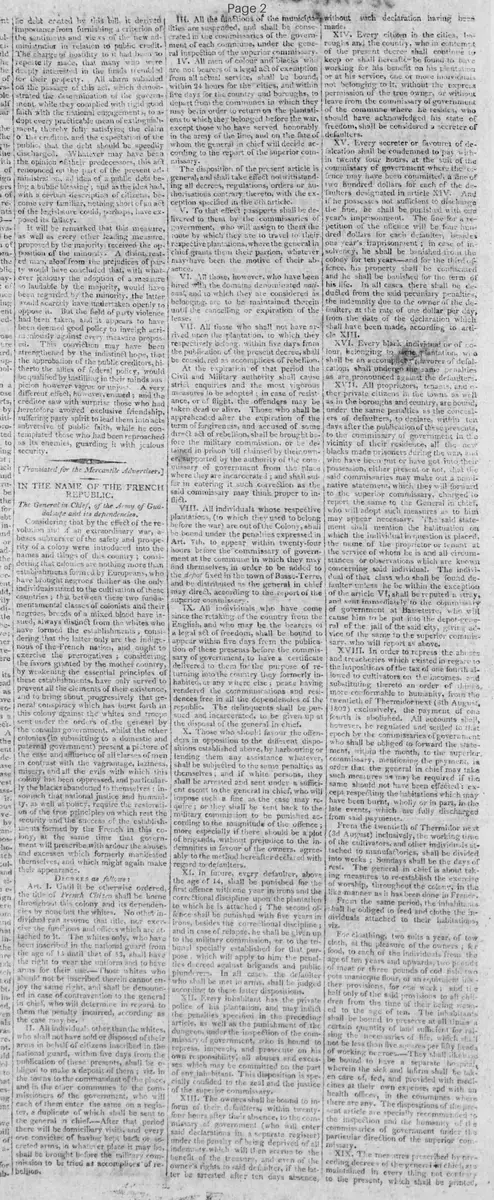
[Translated for the Mercantile Advertiser.]
IN THE NAME OF THE FRENCH
REPUBLIC.
The General in Chief, of the Army of Gua-
daloupe and its dependencies.
Considering that by the effect of the re-
volution and of an extraordinary war, a-
buses subversive of the safety and prospe-
rity of a colony were introduced into the
names and things of this country; consi-
dering that colonies are nothing more than
establishments formed by Europeans, who
have brought negroes thither as the only
individuals suited to the cultivation of these
countries; that between these two funda-
mental classes of colonists and their
negroes, breeds of a mixed blood have is-
sued, always distinct from the whites who
have formed the establishments, consi-
dering that the latter only are the indige-
nous of the French nation, and ought to
exercise the prerogatives; considering
the favors granted by the mother country,
by weakening the essential principles of
these establishments, have only served to
prevent all the elements of their existence,
and to bring about progressively that ge-
neral conspiracy which has burst forth in
this colony against the whites and troops
sent under the orders of the general by
the consular government, whilst the other
colonies (in submitting to a domestic and
paternal government) present a picture of
the ease and affluence of all classes of men
in contrast with the vagrancy, laziness,
misery, and all the evils with which this
colony has been oppressed, and particular-
ly the blacks abandoned to themselves; in-
somuch that national justice and humani-
ty, as well as policy, require the restorati-
on of the true principles on which rest the
security and the success of the establish-
ments formed by the French in this co-
lony, at the same time that govern-
ment will proscribe with ardour the abuses
and excesses which formerly manifested
themselves, and which might again make
their appearance.
Decrees as follows:
Art. I. Until it be otherwise ordered,
the title of French citizen shall be borne
throughout this colony and its dependen-
cies by none but the whites. No other in-
dividual can assume that title, nor exer-
cise the functions and offices which are at-
tached to it. The whites only, who have
been inscribed in the national guard from
the age of 18 until that of 53, shall have
the right to wear the uniform and to have
arms for their use. Those whites who
should not be inscribed therein cannot en-
joy the same right, and shall be denounced in case of contravention to the general
in chief, who will determine in regard to
them the penalty incurred, according as
the case may be.
II. All individuals other than the whites,
who shall not have sold or disposed of their
arms in behalf of citizens inscribed in the
national guard, within five days from the
publication of these presents, shall be ob-
liged to make a deposit of them; viz. in
the towns to the commandant of the place,
and in the other communes to the com-
missioners of the government, who will
each of them enter the same on a regis-
ter, a duplicate of which shall be sent to
the general in chief. After that period
there will be domiciliary visits, and every
one convicted of having kept back or se-
creted arms, in whatever place it may be,
shall be brought before the military com-
mission to be tried as accomplices of re-
bellion.
III. All the functions of the municipa-
lities are suspended, and shall be conse-
crated in the commissaries of the govern-
ment of each commune, under the gene-
ral inspection of the superior commissary.
IV. All men of colour and blacks who
are not bearers of a legal act of exemption
from all actual service, shall be bound,
within 24 hours for the cities, and within
five days for the country and boroughs, to
depart from the communes in which they
may be, in order to return on the planta-
tions to which they belonged before the war,
except those who have served honorably
in the army of the line, and on the fate of
whom the general in chief will decide ac-
cording to the report of the superior com-
missary.
The disposition of the present article is
general, and shall take effect not withstand-
ing all decrees, regulations, orders or au-
thorizations contrary thereto, with the ex-
ception specified in the 4th article.
V. To that effect passports shall be de-
livered to them by the commissaries of
government, who will assign to them the
route by which they are to travel to their
respective plantations, where the general in
chief grants them their pardon, whatever
may have been the motive of their ab-
sence.
VI. All those, however, who have been
hired with the domains denominated nati-
nal, and to which they are considered as
belonging, are to be maintained therein
until the cancelling or expiration of the
lease.
VII. All those who shall not have ar-
rived upon the plantation, to which they
respectively belong, within five days from
the publication of the present decree, shall
be considered as accomplices of rebellion.
At the expiration of that period the
Civil and Military authority shall cause
strict enquiries and the most vigorous
measures to be adopted; in case of resist-
anace, or of flight, the offenders may be
taken dead or alive. Those who shall be
apprehended after the expiration of the
term of forgiveness, and accused of some
direct act of rebellion, shall be brought be-
fore the military commission, or be de-
tained in prison till claimed by their own-
er, supported by the authority of the com-
missary of government from the place
where they are incarcerated; and shall suf-
fer in entering it such correction as the
said commissary may think proper to in-
flict.
VIII. All individuals whose respective
plantations, (to which they used to belong
before the war) are out of the Colony, shall
be bound under the penalties expressed in
Art. VII, to appear within twenty-four
hours before the commissary of govern-
ment at the commune in which they may
find themselves, in order to be added to
the depot fixed in the town of Basse-Terre,
and be distributed as the general in chief
may direct, according to the report of the
superior commissary.
IX. All individuals who have come
since the retaking of the country from the
English, and who may be the bearers of
a legal act of freedom, shall be bound to
appear within five days from the publica-
tion of these presents before the commis-
sary of government, to have a certificate
delivered to them for the purpose of re-
turning into the country they formerly in-
habited, or any where else; peace having
rendered the communications and resi-
dences free in all the dependencies of the
republic. The delinquents shall be pur-
sued and incarcerated, to be given up at
the disposal of the general in chief.
X. Those who should favour the offen-
ders in opposition to the different dispo-
sitions established above, by harbouring or
lending them any assistance whatever,
shall be subjected to the same penalties as
themselves; and if white persons, they
shall be arrested and sent under a suffici-
ent escort to the general in chief, who will
impose such a fine as the case may re-
quire; or they shall be sent back to the
military commission to be punished ac-
cording to the magnitude of the offence;
more especially if there should be a plot
of brigands, without prejudice to the in-
demnities in favour of the owners, agree-
ab ly to the method hereafter declared with
regard to defaulters.
XI. In future, every defaulter, above
the age of 14, shall be punished for the
first offence with one year in irons and the
correctional discipline upon the plantation
to which he is attached; The second of-
ffence shall be punished with five years in
irons, besides the correctional discipline;
and in case of relapse, he shall be given up
to the military commission, or to the tri-
bunal specially established for that pur-
pose, which will apply to him the penal-
ties decreed against brigands and public
plunderers. In all cases, the defaulter
who shall be met in arms, shall be judged
according to these latter dispositions.
XII. Every inhabitant has the private
police of his plantation, and may inflict
the penalties specified in the preceding
article, as well as the punishment of the
dungeon, under the inspection of the com-
missary of government, who is bound to
repress, impeach, and prosecute on his
own responsibility, all abuses and exces-
ses which may be committed on the part
of any inhabitant. This disposition is spe-
cially confided to the zeal and the justice
of the superior commissary.
XIII. The owners shall be bound to in-
form of their defaulters, within twenty-
four hours after their absence, to the com-
missary of government (who will enter
said declarations in a separate register)
under the penalty of being deprived of all
indemnity, which will then accrue to the
benefit of the treasury, and even of the
owner's rights to said defaulter, if the lat-
ter be arrested after ten days absence,
without such declaration having been
made.
XIV. Every citizen in the cities, bo-
roughs and the country, who in contempt
of the present decree shall continue to
keep or shall hereafter be found to have
working for his benefit on his plantation
or at his service, one or more individuals
not belonging to it, without the express
permission of the true owner, or without
leave from the commissary of government
of the commune where he resides, who
should have acknowledged his state of
freedom, shall be considered a secreter of
defaulters.
XV. Every secreter or favourer of de-
faulters shall be condemned to pay with-
in twenty four hours, at the suit of the
commissary of government where the of-
fence may have been committed, a fine of
two hundred dollars for each of the de-
faulters designated in article XIV. And
if he possesses not sufficient to discharge
the fine, he shall be punished with one
year's imprisonment. The fine for a re-
petition of the offence will be four hun-
dred dollars for each defaulter besides
one year's imprisonment; in case of in-
solvency, he shall be banished from the
colony for ten years--and for the third of-
fence, his property shall be confiscated
and he shall be banished for the term of
his life. In all cases there shall be de-
ducted from the said pecuniary penalties,
the indemnity due to the owner of the de-
faulter, at the rate of one dollar per day,
from the date of the declaration which
shall have been made, according to arti-
cle XIII.
XVI. Every black individual or of co-
lour, belonging to some plantation, who
shall be an accomplice or a favorer of deal-
ication, shall undergo the same penalties
as are pronounced against the defaulters.
XVII. All proprietors, tenants, and other private citizens in the towns as well
as in the boroughs and country, are bound,
under the same penalties as the conceal-
ers of defaulters, to declare, within ten
days after the publication of these presents, to the commissary of government in the vicinity of their residence, all the new
blacks made prisoners during the war, and
who have been put or have got into their
possession, either present or not, that the
said commissaries may make out a nomi-
native statement, which they will forward
to the superior commissary, charged to
report the same to the General in chief,
who will adopt such measures as to him
may appear necessary. The said state-
ment shall mention the habitation on
which the individual in question is placed,
the name of the proprietor or tenant at
the service of whom he is and all circum-
stances or observations which are known
concerning said individual. The indivi-
dual of that class who shall be found de-
faulter unless he be within the exception
of the article VI, shall be reputed a stray,
and sent immediately to the commissary
of government at Basseterre, who will
cause him to be put into the depot-gene-
ral of the jail of the said city, giving ad-
vice of the same to the superior commis-
sary, who will report as above.
XVIII. In order to repress the abuses
and treacheries which existed in regard to
the impositions of the tax of one fourth al-
lowed to cultivators on the incomes, and
substituting thereto an order of things
more conformable to humanity, from the
twentieth of Thermidor next (4th August,
1802) exclusively, the payment of one
fourth is abolished. All accounts shall,
however, be regulated and settled to that
epoch by the commissaries of government who shall be obliged to forward the state-
ment, within the month, to the superior
commissary, mentioning the payment, in
order that the general in chief may take
such measures as may be required if the
same should not have been effected: ex-
cept respecting the habitations which may
have been burnt, wholly or in part, in the
late events, which are fully discharged
from said payments.
From the twentieth of Thermidor next
(3d August) inclusively, the working time
of the cultivators, and other individuals at-
tached to manufactories, shall be divided
into weeks; Sundays shall be the days of
rest. The general in chief is about tak-
ing measures to re-establish the exercise
of worship, throughout the colony, in the
like manner as it has been done in France.
From the same period, the inhabitants
shall be obliged to feed and clothe the in-
dividuals attached to their habitations
viz.
For clothing, two suits a year, of tow
cloth, at the pleasure of the owners; for
food, to each of the individuals from the
age of ten years and upwards, two pounds
of meat or three pounds of cod fish, two
pots manioc flour, or an equivalent in other provisions, for one week; and the
half only of the said provisions to all chil-
dren from the time of their being weaned to the age of ten. The inhabitants
shall be bound to preserve at all times a
certain quantity of land sufficient for rais-
ing the necessaries of life, which shall
not be less than five squares per hundred heads of working negroes. They shall likewise be bound to have a separate hospital,
wherein the sick and infirm shall be taken care of, fed, and provided with medi-
cines at their own expense, and with an
health officer, in the communes where
there are any. The dispositions of the pre-
sent article are specially recommended to
the inspection and the humanity of the
commissaries of government under the
particular direction of the superior com-
missary.
XIX. The measures prescribed by pre-
ceding decrees of the general in chief, are
maintained in every thing not contrary
to this present, which shall be printed,
read, published, registered and posted up wherever it may be necessary.
Done at Head-Quarters, Basseterre Guadaloupe, the 28th Messidor of the year 10 of the French Republic (7th July, 1802.)
(Signed)
RICHEPANSE.
What sub-type of article is it?
What keywords are associated?
What entities or persons were involved?
Where did it happen?
Foreign News Details
Primary Location
Guadaloupe
Event Date
7th July, 1802
Key Persons
Outcome
restoration of white supremacy and slavery; pardon for returning laborers; penalties including irons, fines, banishment, or death for defiance; abolition of one-fourth tax on cultivators; regulations for food, clothing, and rest for attached individuals.
Event Details
General Richepanse decrees restrictions on citizenship and arms to whites only; requires men of color and blacks to return to pre-war plantations within days, with passports and pardon upon return; imposes severe penalties for non-compliance including trial as rebels, irons, or execution; suspends municipal functions; regulates defaulters, harborers, and new prisoners; abolishes certain taxes and mandates provisions, rest days, and hospitals for laborers.