Thank you for visiting SNEWPapers!
Sign up free
Story
August 15, 1911
The Morris County Chronicle
Morristown, Morris County, New Jersey
What is this article about?
Explanation of cheap perfumes' main ingredient, animal musk from muskrats and civet cats, including historical use and zoo collection for revenue.
Clipping
OCR Quality
98%
Excellent
Full Text
SOURCES OF PERFUMES.
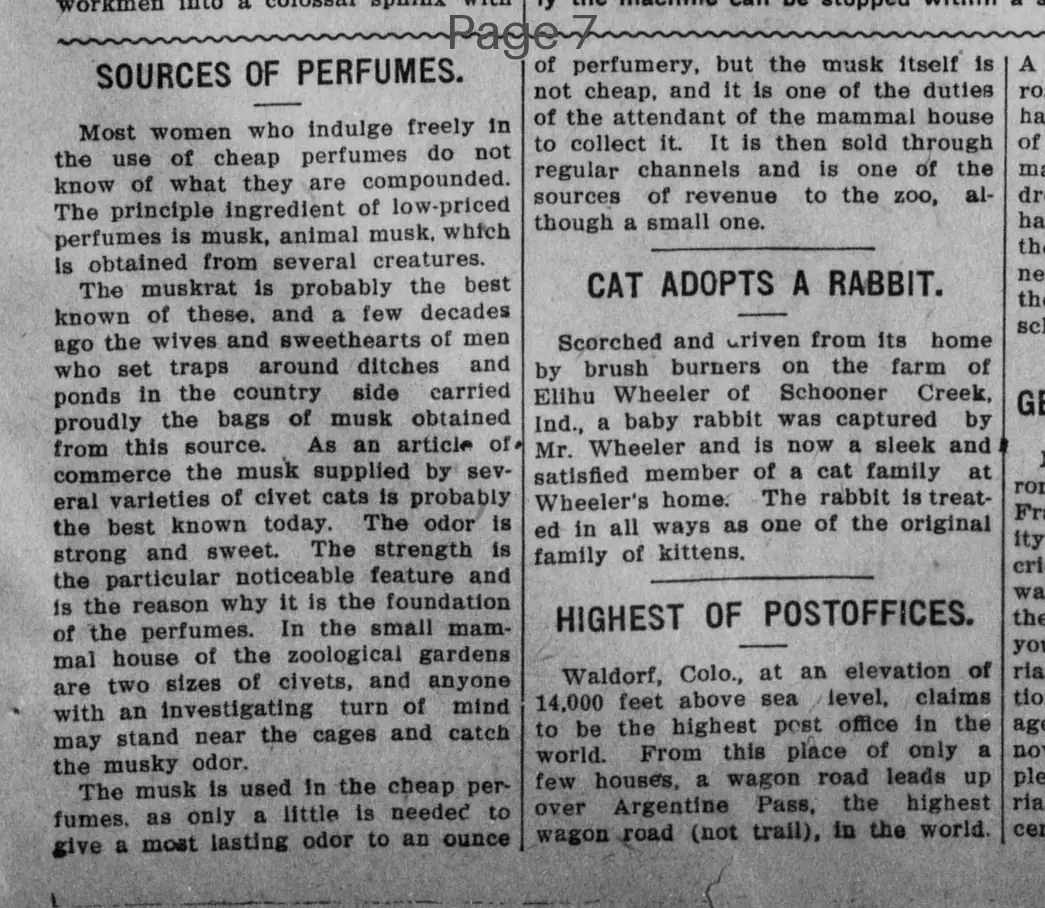
Most women who indulge freely in the use of cheap perfumes do not know of what they are compounded. The principle ingredient of low-priced perfumes is musk, animal musk, which is obtained from several creatures. The muskrat is probably the best known of these, and a few decades ago the wives and sweethearts of men who set traps around ditches and ponds in the country side carried proudly the bags of musk obtained from this source. As an article of commerce the musk supplied by several varieties of civet cats is probably the best known today. The odor is strong and sweet. The strength is the particular noticeable feature and is the reason why it is the foundation of the perfumes. In the small mammal house of the zoological gardens are two sizes of civets, and anyone with an investigating turn of mind may stand near the cages and catch the musky odor. The musk is used in the cheap perfumes, as only a little is needed to give a most lasting odor to an ounce of perfumery, but the musk itself is not cheap, and it is one of the duties of the attendant of the mammal house to collect it. It is then sold through regular channels and is one of the sources of revenue to the zoo, although a small one.
Most women who indulge freely in the use of cheap perfumes do not know of what they are compounded. The principle ingredient of low-priced perfumes is musk, animal musk, which is obtained from several creatures. The muskrat is probably the best known of these, and a few decades ago the wives and sweethearts of men who set traps around ditches and ponds in the country side carried proudly the bags of musk obtained from this source. As an article of commerce the musk supplied by several varieties of civet cats is probably the best known today. The odor is strong and sweet. The strength is the particular noticeable feature and is the reason why it is the foundation of the perfumes. In the small mammal house of the zoological gardens are two sizes of civets, and anyone with an investigating turn of mind may stand near the cages and catch the musky odor. The musk is used in the cheap perfumes, as only a little is needed to give a most lasting odor to an ounce of perfumery, but the musk itself is not cheap, and it is one of the duties of the attendant of the mammal house to collect it. It is then sold through regular channels and is one of the sources of revenue to the zoo, although a small one.
What sub-type of article is it?
Curiosity
Animal Story
What themes does it cover?
Nature
What keywords are associated?
Cheap Perfumes
Animal Musk
Muskrat
Civet Cats
Zoological Gardens
Zoo Revenue
Where did it happen?
Zoological Gardens, Small Mammal House
Story Details
Location
Zoological Gardens, Small Mammal House
Story Details
Cheap perfumes are made primarily from animal musk obtained from muskrats and civet cats; historically used by trappers' families, now commercially from zoos where attendants collect and sell it for revenue.