Thank you for visiting SNEWPapers!
Sign up free
New Hampshire Statesman And State Journal
Concord, Merrimack County, New Hampshire
What is this article about?
Report from the Merrimack County Agricultural Society's October 1837 Cattle Show and Fair on silk culture, discussing winter impacts on mulberry trees, economic potential of domestic silk production, and awarding premiums to Mrs. Kimball of Hopkinton for silk dress and sewing silk, and to Miss Mary Pecker of Concord for sewing silk.
Clipping
OCR Quality
Full Text
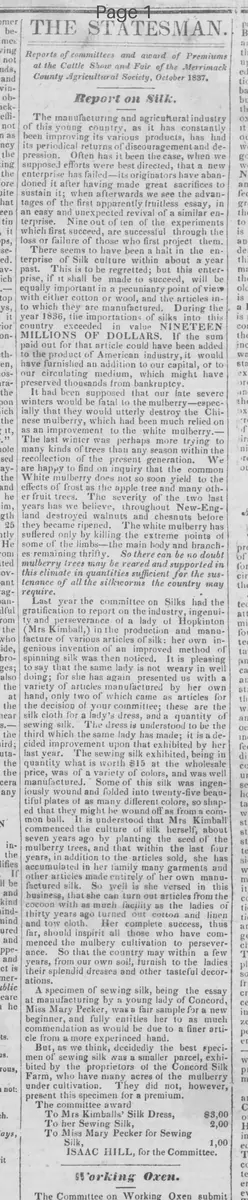
Reports of committees and award of Premiums at the Cattle Show and Fair of the Merrimack County Agricultural Society, October 1837.
Report on Silk.
The manufacturing and agricultural industry of this young country, as it has constantly been improving its various products, has had its periodical returns of discouragement and depression. Often has it been the case, when we supposed efforts were best directed, that a new enterprise has failed—its originators have abandoned it after having made great sacrifices to sustain it; when afterwards we see the advantages of the first apparently fruitless essay, in an easy and unexpected revival of a similar enterprise. Nine out of ten of the experiments which first succeed, are successful through the loss or failure of those who first project them.
There seems to have been a halt in the enterprise of Silk culture within about a year past. This is to be regretted; but this enterprise, if it shall be made to succeed, will be equally important in a pecuniary point of view with either cotton or wool, and the articles into which they are manufactured. During the year 1836, the importations of silks into this country exceeded in value NINETEEN MILLIONS OF DOLLARS. If the sum paid out for that article could have been added to the product of American industry, it would have furnished an addition to our capital, or to our circulating medium, which might have preserved thousands from bankruptcy.
It had been supposed that our late severe winters would be fatal to the mulberry—especially that they would utterly destroy the Chinese mulberry, which had been much relied on as an improvement to the white mulberry.—The last winter was perhaps more trying to many kinds of trees than any season within the recollection of the present generation. We are happy to find on inquiry that the common White mulberry does not so soon yield to the effects of frost as the apple tree and many other fruit trees. The severity of the two last years has we believe, throughout New-England destroyed walnuts and chesnuts before they became ripened. The white mulberry has suffered only by killing the extreme points of some of the limbs—the main body and branches remaining thrifty. So there can be no doubt mulberry trees may be reared and supported in this climate in quantities sufficient for the sustenance of all the silkworms the country may require.
Last year the committee on Silks had the gratification to report on the industry, ingenuity and perseverance of a lady of Hopkinton (Mrs Kimball,) in the production and manufacture of various articles of silk: her own ingenious invention of an improved method of spinning silk was then noticed. It is pleasing to say that the same lady is not weary in well doing; for she has again presented us with a variety of articles manufactured by her own hand, only two of which came as articles for the decision of your committee; these are the silk cloth for a lady's dress, and a quantity of sewing silk. The dress is understood to be the third which the same lady has made; it is a decided improvement upon that exhibited by her last year. The sewing silk exhibited, being in quantity what is worth $15 at the wholesale price, was of a variety of colors, and was well manufactured. Some of this silk was ingeniously wound and folded into twenty-five beautiful plates of as many different colors, so shaped that they might be wound off as from a common ball. It is understood that Mrs Kimball commenced the culture of silk herself, about seven years ago by planting the seed of the mulberry trees, and that within the last four years, in addition to the articles sold, she has accumulated in her family many garments and other articles made entirely of her own manufactured silk. So well is she versed in this business, that she can turn out articles from the cocoon with as much facility as the ladies of thirty years ago turned out cotton and linen and tow cloth. Her complete success, thus far, should inspirit all those who have commenced the mulberry cultivation to perseverance. So that the country may within a few years, from our own soil, furnish to the ladies their splendid dresses and other tasteful decorations.
A specimen of sewing silk, being the essay at manufacturing by a young lady of Concord, Miss Mary Pecker, was a fair sample for a new beginner, and fully entitles her to as much commendation as would be due to a finer article from a more experienced hand.
But, as we think, decidedly the best specimen of sewing silk was a smaller parcel, exhibited by the proprietors of the Concord Silk Farm, who have many acres of the mulberry under cultivation. They did not, however, present this specimen for a premium.
The committee award
To Mrs Kimball's Silk Dress, $3,00
To her Sewing Silk, 2,00
To Miss Mary Pecker for Sewing Silk, 1,00
ISAAC HILL, for the Committee.
What sub-type of article is it?
What keywords are associated?
What entities or persons were involved?
Where did it happen?
Domestic News Details
Primary Location
Merrimack County
Event Date
October 1837
Key Persons
Outcome
awards: to mrs kimball's silk dress, $3.00; to her sewing silk, $2.00; to miss mary pecker for sewing silk, $1.00
Event Details
Committee report on silk culture and manufacturing, noting halt in enterprise but potential importance, effects of severe winters on mulberry trees, exhibits by Mrs Kimball including silk dress and sewing silk, specimen by Miss Mary Pecker, and sample from Concord Silk Farm proprietors.