Thank you for visiting SNEWPapers!
Sign up free
Editorial
October 21, 1937
Montana Labor News
Butte, Silver Bow County, Montana
What is this article about?
The editorial criticizes the Kentucky Court of Appeals for setting aside the legislature's ratification of the federal child labor amendment, arguing it demonstrates judicial usurpation of popular will and justifies President Roosevelt's call for judicial reform. (214 characters)
Clipping
OCR Quality
98%
Excellent
Full Text
Nullifying Courts
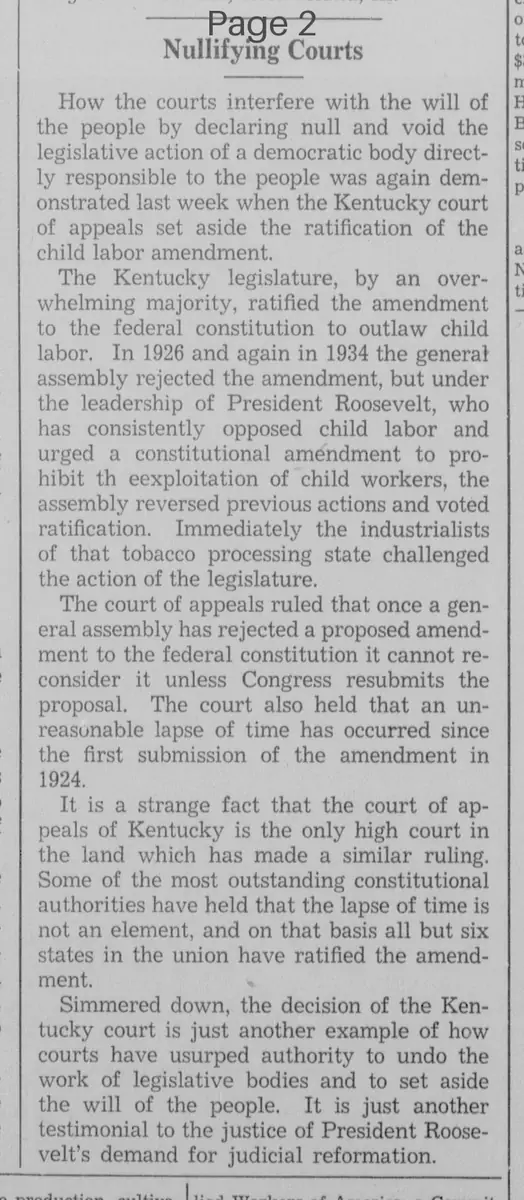
How the courts interfere with the will of the people by declaring null and void the legislative action of a democratic body directly responsible to the people was again demonstrated last week when the Kentucky court of appeals set aside the ratification of the child labor amendment.
The Kentucky legislature, by an overwhelming majority, ratified the amendment to the federal constitution to outlaw child labor. In 1926 and again in 1934 the general assembly rejected the amendment, but under the leadership of President Roosevelt, who has consistently opposed child labor and urged a constitutional amendment to prohibit the exploitation of child workers, the assembly reversed previous actions and voted ratification. Immediately the industrialists of that tobacco processing state challenged the action of the legislature.
The court of appeals ruled that once a general assembly has rejected a proposed amendment to the federal constitution it cannot reconsider it unless Congress resubmits the proposal. The court also held that an unreasonable lapse of time has occurred since the first submission of the amendment in 1924.
It is a strange fact that the court of appeals of Kentucky is the only high court in the land which has made a similar ruling. Some of the most outstanding constitutional authorities have held that the lapse of time is not an element, and on that basis all but six states in the union have ratified the amendment.
Simmered down, the decision of the Kentucky court is just another example of how courts have usurped authority to undo the work of legislative bodies and to set aside the will of the people. It is just another testimonial to the justice of President Roosevelt's demand for judicial reformation.
How the courts interfere with the will of the people by declaring null and void the legislative action of a democratic body directly responsible to the people was again demonstrated last week when the Kentucky court of appeals set aside the ratification of the child labor amendment.
The Kentucky legislature, by an overwhelming majority, ratified the amendment to the federal constitution to outlaw child labor. In 1926 and again in 1934 the general assembly rejected the amendment, but under the leadership of President Roosevelt, who has consistently opposed child labor and urged a constitutional amendment to prohibit the exploitation of child workers, the assembly reversed previous actions and voted ratification. Immediately the industrialists of that tobacco processing state challenged the action of the legislature.
The court of appeals ruled that once a general assembly has rejected a proposed amendment to the federal constitution it cannot reconsider it unless Congress resubmits the proposal. The court also held that an unreasonable lapse of time has occurred since the first submission of the amendment in 1924.
It is a strange fact that the court of appeals of Kentucky is the only high court in the land which has made a similar ruling. Some of the most outstanding constitutional authorities have held that the lapse of time is not an element, and on that basis all but six states in the union have ratified the amendment.
Simmered down, the decision of the Kentucky court is just another example of how courts have usurped authority to undo the work of legislative bodies and to set aside the will of the people. It is just another testimonial to the justice of President Roosevelt's demand for judicial reformation.
What sub-type of article is it?
Legal Reform
Constitutional
Labor
What keywords are associated?
Child Labor Amendment
Judicial Interference
Kentucky Ratification
Constitutional Amendment
Judicial Reform
What entities or persons were involved?
Kentucky Court Of Appeals
Kentucky Legislature
President Roosevelt
Industrialists
Editorial Details
Primary Topic
Critique Of Kentucky Court's Nullification Of Child Labor Amendment Ratification
Stance / Tone
Critical Of Judicial Overreach And Supportive Of Judicial Reform
Key Figures
Kentucky Court Of Appeals
Kentucky Legislature
President Roosevelt
Industrialists
Key Arguments
Courts Interfere With The Will Of The People By Nullifying Legislative Actions
Kentucky Legislature Ratified The Child Labor Amendment After Previous Rejections
Court Ruled That Prior Rejection Prevents Reconsideration Without Congressional Resubmission
Court Held That Unreasonable Lapse Of Time Since 1924 Submission Invalidates Ratification
Kentucky Is The Only High Court To Make Such A Ruling
Lapse Of Time Is Not A Valid Element According To Constitutional Authorities
All But Six States Have Ratified The Amendment
Decision Exemplifies Courts Usurping Legislative Authority
Supports President Roosevelt's Demand For Judicial Reformation