Thank you for visiting SNEWPapers!
Sign up free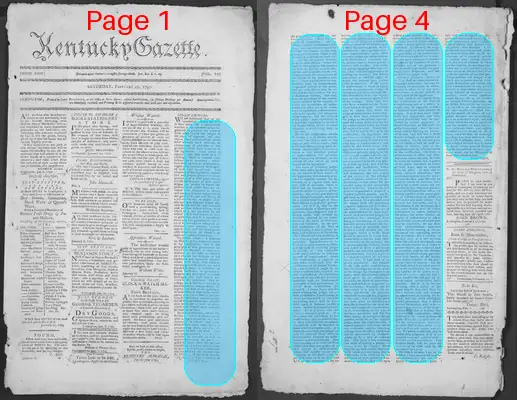
The Kentucky Gazette
Lexington, Fayette County, Kentucky
What is this article about?
A letter warns Kentucky citizens against legislative and executive overreach in removing judges and justices without due process, advocating for impeachment or jury trials to protect judicial independence under the state constitution.
Merged-components note: This is a continuation of the essay signed 'CANDIDUS' from page 1 ('See last Page.') to page 4; relabeled to letter_to_editor as it fits reader letter/opinion format better than general editorial.
Clippings
1 of 2
OCR Quality
Full Text
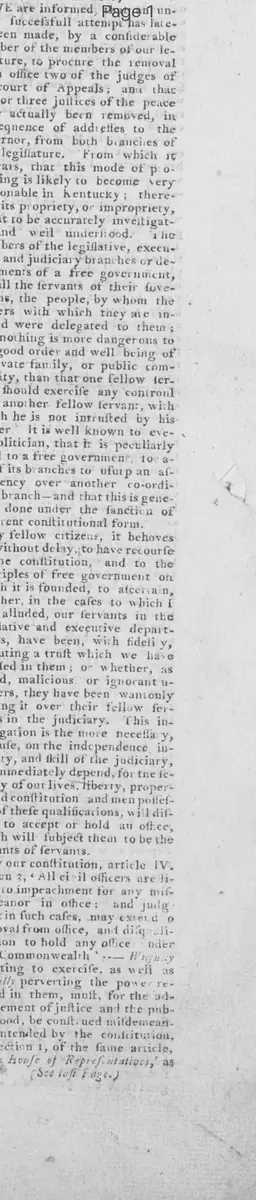
We are informed, that an unsuccessful attempt has lately been made, by a considerable number of the members of our legislature, to procure the removal from office two of the judges of the court of Appeals; and that two or three justices of the peace have actually been removed, in consequence of addresses to the governor, from both branches of the legislature. From which it appears, that this mode of proceeding is likely to become very fashionable in Kentucky; therefore its propriety, or impropriety, ought to be accurately investigated and well understood.
The members of the legislative, executive, and judiciary branches or departments of a free government, are all the servants of their sovereigns, the people, by whom the powers with which they are invested were delegated to them; and nothing is more dangerous to the good order and well being of a private family, or public community, than that one fellow servant should exercise any control over another fellow servant, with which he is not intrusted by his master. It is well known to every politician, that it is peculiarly fatal to a free government, to any of its branches to usurp an ascendency over another co-ordinate branch—and that this is generally done under the sanction of apparent constitutional form.
My fellow citizens, it behoves us, without delay, to have recourse to the constitution, and to the principles of free government on which it is founded, to ascertain, whether, in the cases to which I have alluded, our servants in the legislative and executive departments, have been, with fidelity, executing a trust which we have reposed in them; or whether, as proud, malicious or ignorant usurpers, they have been wantonly lording it over their fellow servants in the judiciary. This investigation is the more necessary, because, on the independence integrity, and skill of the judiciary, we immediately depend, for the security of our lives, liberty, property and constitution and men possessed of these qualifications, will disdain to accept or hold an office, which will subject them to be the servants of servants.
By our constitution, article IV. section 3, All civil officers are liable to impeachment for any misdemeanor in office; and judgment in such cases, may extend to removal from office, and disqualification to hold any office under the Commonwealth.—Injury omitting to exercise, as well as willfully perverting the power reposed in them, must, for the advancement of justice and the public good, be construed misdemeanors intended by the constitution.
By section 1, of the same article, The House of Representatives, as
(See last Page.)
the grand jury of inquest for the Commonwealth, have the sole power of impeaching.' And by section 2, which immediately follows, 'All impeachments are to be tried by the senate,' as the most proper judicial court, which could be devised, to decide on such cases. And for the greater security of the accused officers, when sitting for that purpose, the senators are to be on special oath or affirmation, and no person can be convicted without the concurrence of two thirds of the members present.' Thus we find from the constitution, that, by impeachment, judges and justices of the peace, who are civil officers, may be removed from their offices for any misdemeanor therein. And that, from the provisions of the constitution, relative to the manner in which the accusations of misdemeanors in office are to be made, tried and punished, it seems to promise to be equally the safeguard of the innocent, and the scourge of the guilty: more especially, as it is further regulated by an act of the second session of our General Assembly, to which I beg leave to refer you.
But by the constitution, article V. section 2. it is further provided, that the Judges, both of the supreme and inferior courts, shall hold their offices during good behavior; but for any reasonable cause which is not sufficient ground of impeachment, the governor may remove any of them, on the address of two thirds of each branch of the legislature.'
The mode of removing judges from their office, by the executive, on the address of both houses of the legislature, was formerly practiced in England without the solemnity of a regular trial, and, like bills of attainder, seems to have had its foundation in the doctrine of the omnipotence of Parliament; but on the prevalence of more liberal sentiments, both have for a considerable length of time, been disused even in that government. Yet so it is, that on the commencement of American independence, this antiquated and arbitrary mode, was, without restriction, inserted in the constitution of the states of Massachusetts and Delaware. In the present constitution of the state of Pennsylvania, it was, at a later period, and with more deliberation, also inserted and new modeled, so as to wear a greater appearance of propriety. Impeachments are restricted to misdemeanors in office, and the mode of removing judges on address, to any reasonable cause which shall not be sufficient ground of impeachment.' From that constitution, it appears to have been transcribed into the constitution of the state of Kentucky: and in both, it ought to receive a construction, which is not only authorized by the expressions made use of, but which is as clearly consistent with the fundamental principles of free government, on which these constitutions are founded. I do not know that this mode of removing judges has yet been practiced in Pennsylvania, or that a law has passed in that state prescribing how it shall be practiced when it becomes necessary there; neither is it material to enquire. It is propriety and not practice, we are in quest of. It is clear from the expressions in our constitution, that no misdemeanor in office will authorize an address. An address must be founded on some other reasonable cause. It is also to be remarked, that judges can only be removed from office by impeachment founded on misdemeanors committed therein. How then are they to be removed from office when they are guilty of other crimes or misdemeanors, which will equally render them unworthy of the public trust reposed in them, or to be associated with upright characters in the execution of that trust? All such crimes and misdemeanors are certainly to be taken as reasonable causes of removal by address, and to be in the contemplation of the constitution. But a question of infinite importance here arises. How are these crimes and misdemeanors to be ascertained? Certainly not by general report, which is sometimes a false accuser. Not without giving the judge who is accused, a fair trial and opportunity of making his defence; this would contravene an essential right, of which the meanest slave cannot justly be deprived. If the crime or misdemeanor is fixed by a jury in trial at common law, a copy of the record will be an unexceptionable demonstration to the legislature and the Governor of the truth of the charge. They will then only have to decide on the demerit of what is charged. To which may be added, that when the crime or misdemeanor is only charged to have been committed by the Judge in his private capacity, none but a jury of his vicinage are his constitutional Peers, by whom he ought to be tried. It may however still be urged, that, as by the constitution, the legislature and governor are to judge of the sufficiency of the cause of address, the trial may as constitutionally and safely be had before them. I reply, that there is a very material difference between judging of the sufficiency of a cause, and the existence of that cause; and those who are acquainted with the true policy of trial by jury, and with the passions and partialities which sometimes reign in legislatures, will pronounce that such a trial of the existence of the alleged cause of address, would not be constitutional, or safe either for the accused judge or the community which he serves. Even in the trial of an impeachment, which is a regular judicial process, our legislature, in the act to which I before referred, have provided, that the Senate shall not pronounce judgment without a jury to ascertain facts. And by another act of the third session of the same legislature, civil courts and judges are prohibited, for a contempt, from fining or imprisoning to any considerable extent, without the verdict of a jury to authorize them. If this is a well devised act, the principles which it holds forth should be pursued in every case, where there is not the most absolute necessity to the contrary. But if, as is commonly believed, it was only passed to serve a particular purpose, the universal apprehension of free men, that they ought not to be punished without the intervention of a jury, is laid hold of to give it popularity. But suppose in the case under consideration, that the investigation of the truth of the charge was attempted to be made, under this authority alleged to be given by the constitution. Certainly the house of representatives must first sit in judgment on the accusation; second, the senate which is to join in the address; and thirdly, the governor who is also to exercise his judgment in the case. And I need not point out, how great an absurdity and solecism it would be, for three distinct and independent authorities, to sit, in succession, on the trial of the same accusation and for the same intent; or how great the oppression would be, to the accused judge, from this triplicate trial. I cannot conceive, that there can be any reasonable cause for removing a judge from his office, which may not be ascertained by impeachment, or by a jury at common law. (For there is also a common law mode of finding a person non compos mentis by a jury.) But if there be any such causes, they must be so vague and indefinite, that to suffer them to be acted on, at the discretion of the legislature and executive, would so effectually open a door to the exercise of malice, favoritism, and other selfish passions, that the cure would certainly become a much greater evil than the disease; by reducing the judges, who ought to be the independent guardians of the constitution, and the other rights of the citizens, into the mere creatures or humble servants of the members of the legislature and of the governor: which would soon render the poor man's cause desperate, and the constitution a paper wall.
Article V, section 6, Justices of the Peace shall be commissioned during good behaviour; but may be removed, on conviction of misbehaviour in office, or of any infamous crime, or on the address of both houses of the legislature.'
This clause is also copied from the constitution of the state of Pennsylvania, and as it differs in words, may be supposed to differ in substance from those relative to judges. It is, at least more indefinite and unguarded, and with greater plausibility may be perverted to wicked purposes. It should therefore, be still more rigidly scrutinized. But I have already nearly filled up my intended bounds, and will but a little further trespass on the patience of my readers. On the two first parts of this clause, it will be only necessary to observe, that, as impeachments are, by a former clause of the constitution, restricted to misdemeanors in office, and other infamous crimes can only be tried in courts of common law, a justice of the peace, convicted in either of these ways, may be removed from his office. It may also be safely inferred therefrom, that accusations against them for misbehaviour in office may likewise be tried in courts of common law; and so far as these courts are authorized by law, they may pass sentence of exclusion from office, on finding a justice of the peace guilty of misbehaviour in office, as well as for any other crime. But no such law now exists, and it is improbable, if not improper, that any court should ever be vested with power to cashier justices of the peace, for every species and degree of misbehaviour in office, and of other crimes, of which they may be convicted; we are from these considerations, furnished with a clue for coming at the intention of the remaining part of this provision; for I confess, on the first view it is not obvious. From the case as it now stands, and may always remain in a lesser or greater degree, the record of such a conviction, must be the foundation of an address to the governor from both houses of the legislature, before a justice of the peace can be removed thereon. To say the least, there is no other provision in the constitution, for removing a justice of the peace on account of insanity: and this case alone, renders this last part of the clause under consideration indispensable. But if it be its real meaning, that a justice of the peace may be degraded from his office, without trial, and without an opportunity of making his defence, will not every intelligent patriot pronounce, that it should forever lie obsolete, only to be regarded as a memento of the imperfection of all that is human? But it is a rule of construction, which deserves to be wrote in letters of gold—When an expression will admit two interpretations, that interpretation shall prevail, which is the most consistent with reason and justice. To which, in this case, may be added with propriety, if it is not implied—and most consistent with the principles of free government. This without doubt, will be, that the existence of the cause must be ascertained by a jury.
My fellow citizens, I am of no faction, I have no interest to advocate in which you are not all equally concerned with myself. I only wish you to regard the suggestions I have made according to their importance, and to apply them as justice shall dictate, and the public weal demand. I am persuaded, you will at least, adopt my favorite idea, that on all accusations of a criminal nature or which may induce forfeiture, if a jury of citizens in their private capacity, be not placed between the accused and their judges, there can be no effectual barrier against the exercise of the most pernicious passions and designs with which men in power may be instigated. Remember and realize, the fatal consequences of one public servant, or department of servants being suffered to domineer over another, even under constitutional forms, so as to render an upright servant dependent on his fellow servants for his character, his office, or the subsistence his office ought to afford him. We the people, to whom all our public servants are accountable, have an undoubted right, and it is a duty which we owe to ourselves and our country, to hold the balance between them, and rigidly to inflict censure on any or all of them, when we find, on thorough investigation, they deserve it. We have a free printing press, which evil minded servants may be made to dread as the greatest scourge and by the medium of which, precious metal can be distinguished from that which is base.
CANDIDUS.
What sub-type of article is it?
What themes does it cover?
What keywords are associated?
What entities or persons were involved?
Letter to Editor Details
Author
Candidus
Recipient
Fellow Citizens
Main Argument
legislators and the governor should not remove judges or justices via address without prior conviction by jury or impeachment, as this undermines judicial independence and violates principles of free government and due process under the kentucky constitution.
Notable Details