Thank you for visiting SNEWPapers!
Sign up free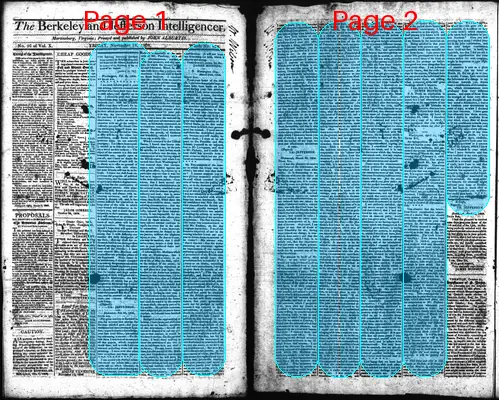
Berkeley And Jefferson Intelligencer
Martinsburg, Berkeley County, Virginia
What is this article about?
Newspaper publishes correspondence between President Thomas Jefferson and James Monroe (1803-1808), discussing diplomatic missions, the Monroe-Pinkney Treaty, personal friendship amid political tensions, and reassurances ahead of the 1808 presidential election.
Merged-components note: Continuation of the correspondence between Thomas Jefferson and James Monroe across pages 1 and 2, forming a single coherent domestic news article.
Clippings
1 of 2
OCR Quality
Full Text
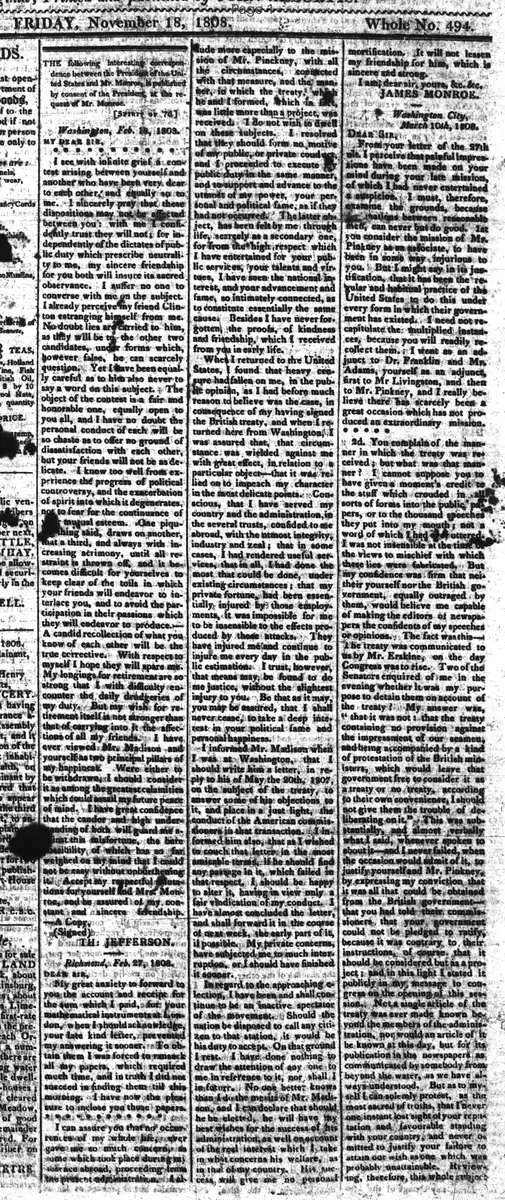
THE following interesting correspondence between the President of the United States and Mr. Monroe published by consent of the President at the request of Mr. Monroe.
[SPIRIT OF 76]
Washington, Feb.18, 1803.
MY DEAR SIR,
I see with infinite grief a contest arising between yourself and another who have been very dear to each other and equally so to me. I sincerely pray that these dispositions may not be affected between you: with me confidently trust they will not; for independently of the dictates of public duty which prescribe neutrality to me, my sincere friendship for you both will insure its sacred observance. I suffer no one to converse with me on the subject. I already perceive my friend Clinton estranging himself from me. No doubt lies are carried to him, as they will be to the other two candidates, under forms which, however false, he can scarcely question. Yet I have been equally careful as to him also never to say a word on this subject. The object of the contest is a fair and honorable one, equally open to you all, and I have no doubt the personal conduct of each will be so chaste as to offer no ground of dissatisfaction with each other. but your friends will not be as delicate. I know too well from experience the progress of political controversy, and the exacerbation of spirit into which it degenerates, not to fear for the continuance of mutual esteem. One piquing thing said, draws on another, that a third, and always with increasing acrimony, until all restraint is thrown off and it becomes difficult for yourselves to keep clear of the toils in which your friends will endeavor to interlace you, and to avoid the participation in their passions which they will endeavor to produce. A candid recollection of what you know of each other will be the true corrective. With respect to myself I hope they will spare me. My longings for retirement are so strong that I with difficulty encounter the daily drudgeries of my duty But my wish for retirement itself is not stronger than that of carrying into it the affections of all my friends. I have ever viewed Mr Madison, and yourself as two principal pillars of my happiness. Were either to be withdrawn, I should consider it as among the greatest calamities which could assail my future peace of mind. I have great confidence that the candor and high understanding of both will guard me against this misfortune yet the bare possibility of which has so far weighed on my mind that I could not be easy without unburthening it to you. Accept my respectful salutations for yourself and Mrs. Monroe and be assured of my constant and sincere friendship.
(Signed)
TH: JEFFERSON
Richmond, Feb, 27, 1808,
I have very great anxiety to forward to you the account and receipt for the sum which I paid, for your mathematical instruments at London when I should acknowledge your late kind letter, prevented my answering it sooner. To obtain them I was forced to ransack all my papers, which required much time, and in truth I did not succeed in finding them till this morning. I have now the pleasure to inclose you those papers. I can assure you that no occurrences of my whole life have ever gave me so much concern, as some which took place during my absence abroad, proceeding from the present administration. I allude more especially to the mission of Mr. Pinckney, with all the circumstances, connected with that measure and the manner in which the treaty which he and I formed, which in fact was little more than a project, was received. I do not wish to dwell on these subjects. I resolved that they should form no motive of my public or private conduct and I proceeded to execute my public duty in the same manner, and to support and advance to the utmost of my power, your personal and political fame, as if they had not occurred The latter object, has been felt by me through life, scarcely as a secondary one, for from the high respect which I have entertained for your public services, your talents and virtues, I have seen the national interest, and your advancement and fame, so intimately connected, as to constitute essentially the same cause. Besides I have never forgotten, the proofs of kindness and friendship, which I received from you in early life. When I returned to the United States, I found that heavy censure had fallen on me, in the public opinion, as I had before much reason to believe was the case, in consequence of my having signed the British treaty, and when I returned here from Washington, I was assured that, that circumstance was wielded against me with great effect, in relation to a particular object—that it was relied on to impeach my character in the most delicate points. Conscious, that I have served my country and the administration, in the several trusts, confided to me abroad, with the utmost integrity. industry and zeal; that in some cases, I had rendered useful services, that in all, I had done the most that could be done under existing circumstances; that my private fortune had been essentially injured by those employments, it was impossible for me to be insensible to the effects produced by those attacks, They have injured me and continue to injure me every day in the public estimation. I trust, however, that means may be found to do me justice, without the slightest injury to you, Be that as it may. you may be assured, that, I shall never cease to take a deep interest in your political fame and personal happiness. I informed Mr. Madison when I was at Washington, that I should write him a letter in reply to his of May the 20th, 1807 on the subject of the treaty to answer some of his objections to it, and place in a just light the conduct of the American commissioners in that transaction. Informed him also, that as I wished to couch that letter in the most amicable terms if he should find any passage in it which failed in that respect, I should be happy to alter it having view only a fair vindication of my conduct. I have almost concluded the letter. and shall forward it in the course of next week, the early part of it if possible. My private concerns, have subjected me to much interruption, or I should have finished it sooner. In regard to the approaching election. I have been, and shall continue to be an inactive spectator of the movement. Should the nation be disposed to call any citizen to that station, it would be his duty to accept. On that ground I rest. I have done nothing to draw the attention of any one to me in reference to it, nor shall I in future. No one better knows than I do the merits of Mr Madison and can declare that should he be elected he will have my best wishes for the success of his administration as well on account of the real interest which I take in what concerns his welfare as in that of my country. His success, will give me no personal mortification. It will not lessen my friendship for him, which is sincere and strong.
I am dear sir yours, &c. &c.
James MONROE.
Washington. City
March 10th, 1808.
Dear Sir
From your letter of the 27th ult. I perceive that painful impressions have been made on your mind during your late mission of which I had never entertained a suspicion. I must, therefore, examine the grounds, because communications between reasonable men can never but do good, 1st you consider the mission of Mr. Pinkney as an associate, to have been in some way, injurious to you. But I might say in its justification. that it has been the regular and habitual practice of the United States to do this under every form in which their government has existed. I need not recapitulate the multiplied instances, because you will readily recollect them. I went as an adjunct to Dr. Franklin and Mr. Adams, yourself as an adjunct, first to Mr Livingston, (and then to Mr. Pinkney, and I really believe there has scarcely been a great occasion which has not produced an extraordinary mission. 2d. You complain of the manner in which the treaty was received : but what was that manner ? I cannot suppose you to have given a moment's credit to the stuff which crowded in a sorts of forms into the public papers, or to the thousand speeches they put into my mouth; not a word of which I had uttered. I was not insensible at the time to the views to mischief with which these lies were fabricated. But my confidence was firm that neither yourself nor the British government, equally outraged by them, would believe me capable of making the editors of newspapers the confidents of my speeches or opinions. The fact was this I he treaty was communicated to us by Mr. Erskine, on the day Congress was to rise. I wo of the Senators enquired of me in the evening whether it was my purpose to detain them on account of the treaty ? My answer was, "that it was not : that the treaty containing no provision against the impressment of our seamen, and being accompanied by a kind of protestation of the British ministers, which would leave that government free to consider it as a treaty or no treaty, according to their own convenience I should not give them the trouble of deliberating on it." This was substantially and almost verbally what said, whenever spoken to about it and I never failed, when the occasion would admit of it to justify yourself and Mr. Pinkney, by expressing my conviction that it was all that could be obtained from the British government that you had told their commissioners, that your government could not be pledged to ratify because it was contrary to, their. instructions of course. that it should be considered but as a project ; and in this light I stated it publicly in my message to congress on the opening of this session. Not a single article of the treaty was ever made known beyond the members of the administration nor would an article of it be known at this day, but for its publication in the newspapers, as communicated by somebody from beyond the water as we have always understood. But as to myself I can solemnly protest, as the most sacred of truths, that I never one instant lost sight of your reputation and favourable standing with your country, and never omitted to justify your failure to attain our wish as one which. was probably unattainable. Reviewing, therefore, this whole subject
I cannot doubt you will become sensible that your impressions have been without just ground. I cannot indeed judge what falsehoods may have been written or told you; but if you have been made to believe that I ever did, said, or thought a thing unfriendly to you, inflicting to me. In the present contest in which you are concerned, I feel no passion, I take no part, I express no sentiment. Whichever of my friends is called to the supreme care of the nation, I know that they will be wisely and faithfully administered: and as far as my individual conduct can influence they shall be cordially supported. For myself, I have nothing further to ask of the world than to preserve in retirement so much of their esteem, as I may have fairly earned, and to be permitted to pass in tranquility in the bosom of my family and friends the days which yet remain for me. Having reached the harbor myself I shall view with anxiety (but certainly not with a wish to be in their place) those who are still buffeting the storm, uncertain of their fate. Your voyage has so far been favorable and that it may continue with entire prosperity is the sincere prayer of that friendship which I have ever borne you, and of which I now assure you with the tender of my high respect and affectionate salutations.
A copy
(Signed)
TH: JEFFERSON
Richmond, March 22, 1808.
Dear Sir,
I had the pleasure to receive your letter of the 10th instant, the day after my return from Albemarle. It is distressing to me to discuss with you the topics on which it treats; but in the state which things are, it is certainly best to come to a perfect understanding on every point, and to remove on each side any injury which may have been received. To do you an injury, or indeed any one in the administration, never entered into my mind; for while I laboured under a conviction, not only that I had been injured, but that the friendly feeling which you had so long entertained for me, had ceased to exist: I never indulged any other sentiment in consequence of it, than that of sorrow. At present, I am happy to say, that all doubt of your friendship for me, having experienced any change, is completely done away; and that the only anxiety, which I feel, is to satisfy you, that the impression was not taken on slight ground, nor imputable to communications made me by persons, out of the administration.
The mission in itself of Mr. Pinkney, or any other person, would not have produced such an effect. It resulted from a chain of circumstances of which that measure was only a part. When I left Madrid I communicated to Mr. Madison in aid of our public despatches every idea which I had formed of the state of our affairs there, in all their relations, by sending him a copy of my private journal, and added in private letters what it did not contain. Although it was my sincere desire to get home and look to my private concerns, which I proposed to do, soon after my return to London; I intimated to him that I was willing, in consideration of the existing crisis, to act in any situation in which I might be useful. On my return to London I found that the seizures which had commenced in my absence, had imposed on me a new and important duty. I resisted them, and not without some effect. By announcing to the British minister my intention to return to the United States that autumn, I assumed the character for every essential purpose of a special envoy; with which Mr. Madison was made acquainted as he was likewise with my determination to remain there till the business was concluded. The evidence before him seemed to be satisfactory that as nothing could be gained for the existing ministry, but on the contrary, any change of the attitude taken on our part was likely to do harm, and that if the ministry retired the danger of such an effect would be increased by a change of attitude. This latter idea was strongly urged in a private letter to him of the 2d of February, 1806 with my earnest advice against such a mission. As the ship by which that letter was sent arrived at Philadelphia on the 26th of March, I concluded that I had received it by the 30th. It was written in consequence of intelligence from the United States that such a mission was decided on by the government. And I had received no answer to any of my communications from Madrid or London, after my return, nor any acknowledgment of my services at either place, or expressions of a desire that I should come home or remain there, it seemed by the measure alluded to, as if it was considered that I was rather in the way, than of use to the administration! It reserve to me for so long a time, and the appointment of an associate, after the receipt of my private letter of February 2d, and a public one of nearly the same date and after the change in the administration was known, made a deep impression on my mind to that effect. Special missions were never well received by those on the ground, and perhaps never will be while men are governed by those useful passions which stimulate them to virtuous actions. Such a mission reduces the resident minister, however respectable for his talents and character, to a cypher, from the moment it is known that it is contemplated and if it does not destroy him, it is because his character is sufficiently strong to bear the shock. The footing on which I had left my country a consciousness of the zeal and integrity of my conduct in the public service, and of my personal attachment and devotion to the administration, with a firm belief that no change could be made to advantage may possibly have increased my sensibility to the measure. Had such an one been contemplated, I thought that I should have been the first to hear of it in a private letter from yourself or Mr. Madison, but I had to gather the intelligence from the newspapers, the correspondence of others, the hints of Lord Holland, and even of Mr. Fox. Mr. Madison's first letter to me on any important subject, which was of the 11th of March, 1806, almost ten months after I had left Madrid, and eight after my return to London, was received on the 25th of April. It seemed to be intended to announce the proposed measure, and from its style, taken in connection with the preceding circumstances, contributed greatly to confirm the impression which they had already made. The facility which it afforded to my departure appeared to me to be the strongest feature in it. The letter which Mr. Pinkney brought me, which was delivered to him and by him to me open was in the same tone. It stated that I was included in the special mission, but that Mr. Pinkney had a separate commission with him, to take my place in case I chose to return home. It expressed no desire that I would remain and join in the negotiation. The joint commission seemed also to be peculiarly adapted to favor that object, as it authorized one commissioner to act singly in the absence of the other, in which it differed from those, which I had carried with me abroad the former giving that power to the one in case only of the death of the other. I could see no reason for his bringing with him a separate commission, to succeed me in the ordinary mission, if my immediate return had not been contemplated as sufficient time would have been allowed for supplying it if I remained and joined in the negotiation before it could be concluded or for the variance in the conditions of the joint one. All these circumstances tended to convince me that the administration had withdrawn its confidence from me, and that it really wished to get rid of me. I was struck with astonishment at the idea, and deeply affected it as it was utterly impossible for me to trace the cause. Had I followed the impulse of my feelings, it would have withdrawn on the arrival of Mr. Pinkney; but many considerations of great weight admonished me to pursue a different course. I had much communication with Mr. Fox, and entertained great hopes, that through him our affairs might be settled, to advantage. It did not seem probable that any other person could derive the same aid from those communications that might be done, by a party to them. By remaining, I thought that I might give support to the administration at home, which I most earnestly wished to do. For these and other reasons of the same kind, I resolved to remain and unite in the negotiation with such character as might be sent of which I gave Mr. Madison information in my letter, of the 29th of April, which was written a few days after the receipt of his of March the 11th, and in which I gave him distinctly to understand that, that measure would be no cause of disagreement between the administration and myself. I remained and acted accordingly, and did every thing in my power to accomplish the views of my government and country, and finally concluded with Mr. Pinkney, the best treaty which it was possible to obtain of the British government. In uniting in the negotiation and signing the treaty I committed my reputation on the result, and it is only by the course which the business afterwards took, that any unpleasant occurrence has arisen between the administration and myself. These were the circumstances which produced the impression, which I have acknowledged in the commencement of this letter, that your friendship had been withdrawn from me. But the assurances which you now make me and the perfect knowledge which I have of your rectitude and sincerity have completely effaced that impression, and restored to my mind, that entire and friendly confidence which it had always been accustomed to cherish. I am perfectly satisfied, that you never meant to injure me, and that a belief, that I had suffered by any act, to which you were an innocent party, would give you great pain. Still the circumstance of my having signed a treaty which was disapproved, for imputed great defects; in having exceeded our powers, in signing it, which I should not have done but in a belief that I promoted thereby the best interests of my country and of the administration, while I exposed myself to great responsibility by the measure, have given a handle to those who have wielded it with great effect against me. You can little imagine to what extent the mischief has been carried, I could give you many details which it would be as painful for you to read as for me to recite. When I saw that I was depressed in a country which I had long served with fidelity and zeal I could not be indifferent either to the cause or the consequences resulting from it. My sensibility was naturally increased by the excitement of those on the ground, who, being part in my favor, had essentially compromised themselves. I replied to the denunciation that was circulated against me here for improper purposes to many of my friends, who called on me in decisive terms and complained earnestly of the injury done me by it. I have sum of all these conversations, which were always of a nature confidential it is not in my power to recollect with precision: It is possible that on some occasion I may have expressed myself with too much zeal and in others been misconceived. You may however be assured, that my only object was to do justice to myself in a case of peculiar hardship, and that I never went beyond that limit. I am happy that we have had this explanation with each other. It has banished me that I had misconceived your feelings and disposition towards me. Nothing remains but to prevent as far as I possibly can all further inquiries from the period above mentioned of peculiar excitement, I have been attentive to this object, and shall pursue it in future with still greater zeal. I estimate the acts of my friends by the intention only. Being satisfied in that point I can bear with patience any consequences which may casually result from them. I am aware that under free governments it is difficult to avoid those of the kind alluded to, for perhaps, no important good was ever altogether free from some alloy, I am however equally aware, that the evils incident to the system, if indeed there are any, even to the individual who suffers under them, are trifling, when compared with the great blessings which it imparts.
I am, dear sir, &c. &c.
JAMES MONROE
P.S. From an expression in your letter, that you had not supposed that I had entertained any objection to the association of any one in a business at London I perceive that you have not received or if you have read, that you have forgotten my letter of February 2d, 1806. I therefore send you a copy of it, which I have to request that you will be so good as to return me after perusal.
Washington, April 11.
Dear Sir,
An indisposition or periodical head ache has for some time disabled me from business, and prevented my sooner acknowledging your letter of March 22, and returning that of February 2, 1806, which inclosed. The receipt of the letter of March 22, has given me pleasure. Conscious as I am that I never felt a sentiment towards you that was not affectionate, It is a great relief to find that the doubts you had entertained on that subject are removed by an explanation of the circumstances produced them. Some matters however appearing from your letter, not yet sufficiently understood, I have conceived that a more minute detail of the facts bearing on them would completely disarm them of all misconstructions. You observe that the letters, from hence contained no expression of a desire that you should come home or remain there, and the facility afforded to your departure by the commission to Mr. Pinkney seemed to authorize an inference that you were considered as in the way of the administration. The truth however was thus: your letters from Madrid in 1804.5. expressed your anxious wish and intention to come home on your return to London. My extreme wish was that you should remain there and I hoped by not being in a hurry to answer that manifestation of your desire, time might produce a change in your mind, But as decision of 1806. that yourself and Mr. Madison were both contemplated as candidates for the succession to the Presidency I became apprehensive that by declining longer to assent to your return, I might be suspected of a partial design to keep you out of the way. This produced the acquiescence in your desire to come home which then took place, and the commission to Mr. Pinkney to succeed you whenever you should determine to come: and these motives clearly show themselves in my letter of March 16. which says, I shall join Mr. Pinkney of Maryland as your associate for settling our differences with Great Britain. He will be authorized to take your place whenever you think yourself obliged to return. It will be desirable for your own as well as the public interest that you should join in the settlement of this business, and I am perfectly satisfied that if this can be done so as to be here before the next meeting of congress, it will be greatly for your benefit. But I do not mean by this to overrule your own determination, (i.e. either to stay or come home) which measures to be taken here will place in perfect freedom. Here you will perceive how much I wished your aid in the joint commission, and that your longer continuance there could not but, in itself be desirable, but that I did not ask it from an apprehension that your return before the next congress, might be important to your higher interests. I consider it now as a great misfortune that my letter of March 16, did not go on to you. It would, I trust, have corrected the inferences of a change in my affections towards you, drawn from a combination of circumstances, which circumstances were produced from very different causes, and some of them from the strength of those very affections, of which you thought that they noted a diminution, a desire to conform your movements in point of time, to what I deemed your best interests. I have gone thus minutely into these details, from a desire to eradicate from your mind, every fibre of doubt as to my sentiments towards you; and I am persuaded that they will satisfactorily solve every circumstance which might at any time have occasioned doubt. I have done so the more cordially, because I perceive from your letter a disposition to a correct view of the subject, which I knew to be inherent in your mind. What I have hitherto said has been confined to my own part only of these transactions. Yet it would be criminal suppression of truth, were I not to add that in the whole course of them, Mr. Madison has appeared to be governed by the most cordial friendship for you has manifested on every occasion, the most attentive concern for whatever might befriend your fame or fortune, and has been as much alive to whatever regarded you, as a brother could have been.
I salute you with unchanged affection,
TH. JEFFERSON.
Richmond, April 18, 1808.
Dear Sir,
I had the pleasure to receive some days past your favor of the 11th and that of the 13th, to-day. Being perfectly satisfied with the explanations and assurances which you had given me in your preceding letters that I had taken an improper idea of your disposition towards me the details contained in your last one were not necessary in that view. I receive them however with great interest, because in giving them, you afford me a new proof of your friendship I am. Dear Sir.
With great respect,
Very sincerely your friend
JAMES MONROE.
What sub-type of article is it?
What keywords are associated?
What entities or persons were involved?
Where did it happen?
Domestic News Details
Primary Location
Washington
Event Date
November 18, 1808
Key Persons
Outcome
reconciliation of personal friendship and political misunderstandings; no physical casualties.
Event Details
Publication of private correspondence between President Jefferson and former diplomat Monroe, addressing concerns over Monroe's diplomatic mission to Britain, the Monroe-Pinkney Treaty reception, perceived slights, and affirmations of friendship amid the 1808 presidential contest.