Thank you for visiting SNEWPapers!
Sign up free
Literary
January 6, 1825
The Wilmingtonian, And Delaware Register
Wilmington, New Castle County, Delaware
What is this article about?
Captain Hill recounts his 1820 voyage on HMS Conway from England to Valparaiso, Chile, via Cape Horn, describing the passage, a distant volcano, the landscape of Cape Horn, arrival after 38 days from River Plate, and Christmas festivities including non-lethal bull-baits, dances, and local customs.
Clipping
OCR Quality
95%
Excellent
Full Text
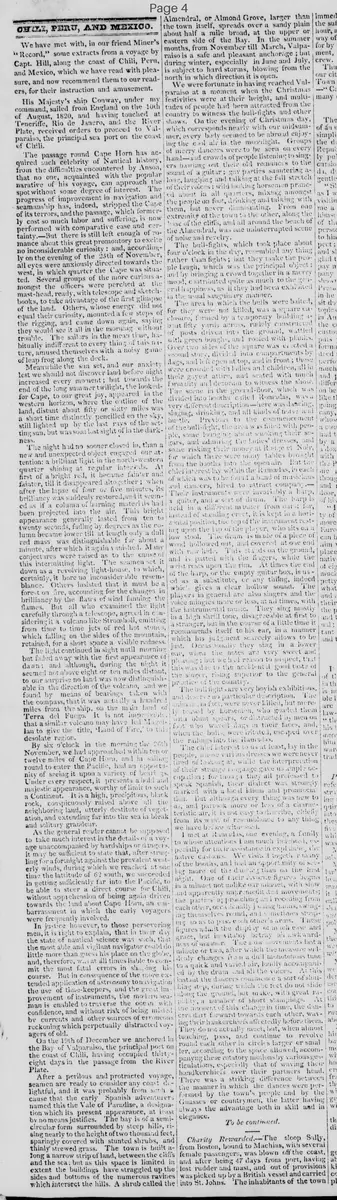
CHILE, PERU, AND MEXICO.
We have met with, in our friend Miner's "Record," some extracts from a voyage by Capt. Hill, along the coast of Chile, Peru, and Mexico, which we have read with pleasure, and now recommend them to our readers, for their instruction and amusement.
His Majesty's ship Conway, under my command, sailed from England on the 10th of August, 1820, and having touched at Teneriffe, Rio de Janeiro, and the River Plate, received orders to proceed to Valparaiso, the principal sea port on the coast of Chile.
The passage round Cape Horn has acquired such celebrity in nautical history, from the difficulties encountered by Anson, that no one, acquainted with the popular narrative of his voyage, can approach the spot without some degree of interest. The seamanship has, indeed, stripped the Cape of its terrors, and the passage, which formerly cost so much labor and suffering, is now performed with comparative ease and certainty. But there is still left enough of romance about this great promontory to excite no inconsiderable curiosity: and, accordingly on the evening of the 25th of November, all eyes were anxiously directed towards the west, in which quarter the Cape was situated. Several groups of the more curious amongst the officers were perched at the mast-head, ready, with telescope and sketch-books, to take advantage of the first glimpse of the land. Others, whose energy did not equal their curiosity, mounted a few steps of the rigging, and came down again, saying they would see it all in the morning without trouble. The sailors in the mean time, habitually indifferent to everything of this nature, amused themselves with a noisy game of leap frog along the deck.
Meanwhile the sun set, and our anxiety lest we should not discover land before night increased every moment; but towards the end of the long summer twilight, the looked-for Cape, to our great joy, appeared in the western horizon, where the outline of the land, distant about fifty or sixty miles was a short time distinctly pencilled on the sky, still lighted up by the last rays of the setting sun, but was soon lost sight of in the darkness.
The night had no sooner closed in, than a new and unexpected object engaged our attention: a brilliant light in the north-western quarter shining at regular intervals. At first of a bright red, it became fainter and fainter, till it disappeared altogether: when after the lapse of four or five minutes, its brilliancy was suddenly restored, and it seemed as if a column of burning materials had been projected into the air. This bright appearance generally lasted from ten to twenty seconds, fading by degrees as the column became lower till at length only a dull red mass was distinguishable for about a minute, after which it again vanished. Many conjectures were raised as to the cause of this intermitting light. The seamen set it down as a revolving light-house, to which, certainly, it bore no inconsiderable resemblance. Others insisted that it must be a forest on fire, accounting for the changes in brilliancy by the flaws of wind fanning the flames. But all who examined the light carefully through a telescope, agreed in considering it a volcano like Stromboli, emitting from time to time jets of red hot stones, which falling on the sides of the mountain, retained, for a short space a visible redness.
The light continued in sight until morning but faded away with the first appearance of dawn: and although, during the night it seemed not above eight or ten miles distant, to our surprise no land was now distinguishable in the direction of the volcano, as we found by means of bearings taken with the compass, that it was actually a hundred miles from the ship, on the main land of Terra del Fuego. It is not improbable that a similar volcano may have led Magellan to give the title, 'Land of Fire,' to this desolate region.
By six o'clock in the morning the 26th November, we had approached within ten or twelve miles of Cape Horn, and in sailing round to enter the Pacific, had an opportunity of seeing it upon a variety of bearings. Under every respect, it presents a bold and majestic appearance, worthy of a limit to such a Continent. It is a high, precipitous, black rock, conspicuously raised above all the neighboring land, utterly destitute of vegetation, and extending far into the sea in bleak and solitary grandeur.
As the general reader cannot be supposed to take much interest in the details of a voyage unaccompanied by hardships or dangers, it may be sufficient to state that, after struggling for a fortnight against the prevalent westerly winds, during which we reached at one time the latitude of 62 south, we succeeded in getting sufficiently far into the Pacific, to be able to steer a direct course for Chile, without apprehension of being again driven towards the land about Cape Horn, an embarrassment in which the early voyagers were frequently involved.
In justice however, to those persevering men, it is right to explain, that in their day the state of nautical science was such, that the most able and vigilant navigator could do little more than guess his place on the globe, and, therefore, was at all times liable to commit the most fatal errors in shaping his course. But in consequence of the more extended application of astronomy to navigation the use of time-keepers, and the great improvement of instruments, the modern seaman is enabled to traverse the ocean with confidence, and without risk of being misled by currents and other sources of erroneous reckoning which perpetually distracted voyagers of old.
On the 10th of December we anchored in the Bay of Valparaiso, the principal port on the coast of Chile, having occupied thirty-eight days in the passage from the River Plate.
After a perilous and protracted voyage, seamen are ready to consider any coast delightful, and it was probably from such a cause that the early Spanish adventurer named this the Vale of Paradise, a designation which its present appearance, at least by no means justifies. The bay is of a semi-circular form surrounded by steep hills, rising nearly to the height of two thousand feet, sparingly covered with stunted shrubs, and thinly strewed grass. The town is built along a narrow strip of land, between the cliffs and the sea: but as this space is limited in extent the buildings have straggled up the sides and bottoms of the numerous ravines which intersect the hills. A shrub called the Almendral, or Almond Grove, larger than the town itself, spreads over a sandy plain about half a mile broad, at the upper or eastern side of the Bay. In the summer months, from November till March, Valparaiso is a safe and pleasant anchorage; but during winter, especially in June and July, is subject to hard storms, blowing from the north in which direction it is open.
We were fortunate in having reached Valparaiso at a moment when the Christmas festivities were at their height, and multitudes of people had been attracted from the country to witness the bull-fights and other shows. On the evening of Christmas day, which corresponds nearly with our midsummer, everybody seemed to be abroad enjoying the cool air in the moonlight. Groups of merry dancers were to be seen on every hand—crowds of people listening to singers bawling out their old romances to the sound of a guitar: gay parties sauntering along, laughing and talking at the full stretch of their voices; wild looking horsemen pranced about in all quarters, mingling amongst the people on foot, drinking and talking with them, but never dismounting. From one extremity of the town to the other, along the base of the cliffs, and all around the beach of the Almendral, was one uninterrupted scene of noise and revelry.
The bull-fights, which took place about four o'clock in the day, resembled anything rather than fights; but they make the people laugh, which was the principal object: and by bringing a crowd together in a merry mood, contributed quite as much to the general happiness, as if they had been exhibited in the usual sanguinary manner.
The area in which the bulls were baited, for they were not killed, was a square enclosure, formed by a temporary building about fifty yards across, rudely constructed of posts driven into the ground, wattled with green boughs, and roofed with planks. Over two sides of the square was erected a second story, divided into compartments by flags, and it is open at top, and in front; these were crowded with ladies and children, all in their gayest attire, and seated with much formality and decorum to witness the show.
The scene in the ground-floor, which was divided into booths called Ramadas, was of very different description—here was dancing, singing, drinking, and all kinds of noise: and bustle. Previous to the commencement of the bull-fight, the area was filled with people, some lounging about smoking their segars, and admiring the ladies' dresses, and some risking their money at Rouge et Noir, for which there were many tables brought from the booths into the open air. But the chief interest lay within the Ramadas, in each of which was to be found a band of musicians and dancers, hired to attract company.
Their instruments were invariably a harp, a guitar, and a sort of drum. The harp is held in a different manner from ours; for, instead of standing erect, it is kept in a horizontal position, the top of the instrument resting upon the lap of the player, who sits on a low stool. The drum is made of a piece of wood hollowed out, and covered at one end with raw hide. This stands on the ground, and is patted with the fingers, while the wrist rests upon the rim. At times the end of the harp, or the empty guitar box, is used as a substitute, or anything, indeed which gives a clear hollow sound. The players in general are also singers and the voice mingles more or less, at all times, with the instrumental music. They sing mostly in a high shrill tone, disagreeable at first to a stranger, but in the course of a little time it recommends itself to his ear, in a manner which his judgment scarcely allows to be just. Occasionally they sing in a lower one, when the notes are very sweet and pleasing: but we had reason to suspect, that this was due to the accidental good taste of the singer, rising superior to the general practice of the country.
The bull-fights are very bovish exhibitions, and deserve no particular description. The animals, in fact, were never killed, but merely teased by horsemen, who goaded them with blunt spears, or distracted by men on foot who waved flags in their faces, and, when the bulls were irritated, escaped over the railings into the Ramadas.
The chief interest to us at least, lay in the people, whose various dresses we were never tired of looking at, while the interpretation of their strange language gave us ample occupation; for though they all professed to speak Spanish, their dialect was strongly marked with a local idiom and pronunciation. But although everything was new to us, and partook more or less of a characteristic air, it is not easy to describe, chiefly from its want of resemblance to anything we have before witnessed.
I met at Ramadas, one evening, a family to whose attentions I am much indebted, especially for their assistance in explaining certain native customs. We visited together many of the booths, and had an opportunity of seeing more of the dancing than on the first night. One of their favorite figures begins in a minuet not unlike our minuet, with slow and apparently unprecipitated movements; the parties approaching and receding from each other, occasionally joining hands, swinging themselves round, and sometimes stooping so as to pass each other's arms. These figures admit the display of much ease and grace, but inevitably betray an awkwardness of manner. The slow movements last a minute or two, after which the measure suddenly changes from a dull monotonous tune to a quick and varied air, loudly accompanied by the drum and all the voices. At this instant the dancers commence a sort of shuffling step, during which the feet do not slide along the ground, but make, with great rapidity, a number of short stampings. At the moment of this change in time, the dancers dart forward towards each other, waving their handkerchiefs affectedly before them. They do not actually meet, but, when almost touching, pass, and continue to revolve round each other in circles larger or smaller, according to the space allowed, accompanying these rotatory motions by various gesticulations, especially that of waving their handkerchiefs over their partner's head.
There was a striking difference between the manner in which the dances were performed by the town's people and by the masses or countrymen, the latter having always the advantage both in skill and in elegance.
To be continued.
We have met with, in our friend Miner's "Record," some extracts from a voyage by Capt. Hill, along the coast of Chile, Peru, and Mexico, which we have read with pleasure, and now recommend them to our readers, for their instruction and amusement.
His Majesty's ship Conway, under my command, sailed from England on the 10th of August, 1820, and having touched at Teneriffe, Rio de Janeiro, and the River Plate, received orders to proceed to Valparaiso, the principal sea port on the coast of Chile.
The passage round Cape Horn has acquired such celebrity in nautical history, from the difficulties encountered by Anson, that no one, acquainted with the popular narrative of his voyage, can approach the spot without some degree of interest. The seamanship has, indeed, stripped the Cape of its terrors, and the passage, which formerly cost so much labor and suffering, is now performed with comparative ease and certainty. But there is still left enough of romance about this great promontory to excite no inconsiderable curiosity: and, accordingly on the evening of the 25th of November, all eyes were anxiously directed towards the west, in which quarter the Cape was situated. Several groups of the more curious amongst the officers were perched at the mast-head, ready, with telescope and sketch-books, to take advantage of the first glimpse of the land. Others, whose energy did not equal their curiosity, mounted a few steps of the rigging, and came down again, saying they would see it all in the morning without trouble. The sailors in the mean time, habitually indifferent to everything of this nature, amused themselves with a noisy game of leap frog along the deck.
Meanwhile the sun set, and our anxiety lest we should not discover land before night increased every moment; but towards the end of the long summer twilight, the looked-for Cape, to our great joy, appeared in the western horizon, where the outline of the land, distant about fifty or sixty miles was a short time distinctly pencilled on the sky, still lighted up by the last rays of the setting sun, but was soon lost sight of in the darkness.
The night had no sooner closed in, than a new and unexpected object engaged our attention: a brilliant light in the north-western quarter shining at regular intervals. At first of a bright red, it became fainter and fainter, till it disappeared altogether: when after the lapse of four or five minutes, its brilliancy was suddenly restored, and it seemed as if a column of burning materials had been projected into the air. This bright appearance generally lasted from ten to twenty seconds, fading by degrees as the column became lower till at length only a dull red mass was distinguishable for about a minute, after which it again vanished. Many conjectures were raised as to the cause of this intermitting light. The seamen set it down as a revolving light-house, to which, certainly, it bore no inconsiderable resemblance. Others insisted that it must be a forest on fire, accounting for the changes in brilliancy by the flaws of wind fanning the flames. But all who examined the light carefully through a telescope, agreed in considering it a volcano like Stromboli, emitting from time to time jets of red hot stones, which falling on the sides of the mountain, retained, for a short space a visible redness.
The light continued in sight until morning but faded away with the first appearance of dawn: and although, during the night it seemed not above eight or ten miles distant, to our surprise no land was now distinguishable in the direction of the volcano, as we found by means of bearings taken with the compass, that it was actually a hundred miles from the ship, on the main land of Terra del Fuego. It is not improbable that a similar volcano may have led Magellan to give the title, 'Land of Fire,' to this desolate region.
By six o'clock in the morning the 26th November, we had approached within ten or twelve miles of Cape Horn, and in sailing round to enter the Pacific, had an opportunity of seeing it upon a variety of bearings. Under every respect, it presents a bold and majestic appearance, worthy of a limit to such a Continent. It is a high, precipitous, black rock, conspicuously raised above all the neighboring land, utterly destitute of vegetation, and extending far into the sea in bleak and solitary grandeur.
As the general reader cannot be supposed to take much interest in the details of a voyage unaccompanied by hardships or dangers, it may be sufficient to state that, after struggling for a fortnight against the prevalent westerly winds, during which we reached at one time the latitude of 62 south, we succeeded in getting sufficiently far into the Pacific, to be able to steer a direct course for Chile, without apprehension of being again driven towards the land about Cape Horn, an embarrassment in which the early voyagers were frequently involved.
In justice however, to those persevering men, it is right to explain, that in their day the state of nautical science was such, that the most able and vigilant navigator could do little more than guess his place on the globe, and, therefore, was at all times liable to commit the most fatal errors in shaping his course. But in consequence of the more extended application of astronomy to navigation the use of time-keepers, and the great improvement of instruments, the modern seaman is enabled to traverse the ocean with confidence, and without risk of being misled by currents and other sources of erroneous reckoning which perpetually distracted voyagers of old.
On the 10th of December we anchored in the Bay of Valparaiso, the principal port on the coast of Chile, having occupied thirty-eight days in the passage from the River Plate.
After a perilous and protracted voyage, seamen are ready to consider any coast delightful, and it was probably from such a cause that the early Spanish adventurer named this the Vale of Paradise, a designation which its present appearance, at least by no means justifies. The bay is of a semi-circular form surrounded by steep hills, rising nearly to the height of two thousand feet, sparingly covered with stunted shrubs, and thinly strewed grass. The town is built along a narrow strip of land, between the cliffs and the sea: but as this space is limited in extent the buildings have straggled up the sides and bottoms of the numerous ravines which intersect the hills. A shrub called the Almendral, or Almond Grove, larger than the town itself, spreads over a sandy plain about half a mile broad, at the upper or eastern side of the Bay. In the summer months, from November till March, Valparaiso is a safe and pleasant anchorage; but during winter, especially in June and July, is subject to hard storms, blowing from the north in which direction it is open.
We were fortunate in having reached Valparaiso at a moment when the Christmas festivities were at their height, and multitudes of people had been attracted from the country to witness the bull-fights and other shows. On the evening of Christmas day, which corresponds nearly with our midsummer, everybody seemed to be abroad enjoying the cool air in the moonlight. Groups of merry dancers were to be seen on every hand—crowds of people listening to singers bawling out their old romances to the sound of a guitar: gay parties sauntering along, laughing and talking at the full stretch of their voices; wild looking horsemen pranced about in all quarters, mingling amongst the people on foot, drinking and talking with them, but never dismounting. From one extremity of the town to the other, along the base of the cliffs, and all around the beach of the Almendral, was one uninterrupted scene of noise and revelry.
The bull-fights, which took place about four o'clock in the day, resembled anything rather than fights; but they make the people laugh, which was the principal object: and by bringing a crowd together in a merry mood, contributed quite as much to the general happiness, as if they had been exhibited in the usual sanguinary manner.
The area in which the bulls were baited, for they were not killed, was a square enclosure, formed by a temporary building about fifty yards across, rudely constructed of posts driven into the ground, wattled with green boughs, and roofed with planks. Over two sides of the square was erected a second story, divided into compartments by flags, and it is open at top, and in front; these were crowded with ladies and children, all in their gayest attire, and seated with much formality and decorum to witness the show.
The scene in the ground-floor, which was divided into booths called Ramadas, was of very different description—here was dancing, singing, drinking, and all kinds of noise: and bustle. Previous to the commencement of the bull-fight, the area was filled with people, some lounging about smoking their segars, and admiring the ladies' dresses, and some risking their money at Rouge et Noir, for which there were many tables brought from the booths into the open air. But the chief interest lay within the Ramadas, in each of which was to be found a band of musicians and dancers, hired to attract company.
Their instruments were invariably a harp, a guitar, and a sort of drum. The harp is held in a different manner from ours; for, instead of standing erect, it is kept in a horizontal position, the top of the instrument resting upon the lap of the player, who sits on a low stool. The drum is made of a piece of wood hollowed out, and covered at one end with raw hide. This stands on the ground, and is patted with the fingers, while the wrist rests upon the rim. At times the end of the harp, or the empty guitar box, is used as a substitute, or anything, indeed which gives a clear hollow sound. The players in general are also singers and the voice mingles more or less, at all times, with the instrumental music. They sing mostly in a high shrill tone, disagreeable at first to a stranger, but in the course of a little time it recommends itself to his ear, in a manner which his judgment scarcely allows to be just. Occasionally they sing in a lower one, when the notes are very sweet and pleasing: but we had reason to suspect, that this was due to the accidental good taste of the singer, rising superior to the general practice of the country.
The bull-fights are very bovish exhibitions, and deserve no particular description. The animals, in fact, were never killed, but merely teased by horsemen, who goaded them with blunt spears, or distracted by men on foot who waved flags in their faces, and, when the bulls were irritated, escaped over the railings into the Ramadas.
The chief interest to us at least, lay in the people, whose various dresses we were never tired of looking at, while the interpretation of their strange language gave us ample occupation; for though they all professed to speak Spanish, their dialect was strongly marked with a local idiom and pronunciation. But although everything was new to us, and partook more or less of a characteristic air, it is not easy to describe, chiefly from its want of resemblance to anything we have before witnessed.
I met at Ramadas, one evening, a family to whose attentions I am much indebted, especially for their assistance in explaining certain native customs. We visited together many of the booths, and had an opportunity of seeing more of the dancing than on the first night. One of their favorite figures begins in a minuet not unlike our minuet, with slow and apparently unprecipitated movements; the parties approaching and receding from each other, occasionally joining hands, swinging themselves round, and sometimes stooping so as to pass each other's arms. These figures admit the display of much ease and grace, but inevitably betray an awkwardness of manner. The slow movements last a minute or two, after which the measure suddenly changes from a dull monotonous tune to a quick and varied air, loudly accompanied by the drum and all the voices. At this instant the dancers commence a sort of shuffling step, during which the feet do not slide along the ground, but make, with great rapidity, a number of short stampings. At the moment of this change in time, the dancers dart forward towards each other, waving their handkerchiefs affectedly before them. They do not actually meet, but, when almost touching, pass, and continue to revolve round each other in circles larger or smaller, according to the space allowed, accompanying these rotatory motions by various gesticulations, especially that of waving their handkerchiefs over their partner's head.
There was a striking difference between the manner in which the dances were performed by the town's people and by the masses or countrymen, the latter having always the advantage both in skill and in elegance.
To be continued.
What sub-type of article is it?
Journey Narrative
Essay
What themes does it cover?
Social Manners
Nature
What keywords are associated?
Voyage
Cape Horn
Valparaiso
Chile
Bull Fights
Dances
Customs
Volcano
What entities or persons were involved?
Capt. Hill
Literary Details
Author
Capt. Hill
Subject
Voyage Along The Coast Of Chile, Peru, And Mexico
Form / Style
Narrative Prose Account Of A Sea Voyage And Local Customs
Key Lines
The Passage Round Cape Horn Has Acquired Such Celebrity In Nautical History, From The Difficulties Encountered By Anson, That No One, Acquainted With The Popular Narrative Of His Voyage, Can Approach The Spot Without Some Degree Of Interest.
It Is A High, Precipitous, Black Rock, Conspicuously Raised Above All The Neighboring Land, Utterly Destitute Of Vegetation, And Extending Far Into The Sea In Bleak And Solitary Grandeur.
The Bull Fights, Which Took Place About Four O'clock In The Day, Resembled Anything Rather Than Fights; But They Make The People Laugh, Which Was The Principal Object.