Thank you for visiting SNEWPapers!
Sign up free
Daily National Intelligencer
Washington, District Of Columbia
What is this article about?
A letter from New York describes recent arrivals of scientific curiosities, including artifacts from Pacific islands, Egyptian antiquities, animals, minerals, and plants, brought by ships and individuals, highlighting the city's enterprise and benefits to science and museums.
Clipping
OCR Quality
Full Text
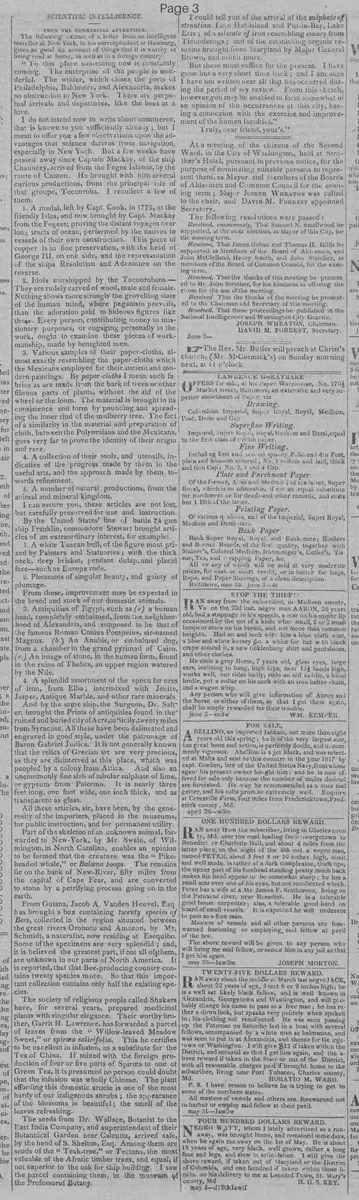
FROM THE COMMERCIAL ADVERTISER.
The following extract of a letter from an intelligent traveller at New York, to his correspondent at Hamburg gives so good an account of things that it is worthy of being read at home, as well as in a foreign country:
"To this place something new is constantly coming. The enterprise of the people is wonderful. The winter, which closes the ports of Philadelphia, Baltimore, and Alexandria, makes no obstruction to New York. There are perpetual arrivals and departures, like the bees at a hive.
I do not intend now to write about commerce, that is known to you sufficiently already; but I mean to offer you a few observations upon the advantages that science derives from navigation, especially in New York. But a few weeks have passed away since Captain Mackay, of the ship Chauncey, arrived from the Fegee Islands, by the route of Canton. He brought with him several curious productions, from the principal isle of that groupe, Toconroba. I recollect a few of them.
1. A medal, left by Capt. Cook, in 1772, at the friendly Isles, and now brought by Capt. Mackay from the Fegees; proving the distant voyages over long tracts of ocean, performed by the natives in vessels of their own construction. This piece of copper is in fine preservation, with the head of George III. on one side, and the representation of the ships Resolution and Adventure on the reverse.
2. Idols worshipped by the Toconrobans.—They are rudely carved of wood, male and female. Nothing shows more strongly the grovelling state of the human mind, where paganism prevails, than the adoration paid to hideous figures like these. Every person, contributing money to missionary purposes, or engaging personally in the work, ought to examine these pieces of workmanship, made by benighted men.
3. Various samples of their paper-cloths, almost exactly resembling the paper-cloths which the Mexicans employed for their ancient and modern paintings. By paper-cloths I mean such fabrics as are made from the bark of trees or other fibrous parts of plants, without the aid of the wheel or the loom. The material is brought to its consistence and form by pounding and spreading the inner rind of the mulberry tree. The fact of a similarity in the material and preparation of cloth, between the Polynesians and the Mexicans, goes very far to prove the identity of their origin and race.
4. A collection of their tools, and utensils, indicative of the progress made by them in the useful arts, and the approach made by them towards refinement.
5. A number of natural productions, from the animal and mineral kingdom.
I can assure you, these articles are not lost but carefully preserved for use and instruction.
By the United States' line of battle 74 gun ship Franklin, commodore Stewart brought articles of an extraordinary interest, for example:
1. A white Tuscan bull, of the figure most prized by Painters and Statuaries; with the thick neck, deep brisket, pendant dewlap, and placid face—such as Europa rode.
2. Pheasants of singular beauty, and gaiety of plumage.
From these, improvement may be expected in the breed and stock of our domestic animals.
3. Antiquities of Egypt, such as (a) a human head, completely embalmed, from the neighborhood of Alexandria, and supposed to be that of the famous Roman Cneius Pompeius, sir-named Magnus. (b.) An Anubis, or embalmed dog, from a chamber in the grand pyramid of Cairo. (c.) An image of stone, in the human form, found in the ruins of Thebes, an upper region watered by the Nile.
4. A splendid assortment of the specular ores of iron, from Elba; intermixed with Jenite. Jasper, Antique Marble, and other rare minerals.
And by the same ship, the Surgeon, Dr. Salter, brought the Prints of antiquities found in the ruined and buried city of Acré, in Sicily, twenty miles from Syracuse. All these have been delineated and engraved in good style, under the patronage of Baron Gabriel Judica. It is not generally known that the relics of Grecian art are very precious, as they are disinterred at this place, which was peopled by a colony from Attica. And also an uncommonly fine slab of tabular sulphate of lime, or gypsum from Palermo. It is nearly three feet long, one foot wide, one inch thick, and as transparent as glass.
All these articles, sir, have been, by the generosity of the importers, placed in the museums, for public instruction, and for permanent utility.
Part of the skeleton of an unknown animal, forwarded to New-York, by Mr. Swain, of Wilmington, in North Carolina, enables an opinion to be formed that the creature was the "Pike-headed whale," or Balæna boops. The remains lie on the bank of New-River, fifty miles from the capital of Cape Fear, and are converted to stone by a petrifying process going on in the earth.
From Guiana, Jacob A. Vanden Heuvel, Esq. has brought a box containing twenty species of Bees, collected in the region situated between the great rivers Oronoco and Amazon, by Mr. Schmidt, a naturalist, now residing at Esequibo. Some of the specimens are very splendid; and, it is believed the greatest part, if not all of them, are unknown in our parts of North America. It is reported, that that Bee-producing country contains twenty species more. So that this important collection contains only half the existing species.
The society of religious people called Shakers have, for several years, prepared medicinal plants with singular elegance. Their worthy brother, Garrit H. Lawrence, has forwarded a parcel of leaves from the "Willow-leaved Meadow Sweet," or spiraea salicifolia. This he certifies to be excellent in infusion, as a substitute for the Tea of China. If mixed with the foreign production of four or five parts of Spiraea to one of Green Tea, it is presumed no person could doubt that the infusion was wholly Chinese. The plant affording this domestic article is one of the most hardy of our indigenous shrubs; the appearance of the blossoms is beautiful; the smell of the leaves refreshing.
The seeds from Dr. Wallace, Botanist to the East India Company, and superintendant of their Botanical Garden near Calcutta, arrived safe, by the hand of S. Shelton, Esq. Among them are seeds of the "Teak-tree," or Tectona, the most valuable of the Asiatic timber trees, and equal, if not superior to the oak for ship building. I saw the parcel containing them, in the museum of the Professor of Botany.
I could tell you of the arrival of the sulphate of strontian from Hat-island and Put-in-Bay, Lake Erie; of a silicate of iron resembling emery from Ticonderoga; and of the astonishing organic remains brought from Maryland by Major General Brown, and much more. But these must suffice for the present. I have gone but a very short time back; and I am sure I have not written near all that has occurred during the period of my review. From this sketch, however, you may be enabled to form somewhat of an opinion of the occurrences at this city, having a connexion with the exercise and improvement of the human faculties."
Truly, dear friend, yours.
What sub-type of article is it?
What themes does it cover?
What keywords are associated?
What entities or persons were involved?
Where did it happen?
Story Details
Key Persons
Location
New York
Story Details
A traveler's letter details recent imports to New York of scientific specimens and artifacts, including a Cook medal and idols from Fegee Islands, a bull and pheasants, Egyptian antiquities, Sicilian prints, a whale skeleton, Guianan bees, Shaker plant substitute for tea, teak seeds, and more minerals and remains, all preserved in museums for public benefit.