Thank you for visiting SNEWPapers!
Sign up free
Lynchburg Virginian
Lynchburg, Virginia
What is this article about?
Virginia House of Delegates debates on organizing a constitutional convention, focusing on representation basis (population, taxation, counties). Multiple amendments proposed and rejected by votes; discussions on suffrage extension and eligibility. Bill laid on table after adopting graduated county representation amendment.
Merged-components note: These two components form a continuous report on the Virginia Legislature proceedings, spanning pages 1 and 2. The text flows directly from one to the other without interruption, focusing on the same topic of the convention bill debate.
Clippings
1 of 2
OCR Quality
Full Text
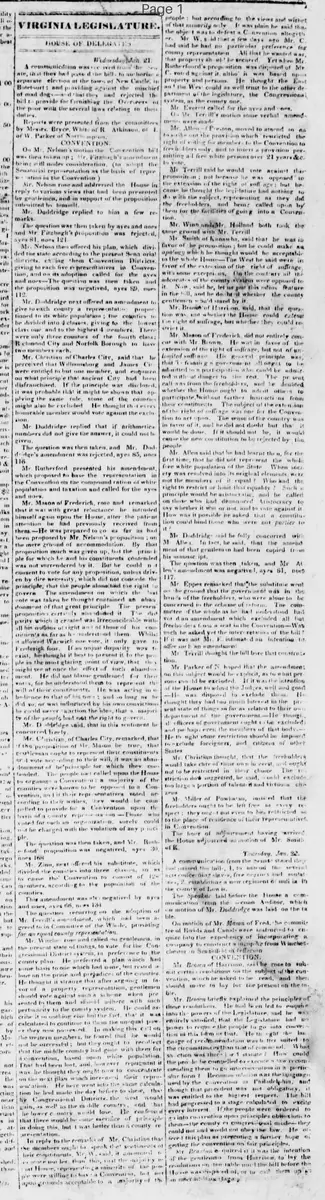
HOUSE OF DELEGATES
Wednesday, Jan. 21.
A communication was received from the Senate, that they had passed the bill, to authorize a separate election at the town of New Castle, in Botetourt: and providing against the mischief of mad dogs—and that they had rejected the bill to provide for furnishing the Overseers of the poor with the several laws relating to their duties.
Reports were presented from the committees by Messrs. Bryce, White of R., Atkinson, of N. and Parker of Northampton.
CONVENTION.
On Mr. Nelson’s motion the Convention bill was then taken up; Mr. Fitzhugh’s amendment being still under consideration. (to adopt the Senatorial representation as the basis of representation in the Convention)
Mr. Nelson rose and addressed the House in reply to various views that had been presented by gentlemen, and in support of the proposition submitted by himself.
Mr. Doddridge replied to him a few remarks.
The question was then taken by ayes and noes and Mr. Fitzhugh’s proposition was rejected, ayes 81, noes 121.
Mr. Nelson then offered his plan, which divided the state according to the present Senatorial districts, calling them Convention Districts, giving to each five representatives in Convention, and on its adoption called for the ayes and noes—The question was then taken and the proposition was negatived, ayes 89, noes 112.
Mr. Doddridge next offered an amendment to give to each county a representation proportioned to its white population; the counties to be divided into 4 classes, giving to the lowest class one and to the highest 4 members. There were only three counties of the fourth class: Richmond City and Norfolk Borough to have two members each.
Mr. Christian of Charles City, said that he perceived that Williamsburg and James City were entitled to but one member, and enquired on what principle that ancient City had been disfranchised. If the principle was disclosed, it was probable that it might be shown that applying the same rule, some of the counties might also be excluded. He thought that every honorable member would vote against the exclusion.
Mr. Doddridge replied that if arithmetic numbers did not give the answer, it could not be given.
The question was then taken, and Mr. Doddridge’s amendment was rejected, ayes 85, noes 116.
Mr. Rutherford presented his amendment which proposed to base the representation in the Convention on the compound ratio of white population and taxation and called for the ayes and noes.
Mr. Mason of Frederick, rose and remarked that it was with great reluctance he intruded himself again upon the House, after the patient attention he had previously received from them.—He was prepared to go as far as had been proposed by Mr. Nelson’s proposition; on the mere ground of accommodation. By that proposition much was given up, but the principle for which he and his constituents contended was not surrendered by it. But he could not consent to vote for any proposition, unless driven by dire necessity, which did not concede the principle, that the people alone had the right to govern.
The amendment on which the last vote was taken he thought contained an abandonment of that great principle. The present proposition certainly abandoned it. The disparity which it created was irreconcilable with all his notions of right and of those of his constituents as far as he understood them. While it allowed Warwick one vote, it only gave to Frederick four. If an unjust disparity was to exist, he thought it best to present it to the people in the most glaring point of view, that they might see at once the effect of such abandonment. He did not blame gentlemen for their votes, for he understood them to represent the will of their constituents. He was acting in obedience to that of his own: and so long as he did so, or was influenced by his own convictions he could never sanction the idea, that a majority of the people had not the right to govern.
Mr. Doddridge said, that in this sentiment he concurred freely.
Mr. Christian, of Charles City, remarked, that if the proposition of Mr. Mason be true, that gentlemen ought to represent their constituents and vote according to their will, it was an abandonment of the principle for which they contended. The people had called upon the House to organize a Convention: a majority of the counties were known to be opposed to a Convention, and if their representatives voted according to their wishes, they would be compelled to provide for a Convention upon the basis of a county representation—Those who voted for such an organization, surely could not be charged with the violation of any principle.
The question was then taken, and Mr. Rutherford’s proposition was negatived, ayes 30, noes 168.
Mr. Zinn, next offered his substitute, which divided the counties into three classes, so as to cause the Convention to consist of 120 members, according to the population of the counties.
The amendment was also negatived by ayes and noes, ayes 66, noes 184.
The question recurring on the adoption of Mr. Terrill’s amendment, which had been agreed to in Committee of the Whole, providing for an equal county representation.
Mr. White rose and called on gentlemen, in the present state of things, to vote for the Congressional district system, in preference to the county plan. He preferred a plan which had some basis to one which had none, but rested alone on the pride and prejudice of the counties. He thought it strange that after arguing in favor of a property representation, gentlemen should vote against such a scheme when presented to them and should adhere with such pertinacity to the county system. He could ascribe it to nothing else but the fact, that it was calculated to continue to them the unequal power they now possessed. In making this call on the western members, he feared that he would not be successful; but they ought to recollect that the middle country had gone with them for a convention, based upon white population. That had been lost, and, however repugnant it was he thought they ought now to concentrate on the next plan which increased their representation. He here went into the same calculation he had made the day before to shew, that by Congressional Districts, the west would gain, as well as the middle country, and that the lower country would lose. He confessed that there would be some sacrifice of principle in doing this, but it was better than a county representation.
In reply to the remarks of Mr. Christian that the members ought to speak the sentiments of their constituents, Mr. W. said, it amounted to worse than this, that the majority in that House, representing a minority of the people were willing to have a Convention, but not upon grounds acceptable to a majority of the people: but according to the views and wishes of that minority only. It was plain he said that the object was to defeat a Convention altogether.
Mr. W. said that a few days ago Mr. C. had said he had no particular preference for county representation. All that he wanted was, that property should be secured. Yet when Mr. Rutherford’s proposition was disposed of Mr. C. voted against it, although it was based upon property and persons. He thought the East and the West could as well trust to the other department of the legislature, the Congressional system, as the county one.
Mr. Everett called for the ayes and noes.
On Mr. Terrill’s motion some verbal amendments were made.
Mr. Allen of Preston, moved to amend so as to strike out the provision which restricted the right of voting for members to the Convention to freeholders only, and to insert a provision permitting all free white persons over 21 years &c. to vote.
Mr. Terrill said he would vote against this proposition: not because he was opposed to the extension of the right of suffrage; but because he thought the legislature had nothing to do with the subject, representing as they did the freeholders, and being called upon by them for the facilities of going into a Convention.
Mr. Winn and Mr. Holland both took the same ground with Mr. Terrill.
Mr. Smith of Kanawha, said that he was in favor of the proposition; but he could make an apology which he thought would be acceptable to the whole House. The West he said were in favor of the extension of the right of suffrage, with some exceptions. On the contrary all the advocates of the county system were opposed to it. Now, said he, let us put this odious feature in the bill, and he doubted whether the county gentlemen would stand by it.
Mr. Brown of Harrison, said, that the question was, not whether the House could extend the right of suffrage, but whether they could restrict it.
Mr. Mason of Frederick, did not entirely concur with Mr. Brown. He was in favor of the extension of the right of suffrage, but not of universal suffrage. His general principle was, that in forming a government all ought to be admitted to a participation who could be admitted without danger to the rest. The present call was from the freeholders, and he doubted whether the House ought to admit others to participate, without further instructions from their constituents. The subject of the extension of the right of suffrage was one for the Convention to act upon. The sense of the country was in favor of it, and he did not doubt but that it would be done. If it should not be, it would cause the new constitution to be rejected by the people.
Mr. Allen said that he had learnt for the first time, that he did not represent the whole free white population of the State. When society was resolved into its original elements were not the members of it equal? Who had the right to restrict or limit this equality? Such a principle would be aristocratical, and he called upon those who had denounced Aristocracy to say whether it was or not, and to vote against it. How was it possible he asked that a constitution could bind those who were not parties to it?
Mr. Doddridge said he fully concurred with Mr. Allen, in fact, he said, that the amendment of that gentleman had been copied from his manuscript.
The question was then taken, and Mr. Allen’s amendment was negatived, ayes 81, noes 117.
Mr. Eppes remarked that the substitute went on the ground that the government was in the hands of the freeholders, who were alone to be concerned in the scheme of reform. The committee of the whole as he had understood had voted an amendment which excluded all but freeholders from a seat in the Convention—Was such yet the interpretation of the bill? If it was not Mr. E. intimated an intention to offer such an amendment.
Mr. Terrill thought the bill bore that construction.
Mr. Parker of N. hoped that the amendment on this subject would be explicit, as to what persons should be excluded. If it was the intention of the House to admit the Judges, well and good—He was disposed to exclude them. He thought they had too much interest in the present state of things so far as related to their own department of the government.—He thought all officers of government ought to be excluded and perhaps, even the members of that body.—He thought some restriction should be imposed to exclude foreigners, and citizens of other States.
Mr. Christian thought, that the freeholders would take care of their own interest, and ought not to be restricted in their choice. The restriction now suggested, he said, would exclude too large a portion of talent and virtuous citizens.
Mr. Miller of Powhatan, insisted that the freeholders ought to be left free in every respect: they ought not even to be restricted as to the place of residence of their representatives in Convention.
The hour of adjournment having arrived the House adjourned on motion of Mr. Smith of K.
Thursday, Jan. 22.
A communication from the senate stated they had passed the bill, to amend the several acts concerning stay-laws, free negroes and mulattoes, &c. establishing a new regiment of militia in the county of Lewis.
The Speaker laid before the House a communication from the second Auditor, which on motion of Mr. Doddridge was laid on the table.
On motion of Mr. Mason of Fred.: the committee of Roads and Canals were instructed to enquire into the expediency of incorporating a company to construct a turnpike from Winchester to Smithfield in Jefferson.
CONVENTION.
Mr. Brown of Harrison, said he rose to submit certain resolutions on the subject of the convention, which he asked to be read, and then should move to lay for the present on the table.
Mr. Brown briefly explained the principles of these resolutions. He had been led to enquire into the powers of the Legislature, and he was entirely satisfied, that the Legislature had no power to require the people to go into convention on this form or that. The right the Legislature had was to recommend. The language of recommendation was better suited to the circumstances than that of command. What sanction was there to a statute? How could the people be compelled to execute a law recommending them to go into convention in a particular form? Recommendation was the language used by the Convention in Philadelphia, and though that precedent was not obligatory, it was entitled to the highest respect. The bill had progressed to a stage calculated to excite every interest. If the people were ordered to go into convention upon principles obnoxious to them—the county or congressional mode—they could not and would not obey the law. He offered this plan as presenting a further hope of getting the convention on fair principles.
Mr. Barbour enquired if it was the intention of the gentleman from Harrison, to lay the resolutions on the table until the bill before the House was disposed of, or to call them up in preference?
Mr. Brown said he would lay them on the table for the present.
Resolved, That it was the sense of this House, that the convention bill ought to be so amended as to provide for taking the vote of the people on the same day with the election for members of Assembly.
Mr. Barbour having entered upon a discussion of the merits of the resolution, Mr. Brown withdrew his motion for laying on the table.
Course of proceeding indicated by the resolution. Mr. Barbour proceeded to deprecate the course of proceeding indicated by the resolutions pending the convention bill.
What would be the effect of entertaining such motions? After so much time had been consumed to distract members with a variety of propositions.
When gentlemen found that they could not succeed in discussing the bill we were now told the Legislature had no power over the subject.
Procure the precise bill that they wished, that upon disappointment and indignation of the people.
Mr. B. alluded in strong language to the time and money consumed in long speeches.
At least as the evidence of his opinions on the subject of the resolutions. He wished to leave their fate to a vote.
Mr. Brown would not enter into the merits of the state of things now existing.
Had discovered that the Legislature had no power over the subject.
When it was that the gentleman from Harrison.
Mr. Atkinson of Isle of Wight inquired power over this subject. Was it since the votes of yesterday? Every proposition submitted the gentleman from Harrison had voted for majority of them. Was it not singular that he should now say that the General Assembly had no power over the subject? He thought that while for a bill that suited him, but when he discovered the case applied the gentleman would the old adage that the 'cake being altered.'
Covered that counties were to be represented even old Williamsburg; he was of opinion that if the friends of a convention chose, said Mr. A. the Legislature had no power to pass a law to defeat the bill, be it so—the responsibility would be on them, and not on its opponents who were willing to grant facilities of inconsistency. The gentleman from Isle of Wight had said that the bill for taking the sense of the people was imperative in its language, and that he (Mr. B.) had voted for it.
He was mistaken in the character of that bill. It commanded indeed the Sheriffs to open a poll, and it was not imperative on the people. It came for his voting for different propositions before authority over them. As to the other charge he willingly conceded that the Legislature had this power. He had merely chosen between rival propositions. It did not follow that he approved either. He had now for the first time declared his views, and the gentleman might have done him the justice to wait and see if his vote would conform to his principles.
Mr. May renewed the motion to lay on the table.
Mr. Hall moved to postpone indefinitely. He could see no use in voting on the same propositions day after day, and hour after hour.
Mr. Craig, while he approved the resolution as to the bill, felt under the necessity of voting for postponement. He felt himself vanquished by the votes of the House, and would yield. He thought there was more difference in form than in substance, between proceeding by bill or by resolution. The decision that the Convention bill if passed was a law properly speaking. When the people acquiesced, and not before, it was entitled to the consideration and validity of law. He expressed the hope that however constituted, the Convention would do justice.
Mr. Duncan said he should vote against postponement, and if doomed to perish, perish sword in hand.
Mr. Kire of Prince George, while he was in favor of passing an act to organize a convention was opposed to the resolution. He was opposed to the basis of slave representation, and to recommending to the people an extension of the right of suffrage. If more freeholders were permitted to vote, parties would be formed in every county or district, of freeholders vs. non-freeholders, to go to the convention. It had been said that the non-freeholders were a majority; if the fact was true, it followed that by admitting them to vote, the government would be placed in the hands of those who did not pay taxes.
Mr. May suggested to the mover the policy of withdrawing his resolutions at present, to await the fate of the bill. He should be glad if they were kept in reserve; while if they were now pressed, he should be compelled to vote for their postponement.
Mr. Brown in reply said that the reasons assigned by the gentleman from Petersburg were such as ought to prevail on the House to take the course he wished, and lay them for the present on the table.
The question was then taken on the indefinite postponement, and carried in the affirmative, by ayes and noes—ayes 122, noes 81.
On motion of Mr. Doddridge, the Convention bill was taken up.
Mr. Terrill moved an amendment to the bill fixing the time of choosing members of Convention on the same day with the elections for members of Assembly.
Mr. Doddridge said if this amendment to which he was opposed, did not prevail he should move to make the time of election the last Monday in May.
Mr. Upshaw of Essex declared his purpose if the amendment was rejected, to move that the time of election be fixed for the May court. He thought it important that the people should not be required to vote for members at the same time that they choose members of Congress and of the General Assembly.
Mr. Craig supported the amendment.
Mr. Eppes decidedly opposed the amendment, and urged the necessity of giving the people full time to reflect upon the subject, and to deliberate upon a choice of representatives in the convention.
The amendment was agreed to, ayes 110, noes 76.
Mr. Terrill then moved an amendment, restricting the choice of members to such as possess the qualifications of members of the House of Delegates. In doing this, Mr. T. observed that he was acting at the request of others. His own views were in opposition to the amendment.
Mr. Christian of Charles City hoped the amendment would not prevail. The interests of the freeholders were sufficiently protected by confining the suffrage to freeholders.
Mr. Terrill then withdrew the motion but it was immediately renewed by Mr. Gilleland.
Mr. Miller of Powhatan asked if gentlemen were aware that by this they were excluding members of Congress, the clergy, &c. Would this House impose such a restriction as this upon the people? As he said yesterday, if any were to be excluded, he thought it ought to be members of this House.
Mr. Mayo said he was in favor of the amendment. It was democratic. If not passed, ministers of the gospel and the judiciary would be entitled to hold seats in the convention. Was not the reason for excluding them there still stronger than for excluding them from the General Assembly? Was it not one of the objects of a Convention to reform the Judiciary?
The amendment was further opposed by Messrs. Terrill, Harvie and May.
Mr. Gilleland then withdrew, but Mr. Pills immediately renewed the motion.
Mr. May hoped that if the restriction was imposed, it would be extended to members of Assembly; and indicated his purpose of proposing an amendment to that effect. He hoped that if all officers were to be excluded—that our 'noble selves' would be included in the exclusion.
Mr. Parker of Northampton, conceiving the remarks of the gentleman from Petersburg as levelled at the honor of the House, vindicated it, and threw back the aspersions with contempt.
Mr. May replied to the reflection of the gentleman from Northampton, and assured him that he was not in his eye at the time. Much space as that gentleman filled in the House, he hoped he might advance a general proposition without being thought to intend 'personally for him.' He threw back the contempt of the gentleman with scorn.
Mr. Parker rejoined.
Messrs. Newton and Megginson further opposed the amendment, when it was rejected by ayes and noes—ayes 25, noes 177.
The question recurring on the amendment adopted in committee of the whole, (Mr. Terrill's County plan) to the original bill (congressional districts).
Mr. Doddridge briefly addressed the House. He had at a former period declared that county and slave representation were equally obnoxious to him; but as the latter did approximate to something like equality he should oppose the amendment of the committee of the whole.
Mr. Everett made a few remarks, which we were not so fortunate as to hear—but we believe in favor of the amendment.
Mr. Gordon now offered a new project for organizing the convention, by graduated county representation.
Mr. Goodle asked if it was in order to entertain the proposition, as another section of the bill provided for the choice of one member from each county to the Convention.
The Chair replied that it was a question of consistency which the House must decide and not one of order.
The question was then put by ayes and noes and Mr. Gordon's amendment rejected by the following vote:
Ayes—Messrs. Bailey, Drummond, Gordon, Nelson, Ellis, Duncan, Clarke, Tapp, Goggins, Boyd, Ward, Miller of Bot., Doddridge, E.,ington, Thorourg, Rives of Campbell, Munter, Gaines, Hill, Ross, Christian, Wallace, Suddman, Win of Elizabeth City, Holland, Callaway, Pack, Peairs, Bryce Jr., Hall, Blair, M'Laughlin of Greenbrier, both of Greenbrier, K., chevalier, Carskaddon, Seymour, Mullett, Brown of Harrison, Williams, Mayo, Harvie, Oyer, Morgan, Woods, Smith of Kan., Dugar, Allen of Lee, M'Mullan, Bland, Camden, Burgess, Stratton, Elizey, Powell of Lou., McCulloch, Singing, Wait, Wilson, Caperton, Vance, Craig, Kent, Cross, O'Ferrell, Rives Jr. of Nelson, Megginson, Kelly, Read, Parrott, Fitzgerald of Ohio, Jones of Pendleton, Dice, Witcher, Walton, Milles of Pow., Allen of Preston, Zinn, Macrae, Tyler of P. W., Dycus, White of Rockbridge, Moore, W'Mahon, Clum, Alexander of Russell, M'Farlane of Russell, Carson, Minor, George, Deskms, M'Coy, Laughram, Cummings, Keller, Sneer of Wood, Javer, Saunders, Stanger, May, Rutherford—101.
Noes—Messrs. Banks (Speaker), Perninger, Ferrall, Baker, Allen, Jeter, Sullins, Beasley, Trotter, Bocock, Yancey, Everett, Childs, Parker of Caroline, Christian of Charles City, Tyler of Charles City, Richardson of Charlotte, Johnson of Chesterfield, Buford, Tannehill, Miller of Cumberland, Fitzgerald, Lyon of Dinwiddie, Boisseau, Wray, Booker of East Carolina, Upshaw of Essex, Pitts, Castleman Jr., Mawhon of Frederick, Smith of Giles, Billups, Spencer of Greenville, Folkes, Scott, Goodall, White of Hanover, Holleman, Atkinson of Isle of Wight, Cole, Richardson of James City, Pollard of King and Queen, Upshaw of King and Queen, Mason of King George, Oldham, Pollard of King William, Gregory, Leland, Ball, Kimbrough, Johnson of Louisa, Suggett, M'Farland of Lunenburg, Finks, Hudgins, Braxton, Alexander of Mecklenburg, Goode, Segar, Booth, Cohoon, Murdaugh, Christian of New Kent, M'Laughlin of Nicholas, Waudin, Manly, Parker of Northampton, Busye, Harding, Anderson of Nottoway, Davies, Woolfolk, Tatum, Adams, Aichison, Gilleland, Old, Dupuy, Anderson of Prince Edward, Woodhouse, Ward, Temple, Rives of Prince George, Carter, Barnes, Martin, Megginson, Lovell, Goodwin, Griffin of Southampton, Powell of Spotsylvania, Cook, Ford, Rains, Dillard, Eppes, Brown of Warwick, Newton, Hungerford, Shields, Griffin of York, Gregory—Monday—ler 2.
Mr. Everett moved to amend the bill, by giving to Winchester and Staunton, one member each.
Mr. Doddridge moved to add Wheeling, Fredericksburg and Lynchburg—but the motion was declared not in order.
Mr. Jones of Powhatan believing that by delay an acceptable bill could be carried moved to lay the bill for the present, on the table.
Mr. Terrill opposed the motion, and it was supported by Mr. Gordon when the question being put, the vote stood, ayes 101, noes 95—so the bill was laid on the table.
Friday, Jan 24.
The bill to suppress intemperance at Camp Meeting, came up on the second reading. Mr. Oyer moved an indefinite postponement, which was opposed by Messrs. Yancey, Parker of Caroline, Miller of Cumberland and Camden, and carried in the negative, when the bill was committed on motion of Mr. Dalbycare—Mr. Yancey moved the reference of a petition from a number of his constituents to the committee having received it too late to offer to the House.
Mr. Rives of Prince George offered a resolution declaring it expedient to appoint a reporter to the House. He complained of the manner in which his remarks of the day before had been reported (in another paper of this city) and explained what he had said. This motion gave rise to a protracted conversation in which Messrs. Rives of Prince George, Miller of Powhatan, Mason of King George, Christian of Charles City, Moore of Rockbridge, Williams of Harrison, Doddridge and Smith of Kanawha, took part. It was stated that there would be difficulty in bettering the condition of things in this respect—and that the Reporters, when they had made any mistake of the views of gentlemen, had shown the greatest alacrity in correcting them—several of these gentlemen bore testimony to this fact.
Mr. Rives said in explanation of the inducements to offering the resolution, that he was placed by the report in a ridiculous attitude before the public, as 'saying what he did not say and advancing opinions which he did not entertain'; and thought that upon such a question as it was desirable to the members of that House, if their remarks were to go out at all they should be correctly given.
Several motions were made to lay the resolution on the table, and withdrawn, and to postpone it indefinitely. Mr. Rives at length withdrew it.
CONVENTION.
On Mr. Terrill's motion, the Convention Bill was taken up, Mr. Everett's amendment being under consideration—Mr. E. withdrew his motion.
Mr. Gordon then offered the following amendment.
After the second section insert,
Be it declared, that the several counties of the Commonwealth, whose white population by the Census of 1820 was 5000 free white persons, are entitled to an additional Representative in Convention, that is to say, the counties of Monongalia, Ohio, Harrison, Washington, Berkeley, Jefferson, Hampshire, Rockbridge, Botetourt, Wythe, Norfolk County, Halifax, Campbell, Franklin, Bedford, Accomack, Albemarle, Fauquier and Culpeper, and the counties of Chesterfield, Buckingham, Montgomery, and Mecklenburg, having within small fractions of 5000 shall also be entitled to one additional Representative each & that each county which had a white population of more than 5000 i.e. for every 4000 free white persons over 5000, entitled to one other Representative; that is to say the counties of Rockingham, Augusta, and Pittsylvania to two additional, and the counties of Frederick, Shenandoah, and Loudoun to three additional Representatives each.
This scheme Mr. Gordon said was a little different from that offered by him on the day before, it embraced a few more counties in the second class. He thought this plan would do justice to every portion of the state; and came nearer than any other, both to 'the preservation of the balance of power, and the principles advocated by gentlemen on that floor, except perhaps by the friends of equal county representation.' Mr. Gordon explained the operation of this amendment, and compared the result with those of the other plans that had been under consideration.
Mr. Mason opposed the amendment, if it prevailed, he would vote against the whole scheme and take that on the basis of congressional districts. He did not think that the friends of any of the other schemes could vote for this, because it violated the principle for which all of them contended. His own opinions had been misunderstood. He never had contended that the people had no right to touch the vested rights of the counties. He never had denied their sovereignty and their power to alter or abolish the institutions of the country according to their pleasure. But he had contended that the Legislature had no right to do either.—The reference to elementary or fundamental principles was intended should be made by the people. When any great doubtful constitutional question, then it was the duty of the Legislature to refer to fundamental principles. But on all other subjects, the Constitution contained quo ad the fundamental principles to which the Legislature ought alone to look. He would never vote for any proposition which infringed or even lead to an infringement of the Constitution. He would resort to force to throw off any tyrannical government, if one existed; but as the creature of a government he could not do that which was intended to destroy it, and with its principles of representation on which it was based. Of all the propositions that had been presented, this amendment was to him the most objectionable.
(There was a good deal of other debate on the subject)
The question was then taken, and Mr. Gordon's amendment was carried, ayes 105, noes 91.
The bill was then laid on the table, and Mr. Gordon's amendment ordered to be printed.
What sub-type of article is it?
What keywords are associated?
What entities or persons were involved?
Where did it happen?
Domestic News Details
Primary Location
Virginia
Event Date
January 21, 22, And 24
Key Persons
Outcome
multiple amendments on representation basis rejected (e.g., fitzhugh's 81-121, nelson's 89-112, doddridge's 85-116, rutherford's 30-168, zinn's 66-184); allen's suffrage extension negatived 81-117; eligibility restrictions rejected 25-177; gordon's graduated representation carried 105-91; bill laid on table.
Event Details
The House of Delegates debated the Convention bill, considering amendments for representation based on senatorial districts, white population, compound ratio of population and taxation, equal county representation, and congressional districts. Discussions included suffrage extension to non-freeholders, eligibility of officials and clergy for convention seats, and legislative powers. Senate communications and other routine business noted.