Thank you for visiting SNEWPapers!
Sign up free
Daily National Intelligencer
Washington, District Of Columbia
What is this article about?
In a partisan defense during the War of 1812, Reginald rebuts Federalist critiques of President Madison's administration, praising military triumphs on land and sea, financial strength, and exposing opposition as traitorous, while urging unity against British aggression and internal division.
Merged-components note: Single long letter to the editor ('REGINALD TO THE WRITER OF PUBLIUS') spanning multiple components across pages 2 and 3; relabeled the third component from 'editorial' as it is part of the letter.
Clippings
1 of 2
OCR Quality
Full Text
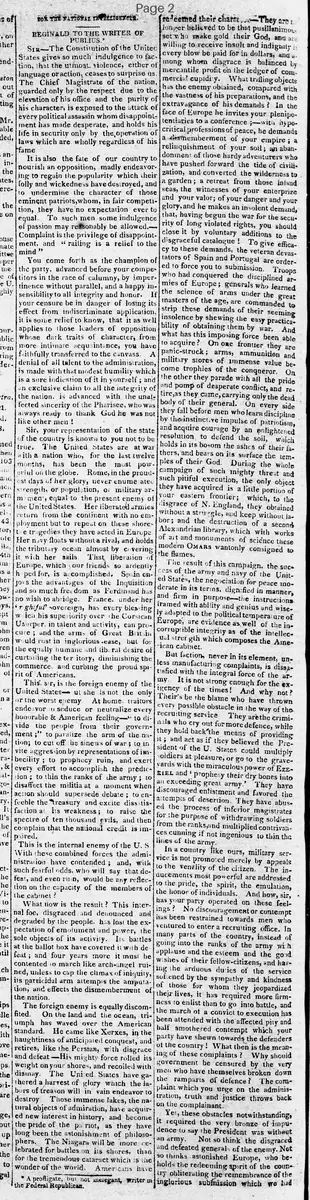
REGINALD TO THE WRITER OF PUBLIUS.*
Sir--The Constitution of the United States gives so much indulgence to faction, that the utmost violence, either of language or action, ceases to surprise us. The Chief Magistrate of the nation, guarded only by the respect due to the elevation of his office and the purity of his character, is exposed to the attack of every political assassin whom disappointment has made desperate, and holds his life in security only by the operation of laws which are wholly regardless of his fame.
It is also the fate of our country to nourish an opposition, madly endeavoring to regain the popularity which their folly and wickedness have destroyed, and to undermine the character of those eminent patriots, whom, in fair competition, they have no expectation ever to equal. To such men some indulgence of passion may reasonably be allowed.--Complaint is the privilege of disappointment, and "railing is a relief to the mind."
You come forth as the champion of the party, advanced before your competitors in the race of calumny, by impetinence without parallel, and a happy insensibility to all integrity and honor. If your censure be in danger of losing its effect from indiscriminate application, it is some relief to know, that it as well applies to those leaders of opposition whose dark traits of character, from more intimate acquaintance, you have faithfully transferred to the canvass.
A denial of all talent to the administration, is made with that modest humility which is a sure indication of it in yourself; and an exclusive claim to all the integrity of the nation, is advanced with the unaffected sincerity of the Pharisee, who was always ready to thank God he was not like other men!
Sir, your representation of the state of the country is known to you not to be true. The United States are at war with a nation who, for the last twelve months, has been the most powerful on the globe. Rome, in the proudest days of her glory, never enumerated strength, or population, or military armament, equal to the present enemy of the United States. Her liberated armies return from the continent with no employment but to repeat on these shores the tragedies they have acted in Europe. Her navy floats without a rival, and holds the tributary ocean almost by covering it with her sails. That liberation of Europe, which our friends so ardently hoped for, is accomplished. Spain enjoys the advantages of the Inquisition and so much freedom as Ferdinand has no wish to abridge. France, under her 'rightful' sovereign, has every blessing which his superiority over the Corsican Usurper, in talent and activity, can procure; and the arms of Great Britain would rust in inglorious ease, but for the equally humane and liberal desire of curtailing the territory, diminishing the commerce, and curbing the proud spirit of Americans.
This, sir, is the foreign enemy of the United States--but she is not the only or the worst enemy. At home, traitors endeavor to seduce or neutralize every honorable & American feeling--to divide the people from their government; to paralyze the arm of the nation; to cut off the sinews of war; to invite aggression by representations of imbecility; to prophecy ruin, and exert every effort to accomplish the prediction; to thin the ranks of the army; to disaffect the militia at a moment when action should supersede debate: to enfeeble the treasury and excite dissatisfaction at its weakness; to raise the spectre of ten thousand evils, and then complain that the national credit is impaired.
This is the internal enemy of the U. S. With these combined forces the administration have contended; and, with such fearful odds, who will say that defeat, and even ruin, would be any reflection on the capacity of the members of the cabinet?
What now is the result? This internal foe, disgraced and denounced and degraded by the people, has lost the expectation of emolument and power, the sole objects of its activity. Its battles at the ballot box have covered it with defeat; and four years more it must be contented to march like arch-angel ruined, unless to cap the climax of iniquity, its parricidal arm attempts the amputation, and effects the dismemberment of the nation.
The foreign enemy is equally discomfited. On the land and the ocean, triumph has waved over the American standard. He came like Xerxes, in the haughtiness of anticipated conquest, and retires, like the Persian, with disgrace and defeat--His mighty force rolled its weight on your shores, and recoiled with dismay. The United States have gathered a harvest of glory which the labors of treason will in vain endeavor to destroy. Those immense lakes, the natural objects of admiration, have acquired new interest in history, and become the pride of the patriot, as they have long been the astonishment of philosophers. The Niagara will be more celebrated for battles on its shores, than for the tremendous cataract which is the wonder of the world. Americans have
redeemed their character. They are no longer believed to be that pusillanimous set who make gold their God, and are willing to receive insult and indignity every blow be paid for in dollars, and among whom disgrace is balanced by mercantile profit on the ledger of commercial cupidity. What trifling objects has the enemy obtained, compared with the vastness of his preparations, and the extravagance of his demands? In the face of Europe he invites your plenipotentiaries to a conference;--with hypocritical professions of peace, he demands a dismemberment of your empire; a relinquishment of your soil; an abandonment of those hardy adventurers who have pushed forward the tide of civilization, and converted the wilderness to a garden; a retreat from those inland seas, the witnesses of your enterprize and your valor; of your danger and your glory, and he makes an insolent demand, that, having begun the war for the security of long violated rights, you should close it by voluntary additions to the disgraceful catalogue! To give efficacy to these demands, the veteran devastators of Spain and Portugal are ordered to force you to submission. Troops who had conquered the disciplined armies of Europe; generals who learned the science of arms under the great masters of the age, are commanded to strip these demands of their seeming insolence by shewing the easy practicability of obtaining them by war. And what has this imposing force been able to acquire? On one frontier they are panic-struck; arms, ammunition and military stores of immense value become trophies of the conqueror. On the other they parade with all the pride and pomp of desperate conflict, and retire, as they came, carrying only the dead body of their general. On every side they fall before men who learn discipline by the instinctive impulse of patriotism, and acquire courage by an enlightened resolution to defend the soil, which holds in its bosom the ashes of their fathers, and bears on its surface the temples of their God. During the whole campaign of such mighty threat and such pitiful execution, the only object they have acquired is a little portion of your eastern frontier; which, to the disgrace of N. England, they obtained without a struggle, and keep without labor; and the destruction of a second Alexandrian library, which with works of art and monuments of science these modern Omars wantonly consigned to the flames.
The result of this campaign, the success of the army and navy of the United States, the negotiation for peace moderate in its terms, dignified in manner, and firm in purpose--the instructions, framed with ability and genius and wisely adapted to the political temperature of Europe, are evidence as well of the incorruptible integrity as of the intellectual strength which composes the American cabinet.
But faction, never in its element, unless manufacturing complaints, is dissatisfied with the integral force of the army.
It is not strong enough for the exigency of the times! And why not? Their's be the blame who have thrown every possible obstacle in the way of the recruiting service. They are the criminals who cry out for more defence, while they hold back the means of providing it; and act as if they believed the President of the U. States could multiply soldiers at pleasure, or go to the graveyards with the miraculous power of Ezekiel and 'prophesy their dry bones into an exceeding great army.' They have discouraged enlistment and favored the attempts of desertion. They have abused the process of inferior magistrates for the purpose of withdrawing soldiers from the ranks, and multiplied contrivances cunning if not ingenious to thin the lines of the army.
In a country like ours, military service is not promoted merely by appeals to the venality of the citizen. The inducements most powerful are addressed to the pride, the spirit, the emulation, the honor of individuals. And how, sir, has your party operated on these feelings? No discouragement or contempt has been restrained towards men who ventured to enter a recruiting office. In many parts of the country, instead of going into the ranks of the army with applause and the esteem and the good wishes of their fellow-citizens, and having the arduous duties of the service softened by the sympathy and kindness of those for whom they jeopardized their lives, it has required more firmness to enlist than to go into battle, and the march of a convict to execution has been attended with the affected pity and half smothered contempt which your party have shewn towards the defenders of the country! What then is the meaning of these complaints? Why should government be censured by the very men who have themselves broken down the ramparts of defence? The complaint which you urge on the administration, truth and justice throws back on the complainant.
Yet, these obstacles notwithstanding, it required the very bronze of impudence to say the President was without an army. Not so think the disgraced and defeated generals of the enemy. Not so thinks astonished Europe, who beholds the redeeming spirit of the country obliterating the remembrance of the inglorious submission which we had.
Slumbered in our years. Not so think our gratified fellow-citizens, who hail the restorers of revolution-glory, and raise for the gallant spirits of our soldiery as the re-them the imperishable monument of a nation's praise.
But the finances! The vacant vaults of the Treasury, which should entomb every hope of the opposition, are made the fruitful subject of censure and complaint. A nation, rich beyond parallel; inhabiting a country in which nature has assumed every form of luxuriant prodigality, which teems with the richest productions of every soil, and opens unbounded prospects of wealth to manufacturing and agricultural industry; is libelled by the malignancy of its enemies by a charge of pecuniary inability to conduct a war! The wealth of this nation is untouched. It belongs to the public. It is held by the patriotism of the citizens in trust for the service of the state. This treasure will redeem every promise of the nation now that the wealth of the nation has superseded its faith as an instrument of finance. The ability of the nation & the willingness to discharge the public obligations remain with the people. They wait only the requisition of government ever anxious not too largely to make demands on the liberality of the citizen. Who then dare say, that the confidence of the government has fallen to the ground? Is it to assert it too in that manner that proclaims with what malignant anxiety he wishes it to be fact? And this declaration is made too in an exulting comparison with the enemy; whose whole island, if converted into diamond, would not be rich enough to pay their national debt. It is a dark minded attachment to the foe which leads to such assertions. It is moral treason which undervalues the resources of its own country and exaggerates those of the enemy. It is the vilest species of speculating avarice which depresses the public securities to thrive on the ill-gotten gains of a purchase. It is that profligacy of character which adds infamy upon falsehood, and anticipates with laughing deviltry the ruin of the nation. Great God! How inexhaustible is thy mercy, when such detestable ingrates are permitted to live within the protection of thine American Israel!
From the enemy whom you seem so much to admire, one useful lesson may be learned. The pillory which they awarded to the noble speculator, who imposed on the public credulity as to the value of the national paper, is well deserved by the profligate prevaricator who endeavors to play the counter part of the same game with the American public.
Last of all appears New-England. She must be courted back to the Union! Her talents and her resources are necessary to our political existence! Let her display these talents in the service of the empire—let her voluntarily bring out these resources against the common enemy, and she may then boast of her importance. Under the influence of disappointment and ambition, she has hung a dead weight on the confederacy, encouraging the enemy with hope of dis-union & alarming timid citizens with the terrors of internal war. Her just weight in the national councils will be readily allowed, whenever her force is directed to national purposes; when no narrow jealousy destroys her respectability, and no paltry object of individual aggrandizement regulates her motion: when her statesmen shall sacrifice their little local prejudices on the altar of general good; when they bring their temporary expedients, their private piques, their excessive vanity and their personal expectations into one common centre, and immolate them as an atonement to the injured honor of their country; when, with undivided affection, they return to the constitution of the confederacy, and with united zeal endeavor to exalt the character and maintain the rights of the nation; then a grateful people will receive them with liberal gratitude, and allow them, as they have ever been willing to do, more than their proportionate share in the councils of the empire.
It gratifies the spirit of patriotism to anticipate the time, not very distant, when this great nation will rise in the majesty of its might, and command the respect which the God of nations ordains it to possess: when this great people, bursting the bonds of party passion and obliterating the lines of geographical dissention, shall conquer, by its power, the peace which was denied to the justice of its cause and the patience of its policy: when the eye will cower that dares look like submission, and the face blanch at proposals of dishonor: when the instigators of insurgency and the demagogues of dissention will call on the rocks to fall on them, and the mountains to cover them from the vengeance of an insulted people.
What sub-type of article is it?
What themes does it cover?
What keywords are associated?
What entities or persons were involved?
Letter to Editor Details
Author
Reginald
Recipient
The Writer Of Publius
Main Argument
the letter defends the u.s. administration's competence and integrity in managing the war of 1812 against foreign and internal enemies, attributing opposition complaints to factional disappointment and treasonous motives, while highlighting military victories, financial resilience, and the need for national unity.
Notable Details