Thank you for visiting SNEWPapers!
Sign up free
The Enquirer
Richmond, Henrico County, Virginia
What is this article about?
Detailed account of the failed US attempt to capture Queenston Heights on October 13, 1812, during the War of 1812. Led by Gen. Van Rensselaer, initial success turned to defeat due to lack of boats and reinforcements, resulting in heavy casualties and surrender. Gen. Brock killed.
Clipping
OCR Quality
Full Text
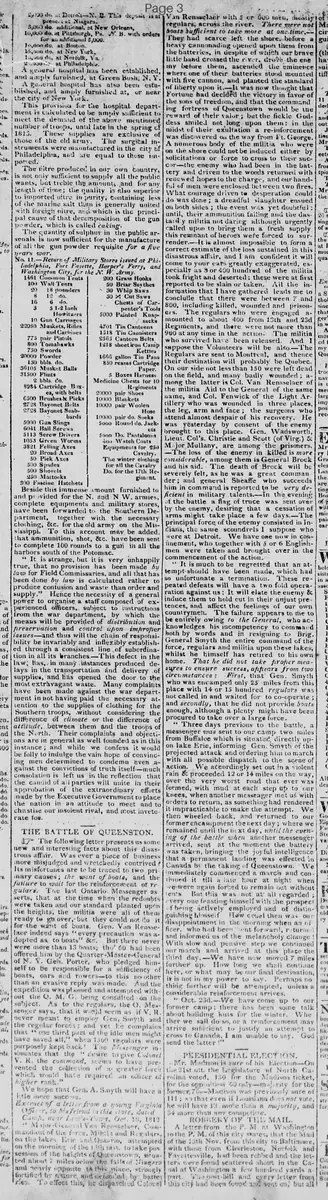
The following letter presents us some new and interesting facts about this disastrous affair. Was ever a piece of business more misjudged and wretchedly contrived? Its misfortunes are to be traced to two primary Causes; the want of boats, and the failure to wait for the reinforcement of regulars. The last Ontario Messenger asserts, that at the time when the redoubts were taken and our standard planted upon the heights, the militia were all of them ready to go over, but they could not do it for the want of boats. Gen. Van Rensselaer indeed says "every precaution was adopted as to boats" &c. But there never were more than 13 boats; tho' 60 had been offered him by the Quarter-Master-General of N. Y. Gen. Porter, who pledged himself to be responsible for a sufficiency of boats, oars and rowers—to this no other than an evasive reply was made. And the expedition was planned and attempted without the Q. M. G. being consulted on the subject. As to the regulars, the O. Messenger says, that it would seem as if V. R. never meant to employ Gen. Smyth and the regular forces; and yet he complains that "one third part of the idle men might have saved all," when 150 regulars were purposely kept back! The Messenger insinuates that the "desire to give Colonel V. R. the command, seems to have prevented the Collection of a greater force: which would have required an officer of higher rank."
We hope that Gen. A. Smyth will have a little more success.
Extract of a letter from a young Virginia Officer, to his friend in this state, dated Camp, near Lewiston, Oct. 18, 1812
"Major-General Van Rensselaer, Commandant of the force, Militia and Regulars, on the lakes Erie and Ontario, attempted on the morning of the 13th inst. to take possession of the heights of Queenstown, situated about 7 miles below the falls of Niagara and nearly opposite to this place, strongly fortified by nature, and defended, by batteries. To effect this, he dispatched Colonel Van Rensselaer with 500 or 600 men, mostly regulars, across the river. There were not boats sufficient to take more at one time. They had scarce left the shore, before a heavy cannonading opened upon them from the batteries, in despite of which our brave little band crossed the river, drove the enemy before them, ascended the eminence where one of their batteries stood mounted with five cannon, and planted the standard of liberty upon it.—It was now thought that Fortune had decided the victory in favor of the sons of freedom, and that the commanding fortress of Queenstown would be the reward of their valor; but the fickle Goddess smiled not long upon them: in the midst of their exultation a re-inforcement was discovered on the way from Ft. George. A numerous body of the militia who were on the shore could not be induced either by solicitations or force to cross to their succor—the enemy who had been in the battery and driven to the woods returned with renewed hopes to the charge. and our handful of men were enclosed between two fires. What courage driven to desperation could do was done: a dreadful slaughter ensued on both sides; the event was yet doubtful: until, their ammunition failing and the dastardly militia not daring although urgently called upon to bring them a fresh supply this remnant of heroes were forced to surrender.—It is almost impossible to form a correct estimate of the loss sustained in this disastrous affair. and I am confident it will come to your ears greatly exaggerated, especially as 300 or 400 of the militia took fright and deserted: these were at first reported to be slain or taken.' All the information that I have gathered leads me to conclude that there were between 700 and 800, including killed, wounded and prisoners. The regulars who were engaged amounted to about 400 from 13th and 23d Regiments, and there were not more than 900 at any time in the action. The militia who survived have been released. And I suppose the Volunteers will be also.—The Regulars are sent to Montreal. and thence their destination will probably be Quebec. On our side not less than 150 were left dead on the field, and many badly wounded; among the latter is Col. Van Rensselaer of the militia Aid to the General of the same name, and Col. Fenwick of the Light Artillery who was wounded in three places. the leg, arm and face: the surgeons who attend almost despair of his recovery. He was yesterday by consent of the enemy brought to this place. Gen. Wadsworth, Lieut. Col's. Christie and Scott (of Va.) & Major Mullany. are among the prisoners. -The loss of the enemy in killed is more considerable, among them is General Brock and his aid. The death of Brock will be severely felt, as he was a great commander: and general Sheaffe who succeeds him in command is reported to be very deficient in military talents.—In the evening of the battle a flag of truce was sent over by the enemy, desiring that a cessation of arms might take place a few days.—The principal force of the enemy consisted in Indians, the same scoundrels I suppose who were at Detroit. We have one now in confinement, who together with 5 or 6 Englishmen were taken and brought over in the Commencement of the action.
It is much to be regretted that an attempt should have been made, which had so unfortunate a termination. These repeated defeats will have a two fold operation against us: It will elate the enemy & induce them to hold out in their unjust pretences, and affect the feelings of our own countrymen. The failure appears to me to be entirely owing to the General, who acknowledges his incompetency to command both by words and in resigning to Brig. General Smyth the entire command of the force, regulars and militia upon these lakes, whilst he himself has retired to his own home. That he did not take proper measures to ensure success, appears from two circumstances; First. that Gen. Smyth who was encamped only 25 miles from this place with 1400 or 1500 regulars was not called in and waited for to co-operate; and secondly, that he did not provide boats enough, although a plenty might have been procured to take over a large force.
"Three days previous to the battle, a messenger was sent to our camp two miles from Buffalo which is situated directly upon lake Erie, informing Gen. Smyth of the projected attack and ordering him to march with all possible dispatch to the scene of action. We accordingly set out in a violent rain & proceeded 12 or 14 miles on the way, over the very worst road that ever was formed, with mud at each step up to our knees. when another messenger met us with orders to return, as something had rendered it impracticable to make the attempt. We then wheeled back, and returned to our former encampment the next day; where we remained until the next day, until the evening of the battle when another messenger arrived, sent at the moment the battery was taken, bringing the joyful intelligence that a permanent landing was effected in Canada by the taking of Queenstown. We immediately commenced a march and continued it till a late hour at night when we were again forced to remain out without tents But this was not at all regarded; every one feasting himself with the prospect of being actively employed and of distinguishing himself How cruel then was our disappointment in the morning when an officer, who had been sent forward, returned and informed us of the melancholy change! With slow and pensive step we continued our march and arrived at this place the third day.—We have now moved 7 miles further up. How long we shall continue here, or what may be our final destination, it is not in my power to say. Perhaps nothing further will be attempted, unless a considerable reinforcement arrives.
"Oct. 23d.—We have come up to our former camp: there has been some talk about building huts for the winter. Whether we shall do so, or a reinforcement may arrive sufficient to justify an attempt to cross to Canada, I am unable to say. God send the latter!"
What sub-type of article is it?
What keywords are associated?
What entities or persons were involved?
Where did it happen?
Domestic News Details
Primary Location
Queenston Heights, Near Lewiston
Event Date
October 13, 1812
Key Persons
Outcome
us losses: 700-800 total including 150 killed, many wounded (e.g., col. fenwick severely), prisoners sent to montreal/quebec; militia released. enemy: general brock and aid killed, greater losses in killed.
Event Details
US forces under Gen. Van Rensselaer attempted to capture Queenston Heights with 500-600 men crossing in limited boats; initial success in taking battery, but reinforcements from Ft. George, failure of militia to cross, and ammunition shortage led to surrender after heavy fighting. Criticisms include lack of boats and not waiting for Gen. Smyth's regulars.