Thank you for visiting SNEWPapers!
Sign up free
Editorial
April 13, 1793
The Kentucky Gazette
Lexington, Fayette County, Kentucky
What is this article about?
Philosophical editorial urging Kentucky Christians to repent mutual animosity, political cursing, and vice; affirms human freedom to choose virtue via divine spark; contrasts with heathens' harmony; cites history for hope in reform.
Clipping
OCR Quality
88%
Good
Full Text
Nil admirari prope res est una Numici
Sotique quas possit accre et fer
yare beatum.
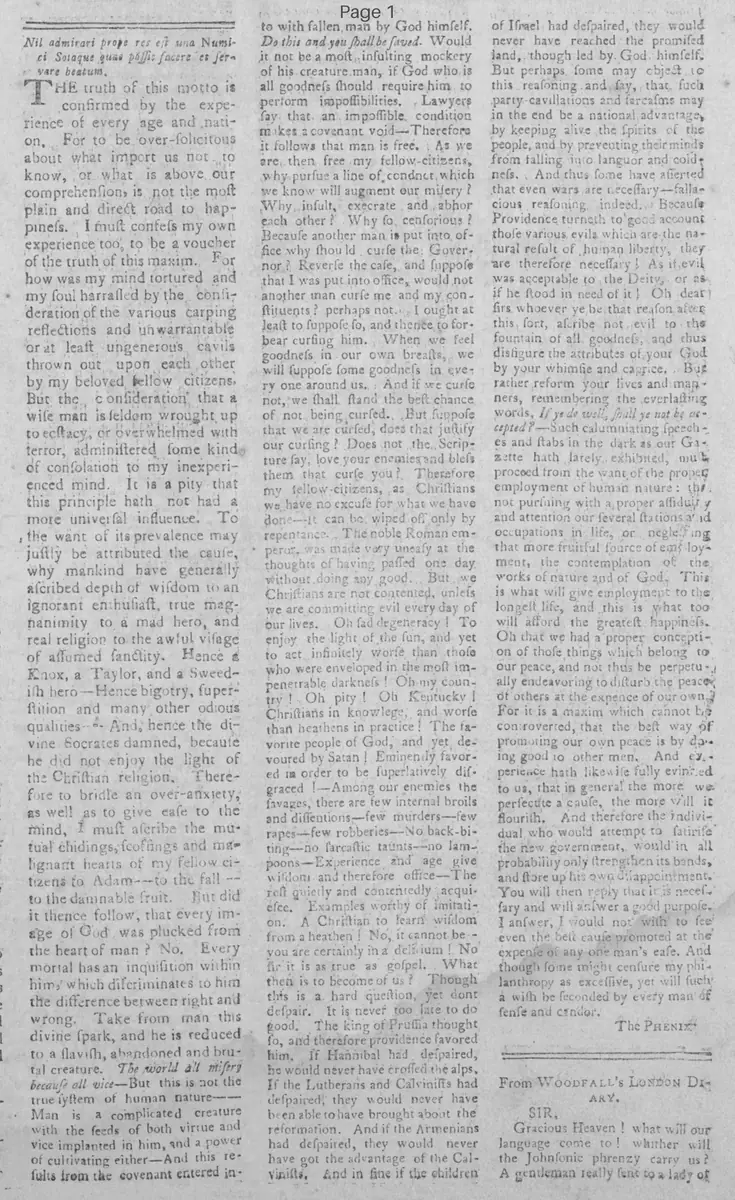
THE truth of this motto is confirmed by the experience of every age and nation. For to be over-solicitous about what imports us not to know, or what is above our comprehension, is not the most plain and direct road to happiness. I must confess my own experience too, to be a voucher of the truth of this maxim. For how was my mind tortured and my soul harassed by the consideration of the various carping reflections and unwarrantable or at least ungenerous cavils thrown out upon each other by my beloved fellow citizens. But the consideration that a wise man is seldom wrought up to ecstasy, or overwhelmed with terror, administered some kind of consolation to my inexperienced mind. It is a pity that this principle hath not had a more universal influence. To the want of its prevalence may justly be attributed the cause, why mankind have generally ascribed depth of wisdom to an ignorant enthusiast, true magnanimity to a mad hero, and real religion to the awful visage of assumed sanctity. Hence a Knox, a Taylor, and a Swedish hero—Hence bigotry, superstition and many other odious qualities— And, hence the divine Socrates damned, because he did not enjoy the light of the Christian religion. Therefore to bridle an over-anxiety, as well as to give ease to the mind, I must ascribe the mutual chidings, scofangs and malignant hearts of my fellow citizens to Adam—to the fall— to the damnable Sin. But did it thence follow, that every image of God was plucked from the heart of man? No. Every mortal has an inquisition within him, which discriminates to him the difference between right and wrong.
Take from man this divine spark, and he is reduced to a slavish, abandoned and brutal creature. The world all misery because of vice—But this is not the true system of human nature—
Man is a complicated creature with the seeds of both virtue and vice implanted in him, and a power of cultivating either—And this results from the covenant entered into with fallen, man by God himself.
Do this and you shall be saved. Would it not be a most insulting mockery of his creature man, if God who is all goodness should require him to perform impossibilities. Lawyers say that an impossible condition makes a covenant void—Therefore it follows that man is free. As we are then free my fellow-citizens, why pursue a line of conduct, which we know will augment our misery? Why insult, execrate and abhor each other? Why so censorious? Because another man is put into office why should curse the Governor? Reverse the case, and suppose that I was put into office, would not another man curse me and my constituents? perhaps not. I ought at least to suppose so, and thence to forbear cursing him. When we feel goodness in our own breasts, we will suppose some goodness in every one around us. And if we curse not, we shall stand the best chance of not being cursed. But suppose that we are cursed, does that justify our cursing? Does not the Scripture say, love your enemies and bless them that curse you? Therefore my fellow-citizens, as Christians we have no excuse for what we have done—it can be wiped off only by repentance. The noble Roman emperor was made very uneasy at the thoughts of having passed one day without doing any good. But we Christians are not contented, unless we are committing evil every day of our lives. Oh sad degeneracy! To enjoy the light of the sun, and yet to act infinitely worse than those who were enveloped in the most impenetrable darkness! Oh my country! Oh pity! Oh Kentucky! Christians in knowledge, and worse than heathens in practice! The favorite people of God, and yet devoured by Satan! Eminently favored in order to be superlatively disgraced!—Among our enemies the savages, there are few internal broils and dissensions—few murders—few rapes—few robberies—No back-biting—no sarcastic taunts—no lampoons—Experience and age give wisdom and therefore office—The rest quietly and contentedly acquiesce. Examples worthy of imitation. A Christian to learn wisdom from a heathen! No, it cannot be—you are certainly in a delirium! No sir it is as true as gospel. What then is to become of us? Though this is a hard question, yet dont despair. It is never too late to do good. The king of Prussia thought so, and therefore providence favored him, If Hannibal had despaired, he would never have crossed the alps, If the Lutherans and Calvinists had despaired, they would never have been able to have brought about the reformation. And if the Armenians had despaired, they would never have got the advantage of the Calvinists. And in fine if the children of Israel had despaired, they would never have reached the promised land. though led by God himself.
Sotique quas possit accre et fer
yare beatum.
THE truth of this motto is confirmed by the experience of every age and nation. For to be over-solicitous about what imports us not to know, or what is above our comprehension, is not the most plain and direct road to happiness. I must confess my own experience too, to be a voucher of the truth of this maxim. For how was my mind tortured and my soul harassed by the consideration of the various carping reflections and unwarrantable or at least ungenerous cavils thrown out upon each other by my beloved fellow citizens. But the consideration that a wise man is seldom wrought up to ecstasy, or overwhelmed with terror, administered some kind of consolation to my inexperienced mind. It is a pity that this principle hath not had a more universal influence. To the want of its prevalence may justly be attributed the cause, why mankind have generally ascribed depth of wisdom to an ignorant enthusiast, true magnanimity to a mad hero, and real religion to the awful visage of assumed sanctity. Hence a Knox, a Taylor, and a Swedish hero—Hence bigotry, superstition and many other odious qualities— And, hence the divine Socrates damned, because he did not enjoy the light of the Christian religion. Therefore to bridle an over-anxiety, as well as to give ease to the mind, I must ascribe the mutual chidings, scofangs and malignant hearts of my fellow citizens to Adam—to the fall— to the damnable Sin. But did it thence follow, that every image of God was plucked from the heart of man? No. Every mortal has an inquisition within him, which discriminates to him the difference between right and wrong.
Take from man this divine spark, and he is reduced to a slavish, abandoned and brutal creature. The world all misery because of vice—But this is not the true system of human nature—
Man is a complicated creature with the seeds of both virtue and vice implanted in him, and a power of cultivating either—And this results from the covenant entered into with fallen, man by God himself.
Do this and you shall be saved. Would it not be a most insulting mockery of his creature man, if God who is all goodness should require him to perform impossibilities. Lawyers say that an impossible condition makes a covenant void—Therefore it follows that man is free. As we are then free my fellow-citizens, why pursue a line of conduct, which we know will augment our misery? Why insult, execrate and abhor each other? Why so censorious? Because another man is put into office why should curse the Governor? Reverse the case, and suppose that I was put into office, would not another man curse me and my constituents? perhaps not. I ought at least to suppose so, and thence to forbear cursing him. When we feel goodness in our own breasts, we will suppose some goodness in every one around us. And if we curse not, we shall stand the best chance of not being cursed. But suppose that we are cursed, does that justify our cursing? Does not the Scripture say, love your enemies and bless them that curse you? Therefore my fellow-citizens, as Christians we have no excuse for what we have done—it can be wiped off only by repentance. The noble Roman emperor was made very uneasy at the thoughts of having passed one day without doing any good. But we Christians are not contented, unless we are committing evil every day of our lives. Oh sad degeneracy! To enjoy the light of the sun, and yet to act infinitely worse than those who were enveloped in the most impenetrable darkness! Oh my country! Oh pity! Oh Kentucky! Christians in knowledge, and worse than heathens in practice! The favorite people of God, and yet devoured by Satan! Eminently favored in order to be superlatively disgraced!—Among our enemies the savages, there are few internal broils and dissensions—few murders—few rapes—few robberies—No back-biting—no sarcastic taunts—no lampoons—Experience and age give wisdom and therefore office—The rest quietly and contentedly acquiesce. Examples worthy of imitation. A Christian to learn wisdom from a heathen! No, it cannot be—you are certainly in a delirium! No sir it is as true as gospel. What then is to become of us? Though this is a hard question, yet dont despair. It is never too late to do good. The king of Prussia thought so, and therefore providence favored him, If Hannibal had despaired, he would never have crossed the alps, If the Lutherans and Calvinists had despaired, they would never have been able to have brought about the reformation. And if the Armenians had despaired, they would never have got the advantage of the Calvinists. And in fine if the children of Israel had despaired, they would never have reached the promised land. though led by God himself.
What sub-type of article is it?
Moral Or Religious
Social Reform
What keywords are associated?
Christian Virtue
Original Sin
Political Cursing
Kentucky Citizens
Moral Degeneracy
Human Freedom
Repentance
Heathen Wisdom
What entities or persons were involved?
Fellow Citizens
Governor
God
Socrates
Knox
Taylor
Swedish Hero
King Of Prussia
Hannibal
Lutherans
Calvinists
Arminians
Children Of Israel
Savages
Editorial Details
Primary Topic
Exhortation To Christian Virtue And Against Mutual Animosity
Stance / Tone
Moral Exhortation Calling For Repentance And Goodwill
Key Figures
Fellow Citizens
Governor
God
Socrates
Knox
Taylor
Swedish Hero
King Of Prussia
Hannibal
Lutherans
Calvinists
Arminians
Children Of Israel
Savages
Key Arguments
Over Solicitousness About Trivial Matters Leads To Unhappiness
Wise Men Avoid Ecstasy Or Terror From Others' Opinions
Vices Stem From Original Sin But Man Retains A Divine Spark Distinguishing Right From Wrong
Man Is Free To Cultivate Virtue Or Vice Per God's Covenant
Christians Should Not Curse Or Abhor Each Other, Even Politically
Scripture Commands Loving Enemies And Blessing Cursers
Christians Act Worse Than Heathens Despite Knowledge
Savages Exhibit Less Internal Conflict And Wiser Governance
It Is Never Too Late To Do Good, As Shown By Historical Figures