Thank you for visiting SNEWPapers!
Sign up free
Atlanta Daily World
Atlanta, Fulton County, Georgia
What is this article about?
The Community Planning Council in Atlanta warned that a proposed 5% sales tax would cost low-income families $69 monthly, reducing annual income by $84 and causing distress, reduced nutrition, and health issues, based on 1948 budget data.
Clipping
OCR Quality
Full Text
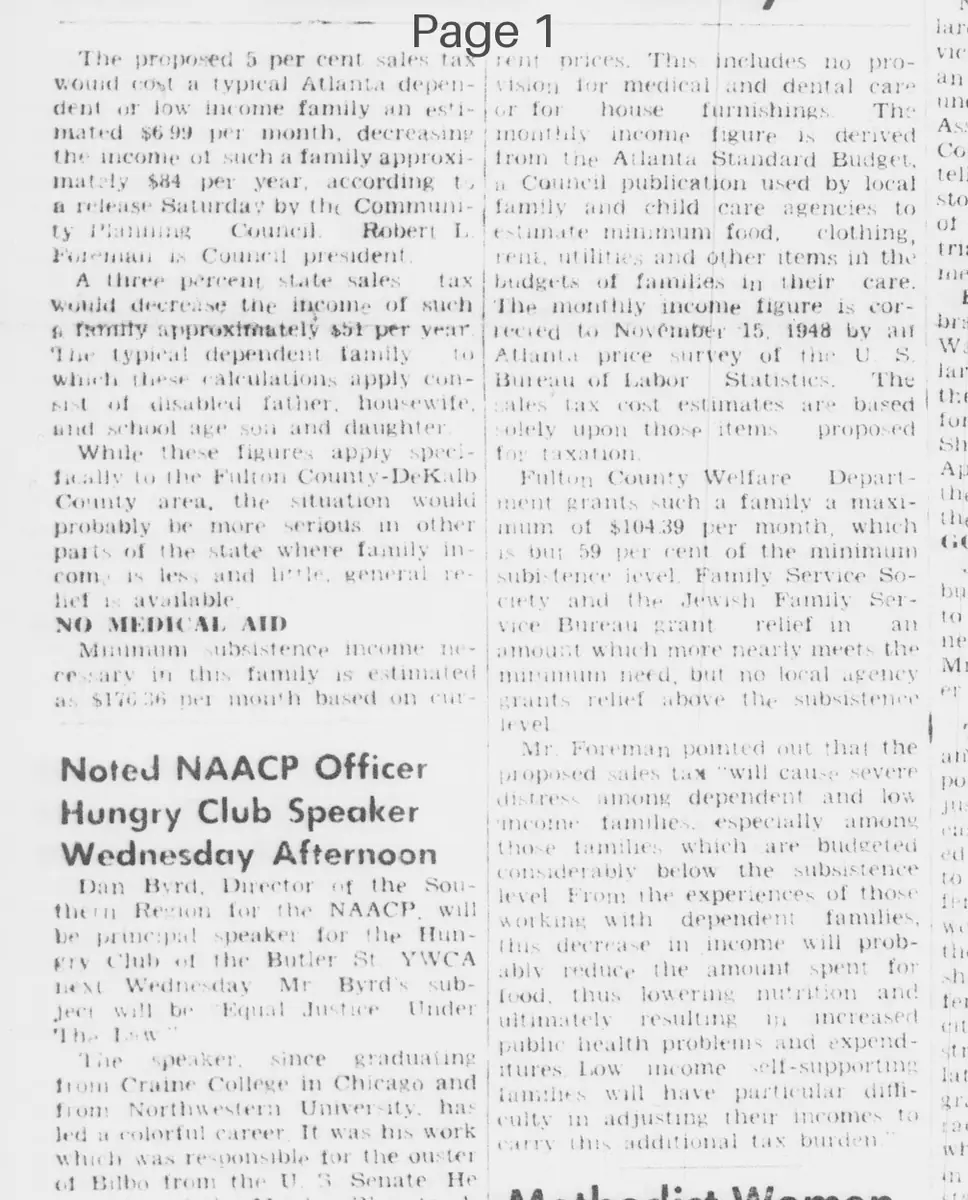
The proposed 5 per cent sales tax would cost a typical Atlanta dependent of low income family an estimated $69 per month, decreasing the income of such a family approximately $84 per year, according to a release Saturday by the Community Planning Council. Robert L. Foreman, Council president.
A three percent state sales tax would decrease the income of such a family approximately $61 per year.
The typical dependent family with these calculations apply consists of disabled father, housewife and school age son and daughter.
While these figures apply specifically to the Fulton County-DeKalb County area, the situation would probably be more serious in other parts of the state where family income is less and little general relief is available.
NO MEDICAL AID
Minimum subsistence income necessary for this family is estimated as $314.80 net per month based on current costs.
Rent prices. This includes no provision for medical and dental care or for house furnishings. The monthly income figure is derived from the Atlanta Standard Budget, a Council publication used by local family and child care agencies to estimate minimum food, clothing, rent, utilities and other items in the budgets of families in their care.
The monthly income figure is corrected to November 15, 1948 by all Atlanta's price survey of the U. S. Bureau of Labor Statistics.
The sales tax cost estimates are based solely upon those items proposed for taxation.
Fulton County Welfare Department grants such a family a maximum of $104.39 per month which is but 59 per cent of the minimum subsistence level. Family Service Society and the Jewish Family Service Bureau grant relief in an amount which more nearly meets the minimum need, but no local agency can grant relief above the subsistence level.
Mr. Foreman pointed out that the proposed sales tax will cause severe distress among dependent and low income families especially among those families which are budgeted considerably below the subsistence level. From the experiences of those working with dependent families this decrease in income will probably reduce the amount spent for food, this lowering nutrition and ultimately resulting in increased public health problems and expenditures. Low income self-supporting families will have particular difficulty in adjusting their incomes to carry this additional tax burden.
What sub-type of article is it?
What keywords are associated?
What entities or persons were involved?
Where did it happen?
Domestic News Details
Primary Location
Atlanta
Event Date
November 15, 1948
Key Persons
Outcome
the proposed 5% sales tax would cost a typical low-income family $69 per month, decreasing income by $84 per year. a 3% tax would decrease income by $61 per year. this would cause severe distress, reduce food spending, lower nutrition, and increase public health problems and expenditures.
Event Details
The Community Planning Council released a statement estimating the impact of a proposed 5% sales tax on low-income families in Atlanta, particularly in Fulton and DeKalb Counties. The typical family consists of a disabled father, housewife, and school-age son and daughter, with a minimum subsistence income of $314.80 net per month based on the Atlanta Standard Budget corrected to November 15, 1948. Current welfare grants are below subsistence levels, and the tax would exacerbate financial difficulties for dependent and low-income families across the state.