Thank you for visiting SNEWPapers!
Sign up free
Letter to Editor
September 13, 1833
Richmond Enquirer
Richmond, Richmond County, Virginia
What is this article about?
John Hartman writes to the editors defending the originality of his wooden rail road invention, sharing correspondence with John S. Williams who claims prior invention, and promoting its potential for internal improvements in Virginia, including planned experiments.
Clipping
OCR Quality
95%
Excellent
Full Text
TO THE EDITORS OF THE ENQUIRER.
WOODEN RAIL ROADS.
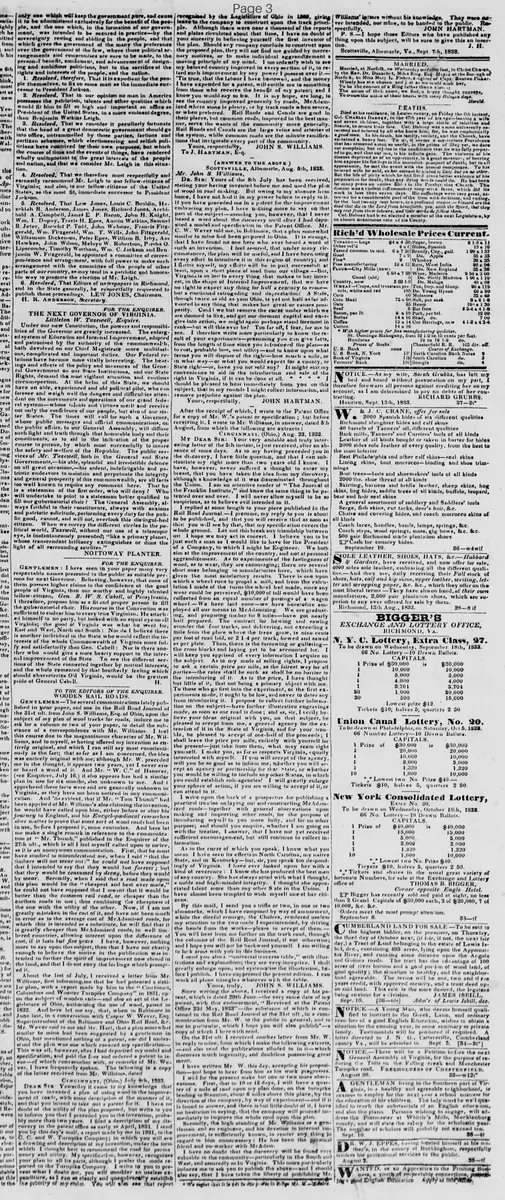
Gentlemen—The several communications lately published in your paper, and one in the Rail Road Journal of the 31st ult. from John S. Williams, Esq. of Ohio, upon the subject of my plan of wood tracks for roads, induce me to ask for a column or two of your paper, to detail the substance of a correspondence with Mr. Williams. I feel this course due to the magnanimous character of Mr. Williams, and to myself, as having offered my invention as entirely original, and which I can still say most conscientiously is the fact; that as far as I am concerned, the idea was entirely original with me; although Mr. W. preceded me in the thought, it appears two years, yet I never saw or heard a word of it. And Mr. "W. C." of Hanover, (see Enquirer, July 16,) it also appears has had a similar plan in use for six months, also unknown to me. And I apprehend these facts were and are generally unknown in Virginia, as they have not been noticed in any communication. And 'tis evident, that if Mr. "Tom Thumb" had been apprised of Mr. Williams's also claiming the invention, he would have called upon him, either before or after his journey to England, and his Encyclopædiacal researches after matter to prove that some sort of wood roads had been in use, before I proposed it, some centuries. And here let me make a single remark in reference to the communication of "Mr. Thumb," published in the Enquirer of the 27th ult., which is all I feel myself called upon to notice, as it is an anonymous communication. First, that he must have studied to misunderstand me, when I said "that the timbers will not wear out:" he could not have supposed that I intended to say that they would last forever; but that they would be consumed by decay, before they would by wear. Secondly, when I said that a road made upon this plan would be the "cheapest and best ever made," he could not have supposed that I meant that it would be better than the common rail road, or cheaper than the earthen roads in use; thus combining the cheapness of the one with the utility of the other. Now, if I am not greatly mistaken in the cost of it, and have not been much in error as to the average cost of McAdamised roads, for which this is intended as a substitute, he will find that it is greatly cheaper than McAdamised roads, in well timbered countries, allowing interest upon the difference of cost, if it lasts but five years. I have, however, nothing more to say upon this subject, than that I have not charity enough to believe the motive in the publication was intended to further the spirit of improvement now abroad in the land, and that I do not envy the feelings which prompted it.
About the last of July, I received a letter from Mr. Williams, first informing me that he had patented a similar plan, with a report made by him to the "Cincinnati, Columbus and Wooster Turnpike Company" in 1831, upon the subject of wooden rails—and also an act of the Legislature of Ohio, authorising the use of wood, passed in 1832. And here let me say, that, when in Baltimore in June last, in a conversation with Caspar W. Wever, Esq. Superintendant of the Baltimore and Ohio Rail Road, &c. Mr. Wever said to me and Mr. Hart, that a plan somewhat similar to mine had been suggested by a gentleman in Ohio, but mentioned nothing of a patent, nor did I understand the plan was one which covered my specification—This was all, however, after I had deposited my model and specification, and paid the fees and ordered a patent to issue—of which conversation with, or remarks of Mr. Wever, I have frequently spoken. The following is a copy of the letter received from Mr, Williams, dated
Cincinnati, (Ohio.) July 8th, 1833
Dear Sir: Yesterday it came to my knowledge that you have invented a plan of using wood in the improvement of road, with some description of the manner of it, and that you intend to take out a patent for it. I have no doubt of the utility of the plan proposed, but write to you to inform you that I preceded you in the invention, probably more than two years. I filed a description of my discovery in the patent office as early as April, 1831. I send you by this day's mail, a report made by me in 1831, to the C. C. and W. Turnpike Company; in which you will see a drawing and description of my invention, under the form which I thought best to recommend the road for permanency and utility. My specification, however, recognizes your plan in all its parts, although I prefer the mode reported to the Turnpike Company. I write to you to prevent what I doubt not, you will consider an useless expenditure, as I can so clearly and unequivocally establish the priority of my claim. You will see that report recognized by the Legislature of Ohio in 1832, giving leave to the company to construct upon the track principle. Although there were near a thousand of the reports and plates circulated about that time, I have no doubt of your sincerity in believing yourself the first inventor of the plan. Should any company conclude to construct upon the proposed plan, they will not find me guided by mercenary motives, or to make individual aggrandizement moving principle of my mind. I too ardently wish to see my beloved country improved in every section of it, to retard such improvement by any power I possess over it.—Tis true, that the labour I have bestowed, and the money I have expended for a patent, will entitle me to something from those who receive the benefit of my patent; and I know you would say so too. It is my hope, ere long, to see the country improved generally by roads, McAdamized where stone is plenty, or by track roads when scarce. or when preferred. Rail Roads and Canals are good in their places, but common roads, improved in the best manner, serve the wants of the community more generally. Rail Roads and Canals are the large veins and arteries of the system, while common roads are the minute ramifications that invigorate every part of the community.
Yours, respectfully,
JOHN S. WILLIAMS.
To J. HARTMAN, Esq.
(ANSWER TO THE ABOVE)
Scottsville, Albemarle, Aug. 6th, 1833.
Mr. John S. Williams,
Dr. Sir: Yours of the 8th July has been received, stating your having invented before me and used the plan of wood in road making. But owing to my absence from home, I have not had it in my power before to reply to it. If you have preceded me in a patent for the improvement embracing my plan, I have nothing more to say on that part of the subject—assuring you, however, that I never heard a word about the discovery until after I had deposited a model and specification in the Patent Office. Mr. C. W. Wever told me, in Baltimore, that a plan somewhat similar to mine had been proposed in Ohio. It is strange, that I have found no one here who ever heard a word of such an invention. I feel assured, that under many circumstances, the plan will be useful, and I have been using every effort to introduce it in this region of country; and I flatter myself, my efforts will be in part successful: at least, upon a short piece of road from our village—But, Virginia is so lost to every thing that makes to her interest, in the shape of Internal Improvement, that we have no right to expect any thing for half a century to come—but a continued retrograding and depreciation: A State, though twice as old as your Ohio, is yet not half as far advanced in any thing that makes her great or causes prosperity. Could we but remove the curse under which we are doomed to live, and get our dormant capital and energies into action, we might again perhaps stand foremost in rank—but will this ever be? Too far off, I fear, for me to see. I therefore write more particularly to know the result of your experiments—presuming you can give facts, from the length of time since you introduced the plan—as to cost, probable loss, and utility—and to know upon what terms you will dispose of the right—how much a mile, or in what way—or what you would expect for a county, or State right—or, have you not sold any? It might suit my convenience to aid in the introduction and sale of the right in Virginia, if it can be done at all.
I should be pleased to hear immediately from you on this subject, that in my rounds I might collect information, and remove prejudice against the plan.
Yours, respectfully
JOHN HARTMAN.
After the receipt of which, I wrote to the Patent Office for a copy of Mr. W.'s patent or specification; but before receiving it, I wrote to Mr. Williams, in answer, dated 5th August, from which the following are extracts:
Cincinnati. (Ohio.) Aug. 23, 1833
My Dear Sir: Your very amiable and truly interesting letter of the 5th instant, is just received, after an absence of some days. As to my having preceded you in the discovery, I have little question, and that I can substantiate my right more than two years old I know. I have, however, never suffered a thought to enter my breast, that you have taken the idea from my discovery although a knowledge of it was disseminated throughout the Union. I am an attentive reader of "The Journal of the Franklin Institute," and know the same thing to be patented over and over. I will never allow myself to be so suspicious, as to believe evil intended in it.
I replied at some length to your piece published in the Rail Road Journal.—I presume, my reply to you is about to be published, and that you will receive that as soon as this: you will see by that, that my specification covers the whole ground. Let not this break any friendship between us: I hope we may act in concert. I believe you to be just such a man as I would like to have for the President of a Company, to which I might be Engineer. We both aim at the improvement of the country, and not at personal aggrandizement. As to experiments of the lastingness of wood, as to wear, they are encouraging; there are several short ones belonging to manufactories here, which have given the most satisfactory results. There is one upon which a wheel runs to propel a mill, and from the calculation I made of the turns the wheel had made, since any wear could be perceived, 10,000 of toll would have been collected from an equal number of passings of a wagon wheel.—We have laid none—we have heretofore employed all our means in McAdamizing. We are graduating. and preparing timber for 8 miles—have got nearly half prepared. The contract for hewing and sawing asunder the four tracks, and delivering, not exceeding a mile from the place where the trees grow, is nine cents per foot of road laid, or 2 1/4 per track, hewed and sawed as per plate. Then, there is the furrowing or gullering—the cross blocks and laying yet to be accounted for."
I will keep you apprised of every information I acquire on the subject. As to my mode of selling rights, I propose to ask a certain price per mile, as the fairest way for all parties—the rates shall be such as shall be no barrier to the introducing of it. As to the price, I have thought but little of it, that not being a primary object with me. To those who go first into the experiment, or the first experiments made, it ought to be low, and never to deter any from introducing it. I propose to collect further information on the subject—have further illustrative engravings made, as soon as our road is done; and as, sir, I verily believe your ideas original with you, on that subject, be pleased to accept from me, a general agency for the extension of it in the State of Virginia, and for your trouble, be pleased to accept of one-half of the proceeds; I shall leave the price per mile, entirely with yourself for the present—just take from them, what may seem right yourself. I make you, as far as respects Virginia, equally interested with myself. If you will accept of the agency. will you be so good as to inform me, whether you will accept an agency or partnership for that State, or whether you would be willing to include any other States, in which you could establish sub-agencies? I will greatly enlarge your sphere of action, if you are willing to accept of it, or can attend to it.
I write upon the back of a prospectus for publishing a practical treatise on laying out and constructing McAdamized roads—together with general observations upon making and improving other roads, for the purpose of introducing myself to you more fully, and for no other purpose; and should you enquire, whether I am going on with the treatise, I answer, that I have not yet received sufficient encouragement, but still continue to collect information.
As to the curse of which you speak, I know what you mean. I have seen its effects in North Carolina, my native State, and in Kentucky—but, sir, you speak too despondingly of Virginia. I have ever looked upon her with a kind of reverence: I know she has produced the best men of any country. She has always acted with what I thought a noble and high-minded integrity. I thought she appreciated talent more than any other State in the Union. I have almost been tempted to wish myself one of her citizens.
By this mail, I send you a trifle or two, in one or two almanacks, which I have composed by way of amusement, while the direful scourge, the Cholera, rendered useless my attention to the two roads I superintended, by driving the hands from the works—please to accept of them.—You will hear from me further on the track road, through the columns of the Rail Road Journal, if not otherwise; and I hope you will not be backward yourself. I am willing to lock arms with you in this business.
I send you also a "universal traverse table," with illustrations and explanations; they are very inexpensive. I shall greatly enlarge upon, and systematise the illustration, before I publish. I have suppressed the present edition. I can work all plane triangles whatever with the table.
Yours, truly,
JOHN S. WILLIAMS.
Since writing the above, I received a copy of his patent, which is dated 29th June—the very same date of my patent, with this endorsement, "Received at the Patent Office 23d May, 1833"—the substance of which is contained in the Rail Road Journal of the 31st ult., in a communication from Mr. W. to the public in general, and to me in particular, which I hope you will also publish”—a copy of which I herewith send.
On the 31st ult. I received another letter from Mr. W. in reply to mine, from which I make the following extracts,—and also read the publications alluded to in it—which discovers much ingenuity, and doubtless possessing great merit.
I have written Mr. W. this day. accepting his proposition—and hope to hear from him as his work progresses.
I will for the present make but one or two more observations. First, that in 10 or 12 days, I will have a quarter of a mile of road upon my plan done, on the turnpike leading to Staunton, about 6 miles above this place, by the direction of the company, by way of experiment—and if it is found to answer, and there is but little doubt of it, I have no hesitation in saying. that the company will proceed immediately to improve the whole road upon this plan.
Secondly, the high standing of Mr. Williams as a gentleman and an engineer, and his devotion to internal improvement, is sufficiently known, to render any thing in regard to him unnecessary: He has been the personal friend and co-worker with McAdam.
I have no doubt that the discovery will be found very valuable to the community—particularly in the South and West, and assuredly so in Virginia. This more particularly induces me to ask you to publish the above—and I should also say, that I have taken the liberty of publishing Mr. Williams' Letters without his knowledge.
They were never intended, nor mine, to be handed to the public. Respectfully
JOHN HARTMAN.
P. S.—I hope those Editors who have published any thing upon this subject, will be sure to give this an insertion.
J. H.
Scottsville, Albemarle. Va., Sept. 7th, 1833.
WOODEN RAIL ROADS.
Gentlemen—The several communications lately published in your paper, and one in the Rail Road Journal of the 31st ult. from John S. Williams, Esq. of Ohio, upon the subject of my plan of wood tracks for roads, induce me to ask for a column or two of your paper, to detail the substance of a correspondence with Mr. Williams. I feel this course due to the magnanimous character of Mr. Williams, and to myself, as having offered my invention as entirely original, and which I can still say most conscientiously is the fact; that as far as I am concerned, the idea was entirely original with me; although Mr. W. preceded me in the thought, it appears two years, yet I never saw or heard a word of it. And Mr. "W. C." of Hanover, (see Enquirer, July 16,) it also appears has had a similar plan in use for six months, also unknown to me. And I apprehend these facts were and are generally unknown in Virginia, as they have not been noticed in any communication. And 'tis evident, that if Mr. "Tom Thumb" had been apprised of Mr. Williams's also claiming the invention, he would have called upon him, either before or after his journey to England, and his Encyclopædiacal researches after matter to prove that some sort of wood roads had been in use, before I proposed it, some centuries. And here let me make a single remark in reference to the communication of "Mr. Thumb," published in the Enquirer of the 27th ult., which is all I feel myself called upon to notice, as it is an anonymous communication. First, that he must have studied to misunderstand me, when I said "that the timbers will not wear out:" he could not have supposed that I intended to say that they would last forever; but that they would be consumed by decay, before they would by wear. Secondly, when I said that a road made upon this plan would be the "cheapest and best ever made," he could not have supposed that I meant that it would be better than the common rail road, or cheaper than the earthen roads in use; thus combining the cheapness of the one with the utility of the other. Now, if I am not greatly mistaken in the cost of it, and have not been much in error as to the average cost of McAdamised roads, for which this is intended as a substitute, he will find that it is greatly cheaper than McAdamised roads, in well timbered countries, allowing interest upon the difference of cost, if it lasts but five years. I have, however, nothing more to say upon this subject, than that I have not charity enough to believe the motive in the publication was intended to further the spirit of improvement now abroad in the land, and that I do not envy the feelings which prompted it.
About the last of July, I received a letter from Mr. Williams, first informing me that he had patented a similar plan, with a report made by him to the "Cincinnati, Columbus and Wooster Turnpike Company" in 1831, upon the subject of wooden rails—and also an act of the Legislature of Ohio, authorising the use of wood, passed in 1832. And here let me say, that, when in Baltimore in June last, in a conversation with Caspar W. Wever, Esq. Superintendant of the Baltimore and Ohio Rail Road, &c. Mr. Wever said to me and Mr. Hart, that a plan somewhat similar to mine had been suggested by a gentleman in Ohio, but mentioned nothing of a patent, nor did I understand the plan was one which covered my specification—This was all, however, after I had deposited my model and specification, and paid the fees and ordered a patent to issue—of which conversation with, or remarks of Mr. Wever, I have frequently spoken. The following is a copy of the letter received from Mr, Williams, dated
Cincinnati, (Ohio.) July 8th, 1833
Dear Sir: Yesterday it came to my knowledge that you have invented a plan of using wood in the improvement of road, with some description of the manner of it, and that you intend to take out a patent for it. I have no doubt of the utility of the plan proposed, but write to you to inform you that I preceded you in the invention, probably more than two years. I filed a description of my discovery in the patent office as early as April, 1831. I send you by this day's mail, a report made by me in 1831, to the C. C. and W. Turnpike Company; in which you will see a drawing and description of my invention, under the form which I thought best to recommend the road for permanency and utility. My specification, however, recognizes your plan in all its parts, although I prefer the mode reported to the Turnpike Company. I write to you to prevent what I doubt not, you will consider an useless expenditure, as I can so clearly and unequivocally establish the priority of my claim. You will see that report recognized by the Legislature of Ohio in 1832, giving leave to the company to construct upon the track principle. Although there were near a thousand of the reports and plates circulated about that time, I have no doubt of your sincerity in believing yourself the first inventor of the plan. Should any company conclude to construct upon the proposed plan, they will not find me guided by mercenary motives, or to make individual aggrandizement moving principle of my mind. I too ardently wish to see my beloved country improved in every section of it, to retard such improvement by any power I possess over it.—Tis true, that the labour I have bestowed, and the money I have expended for a patent, will entitle me to something from those who receive the benefit of my patent; and I know you would say so too. It is my hope, ere long, to see the country improved generally by roads, McAdamized where stone is plenty, or by track roads when scarce. or when preferred. Rail Roads and Canals are good in their places, but common roads, improved in the best manner, serve the wants of the community more generally. Rail Roads and Canals are the large veins and arteries of the system, while common roads are the minute ramifications that invigorate every part of the community.
Yours, respectfully,
JOHN S. WILLIAMS.
To J. HARTMAN, Esq.
(ANSWER TO THE ABOVE)
Scottsville, Albemarle, Aug. 6th, 1833.
Mr. John S. Williams,
Dr. Sir: Yours of the 8th July has been received, stating your having invented before me and used the plan of wood in road making. But owing to my absence from home, I have not had it in my power before to reply to it. If you have preceded me in a patent for the improvement embracing my plan, I have nothing more to say on that part of the subject—assuring you, however, that I never heard a word about the discovery until after I had deposited a model and specification in the Patent Office. Mr. C. W. Wever told me, in Baltimore, that a plan somewhat similar to mine had been proposed in Ohio. It is strange, that I have found no one here who ever heard a word of such an invention. I feel assured, that under many circumstances, the plan will be useful, and I have been using every effort to introduce it in this region of country; and I flatter myself, my efforts will be in part successful: at least, upon a short piece of road from our village—But, Virginia is so lost to every thing that makes to her interest, in the shape of Internal Improvement, that we have no right to expect any thing for half a century to come—but a continued retrograding and depreciation: A State, though twice as old as your Ohio, is yet not half as far advanced in any thing that makes her great or causes prosperity. Could we but remove the curse under which we are doomed to live, and get our dormant capital and energies into action, we might again perhaps stand foremost in rank—but will this ever be? Too far off, I fear, for me to see. I therefore write more particularly to know the result of your experiments—presuming you can give facts, from the length of time since you introduced the plan—as to cost, probable loss, and utility—and to know upon what terms you will dispose of the right—how much a mile, or in what way—or what you would expect for a county, or State right—or, have you not sold any? It might suit my convenience to aid in the introduction and sale of the right in Virginia, if it can be done at all.
I should be pleased to hear immediately from you on this subject, that in my rounds I might collect information, and remove prejudice against the plan.
Yours, respectfully
JOHN HARTMAN.
After the receipt of which, I wrote to the Patent Office for a copy of Mr. W.'s patent or specification; but before receiving it, I wrote to Mr. Williams, in answer, dated 5th August, from which the following are extracts:
Cincinnati. (Ohio.) Aug. 23, 1833
My Dear Sir: Your very amiable and truly interesting letter of the 5th instant, is just received, after an absence of some days. As to my having preceded you in the discovery, I have little question, and that I can substantiate my right more than two years old I know. I have, however, never suffered a thought to enter my breast, that you have taken the idea from my discovery although a knowledge of it was disseminated throughout the Union. I am an attentive reader of "The Journal of the Franklin Institute," and know the same thing to be patented over and over. I will never allow myself to be so suspicious, as to believe evil intended in it.
I replied at some length to your piece published in the Rail Road Journal.—I presume, my reply to you is about to be published, and that you will receive that as soon as this: you will see by that, that my specification covers the whole ground. Let not this break any friendship between us: I hope we may act in concert. I believe you to be just such a man as I would like to have for the President of a Company, to which I might be Engineer. We both aim at the improvement of the country, and not at personal aggrandizement. As to experiments of the lastingness of wood, as to wear, they are encouraging; there are several short ones belonging to manufactories here, which have given the most satisfactory results. There is one upon which a wheel runs to propel a mill, and from the calculation I made of the turns the wheel had made, since any wear could be perceived, 10,000 of toll would have been collected from an equal number of passings of a wagon wheel.—We have laid none—we have heretofore employed all our means in McAdamizing. We are graduating. and preparing timber for 8 miles—have got nearly half prepared. The contract for hewing and sawing asunder the four tracks, and delivering, not exceeding a mile from the place where the trees grow, is nine cents per foot of road laid, or 2 1/4 per track, hewed and sawed as per plate. Then, there is the furrowing or gullering—the cross blocks and laying yet to be accounted for."
I will keep you apprised of every information I acquire on the subject. As to my mode of selling rights, I propose to ask a certain price per mile, as the fairest way for all parties—the rates shall be such as shall be no barrier to the introducing of it. As to the price, I have thought but little of it, that not being a primary object with me. To those who go first into the experiment, or the first experiments made, it ought to be low, and never to deter any from introducing it. I propose to collect further information on the subject—have further illustrative engravings made, as soon as our road is done; and as, sir, I verily believe your ideas original with you, on that subject, be pleased to accept from me, a general agency for the extension of it in the State of Virginia, and for your trouble, be pleased to accept of one-half of the proceeds; I shall leave the price per mile, entirely with yourself for the present—just take from them, what may seem right yourself. I make you, as far as respects Virginia, equally interested with myself. If you will accept of the agency. will you be so good as to inform me, whether you will accept an agency or partnership for that State, or whether you would be willing to include any other States, in which you could establish sub-agencies? I will greatly enlarge your sphere of action, if you are willing to accept of it, or can attend to it.
I write upon the back of a prospectus for publishing a practical treatise on laying out and constructing McAdamized roads—together with general observations upon making and improving other roads, for the purpose of introducing myself to you more fully, and for no other purpose; and should you enquire, whether I am going on with the treatise, I answer, that I have not yet received sufficient encouragement, but still continue to collect information.
As to the curse of which you speak, I know what you mean. I have seen its effects in North Carolina, my native State, and in Kentucky—but, sir, you speak too despondingly of Virginia. I have ever looked upon her with a kind of reverence: I know she has produced the best men of any country. She has always acted with what I thought a noble and high-minded integrity. I thought she appreciated talent more than any other State in the Union. I have almost been tempted to wish myself one of her citizens.
By this mail, I send you a trifle or two, in one or two almanacks, which I have composed by way of amusement, while the direful scourge, the Cholera, rendered useless my attention to the two roads I superintended, by driving the hands from the works—please to accept of them.—You will hear from me further on the track road, through the columns of the Rail Road Journal, if not otherwise; and I hope you will not be backward yourself. I am willing to lock arms with you in this business.
I send you also a "universal traverse table," with illustrations and explanations; they are very inexpensive. I shall greatly enlarge upon, and systematise the illustration, before I publish. I have suppressed the present edition. I can work all plane triangles whatever with the table.
Yours, truly,
JOHN S. WILLIAMS.
Since writing the above, I received a copy of his patent, which is dated 29th June—the very same date of my patent, with this endorsement, "Received at the Patent Office 23d May, 1833"—the substance of which is contained in the Rail Road Journal of the 31st ult., in a communication from Mr. W. to the public in general, and to me in particular, which I hope you will also publish”—a copy of which I herewith send.
On the 31st ult. I received another letter from Mr. W. in reply to mine, from which I make the following extracts,—and also read the publications alluded to in it—which discovers much ingenuity, and doubtless possessing great merit.
I have written Mr. W. this day. accepting his proposition—and hope to hear from him as his work progresses.
I will for the present make but one or two more observations. First, that in 10 or 12 days, I will have a quarter of a mile of road upon my plan done, on the turnpike leading to Staunton, about 6 miles above this place, by the direction of the company, by way of experiment—and if it is found to answer, and there is but little doubt of it, I have no hesitation in saying. that the company will proceed immediately to improve the whole road upon this plan.
Secondly, the high standing of Mr. Williams as a gentleman and an engineer, and his devotion to internal improvement, is sufficiently known, to render any thing in regard to him unnecessary: He has been the personal friend and co-worker with McAdam.
I have no doubt that the discovery will be found very valuable to the community—particularly in the South and West, and assuredly so in Virginia. This more particularly induces me to ask you to publish the above—and I should also say, that I have taken the liberty of publishing Mr. Williams' Letters without his knowledge.
They were never intended, nor mine, to be handed to the public. Respectfully
JOHN HARTMAN.
P. S.—I hope those Editors who have published any thing upon this subject, will be sure to give this an insertion.
J. H.
Scottsville, Albemarle. Va., Sept. 7th, 1833.
What sub-type of article is it?
Informative
Persuasive
What themes does it cover?
Infrastructure
What keywords are associated?
Wooden Rail Roads
Invention Priority
Internal Improvements
Virginia Roads
Patent Dispute
John S Williams
Road Construction
Mcadamized Roads
What entities or persons were involved?
John Hartman
The Editors Of The Enquirer
Letter to Editor Details
Author
John Hartman
Recipient
The Editors Of The Enquirer
Main Argument
john hartman defends the originality of his wooden rail road invention despite prior claims by john s. williams, shares their collaborative correspondence, and promotes the plan's utility for cost-effective road improvements in timber-rich areas like virginia.
Notable Details
Correspondence Dated July 8, 1833, From Williams Claiming Priority Since 1831
Hartman's Response August 6, 1833, Seeking Experiment Details And Licensing Terms
Williams' Reply August 23, 1833, Offering Agency In Virginia
Patents Issued June 29, 1833
Planned Quarter Mile Experiment On Turnpike To Staunton