Thank you for visiting SNEWPapers!
Sign up free
Letter to Editor
April 10, 1835
The Arkansas Advocate
Little Rock, Pulaski County, Arkansas
What is this article about?
A letter advocating for the establishment of a well-regulated bank in Arkansas to counter the influx of foreign bank notes, protect public funds, and provide financial facilities for agriculture and commerce, contrasting with neighboring states' prosperity.
Clipping
OCR Quality
95%
Excellent
Full Text
[For the Advocate.]
NO. I.
To the Editor:
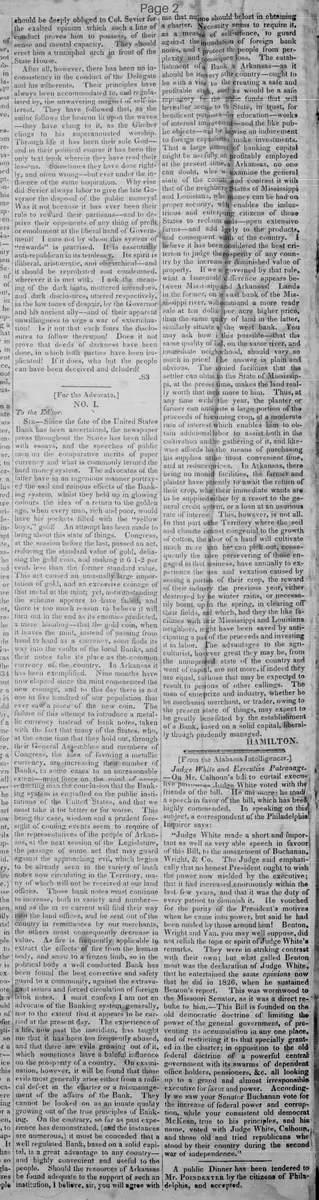
Sir—Since the fate of the United States Bank has been ascertained, the newspaper press throughout the States has been filled with essays, and the speeches of public men on the comparative merits of paper currency and what is commonly termed the hard money system. The advocates of the latter have in an ingenious manner portrayed the evil and ruinous effects of the Banking system, whilst they held up in glowing colours the idea of a return to the golden age, when every man, rich and poor, would have his pockets filled with the "yellow boys," gold! An attempt has been made to bring about this state of things. Congress, at the session before the last, passed an act, reducing the standard value of gold, debasing the gold coin, and making it 6 1-2 per cent. less than the former standard value. This act caused an unusually large importation of gold, and an excessive coinage of that metal at the mint; yet, notwithstanding the scheme appears to have failed, and there is too much reason to believe it will turn out in the end as its enemies predicted, a mere humbug—that the gold coin, when it leaves the mint, instead of passing from hand to hand as a currency, soon finds its way into the vaults of the local Banks, and their notes take its place as the common currency of the country. In Arkansas it has been exemplified. Nine months have now elapsed since the mint commenced the new coinage, and to this day there is not one in five hundred of our population that ever saw a piece of the new coin. The failure of this attempt to introduce a metallic currency instead of bank notes, taken with the fact that many of the States, who, at the same time that they hold out, through their General Assemblies and members of Congress, the idea of favoring a metallic currency, are increasing their number of Banks, in some cases to an unreasonable extent—must force on the mind of every reflecting man the conclusion that the Banking system is engrafted on the public institutions of the United States, and that we must take it for better or for worse. This being the case, wisdom and a prudent foresight of coming events seem to require of the representatives of the people of Arkansas, at the next session of the Legislature, the passage of some act that may guard against the approaching evil, which begins to be already seen in the variety of bank notes now circulating in the Territory, many of which will not be received at our land offices. Those bank notes must continue to increase, both in variety and number—and as the more current will find their way into the land offices, and be sent out of the country in remittances by our merchants, the others must consequently decrease in value. As fire is frequently applicable to extract the effects of fire from the human body, and snow to a frozen limb, so in the political body a well conducted Bank has been found the best corrective and safety guard to a community, against the extravagant issues and forced circulation of foreign bank notes. I must confess I am not an advocate of the Banking system generally, nor to the extent that it appears to be carried at the present day. The experience of a life, now past the meridian, has taught me that it has been too frequently abused, and that there are evils growing out of it, which sometimes have a baleful influence on the prosperity of a country. On examination, however, it will be found that those evils most generally arise either from a radical defect in the charter or a mismanagement of the affairs of the Bank. They cannot be looked on as an innate quality growing out of the true principles of Banking. On the contrary, so far as past experience has demonstrated, (and the instances are numerous,) it must be conceded that a well regulated Bank, based on a solid capital, is a great advantage to any country—and highly convenient and useful to the people. Should the resources of Arkansas be found adequate to the support of such an institution, I believe, sir, you will agree with me that no time should be lost in obtaining a charter. Necessity seems to require it, as a measure of self-defence, to guard against the inundation of foreign bank notes, and to protect the people from perplexity and consequent loss. The establishment of a Bank in Arkansas—as it should be in every other country—ought to be with a view to the creating a safe and profitable stock, such as would be a safe repository for the public funds that will hereafter accrue to the State, in trust, for beneficent purposes—or education—works of internal improvement—and the like public objects—and be likewise an inducement to foreign capitalists to make investments. That a large amount of banking capital might be usefully and profitably employed at the present time, in Arkansas, no one can doubt, who will examine the general state of the country and contrast it with that of the neighboring States of Mississippi and Louisiana, where money can be had on proper security, which enables the industrious and enterprising citizens of those States to reclaim lands—open extensive farms—and add largely to the products, and consequent wealth of the country. I believe it has been considered the best criterion to judge the prosperity of any country by the increase or diminished value of property. If we are governed by that rule, what a lamentable difference appears between Mississippi and Arkansas! Lands in the former, on the east bank of the Mississippi river, will command a more ready sale at ten dollars per acre higher price, than the same quality of land in the latter, similarly situate on the west bank. You may ask how is this possible—that the same quality of land, on the same river, and immediate neighborhood, should vary so much in price? The answer is plain and obvious. The united facilities that the settler can obtain in the State of Mississippi, at the present time, makes the land really worth that much more to him. Thus, at any time within the year, the planter or farmer can anticipate a large portion of the proceeds of his coming crop, at a moderate rate of interest which enables him to obtain additional labor to assist both in the cultivation and the gathering of it, and likewise affords him the means of purchasing his supplies at the most convenient time, and at reduced prices. In Arkansas, there being no moneyed facilities, the farmer and planter have patiently to await the return of their crop, while their immediate wants are to be supplied either by a resort to the general credit system, or a loan at an usurious rate of interest. This, however, is not all. In that part of the Territory where the soil and climate is most congenial to the growth of cotton, the labor of a hand will cultivate much more than he can pick out, consequently the more persevering of those engaged in that business, have annually to experience the loss and vexation caused by seeing a portion of their crop, the reward of their industry the previous year, either destroyed by the winter rains, or necessarily burnt up in the spring, in clearing off their fields, and which, had they the like facilities with their Mississippi and Louisiana neighbors, might have been saved by anticipating a part of the proceeds and investing it in labor. The advantages to the agriculturist, however great they may be, from the unimproved state of the country and want of capital, are not more, if indeed they are equal, to those that may be expected to result to persons of other callings. The man of enterprise and industry, whether he be mechanic, merchant, or trader, owing to the present state of things, may expect to be greatly benefited by the establishment of a Bank, based on a solid capital, liberally though prudently managed.
HAMILTON.
NO. I.
To the Editor:
Sir—Since the fate of the United States Bank has been ascertained, the newspaper press throughout the States has been filled with essays, and the speeches of public men on the comparative merits of paper currency and what is commonly termed the hard money system. The advocates of the latter have in an ingenious manner portrayed the evil and ruinous effects of the Banking system, whilst they held up in glowing colours the idea of a return to the golden age, when every man, rich and poor, would have his pockets filled with the "yellow boys," gold! An attempt has been made to bring about this state of things. Congress, at the session before the last, passed an act, reducing the standard value of gold, debasing the gold coin, and making it 6 1-2 per cent. less than the former standard value. This act caused an unusually large importation of gold, and an excessive coinage of that metal at the mint; yet, notwithstanding the scheme appears to have failed, and there is too much reason to believe it will turn out in the end as its enemies predicted, a mere humbug—that the gold coin, when it leaves the mint, instead of passing from hand to hand as a currency, soon finds its way into the vaults of the local Banks, and their notes take its place as the common currency of the country. In Arkansas it has been exemplified. Nine months have now elapsed since the mint commenced the new coinage, and to this day there is not one in five hundred of our population that ever saw a piece of the new coin. The failure of this attempt to introduce a metallic currency instead of bank notes, taken with the fact that many of the States, who, at the same time that they hold out, through their General Assemblies and members of Congress, the idea of favoring a metallic currency, are increasing their number of Banks, in some cases to an unreasonable extent—must force on the mind of every reflecting man the conclusion that the Banking system is engrafted on the public institutions of the United States, and that we must take it for better or for worse. This being the case, wisdom and a prudent foresight of coming events seem to require of the representatives of the people of Arkansas, at the next session of the Legislature, the passage of some act that may guard against the approaching evil, which begins to be already seen in the variety of bank notes now circulating in the Territory, many of which will not be received at our land offices. Those bank notes must continue to increase, both in variety and number—and as the more current will find their way into the land offices, and be sent out of the country in remittances by our merchants, the others must consequently decrease in value. As fire is frequently applicable to extract the effects of fire from the human body, and snow to a frozen limb, so in the political body a well conducted Bank has been found the best corrective and safety guard to a community, against the extravagant issues and forced circulation of foreign bank notes. I must confess I am not an advocate of the Banking system generally, nor to the extent that it appears to be carried at the present day. The experience of a life, now past the meridian, has taught me that it has been too frequently abused, and that there are evils growing out of it, which sometimes have a baleful influence on the prosperity of a country. On examination, however, it will be found that those evils most generally arise either from a radical defect in the charter or a mismanagement of the affairs of the Bank. They cannot be looked on as an innate quality growing out of the true principles of Banking. On the contrary, so far as past experience has demonstrated, (and the instances are numerous,) it must be conceded that a well regulated Bank, based on a solid capital, is a great advantage to any country—and highly convenient and useful to the people. Should the resources of Arkansas be found adequate to the support of such an institution, I believe, sir, you will agree with me that no time should be lost in obtaining a charter. Necessity seems to require it, as a measure of self-defence, to guard against the inundation of foreign bank notes, and to protect the people from perplexity and consequent loss. The establishment of a Bank in Arkansas—as it should be in every other country—ought to be with a view to the creating a safe and profitable stock, such as would be a safe repository for the public funds that will hereafter accrue to the State, in trust, for beneficent purposes—or education—works of internal improvement—and the like public objects—and be likewise an inducement to foreign capitalists to make investments. That a large amount of banking capital might be usefully and profitably employed at the present time, in Arkansas, no one can doubt, who will examine the general state of the country and contrast it with that of the neighboring States of Mississippi and Louisiana, where money can be had on proper security, which enables the industrious and enterprising citizens of those States to reclaim lands—open extensive farms—and add largely to the products, and consequent wealth of the country. I believe it has been considered the best criterion to judge the prosperity of any country by the increase or diminished value of property. If we are governed by that rule, what a lamentable difference appears between Mississippi and Arkansas! Lands in the former, on the east bank of the Mississippi river, will command a more ready sale at ten dollars per acre higher price, than the same quality of land in the latter, similarly situate on the west bank. You may ask how is this possible—that the same quality of land, on the same river, and immediate neighborhood, should vary so much in price? The answer is plain and obvious. The united facilities that the settler can obtain in the State of Mississippi, at the present time, makes the land really worth that much more to him. Thus, at any time within the year, the planter or farmer can anticipate a large portion of the proceeds of his coming crop, at a moderate rate of interest which enables him to obtain additional labor to assist both in the cultivation and the gathering of it, and likewise affords him the means of purchasing his supplies at the most convenient time, and at reduced prices. In Arkansas, there being no moneyed facilities, the farmer and planter have patiently to await the return of their crop, while their immediate wants are to be supplied either by a resort to the general credit system, or a loan at an usurious rate of interest. This, however, is not all. In that part of the Territory where the soil and climate is most congenial to the growth of cotton, the labor of a hand will cultivate much more than he can pick out, consequently the more persevering of those engaged in that business, have annually to experience the loss and vexation caused by seeing a portion of their crop, the reward of their industry the previous year, either destroyed by the winter rains, or necessarily burnt up in the spring, in clearing off their fields, and which, had they the like facilities with their Mississippi and Louisiana neighbors, might have been saved by anticipating a part of the proceeds and investing it in labor. The advantages to the agriculturist, however great they may be, from the unimproved state of the country and want of capital, are not more, if indeed they are equal, to those that may be expected to result to persons of other callings. The man of enterprise and industry, whether he be mechanic, merchant, or trader, owing to the present state of things, may expect to be greatly benefited by the establishment of a Bank, based on a solid capital, liberally though prudently managed.
HAMILTON.
What sub-type of article is it?
Persuasive
Informative
Political
What themes does it cover?
Economic Policy
Commerce Trade
Agriculture
What keywords are associated?
Banking System
Metallic Currency
Arkansas Bank
Paper Money
Economic Development
Agriculture Finance
Public Funds
What entities or persons were involved?
Hamilton
The Editor
Letter to Editor Details
Author
Hamilton
Recipient
The Editor
Main Argument
given the entrenched banking system and failure of metallic currency, arkansas should charter a well-regulated local bank to defend against foreign notes, safeguard public funds, and enable economic development like in neighboring states.
Notable Details
Critique Of 1834 Gold Standard Act As A 'Humbug'
Comparison Of Land Values And Farming Facilities In Arkansas Vs. Mississippi And Louisiana
Analogy Of Bank As Corrective To Foreign Notes Like Fire To Fire