Thank you for visiting SNEWPapers!
Sign up free
Letter to Editor
July 10, 1815
Portland Gazette, And Maine Advertiser
Portland, Cumberland County, Maine
What is this article about?
An anonymous contributor to the Portland Gazette argues that teachers should leverage children's natural imitative tendencies to teach English grammar by having students copy from approved authors or write compositions, citing specific schoolbooks like the Columbian Orator, and criticizes current ineffective methods.
Clipping
OCR Quality
98%
Excellent
Full Text
MISCELLANY.
FOR THE PORTLAND GAZETTE.
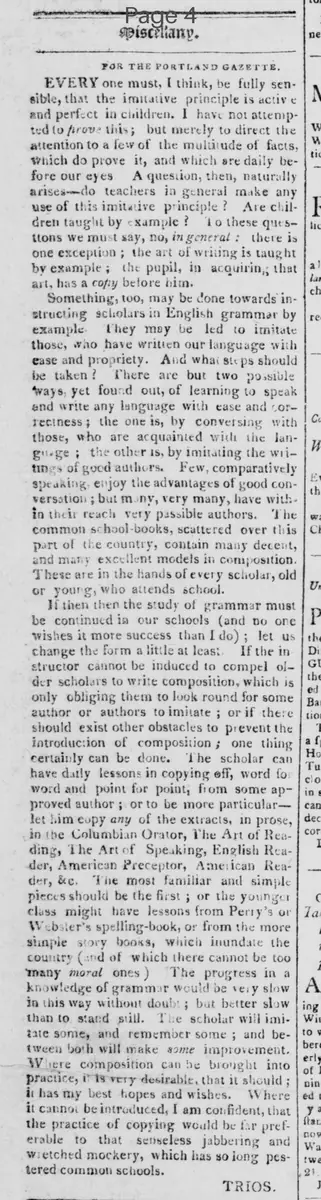
EVERY one must, I think, be fully sensible, that the imitative principle is active and perfect in children. I have not attempted to prove this; but merely to direct the attention to a few of the multitude of facts, which do prove it, and which are daily before our eyes. A question, then, naturally arises—do teachers in general make any use of this imitative principle? Are children taught by example? To these questions we must say, no, in general: there is one exception; the art of writing is taught by example; the pupil, in acquiring that art, has a copy before him.
Something, too, may be done towards instructing scholars in English grammar by example. They may be led to imitate those, who have written our language with ease and propriety. And what steps should be taken? There are but two possible ways, yet found out, of learning to speak and write any language with ease and correctness; the one is, by conversing with those, who are acquainted with the language: the other is, by imitating the writings of good authors. Few, comparatively speaking enjoy the advantages of good conversation; but many, very many, have within their reach very passable authors. The common school-books, scattered over this part of the country, contain many decent, and many excellent models in composition.
These are in the hands of every scholar, old or young, who attends school.
If then the study of grammar must be continued in our schools (and no one wishes it more success than I do); let us change the form a little at least. If the instructor cannot be induced to compel older scholars to write compositions, which is only obliging them to look round for some author or authors to imitate; or if there should exist other obstacles to prevent the introduction of composition; one thing certainly can be done. The scholar can have daily lessons in copying off, word for word and point for point, from some approved author; or to be more particular—let him copy any of the extracts, in prose, in the Columbian Orator, The Art of Reading, The Art of Speaking, English Reader, American Preceptor, American Reader, &c. The most familiar and simple pieces should be the first; or the younger class might have lessons from Perry's or Webster's spelling-book, or from the more simple story books, which inundate the country (and of which there cannot be too many moral ones). The progress in a knowledge of grammar would be very slow in this way without doubt; but better slow than to stand still. The scholar will imitate some, and remember some; and between both will make some improvement.
Where composition can be brought into practice, it is very desirable, that it should; it has my best hopes and wishes. Where it cannot be introduced, I am confident, that the practice of copying would be far preferable to that senseless jabbering and wretched mockery, which has so long pestered common schools.
FOR THE PORTLAND GAZETTE.
EVERY one must, I think, be fully sensible, that the imitative principle is active and perfect in children. I have not attempted to prove this; but merely to direct the attention to a few of the multitude of facts, which do prove it, and which are daily before our eyes. A question, then, naturally arises—do teachers in general make any use of this imitative principle? Are children taught by example? To these questions we must say, no, in general: there is one exception; the art of writing is taught by example; the pupil, in acquiring that art, has a copy before him.
Something, too, may be done towards instructing scholars in English grammar by example. They may be led to imitate those, who have written our language with ease and propriety. And what steps should be taken? There are but two possible ways, yet found out, of learning to speak and write any language with ease and correctness; the one is, by conversing with those, who are acquainted with the language: the other is, by imitating the writings of good authors. Few, comparatively speaking enjoy the advantages of good conversation; but many, very many, have within their reach very passable authors. The common school-books, scattered over this part of the country, contain many decent, and many excellent models in composition.
These are in the hands of every scholar, old or young, who attends school.
If then the study of grammar must be continued in our schools (and no one wishes it more success than I do); let us change the form a little at least. If the instructor cannot be induced to compel older scholars to write compositions, which is only obliging them to look round for some author or authors to imitate; or if there should exist other obstacles to prevent the introduction of composition; one thing certainly can be done. The scholar can have daily lessons in copying off, word for word and point for point, from some approved author; or to be more particular—let him copy any of the extracts, in prose, in the Columbian Orator, The Art of Reading, The Art of Speaking, English Reader, American Preceptor, American Reader, &c. The most familiar and simple pieces should be the first; or the younger class might have lessons from Perry's or Webster's spelling-book, or from the more simple story books, which inundate the country (and of which there cannot be too many moral ones). The progress in a knowledge of grammar would be very slow in this way without doubt; but better slow than to stand still. The scholar will imitate some, and remember some; and between both will make some improvement.
Where composition can be brought into practice, it is very desirable, that it should; it has my best hopes and wishes. Where it cannot be introduced, I am confident, that the practice of copying would be far preferable to that senseless jabbering and wretched mockery, which has so long pestered common schools.
What sub-type of article is it?
Persuasive
Informative
What themes does it cover?
Education
What keywords are associated?
Education Reform
Grammar Teaching
Imitative Principle
School Composition
Copying Exercises
Common Schools
Letter to Editor Details
Main Argument
teachers should teach english grammar by encouraging imitation through copying from good authors or writing compositions, using accessible schoolbooks, as this is more effective than current rote methods.
Notable Details
Mentions Specific Books: Columbian Orator, The Art Of Reading, The Art Of Speaking, English Reader, American Preceptor, American Reader, Perry's Or Webster's Spelling Book