Thank you for visiting SNEWPapers!
Sign up free
Letter to Editor
April 2, 1813
The Enquirer
Richmond, Henrico County, Virginia
What is this article about?
A supporter defends Congressman Clopton against attacks from opponent Morris in the Virginia congressional district election, highlighting Clopton's opposition to British impressment, his war preparedness votes, and criticizing the exploitation of Clopton's illness.
Clipping
OCR Quality
98%
Excellent
Full Text
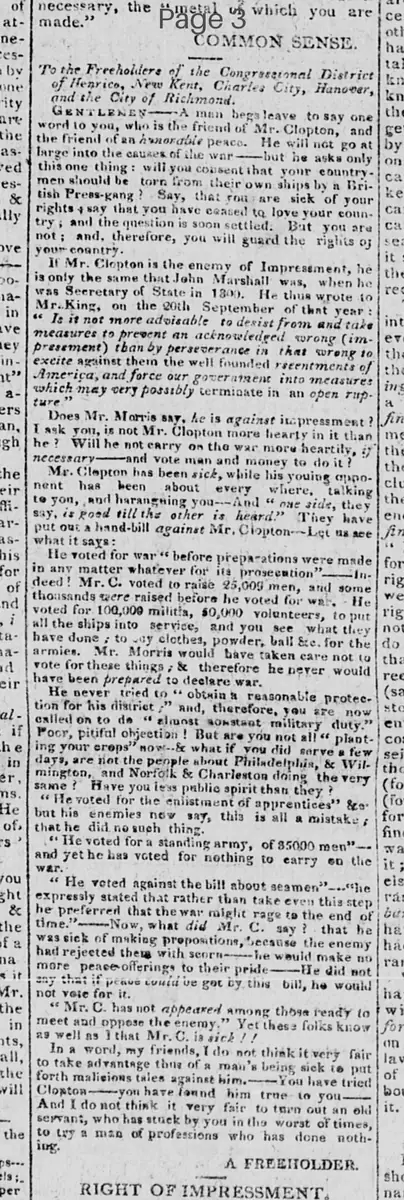
COMMON SENSE.
To the Freeholders of the Congressional District of Henrico, New Kent, Charles City, Hanover, and the City of Richmond.
Gentlemen—A man begs leave to say one word to you, who is the friend of Mr. Clopton, and the friend of an honorable peace. He will not go at large into the causes of the war—but he asks only this one thing: will you consent that your countrymen should be torn from their own ships by a British Press-gang? Say, that you are sick of your rights; say that you have ceased to love your country; and the question is soon settled. But you are not; and, therefore, you will guard the rights of your country.
If Mr. Clopton is the enemy of Impressment, he is only the same that John Marshall was, when he was Secretary of State in 1800. He thus wrote to Mr. King, on the 20th September of that year:
"Is it not more advisable to desist from and take measures to prevent an acknowledged wrong (impressment) than by perseverance in that wrong to excite against them the well founded resentments of America, and force our government into measures which may very possibly terminate in an open rupture"
Does Mr. Morris say, he is against impressment? I ask you, is not Mr. Clopton more hearty in it than he? will he not carry on the war more heartily, and vote men and money to do it?
Mr. Clopton has been sick, while his young opponent has been about every where, talking to you, and haranguing you—and "one side, they say, is good till the other is heard?" They have put out a hand-bill against Mr. Clopton—Let us see what it says:
He voted for war "before preparations were made in any matter whatever for its prosecution"—Indeed! Mr. C. voted to raise 25,000 men, and some thousands were raised before he voted for war. He voted for 100,000 militia, 50,000 volunteers, to put all the ships into service, and you see what they have done; to buy clothes, powder, ball &c. for the armies. Mr. Morris would have taken care not to vote for these things; & therefore he never would have been prepared to declare war.
He never tried to "obtain a reasonable protection for his district," and, therefore, you are now called on to do "almost constant military duty."
Poor, pitiful objection! But are you not all "planting your crops" now—& what if you did serve a few days, are not the people about Philadelphia, & Wilmington, and Norfolk & Charleston doing the very same? Have you less public spirit than they?
"He voted for the enlistment of apprentices" &c. but his enemies now say, this is all a mistake; that he did no such thing.
"He voted for a standing army, of 25,000 men"—and yet he has voted for nothing to carry on the war.
"He voted against the bill about seamen"—"he expressly stated that rather than take even this step he preferred that the war might rage to the end of time."—Now, what did Mr. C. say? that he was sick of making propositions, because the enemy had rejected them with scorn—he would make no more peace-offerings to their pride—He did not say that if peace could be got by this bill, he would not vote for it.
"Mr. C. has not appeared among those ready to meet and oppose the enemy." Yet these folks know as well as I that Mr. C. is sick!!
In a word, my friends, I do not think it very fair to take advantage thus of a man's being sick to put forth malicious tales against him. You have tried Clopton—or you have found him true to you.
And I do not think it very fair to turn out an old servant, who has stuck by you in the worst of times, to try a man of professions who has done nothing.
A FREEHOLDER.
To the Freeholders of the Congressional District of Henrico, New Kent, Charles City, Hanover, and the City of Richmond.
Gentlemen—A man begs leave to say one word to you, who is the friend of Mr. Clopton, and the friend of an honorable peace. He will not go at large into the causes of the war—but he asks only this one thing: will you consent that your countrymen should be torn from their own ships by a British Press-gang? Say, that you are sick of your rights; say that you have ceased to love your country; and the question is soon settled. But you are not; and, therefore, you will guard the rights of your country.
If Mr. Clopton is the enemy of Impressment, he is only the same that John Marshall was, when he was Secretary of State in 1800. He thus wrote to Mr. King, on the 20th September of that year:
"Is it not more advisable to desist from and take measures to prevent an acknowledged wrong (impressment) than by perseverance in that wrong to excite against them the well founded resentments of America, and force our government into measures which may very possibly terminate in an open rupture"
Does Mr. Morris say, he is against impressment? I ask you, is not Mr. Clopton more hearty in it than he? will he not carry on the war more heartily, and vote men and money to do it?
Mr. Clopton has been sick, while his young opponent has been about every where, talking to you, and haranguing you—and "one side, they say, is good till the other is heard?" They have put out a hand-bill against Mr. Clopton—Let us see what it says:
He voted for war "before preparations were made in any matter whatever for its prosecution"—Indeed! Mr. C. voted to raise 25,000 men, and some thousands were raised before he voted for war. He voted for 100,000 militia, 50,000 volunteers, to put all the ships into service, and you see what they have done; to buy clothes, powder, ball &c. for the armies. Mr. Morris would have taken care not to vote for these things; & therefore he never would have been prepared to declare war.
He never tried to "obtain a reasonable protection for his district," and, therefore, you are now called on to do "almost constant military duty."
Poor, pitiful objection! But are you not all "planting your crops" now—& what if you did serve a few days, are not the people about Philadelphia, & Wilmington, and Norfolk & Charleston doing the very same? Have you less public spirit than they?
"He voted for the enlistment of apprentices" &c. but his enemies now say, this is all a mistake; that he did no such thing.
"He voted for a standing army, of 25,000 men"—and yet he has voted for nothing to carry on the war.
"He voted against the bill about seamen"—"he expressly stated that rather than take even this step he preferred that the war might rage to the end of time."—Now, what did Mr. C. say? that he was sick of making propositions, because the enemy had rejected them with scorn—he would make no more peace-offerings to their pride—He did not say that if peace could be got by this bill, he would not vote for it.
"Mr. C. has not appeared among those ready to meet and oppose the enemy." Yet these folks know as well as I that Mr. C. is sick!!
In a word, my friends, I do not think it very fair to take advantage thus of a man's being sick to put forth malicious tales against him. You have tried Clopton—or you have found him true to you.
And I do not think it very fair to turn out an old servant, who has stuck by you in the worst of times, to try a man of professions who has done nothing.
A FREEHOLDER.
What sub-type of article is it?
Persuasive
Political
Informative
What themes does it cover?
Politics
Military War
What keywords are associated?
Clopton Support
Impressment Opposition
War Preparations
Election District
British Press Gang
Congressional Vote
What entities or persons were involved?
A Freeholder
To The Freeholders Of The Congressional District Of Henrico, New Kent, Charles City, Hanover, And The City Of Richmond
Letter to Editor Details
Author
A Freeholder
Recipient
To The Freeholders Of The Congressional District Of Henrico, New Kent, Charles City, Hanover, And The City Of Richmond
Main Argument
electors should support mr. clopton over mr. morris, as clopton has consistently opposed impressment, voted for necessary war preparations, and his illness should not be exploited by opponents' false attacks.
Notable Details
Quotes John Marshall's 1800 Letter On Impressment
Defends Clopton's Votes For 25,000 Men, 100,000 Militia, 50,000 Volunteers
Criticizes Hand Bill Attacks On Clopton's War Votes And District Protection