Thank you for visiting SNEWPapers!
Sign up free
Editorial
May 1, 1802
The Recorder, Or, Lady's And Gentleman's Miscellany
Richmond, Virginia
What is this article about?
Editorial from Providence Gazette defends printers' suitability for postmaster roles, citing historical examples like Benjamin Franklin and their crucial role in the American Revolution, while criticizing Postmaster-General Gideon Granger for excluding them and adding insult to existing taxes on newspapers.
Clipping
OCR Quality
95%
Excellent
Full Text
From the Providence Gazette.
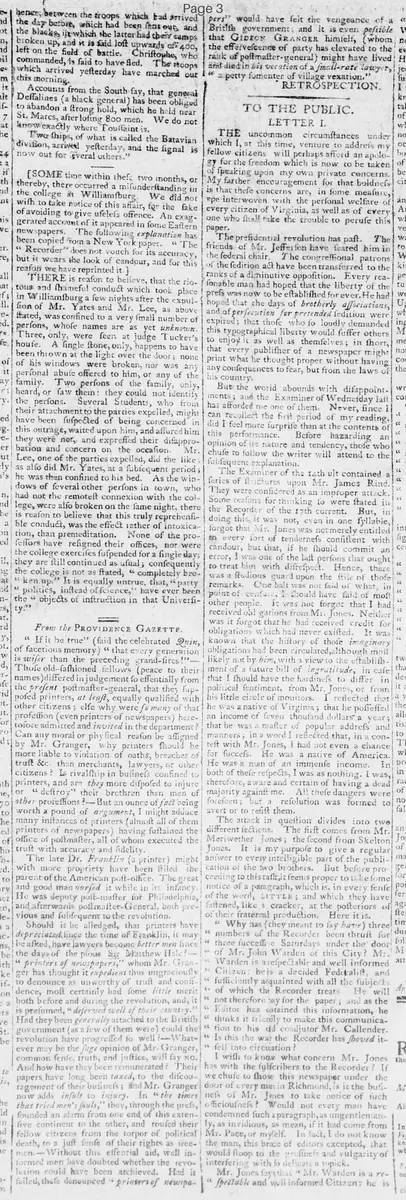
"If it be true" (said the celebrated Quin, of facetious memory) "that every generation is wiser than the preceding grand-sires!" Those old-fashioned fellows (peace to their names) differed in judgement so essentially from the present postmaster-general, that they supposed printers, at least, equally qualified with other citizens; else why were so many of that profession (even printers of newspapers) heretofore admitted and invited in the department? Can any moral or physical reason be assigned by Mr. Granger, why printers should be more liable to violation of oaths, breaches of trust &c. than merchants, lawyers, or other citizens? Is rivalry in business confined to printers, and are they more disposed to injure or "destroy" their brethren than men of other professions?--But an ounce of fact being worth a pound of argument, I might adduce many instances of printers (almost all of them printers of newspapers) having sustained the office of postmaster, all of whom executed the trust with accuracy and fidelity. The late Dr. Franklin (a printer) might with more propriety have been styled the parent of the American post-office. The great and good man nursed it while in its infancy. He was deputy post-master for Philadelphia, and afterwards postmaster-General, both previous and subsequent to the revolution. Should it be alleged, that printers have depreciated since the time of Franklin, it may be asked, have lawyers become better men since the days of the pious Sir Matthew Hale?-- "printers of newspapers," whom Mr. Granger has thought it expedient thus ungraciously to denounce as unworthy of trust and confidence, most certainly had some little merit both before and during the revolution, and, it is presumed, "deserved well of their country." Had they been generally attached to the British government (as a few of them were) could the revolution have progressed so well?--Whatever may be the sage opinion of Mr. Granger, common sense, truth, and justice, will say No. And how have they been remunerated? Their papers have long been taxed, to the discouragement of their business; and Mr. Granger now adds insult to injury. In "the times that tried men's souls," they, through the press, sounded an alarm from one end of this extensive continent to the other, and roused their fellow citizens from the torpor of political death, to a just sense of their rights as freemen.--Without this essential aid, well-informed men have doubted whether the revolution could have been achieved. Had it failed, those denounced "printers of newspapers" would have felt the vengeance of a British government; and it is even possible that Gideon Granger himself, (whom the effervescence of party has elevated to the rank of postmaster-general) might have lived and died in his vocation of a small-rate lawyer, a petty fomenter of village vexation.
"If it be true" (said the celebrated Quin, of facetious memory) "that every generation is wiser than the preceding grand-sires!" Those old-fashioned fellows (peace to their names) differed in judgement so essentially from the present postmaster-general, that they supposed printers, at least, equally qualified with other citizens; else why were so many of that profession (even printers of newspapers) heretofore admitted and invited in the department? Can any moral or physical reason be assigned by Mr. Granger, why printers should be more liable to violation of oaths, breaches of trust &c. than merchants, lawyers, or other citizens? Is rivalry in business confined to printers, and are they more disposed to injure or "destroy" their brethren than men of other professions?--But an ounce of fact being worth a pound of argument, I might adduce many instances of printers (almost all of them printers of newspapers) having sustained the office of postmaster, all of whom executed the trust with accuracy and fidelity. The late Dr. Franklin (a printer) might with more propriety have been styled the parent of the American post-office. The great and good man nursed it while in its infancy. He was deputy post-master for Philadelphia, and afterwards postmaster-General, both previous and subsequent to the revolution. Should it be alleged, that printers have depreciated since the time of Franklin, it may be asked, have lawyers become better men since the days of the pious Sir Matthew Hale?-- "printers of newspapers," whom Mr. Granger has thought it expedient thus ungraciously to denounce as unworthy of trust and confidence, most certainly had some little merit both before and during the revolution, and, it is presumed, "deserved well of their country." Had they been generally attached to the British government (as a few of them were) could the revolution have progressed so well?--Whatever may be the sage opinion of Mr. Granger, common sense, truth, and justice, will say No. And how have they been remunerated? Their papers have long been taxed, to the discouragement of their business; and Mr. Granger now adds insult to injury. In "the times that tried men's souls," they, through the press, sounded an alarm from one end of this extensive continent to the other, and roused their fellow citizens from the torpor of political death, to a just sense of their rights as freemen.--Without this essential aid, well-informed men have doubted whether the revolution could have been achieved. Had it failed, those denounced "printers of newspapers" would have felt the vengeance of a British government; and it is even possible that Gideon Granger himself, (whom the effervescence of party has elevated to the rank of postmaster-general) might have lived and died in his vocation of a small-rate lawyer, a petty fomenter of village vexation.
What sub-type of article is it?
Press Freedom
Partisan Politics
What keywords are associated?
Press Freedom
Printers Rights
Postmaster General
American Revolution
Gideon Granger
Newspaper Taxation
What entities or persons were involved?
Gideon Granger
Dr. Franklin
Quin
Sir Matthew Hale
Printers Of Newspapers
British Government
Editorial Details
Primary Topic
Defense Of Printers Against Exclusion From Postmaster Roles By Gideon Granger
Stance / Tone
Strongly Pro Printers And Anti Granger, Patriotic
Key Figures
Gideon Granger
Dr. Franklin
Quin
Sir Matthew Hale
Printers Of Newspapers
British Government
Key Arguments
Printers Are As Qualified And Trustworthy As Other Citizens For Postmaster Roles
Historical Examples Like Franklin Show Printers' Fidelity In Office
Newspaper Printers Played Vital Role In American Revolution By Rousing Public To Rights
Granger's Exclusion Adds Insult To Existing Taxes On Newspapers
Without Press Aid, Revolution Might Have Failed