Thank you for visiting SNEWPapers!
Sign up free
Alexandria Daily Gazette, Commercial & Political
Alexandria, Virginia
What is this article about?
U.S. Senate debate on repealing the Embargo Act in November 1808. Mr. S. Smith defends the policy against British orders in council, citing Mr. Canning's response. Mr. Crawford represents Georgia's support despite economic hardships, viewing it as alternative to war.
Merged-components note: Continuation of the congressional debate on the embargo, with text flowing directly from one to the next across the components.
Clipping
OCR Quality
Full Text
Senate of the United States.
Tuesday, November 22.
EMBARGO.
On the motion of Mr. Hillhouse for a repeal.
[CONTINUED.]
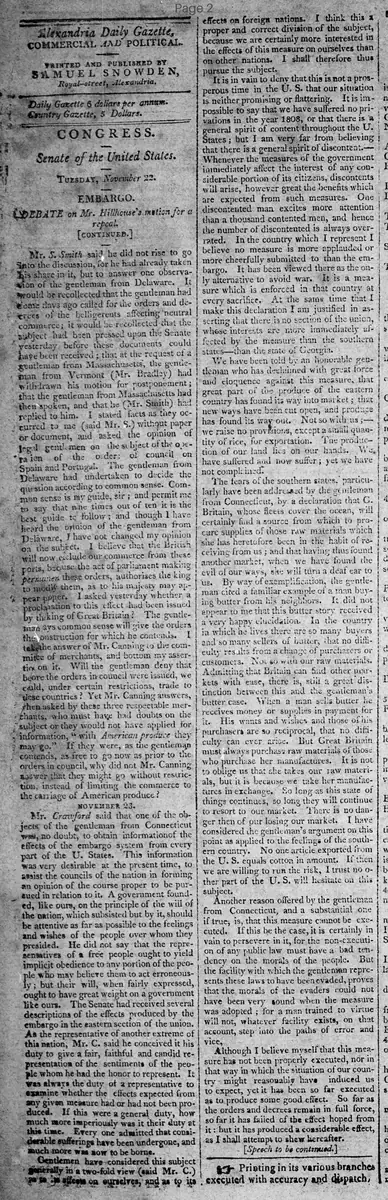
Mr. S. Smith said he did not rise to go into the discussion, for he had already taken his share in it, but to answer one observation of the gentleman from Delaware. It would be recollected that the gentleman had some days ago called for the orders and decrees of the belligerents affecting neutral commerce; it would be recollected that the subject had been pressed upon the Senate yesterday before these documents could have been received: that at the request of a gentleman from Massachusetts, the gentleman from Vermont (Mr. Bradley) had withdrawn his motion for postponement; that the gentleman from Massachusetts had then spoken, and that he (Mr. Smith) had replied to him. I stated facts as they occurred to me (said Mr. S.) without paper or document, and asked the opinion of rational men on the orders in council on legal gentlemen on the subject of the operations of Spain and Portugal. The gentleman from Delaware had undertaken to decide the question according to common sense. Common sense is my guide, sir; and permit me to say that nine times out of ten it is the best guide to follow; and though I have heard the opinion of the gentleman from Delaware, I have not changed my opinion on the subject. I believe that the British will now exclude our commerce from these ports, because the act of parliament making permanent these orders, authorises the king to modify them, as to his majesty may appear proper. I asked yesterday whether a proclamation to this effect had been issued by the king of Great Britain? The gentleman says common sense will give the orders the construction for which he contends. I take the answer of Mr. Canning to the committee of merchants, and bottom my assertion on it. Will the gentleman deny that before the orders in council were issued, we could, under certain restrictions, trade to these countries? Yet Mr. Canning answers, when asked by these three respectable merchants, who must have had doubts on the subject or they would not have applied for information, 'with American produce they may go.' If they were, as the gentleman contends, as free to go now as prior to the orders in council, why did not Mr. Canning answer that they might go without restriction, instead of limiting the commerce to the carriage of American produce?
NOVEMBER 23.
Mr. Crawford said that one of the objects of the gentleman from Connecticut was, no doubt, to obtain information of the effects of the embargo system from every part of the U. States. This information was very desirable at the present time, to assist the councils of the nation in forming an opinion of the course proper to be pursued in relation to it. A government founded, like ours, on the principle of the will of the nation, which subsisted but by it, should be attentive as far as possible to the feelings and wishes of the people over whom they presided. He did not say that the representatives of a free people ought to yield implicit obedience to any portion of the people who may believe them to act erroneously; but their will, when fairly expressed, ought to have great weight on a government like ours. The Senate had received several descriptions of the effects produced by the embargo in the eastern section of the union. As the representative of another extreme of this nation, Mr. C. said he conceived it his duty to give a fair, faithful and candid representation of the sentiments of the people whom he had the honor to represent. It was always the duty of a representative to examine whether the effects expected from any given measure had or had not been produced. If this were a general duty, how much more imperiously was it their duty at this time. Every one admitted that considerable sufferings have been undergone, and much more was now to be borne. Gentlemen have considered this subject generally in a two-fold view (said Mr. C.) as to a effect on ourselves, and as to its
effects on foreign nations. I think this a proper and correct division of the subject, because we are certainly more interested in the effects of this measure on ourselves than on other nations. I shall therefore thus pursue the subject.
It is in vain to deny that this is not a prosperous time in the U. S. that our situation is neither promising or flattering. It is impossible to say that we have suffered no privations in the year 1808, or that there is a general spirit of content throughout the U. States; but I am very far from believing that there is a general spirit of discontent. Whenever the measures of the government immediately affect the interest of any considerable portion of its citizens, discontents will arise, however great the benefits which are expected from such measures. One discontented man excites more attention than a thousand contented men, and hence the number of discontented is always over-rated. In the country which I represent I believe no measure is more applauded or more cheerfully submitted to than the embargo. It has been viewed there as the only alternative to avoid war. It is a measure which is enforced in that country at every sacrifice. At the same time that I make this declaration I am justified in asserting that there is no section of the union, whose interests are more immediately affected by the measure than the southern states--than the state of Georgia.
We have been told by an honorable gentleman who has declaimed with great force and eloquence against this measure, that great part of the produce of the eastern country has found its way into market; that new ways have been cut open, and produce has found its way out. Not so with us; we raise no provisions, except a small quantity of rice, for exportation. The production of our land lies on our hands. We have suffered and now suffer; yet we have not complained.
The fears of the southern states, particularly have been addressed by the gentleman from Connecticut, by a declaration that G. Britain, whose fleets cover the ocean, will certainly find a source from which to procure supplies of those raw materials which she has heretofore been in the habit of receiving from us; and that having thus found another market, when we have found the evil of our ways, she will turn a deaf ear to us. By way of exemplification, the gentleman cited a familiar example of a man buying butter from his neighbors. It did not appear to me that this butter story received a very happy elucidation. In the country in which he lives there are so many buyers and so many sellers of butter, that no difficulty results from a change of purchasers or customers. Not so with our raw materials. Admitting that Britain can find other markets with ease, there is, still a great distinction between this and the gentleman's butter case. When a man sells butter he receives money or supplies in payment for it. His wants and wishes and those of his purchaser are so reciprocal, that no difficulty can ever arise. But Great Britain must always purchase raw materials of those who purchase her manufactures. It is not to oblige us that she takes our raw materials, but it is because we take her manufactures in exchange. So long as this state of things continues, so long they will continue to resort to our market. There is no danger then of our losing our market. I have considered the gentleman's argument on this point as applied to the feelings of the southern country. No one article exported from the U. S. equals cotton in amount. If then we are willing to run the risk, I trust no other part of the U. S. will hesitate on this subject.
Another reason offered by the gentleman from Connecticut, and a substantial one if true; is, that this measure cannot be executed. If this be the case, it is certainly in vain to persevere in it, for the non-execution of any public law must have a bad tendency on the morals of the people. But the facility with which the gentleman represents these laws to have been evaded, proves that the morals of the evaders could not have been very sound when the measure was adopted; for a man trained to virtue will not, whatever facility exists, on that account, step into the paths of error and vice.
Although I believe myself that this measure has not been properly executed, nor in that way in which the situation of our country might reasonably have induced us to expect, yet it has been so far executed as to produce some good effect. So far as the orders and decrees remain in full force, so far it has failed of the effect hoped from it: but it has produced a considerable effect, as I shall attempt to shew hereafter.
[Speech to be continued.]
Printing in its various branches executed with accuracy and dispatch,
What sub-type of article is it?
What themes does it cover?
What keywords are associated?
What entities or persons were involved?
Where did it happen?
Story Details
Key Persons
Location
Senate Of The United States
Event Date
November 22, 1808; November 23, 1808
Story Details
Debate on motion to repeal the Embargo. Mr. S. Smith defends against British orders in council using common sense and Mr. Canning's statements. Mr. Crawford describes Georgia's support for the embargo as alternative to war, despite economic impacts on southern states, and refutes arguments on market loss and enforcement.