Thank you for visiting SNEWPapers!
Sign up free
Letter to Editor
December 23, 1823
American Watchman And Delaware Advertiser
Wilmington, New Castle County, Delaware
What is this article about?
In a letter to the Editor of the Watchman, 'Brindley' refutes claims that Mr. Fairlamb's 'side chambers' for saving water in canal locks represent a new discovery, asserting the principle has been used in Europe for over a century via side ponds, and argues Fairlamb's version is not an improvement. Dated Dec. 17, 1823.
Clipping
OCR Quality
95%
Excellent
Full Text
To the Editor of the Watchman.
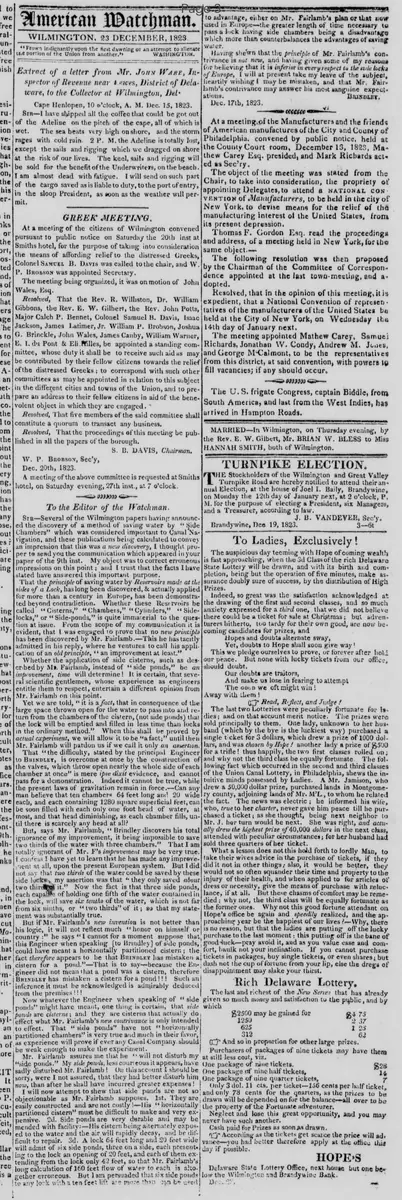
Sir—Several of the Wilmington papers having announced the discovery of a method of saving water by "Side Chambers" which was considered important to Canal Navigation, and these publications being calculated to convey an impression that this was a new discovery, I thought proper to send you the communication which appeared in your paper of the 9th inst. My object was to correct erroneous impressions on this point; and I trust that the facts I have stated have answered this important purpose.
That the principle of saving water by Reservoirs made at the sides of a Lock, has long been discovered, & actually applied for more than a century in Europe, has been demonstrated beyond contradiction. Whether these Reservoirs be called "Cisterns," "Chambers," "Cylinders," "Side locks," or "Side-ponds," is quite immaterial to the question at issue. From the scope of my communication it is evident, that I was engaged to prove that no new principle has been discovered by Mr. Fairlamb.—This he has tacitly admitted in his reply, where he ventures to call his application of an old principle, "an improvement at least."
Whether the application of side cisterns, such as described by Mr. Fairlamb, instead of "side ponds," be an improvement, time will determine! It is certain, that several scientific gentlemen, whose experience as engineers entitle them to respect, entertain a different opinion from Mr. Fairlamb on this point.
Yet we are told, "it is a fact, that in consequence of the large space thrown open for the water to pass unto and return from the chambers of the cistern, (not side ponds) that the lock will be emptied and filled in less time than locks in the ordinary method." When this shall be proved by actual experiment, we will allow it to be "a fact;" until then Mr. Fairlamb will pardon us if we call it only an assertion.
That "the difficulty, stated by the principal Engineer to Brindley, is overcome at once by the construction of the valves, which throw open nearly the whole side of each chamber at once" is mere ipse dixit evidence, and cannot pass for a demonstration. Indeed it cannot be true, while the present laws of gravitation remain in force.—Can any man believe that ten chambers 64 feet long and 20 wide each, and each containing 1280 square superficial feet, can be soon filled with each only one foot head of water, at most, and that head diminishing, as each chamber fills, until there is scarcely any head at all?
But, says Mr. Fairlamb, "Brindley discovers his total ignorance of my improvement, it being impossible to save two thirds of the water with three chambers." That I am totally ignorant of Mr. F's improvement may be very true. I confess I have yet to learn that he has made any improvement at all, upon the present European system. But I did not say that two thirds of the water could be saved by these side locks, my assertion was that "they only saved about two third of it." Now the fact is that three side ponds, each capable of holding one fifth of the water contained in the lock, will save six tenths of the water, which is not far from six ninths, or "two thirds" of it; so that my statement was substantially true.
But if Mr. Fairlamb's new invention is not better than his logic, it will not reflect much "honor on himself or country:" he says "I cannot for a moment suppose that this Engineer when speaking [to Brindley] of side ponds, could have meant a horizontally partitioned cistern; the fact therefore appears to be that Brindley has mistaken a cistern for a pond."—That is to say—because the Engineer did not mean that a pond was a cistern, therefore Brindley has mistaken a cistern for a pond!!! Such an inference it must be acknowledged is admirably deduced from the premises!!!
Now whatever the Engineer when speaking of "side ponds" might have meant, one thing is certain, that side ponds are cisterns; and they are cisterns that actually do effect what Mr. Fairlamb's new contrivance is only intended to effect. That "side ponds" have not "horizontally partitioned chambers" is very true and much in their favor, as experience will prove if ever any Canal Company should be weak enough to make the experiment.
Mr. Fairlamb assures me that he "will not disturb my side ponds." My side ponds, less courteous it appears, have sadly disturbed Mr. Fairlamb! On this account I should be sorry, were I not assured, that they had better disturb him now, than after he shall have incurred greater expenses!
I will now attempt to shew that side ponds are not so objectionable as Mr. Fairlamb supposes. 1st. They are easily constructed and are not costly!—His "horizontally partitioned cistern" must be difficult to make and very expensive. 2d. Side ponds are very durable and may be mended with facility:—His cistern being alternately exposed to the water and the air will rapidly decay, and be difficult to repair. 3d. A lock 64 feet long and 20 feet wide will admit of six side ponds, three on a side, each presenting to the lock an opening of 20 feet, and each of them extending from the lock only 42 feet, so that Mr. Fairlamb's long calculation of 160 feet flow of water to each is altogether erroneous. But I am persuaded that six side ponds to any lock with a ten feet lift are more than can be used to advantage, either on Mr. Fairlamb's plan or that now used in Europe—the greater length of time necessary to pass a lock having side chambers being a disadvantage which more than counterbalances the advantages of saving water.
Having shewn that the principle of Mr. Fairlamb's contrivance is not new, and having given some of my reasons for believing that it is inferior in every respect to the side locks of Europe, I will at present take my leave of the subject, heartily wishing I may be mistaken, and that Mr. Fairlamb's contrivance may answer his most sanguine expectations.
BRINDLEY,
Dec. 17th, 1823.
Sir—Several of the Wilmington papers having announced the discovery of a method of saving water by "Side Chambers" which was considered important to Canal Navigation, and these publications being calculated to convey an impression that this was a new discovery, I thought proper to send you the communication which appeared in your paper of the 9th inst. My object was to correct erroneous impressions on this point; and I trust that the facts I have stated have answered this important purpose.
That the principle of saving water by Reservoirs made at the sides of a Lock, has long been discovered, & actually applied for more than a century in Europe, has been demonstrated beyond contradiction. Whether these Reservoirs be called "Cisterns," "Chambers," "Cylinders," "Side locks," or "Side-ponds," is quite immaterial to the question at issue. From the scope of my communication it is evident, that I was engaged to prove that no new principle has been discovered by Mr. Fairlamb.—This he has tacitly admitted in his reply, where he ventures to call his application of an old principle, "an improvement at least."
Whether the application of side cisterns, such as described by Mr. Fairlamb, instead of "side ponds," be an improvement, time will determine! It is certain, that several scientific gentlemen, whose experience as engineers entitle them to respect, entertain a different opinion from Mr. Fairlamb on this point.
Yet we are told, "it is a fact, that in consequence of the large space thrown open for the water to pass unto and return from the chambers of the cistern, (not side ponds) that the lock will be emptied and filled in less time than locks in the ordinary method." When this shall be proved by actual experiment, we will allow it to be "a fact;" until then Mr. Fairlamb will pardon us if we call it only an assertion.
That "the difficulty, stated by the principal Engineer to Brindley, is overcome at once by the construction of the valves, which throw open nearly the whole side of each chamber at once" is mere ipse dixit evidence, and cannot pass for a demonstration. Indeed it cannot be true, while the present laws of gravitation remain in force.—Can any man believe that ten chambers 64 feet long and 20 wide each, and each containing 1280 square superficial feet, can be soon filled with each only one foot head of water, at most, and that head diminishing, as each chamber fills, until there is scarcely any head at all?
But, says Mr. Fairlamb, "Brindley discovers his total ignorance of my improvement, it being impossible to save two thirds of the water with three chambers." That I am totally ignorant of Mr. F's improvement may be very true. I confess I have yet to learn that he has made any improvement at all, upon the present European system. But I did not say that two thirds of the water could be saved by these side locks, my assertion was that "they only saved about two third of it." Now the fact is that three side ponds, each capable of holding one fifth of the water contained in the lock, will save six tenths of the water, which is not far from six ninths, or "two thirds" of it; so that my statement was substantially true.
But if Mr. Fairlamb's new invention is not better than his logic, it will not reflect much "honor on himself or country:" he says "I cannot for a moment suppose that this Engineer when speaking [to Brindley] of side ponds, could have meant a horizontally partitioned cistern; the fact therefore appears to be that Brindley has mistaken a cistern for a pond."—That is to say—because the Engineer did not mean that a pond was a cistern, therefore Brindley has mistaken a cistern for a pond!!! Such an inference it must be acknowledged is admirably deduced from the premises!!!
Now whatever the Engineer when speaking of "side ponds" might have meant, one thing is certain, that side ponds are cisterns; and they are cisterns that actually do effect what Mr. Fairlamb's new contrivance is only intended to effect. That "side ponds" have not "horizontally partitioned chambers" is very true and much in their favor, as experience will prove if ever any Canal Company should be weak enough to make the experiment.
Mr. Fairlamb assures me that he "will not disturb my side ponds." My side ponds, less courteous it appears, have sadly disturbed Mr. Fairlamb! On this account I should be sorry, were I not assured, that they had better disturb him now, than after he shall have incurred greater expenses!
I will now attempt to shew that side ponds are not so objectionable as Mr. Fairlamb supposes. 1st. They are easily constructed and are not costly!—His "horizontally partitioned cistern" must be difficult to make and very expensive. 2d. Side ponds are very durable and may be mended with facility:—His cistern being alternately exposed to the water and the air will rapidly decay, and be difficult to repair. 3d. A lock 64 feet long and 20 feet wide will admit of six side ponds, three on a side, each presenting to the lock an opening of 20 feet, and each of them extending from the lock only 42 feet, so that Mr. Fairlamb's long calculation of 160 feet flow of water to each is altogether erroneous. But I am persuaded that six side ponds to any lock with a ten feet lift are more than can be used to advantage, either on Mr. Fairlamb's plan or that now used in Europe—the greater length of time necessary to pass a lock having side chambers being a disadvantage which more than counterbalances the advantages of saving water.
Having shewn that the principle of Mr. Fairlamb's contrivance is not new, and having given some of my reasons for believing that it is inferior in every respect to the side locks of Europe, I will at present take my leave of the subject, heartily wishing I may be mistaken, and that Mr. Fairlamb's contrivance may answer his most sanguine expectations.
BRINDLEY,
Dec. 17th, 1823.
What sub-type of article is it?
Persuasive
Informative
Investigative
What themes does it cover?
Infrastructure
What keywords are associated?
Canal Navigation
Side Chambers
Water Saving
Side Ponds
Mr Fairlamb
European Engineering
Lock Reservoirs
Brindley Engineer
What entities or persons were involved?
Brindley
To The Editor Of The Watchman
Letter to Editor Details
Author
Brindley
Recipient
To The Editor Of The Watchman
Main Argument
mr. fairlamb's side chambers for saving water in canal locks are not a new discovery but an old european principle applied via side ponds, and his version is likely inferior in construction, durability, and efficiency.
Notable Details
References European Use For Over A Century
Critiques Fairlamb's Logic And Calculations
Discusses Water Saving Mechanics And Gravitation
Compares Side Ponds Vs. Partitioned Cisterns