Thank you for visiting SNEWPapers!
Sign up free
Literary
August 13, 1818
Alexandria Gazette & Daily Advertiser
Alexandria, Virginia
What is this article about?
This essay praises Great Britain's historical contributions to global civilization, science, arts, and freedom, highlighting the recent discovery of the Loo-Choo Islands. Unlike previous discoveries of savage peoples, the islanders are depicted as skilled, moral, peaceful, and hospitable, fostering ideal friendship with British visitors without conflict or vice.
Clipping
OCR Quality
95%
Excellent
Full Text
ALEXANDRIA:
THURSDAY MORNING, AUGUST 13.
LOO-CHOO ISLANDS.
[No. 2.]
O! wonder!
How many goodly creatures are there here!
How beauteous mankind is! O brave new world,
That have such people in't!
SHAKSPEARE.
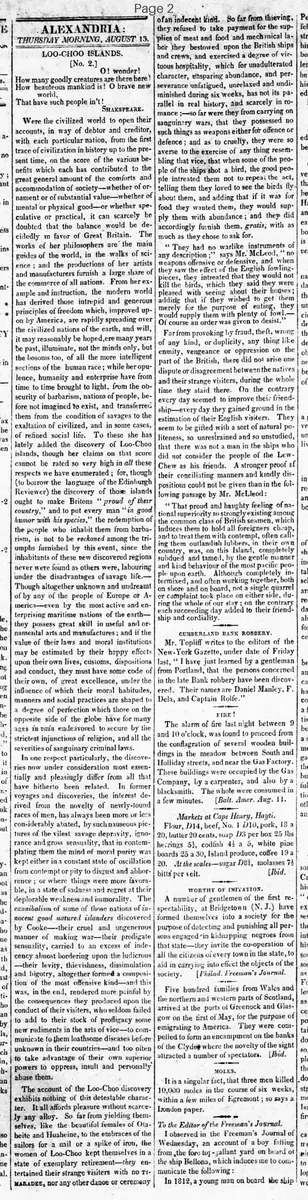
Were the civilized world to open their accounts, in way of debtor and creditor, with each particular nation, from the first trace of civilization in history up to the present time, on the score of the various benefits which each has contributed to the great general amount of the comforts and accommodation of society--whether of ornament or of substantial value--whether of mental or physical good--or whether speculative or practical, it can scarcely be doubted that the balance would be decidedly in favor of Great Britain. The works of her philosophers are the main guides of the world. in the walks of science; and the productions of her artists and manufacturers furnish a large share of the commerce of all nations. From her example and instruction, the modern world has derived those intrepid and generous principles of freedom which, improved upon by America, are rapidly spreading over the civilized nations of the earth, and will, it may reasonably be hoped, ere many years be past, illuminate, not the minds only, but the bosoms too, of all the more intelligent sections of the human race; while her opulence, humanity and enterprise have from time to time brought to light, from the obscurity of barbarism, nations of people, before not imagined to exist, and transferred them from the condition of savages to the exaltation of civilized, and in some cases, of refined social life. To these she has lately added the discovery of Loo-Choo islands, though her claims on that score cannot be rated so very high in all these respects we have enumerated; for, though (to borrow the language of the Edinburgh Reviewer) the discovery of those islands ought to make Britons "proud of their country," and to put every man "in good humor with his species," the redemption of the people who inhabit them from barbarism, is not to be reckoned among the triumphs furnished by this event, since the inhabitants of these new discovered regions never were found as others were, labouring under the disadvantages of savage life.
Though altogether unknown and undreamt of by any of the people of Europe or America even by the most active and enterprising maritime nations of the earth- they possess great skill in useful and ornamental arts and manufactures; and if the value of their laws and moral institutions may be estimated by their happy effects upon their own lives, customs, dispositions and conduct, they must have some code of their own, of great excellence, under the influence of which their moral habitudes, manners and social practices are shaped to a degree of perfection which those on the opposite side of the globe have for many ages in vain endeavored to secure by the strictest injunctions of religion, and all the severities of sanguinary criminal laws.
In one respect particularly, the discoveries now under consideration most essentially and pleasingly differ from all that have hitherto been related. In former voyages and discoveries, the interest derived from the novelty of newly-found races of men, has always been more or less considerably abated, by such nauseous pictures of the vilest savage depravity, ignorance and gross sensuality, that in contemplating them the mind of moral purity was kept either in a constant state of oscillation from contempt or pity to disgust and abhorrence; or where things were more favorable, in a state of sadness and regret at their deplorable weakness and immorality. The cannibalism of some of those nations of innocent goodnatured islanders discovered by Cooke--their cruel and ungenerous manner of making war--their profligate sensuality, carried to an excess of indecency almost bordering upon the ludicrous --their levity, thievishness, dissimulation and bigotry, altogether formed a composition of the most offensive kind--and this was, in the end, rendered more painful by the consequences they produced upon the conduct of their visiters, who seldom failed to add to their stock of profligacy some new rudiments in the arts of vice--to communicate to them loathsome diseases before unknown in their countries--and too often to take advantage of their own superior powers to oppress, insult and personally abuse them.
The account of the Loo-Choo discovery exhibits nothing of this detestable character. It all affords pleasure without scarcely any alloy. So far from yielding themselves, like the beautiful females of Otaheite and Huahine, to the embraces of the sailors for a nail or a spike of iron, the women of Loo-Choo kept themselves in a state of exemplary retirement--they entertained their strange visiters with no TIMARAADEE, nor any other dance or ceremony of an indecent kind. So far from thieving, they refused to take payment for the supplies of meat and food and mechanical labor they bestowed upon the British ships and crews, and exercised a degree of virtuous hospitality, which for unadulterated character, unsparing abundance, and perseverance unfatigued, unrelaxed and undiminished during six weeks, has not its parallel in real history, and scarcely in romance;--so far were they from carrying on sanguinary wars, that they possessed no such things as weapons either for offence or defence; and as to cruelty, they were so averse to the exercise of any thing resembling that vice, that when some of the people of the ships shot a bird, the good people intreated them not to repeat the act, telling them they loved to see the birds fly about them, and adding that if it was for food they wanted them, they would supply them with abundance; and they did accordingly furnish them, gratis, with as much as they chose to ask for.
"They had no warlike instruments of any description:" says Mr. McLeod, "no weapons offensive or defensive, and when they saw the effect of the English fowling-pieces, they intreated that they would not kill the birds, which they said they were pleased with seeing about their houses; adding that if they wished to get them merely for the purpose of eating, they would supply them with plenty of fowl.-- Of course an order was given to desist."
Far from provoking by fraud, theft, wrong of any kind, or duplicity, any thing like enmity, vengeance or oppression on the part of the British, there did not arise one dispute or disagreement between the natives and their strange visiters, during the whole time they staid there. On the contrary every day seemed to improve their friendship--every day they gained ground in the estimation of their English visiters. They seem to be gifted with a sort of natural politeness, so unrestrained and so unstudied, that there was not a man in the ships who did not consider the people of the Lew Chew as his friends. A stronger proof of their conciliating manners and kindly dispositions could not be given than in the following passage by Mr. McLeod:
"That proud and haughty feeling of national superiority so strongly existing among the common class of British seamen, which induces them to hold all foreigners cheap, and to treat them with contempt, often calling them outlandish lubbers, in their own country, was, on this Island, completely subdued and tamed, by the gentle manner and kind behaviour of the most pacific people upon earth. Although completely intermingled, and often working together, both on shore and on board, not a single quarrel or complaint took place on either side, during the whole of our stay; on the contrary each succeeding day added to their friendship and cordiality."
THURSDAY MORNING, AUGUST 13.
LOO-CHOO ISLANDS.
[No. 2.]
O! wonder!
How many goodly creatures are there here!
How beauteous mankind is! O brave new world,
That have such people in't!
SHAKSPEARE.
Were the civilized world to open their accounts, in way of debtor and creditor, with each particular nation, from the first trace of civilization in history up to the present time, on the score of the various benefits which each has contributed to the great general amount of the comforts and accommodation of society--whether of ornament or of substantial value--whether of mental or physical good--or whether speculative or practical, it can scarcely be doubted that the balance would be decidedly in favor of Great Britain. The works of her philosophers are the main guides of the world. in the walks of science; and the productions of her artists and manufacturers furnish a large share of the commerce of all nations. From her example and instruction, the modern world has derived those intrepid and generous principles of freedom which, improved upon by America, are rapidly spreading over the civilized nations of the earth, and will, it may reasonably be hoped, ere many years be past, illuminate, not the minds only, but the bosoms too, of all the more intelligent sections of the human race; while her opulence, humanity and enterprise have from time to time brought to light, from the obscurity of barbarism, nations of people, before not imagined to exist, and transferred them from the condition of savages to the exaltation of civilized, and in some cases, of refined social life. To these she has lately added the discovery of Loo-Choo islands, though her claims on that score cannot be rated so very high in all these respects we have enumerated; for, though (to borrow the language of the Edinburgh Reviewer) the discovery of those islands ought to make Britons "proud of their country," and to put every man "in good humor with his species," the redemption of the people who inhabit them from barbarism, is not to be reckoned among the triumphs furnished by this event, since the inhabitants of these new discovered regions never were found as others were, labouring under the disadvantages of savage life.
Though altogether unknown and undreamt of by any of the people of Europe or America even by the most active and enterprising maritime nations of the earth- they possess great skill in useful and ornamental arts and manufactures; and if the value of their laws and moral institutions may be estimated by their happy effects upon their own lives, customs, dispositions and conduct, they must have some code of their own, of great excellence, under the influence of which their moral habitudes, manners and social practices are shaped to a degree of perfection which those on the opposite side of the globe have for many ages in vain endeavored to secure by the strictest injunctions of religion, and all the severities of sanguinary criminal laws.
In one respect particularly, the discoveries now under consideration most essentially and pleasingly differ from all that have hitherto been related. In former voyages and discoveries, the interest derived from the novelty of newly-found races of men, has always been more or less considerably abated, by such nauseous pictures of the vilest savage depravity, ignorance and gross sensuality, that in contemplating them the mind of moral purity was kept either in a constant state of oscillation from contempt or pity to disgust and abhorrence; or where things were more favorable, in a state of sadness and regret at their deplorable weakness and immorality. The cannibalism of some of those nations of innocent goodnatured islanders discovered by Cooke--their cruel and ungenerous manner of making war--their profligate sensuality, carried to an excess of indecency almost bordering upon the ludicrous --their levity, thievishness, dissimulation and bigotry, altogether formed a composition of the most offensive kind--and this was, in the end, rendered more painful by the consequences they produced upon the conduct of their visiters, who seldom failed to add to their stock of profligacy some new rudiments in the arts of vice--to communicate to them loathsome diseases before unknown in their countries--and too often to take advantage of their own superior powers to oppress, insult and personally abuse them.
The account of the Loo-Choo discovery exhibits nothing of this detestable character. It all affords pleasure without scarcely any alloy. So far from yielding themselves, like the beautiful females of Otaheite and Huahine, to the embraces of the sailors for a nail or a spike of iron, the women of Loo-Choo kept themselves in a state of exemplary retirement--they entertained their strange visiters with no TIMARAADEE, nor any other dance or ceremony of an indecent kind. So far from thieving, they refused to take payment for the supplies of meat and food and mechanical labor they bestowed upon the British ships and crews, and exercised a degree of virtuous hospitality, which for unadulterated character, unsparing abundance, and perseverance unfatigued, unrelaxed and undiminished during six weeks, has not its parallel in real history, and scarcely in romance;--so far were they from carrying on sanguinary wars, that they possessed no such things as weapons either for offence or defence; and as to cruelty, they were so averse to the exercise of any thing resembling that vice, that when some of the people of the ships shot a bird, the good people intreated them not to repeat the act, telling them they loved to see the birds fly about them, and adding that if it was for food they wanted them, they would supply them with abundance; and they did accordingly furnish them, gratis, with as much as they chose to ask for.
"They had no warlike instruments of any description:" says Mr. McLeod, "no weapons offensive or defensive, and when they saw the effect of the English fowling-pieces, they intreated that they would not kill the birds, which they said they were pleased with seeing about their houses; adding that if they wished to get them merely for the purpose of eating, they would supply them with plenty of fowl.-- Of course an order was given to desist."
Far from provoking by fraud, theft, wrong of any kind, or duplicity, any thing like enmity, vengeance or oppression on the part of the British, there did not arise one dispute or disagreement between the natives and their strange visiters, during the whole time they staid there. On the contrary every day seemed to improve their friendship--every day they gained ground in the estimation of their English visiters. They seem to be gifted with a sort of natural politeness, so unrestrained and so unstudied, that there was not a man in the ships who did not consider the people of the Lew Chew as his friends. A stronger proof of their conciliating manners and kindly dispositions could not be given than in the following passage by Mr. McLeod:
"That proud and haughty feeling of national superiority so strongly existing among the common class of British seamen, which induces them to hold all foreigners cheap, and to treat them with contempt, often calling them outlandish lubbers, in their own country, was, on this Island, completely subdued and tamed, by the gentle manner and kind behaviour of the most pacific people upon earth. Although completely intermingled, and often working together, both on shore and on board, not a single quarrel or complaint took place on either side, during the whole of our stay; on the contrary each succeeding day added to their friendship and cordiality."
What sub-type of article is it?
Essay
What themes does it cover?
Moral Virtue
Patriotism
Liberty Freedom
What keywords are associated?
Loo Choo Islands
British Discovery
Moral Society
Peaceful Inhabitants
Hospitality
Pacifism
Cultural Praise
Literary Details
Title
Loo Choo Islands. [No. 2.]
Subject
Discovery Of The Loo Choo Islands And Praise Of Its Inhabitants
Form / Style
Prose Essay With Epigraph From Shakespeare
Key Lines
O! Wonder! How Many Goodly Creatures Are There Here! How Beauteous Mankind Is! O Brave New World, That Have Such People In't!
"They Had No Warlike Instruments Of Any Description:" Says Mr. Mcleod, "No Weapons Offensive Or Defensive, And When They Saw The Effect Of The English Fowling Pieces, They Intreated That They Would Not Kill The Birds, Which They Said They Were Pleased With Seeing About Their Houses; Adding That If They Wished To Get Them Merely For The Purpose Of Eating, They Would Supply Them With Plenty Of Fowl. Of Course An Order Was Given To Desist."
"That Proud And Haughty Feeling Of National Superiority So Strongly Existing Among The Common Class Of British Seamen... Was, On This Island, Completely Subdued And Tamed, By The Gentle Manner And Kind Behaviour Of The Most Pacific People Upon Earth."