Thank you for visiting SNEWPapers!
Sign up free
The New York Herald
New York, New York County, New York
What is this article about?
On August 20, 1852, the steamer Atlantic collided with the propeller Ogdensburg on Lake Erie, sinking rapidly and claiming nearly 400 lives, mostly immigrants. Survivor John S. Blake provides a detailed eyewitness account of the chaos and partial rescues.
Clipping
OCR Quality
Full Text
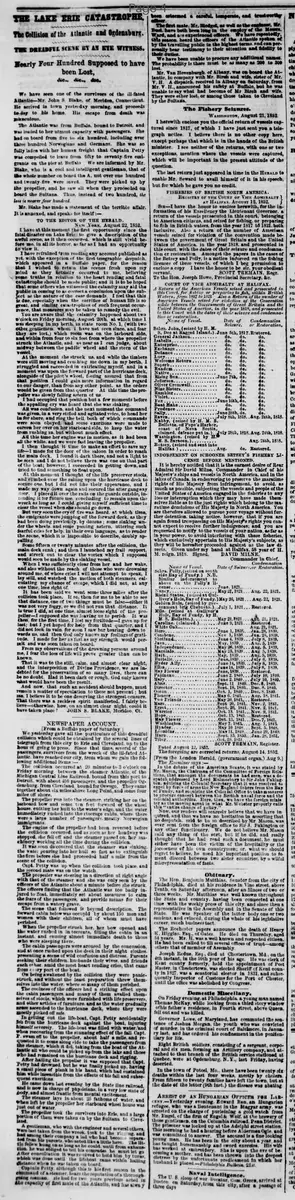
The Collision of the Atlantic and Ogdensburg.
The Particulars Secured by an Eye Witness.
Nearly Four Hundred Supposed to have been Lost.
We have seen one of the survivors of the ill-fated Atlantic—Mr. John S. Blake, of Meriden, Connecticut. He arrived in town yesterday morning, and proceeds to-day to his home. His escape from death was miraculous.
The Atlantic was from Buffalo, bound to Detroit, and was loaded to her utmost capacity with passengers. She had on board from five to six hundred, including over three hundred Norwegians and Germans. She was so fully laden with her human freight that Captain Petty was compelled to leave from fifty to seventy-five emigrants on the pier at Buffalo. We are informed by Mr. Blake, who is a cool and intelligent gentleman, that of the whole number on board the A., not over one hundred and twenty-five were saved. They were picked up by the propeller, and he saw all when they proceeded on board the Sultana. Thus, instead of two hundred, the loss is nearer four hundred.
Mr. Blake has made a statement of the terrible affair. It is annexed, and speaks for itself:-
TO THE EDITOR OF THE HERALD
New York, August 22, 1852.
I have at this moment the first opportunity since the fatal disaster on Lake Erie, to give a description of the awful scene, as it then occurred, which is still vivid before me, in all its horror, as far as I had an opportunity to view it.
I have refrained from reading any account published as yet, with the exception of the first telegraphic despatch, which appeared in a Buffalo paper, for the reason that I wished to retain the scenes fresh upon my mind as they actually occurred to me, believing some truths in relation to the heart-rending and fatal catastrophe should be made public; and it is to be hoped that some others who witnessed the calamity may aid the public in coming to as correct a conclusion upon the subject as the nature of the case demands. I feel that this is due, especially when the sacrifice of human life is so great, and similar catastrophes of such frequent occurrence, that measures may be taken to remedy the evil.
You are aware that the calamity happened about two o'clock on Friday morning, August 20th, at which time I was sleeping in my berth, in state room No. 1, (with two other gentlemen, whom I have not seen since, and fear they are lost,) which room was on the larboard side, and within from four to six feet from where the propeller struck the Atlantic, and as near as I can judge, about midway between the paddle wheel and the stern of the vessel.
At the moment she struck us, and while the timbers were still moving and crushing me down in my berth, I struggled and succeeded in extricating myself, and in a moment was upon the forward part of the hurricane deck, alongside of the pilot's wheel, feeling assured that from that position I could gain more information in regard to our danger, than from any other point, as the orders would be given from that quarter. At this time the propeller was slowly falling astern of us.
I had occupied that position but a few moments before the appalling cry was heard that she was sinking. All was confusion, and the next moment the command was given, in a very stifled and agitated voice, to head her for shore, and ring the bell, both of which commands were soon obeyed, and some exertions were made to careen her over on her starboard side, to keep the water from rushing in, but without much effect.
All this time her engine was in motion, as it had been all the while, and we were fast leaving the propeller. I then thought it time to make an effort to save my life. I made for the door of the saloon in order to reach the main deck. I found it dark there, and not a light to be seen, and I do not believe there was one on that part of the boat; however, I succeeded in getting down, and tried to find something to float upon.
At this moment I thought of the life preserver stools, and climbed over the railing upon the hurricane deck to secure one, but I did not like their appearance, and I made my way down again and secured the after gangway door. I placed it over the rails on the guards outside, intending it for future use, concluding to remain upon the wreck as long as I could, giving myself sufficient time to clear the vessel when she should go down.
But very soon the cry of fire was heard, at which time, the emigrants were jumping off the forward deck, as they had been doing previously, by dozens; some sinking under the wheels, and some passing astern, uttering such fearful cries for help, in their own language, as to render the scene, which it is impossible to describe, doubly appalling.
Some fifteen or twenty minutes after the collision, the main deck sunk; and then I launched my frail support, and struck out to clear the vortex which I supposed would soon be made by the sinking vessel.
When I was sufficiently clear from her and her wake, and also without the reach of those who were drowning around me, of whose cries I will not attempt to speak, I lay still, and watched the motion of both steamers, calculating my chance of escape, which I did not, at any one time, lose sight of.
It has been said we went some three miles after the collision took place. If so, then for me to be able to see that distance, one of two things must be false—either it was not very foggy, or we did not run that distance. It is true I did, at one time, almost lose sight of the propeller—I supposed she was leaving us to perish. It was then, for the first time, I lost my fortitude—I gave up for lost; but I yet hoped for help from that quarter, and I did not look in vain, for soon I saw her bearing down towards us, and then God only knows my feelings of gratitude. I made for her as fast as my strength would permit, and was soon taken on board.
From my observations of the drowning persons around me, I fear the loss of life will prove greater than can be known. That it was to the still, calm, and almost clear night, and the interposition of Divine Providence, we are indebted for the preservation of so many lives, there can be no doubt. Had it been dark or rough, God only knows what would have been the result.
And now, that such an accident should happen, must remain a matter of speculation to those not present; but to me, I believe it to be one deserving the strongest censure. That there was a reckless spirit manifested, I fairly believe—otherwise, how, on an almost clear night, could it have taken place?
JOHN S. BLAKE, Meriden, Ct.
NEWSPAPER ACCOUNT.
[From a Buffalo paper of Saturday.]
We yesterday gave all the particulars of this dreadful collision which could be obtained by the several lines of telegraph from this city to Erie and Cleveland, up to the hour of going to press. Since that time, several of the passengers, survivors from the wreck of the ill-fated Atlantic, have reached our city, from whom we gain the following additional items:-
The collision occurred at 20 minutes to 3 o'clock on Friday morning between the steamer Atlantic, of the Michigan Central Line Railroad, bound from this port to Detroit, with about 450 passengers, and the propeller Ogdensburg, from Cleveland bound for Oswego. They came together about six miles above Long Point, and some four miles off shore.
The propeller run into the steamer, striking her on the larboard bow and some ten feet forward of the wheel house, cutting her hull to the water's edge, and the water immediately rushed into the steerage cabin, where there were a large number of passengers, mostly Norwegian immigrants.
The engine of the propeller had been reversed before the collision occurred, and as soon as her headway was stopped, she fell off and the steamer passed on, her machinery working all the time during the collision.
It was soon discovered that the steamer was sinking, the water pouring into her hull so fast as to extinguish the fires before she had proceeded half a mile from the scene of the collision.
Capt. Petty was up when the collision took place, and the second mate was on the watch. The propeller was steering in a direction at right angles with that of the steamer and she was only seen by the officers of the Atlantic about a minute before she struck.
The officers finding that the Atlantic was too badly injured to float, immediately set about measures to calm the fears of the passengers, and provide means for their escape from a watery grave.
The scene that followed is beyond description. The forward cabin below was occupied by about 150 men and women with their children, all of whom must have perished.
When the propeller struck her, her bow opened and the water rushed in in torrents, filling the cabin in an instant, and causing almost immediate death to those who were sleeping there.
The cabin passengers were aroused by the concussion, and at once rushed upon the deck in their night clothes, presenting a scene of wild confusion and distress. Parents seeking their children, husbands their wives, and friends each other, amid the most heart-rending cries, that came from every part of the boat.
On being awakened by the collision they were panic-struck, and without the least preparation threw themselves into the water, where so many of them perished.
The coolness of the officers had a striking effect upon the cabin passengers, and many of them availed themselves of stools, which were furnished with life preservers, and other articles of furniture, and as the water gradually arose ascended to the hurricane deck, where they were mostly picked off safe.
In getting out the life-boat, Capt. Petty accidentally fell from the hurricane deck against the boat, injuring himself severely. The life-boat was filled with water, and when recovering from the stunning effect of the fall, Capt. P. swam off to the propeller, about half a mile, and requested it to come alongside to take the passengers from the steamer, which it did, taking from the boat of the Atlantic all who could be picked up from the lake and those who had remained on the hurricane deck and rigging.
After hailing the propeller it was supposed that Capt. Petty had drowned, but he was finally picked up, having a small piece of plank in his hand, which had sustained him while insensible from the effects of his fall and subsequent exertions.
He came down last evening by the State line railroad, and is now in charge of physicians, in a very low state of body, and almost frantic from mental excitement.
The steamer lays in about 25 fathoms of water, and when left by the propeller her starboard wheel house was just out of water.
The propeller took the survivors into Erie, and a large portion of them were taken on by the Sultana to Cleveland.
gentleman, who with the engineer and several others, were last taken from the wreck, took to the rigging, and had among their company a lad who had become separated from his parents, who acted like a little hero. The little fellow hung on as long as he could, until from exhaustion, he was obliged to tell his comrades he must let go. After consultation it was resolved to hold him by turns, which was done until the lifeboat came within hailing distance when he was taken on board.
Captain Petty, although this is his first season in the command of a steamer, bears the reputation of a thorough, going seaman. He had for two years previous acted in the capacity of first mate of the Atlantic, and has always
The first mate, Mr. Blodget, as well as the carpenter, Mr. Buck, have both been long in the employ of the Messrs. Ward, and are experienced officers. We have repeatedly, this season, heard the officers of the Atlantic spoken of by the travelling public in the highest terms, and can personally bear testimony to their attention and fidelity to their duties.
We have been unable to procure any additional names. The probability is there must be as many as 200 to 300 lost.
Mr. Van Hovenburgh, of Albany, was on board the Atlantic, in company with Mr. Birch and wife, sister of Mr. V. H. A dispatch, received in Albany on Saturday, from Mr. V.H., announced his safety at Buffalo, but he was unable to say what had become of Mr. Birch and wife. They were either lost, or among those taken to Cleveland by the Sultana.
What sub-type of article is it?
What themes does it cover?
What keywords are associated?
What entities or persons were involved?
Where did it happen?
Story Details
Key Persons
Location
Lake Erie, Six Miles Above Long Point, Four Miles Off Shore
Event Date
August 20, 1852
Story Details
The steamer Atlantic, bound from Buffalo to Detroit with 450-600 passengers including many Norwegian and German immigrants, collided with the propeller Ogdensburg at 2-3 AM on August 20, 1852. The propeller struck the Atlantic's larboard bow, causing rapid flooding and sinking. Nearly 400 lives were lost, mostly immigrants in the steerage. Survivor John S. Blake escaped and was rescued by the Ogdensburg. Captain Petty was injured but survived. The wreck lies in 25 fathoms of water.