Thank you for visiting SNEWPapers!
Sign up free
Story
January 17, 1908
Bisbee Daily Review
Bisbee, Cochise County, Arizona
What is this article about?
Explanation of the nautical term 'heaving the log,' a method to measure a ship's speed using a quadrant-shaped wooden log attached to a 120-fathom knotted line, where knots represent nautical miles per hour.
Clipping
OCR Quality
95%
Excellent
Full Text
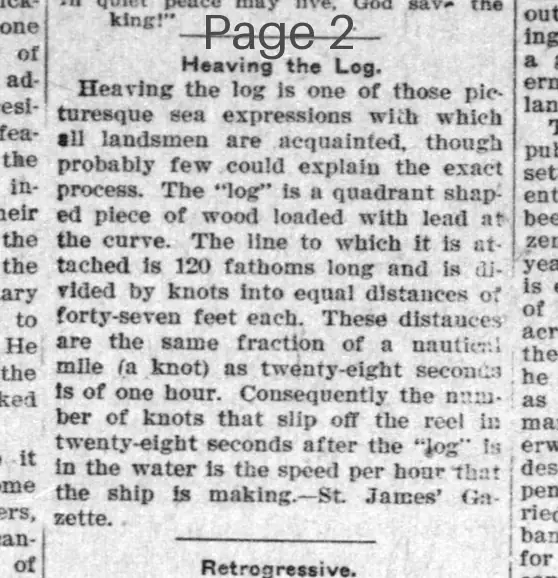
Heaving the Log.
Heaving the log is one of those picturesque sea expressions with which all landsmen are acquainted, though probably few could explain the exact process. The "log" is a quadrant shaped piece of wood loaded with lead at the curve. The line to which it is attached is 120 fathoms long and is divided by knots into equal distances of forty-seven feet each. These distances are the same fraction of a nautical mile (a knot) as twenty-eight seconds is of one hour. Consequently the number of knots that slip off the reel in twenty-eight seconds after the "log" is in the water is the speed per hour that the ship is making. -St. James' Gazette.
Heaving the log is one of those picturesque sea expressions with which all landsmen are acquainted, though probably few could explain the exact process. The "log" is a quadrant shaped piece of wood loaded with lead at the curve. The line to which it is attached is 120 fathoms long and is divided by knots into equal distances of forty-seven feet each. These distances are the same fraction of a nautical mile (a knot) as twenty-eight seconds is of one hour. Consequently the number of knots that slip off the reel in twenty-eight seconds after the "log" is in the water is the speed per hour that the ship is making. -St. James' Gazette.
What sub-type of article is it?
Curiosity
What themes does it cover?
Exploration
What keywords are associated?
Heaving The Log
Nautical Measurement
Ship Speed
Knots
Log Line
Where did it happen?
At Sea
Story Details
Location
At Sea
Story Details
Description of heaving the log: a quadrant-shaped wooden log weighted with lead is thrown overboard, attached to a 120-fathom line divided into 47-foot knots; the knots passing in 28 seconds indicate the ship's speed in knots per hour.