Thank you for visiting SNEWPapers!
Sign up free
The Ypsilanti Daily Press
Ypsilanti, Washtenaw County, Michigan
What is this article about?
Dr. Frank Huntley speaks to Rotarians about Japanese cultural traits, particularly their serious approach to sports and philosophy of self-control, to aid in fighting and peacemaking with Japan during WWII.
Merged-components note: This is a continuation of the Rotary speech story from page 1 to page 5, indicated by 'See ROTARY-Page 5' in the initial text.
Clippings
1 of 2
OCR Quality
Full Text
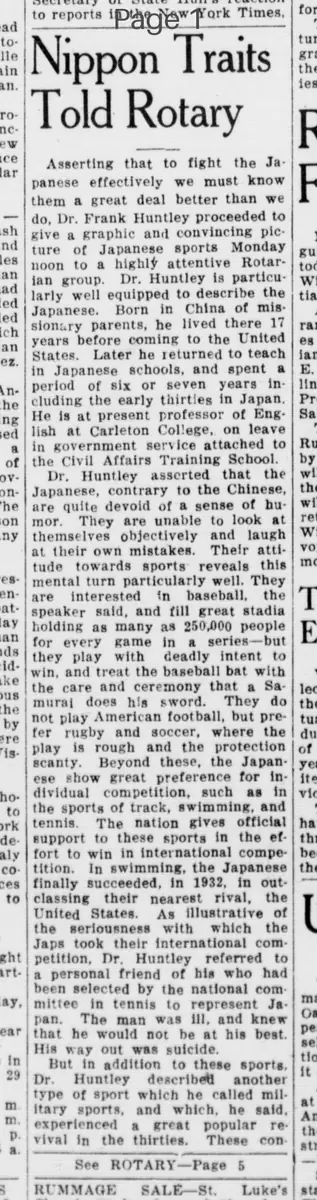
Asserting that to fight the Japanese effectively we must know them a great deal better than we do, Dr. Frank Huntley proceeded to give a graphic and convincing picture of Japanese sports Monday noon to a highly attentive Rotarian group. Dr. Huntley is particularly well equipped to describe the Japanese. Born in China of missionary parents, he lived there 17 years before coming to the United States. Later he returned to teach in Japanese schools, and spent a period of six or seven years including the early thirties in Japan. He is at present professor of English at Carleton College, on leave in government service attached to the Civil Affairs Training School.
Dr. Huntley asserted that the Japanese, contrary to the Chinese, are quite devoid of a sense of humor. They are unable to look at themselves objectively and laugh at their own mistakes. Their attitude towards sports reveals this mental turn particularly well. They are interested in baseball, the speaker said, and fill great stadia holding as many as 250,000 people for every game in a series—but they play with deadly intent to win, and treat the baseball bat with the care and ceremony that a Samurai does his sword. They do not play American football, but prefer rugby and soccer, where the play is rough and the protection scanty. Beyond these, the Japanese show great preference for individual competition, such as in the sports of track, swimming, and tennis. The nation gives official support to these sports in the effort to win in international competition. In swimming, the Japanese finally succeeded, in 1932, in out-classing their nearest rival, the United States. As illustrative of the seriousness with which the Japs took their international competition, Dr. Huntley referred to a personal friend of his who had been selected by the national committee in tennis to represent Japan. The man was ill, and knew that he would not be at his best. His way out was suicide.
But in addition to these sports, Dr. Huntley described another type of sport which he called military sports, and which, he said, experienced a great popular revival in the thirties. These consist of wrestling, archery, and fencing.
In the manner in which they are conducted, they are particularly rigorous if not brutal. Underlying them is a philosophy of self control and what Dr. Huntley termed "psychic poise". Particularly interesting was the speaker's description of ju jitsu, which is based, he said, on the principle of taking advantage of the opponent's weakness. "Ju jitsu is based on the philosophy of the meek," he said, "wherein the antagonist's superior strength is employed to his own undoing." It is this philosophy that the Japanese navy is employing against our Navy at the present time," said Dr. Huntley. "but we are not going to let them outsmart us.
Dr. Huntley concluded with the assertion that not only to win the war, but to make an intelligent peace with the Japanese people who are and will be 73,000,000 strong, we must come to know them much better.
Rotary was visited by Dean W. Myers, Ira M. Smith, and Henry C. Baumgardner from Ann Arbor, T. F. Knuckelman from Belleville, W. A. Cory from Detroit, and Norris G. Wiltse and William W. L. Schmidt, nephew of Walter Sturm who is in the Air Corps, from Ypsilanti.
What sub-type of article is it?
What themes does it cover?
What keywords are associated?
What entities or persons were involved?
Story Details
Key Persons
Story Details
Dr. Frank Huntley delivers a talk to Rotarians on Japanese traits, emphasizing their lack of humor, serious approach to sports like baseball, rugby, soccer, track, swimming, and tennis, and military sports like wrestling, archery, fencing, and ju jitsu, to better understand them for the war effort.