Thank you for visiting SNEWPapers!
Sign up free
Lewistown Gazette
Lewistown, Mifflin County, Pennsylvania
What is this article about?
A report details the army worm, a destructive caterpillar pest affecting corn, clover, grain, and grass, observed near Smithsonian grounds and identical to the southern grass worm. It discusses the worm's habits, hiding places, and natural enemies including toads, larvae, and parasitic flies that control its population.
Clipping
OCR Quality
Full Text
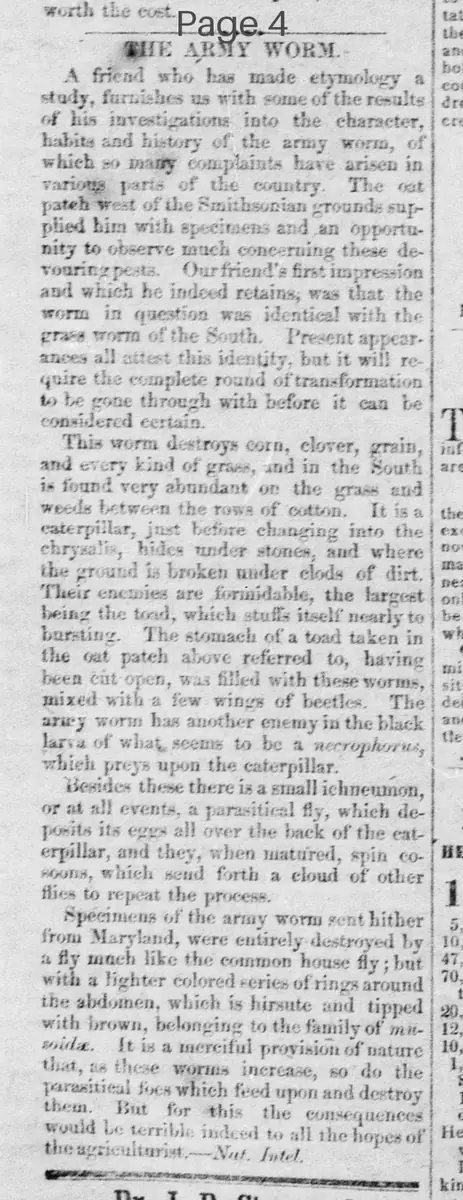
A friend who has made entomology a study, furnishes us with some of the results of his investigations into the character, habits and history of the army worm, of which so many complaints have arisen in various parts of the country. The oat patch west of the Smithsonian grounds supplied him with specimens and an opportunity to observe much concerning these devouring pests. Our friend's first impression and which he indeed retains, was that the worm in question was identical with the grass worm of the South. Present appearances all attest this identity, but it will require the complete round of transformation to be gone through with before it can be considered certain.
This worm destroys corn, clover, grain, and every kind of grass, and in the South is found very abundant on the grass and weeds between the rows of cotton. It is a caterpillar, just before changing into the chrysalis, hides under stones, and where the ground is broken under clods of dirt. Their enemies are formidable, the largest being the toad, which stuffs itself nearly to bursting. The stomach of a toad taken in the oat patch above referred to, having been cut open, was filled with these worms, mixed with a few wings of beetles. The army worm has another enemy in the black larva of what seems to be a necrophorus, which preys upon the caterpillar.
Besides these there is a small ichneumon, or at all events, a parasitical fly, which deposits its eggs all over the back of the caterpillar, and they, when matured, spin cocoons, which send forth a cloud of other flies to repeat the process.
Specimens of the army worm sent hither from Maryland, were entirely destroyed by a fly much like the common house fly; but with a lighter colored series of rings around the abdomen, which is hirsute and tipped with brown, belonging to the family of muscidae. It is a merciful provision of nature that, as these worms increase, so do the parasitical foes which feed upon and destroy them. But for this the consequences would be terrible indeed to all the hopes of the agriculturist.—Nat. Intel.
What sub-type of article is it?
What keywords are associated?
Where did it happen?
Domestic News Details
Primary Location
Smithsonian Grounds
Outcome
worms destroyed by natural enemies including toads, black larvae, and parasitic flies; potential terrible consequences to agriculture without these controls.
Event Details
Investigations into the army worm, a caterpillar pest identical to the southern grass worm, observed in an oat patch west of Smithsonian grounds. It destroys corn, clover, grain, grass, and cotton weeds. Hides under stones or clods before chrysalis stage. Enemies: toads, black necrophorus larva, small ichneumon or parasitic fly depositing eggs leading to more flies; Maryland specimens destroyed by muscidae fly.