Thank you for visiting SNEWPapers!
Sign up free
The Workingman's Advocate
Chicago, Cook County, Illinois
What is this article about?
Letter from M. A. Winn in San Francisco, dated Jan. 14, 1873, to the Workingman's Advocate editor, rebutting Patent Commissioner Leggett's opposition to the eight-hour labor system. Argues shorter hours boost productivity, reduce dissipation, and calls for workingmen to unite against exploitation, including Chinese labor competition.
Clipping
OCR Quality
Full Text
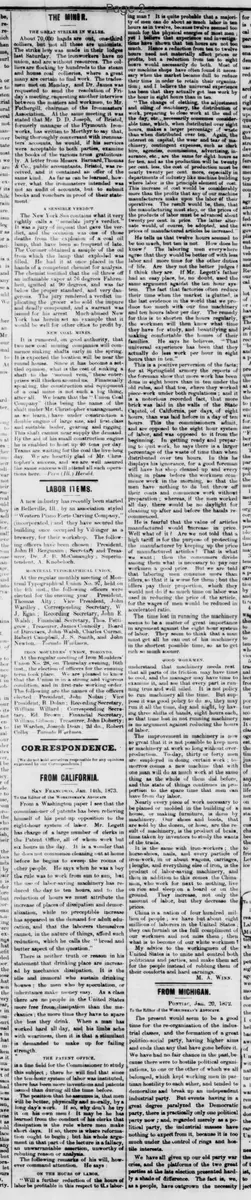
[We do not hold ourselves responsible for any opinions expressed by our Correspondents.]
FROM CALIFORNIA
San Francisco. Jan. 14th, 1873.
To the Editor of the Workingman's Advocate
From a Washington paper I see that the commissioner of patents has been relieving himself of his pent-up opposition to the eight-hour system of labor. Mr. Leggett has charge of a large number of clerks in the Patent Office, all of whom work but six hours in the day. It is a wonder that he does not commence cleaning out at home before he begins to sweep the rooms of other people. He says when he was a boy the rule was to work from sun to sun, but the use of labor-saving machinery has reduced the day to ten hours, and to the reduction of hours we must attribute the increase of places of dissipation and demoralization, while no perceptible increase has appeared in the demand for adult education, and that the laborers themselves cannot, in the nature of things, afford such reduction, which he calls the "bread and butter aspect of the question."
There is neither truth or reason in his statement that drinking places are increased by mechanics dissipation. It is the idle and immoral who sustain drinking houses : the men who by speculation, or inheritance make money easy. As a class there are no people in the United States more free from dissipation than the mechanics; the more time they have to spare the less they drink. When a man has worked hard all day, and his limbs ache with weariness, then it is that a stimulant is demanded to make up for failing strength.
THE PATENT OFFICE.
is a fine field for the Commissioner to study this subject ; there he will find that since the ten-hour system of labor was instituted. there has been more inventions and patents issued than during all the time before. The position that he assumes is, that men will be better, physically and morally, by a long day's work. If so, why don't he try it on his own men? It may be he has learned from the conduct of his clerks that dissipation is the rule where men make short days. If so, there is where reformation ought to begin; but his whole argument in that part of the lecture is a fallacy, an unwarrantable assertion, unworthy of rebutting reason or analysis.
The following remarks of his will, however command attention. He says:
ON THE HOURS OF LABOR.
"Will a further reduction of the hours of labor be profitable in this respect to the laboring man? It is quite probable that a majority of men can do about as much labor in ten hours as in twelve, because twelve seemed too much for the physical energies of most men; yet I believe that experience and investigations have shown that ten hours are not too much. Hence a reduction from ten to twelve hours need not materially affect prices or profits, but a reduction from ten to eight hours would necessarily do both. Most of our machine shops have often found it necessary when the market became dull to reduce their time in order to retain their organization; and I believe the universal experience has been that they actually got less work by the hour in eight hours than in ten.
"The change of clothing, the adjustment and oiling of machinery, the distribution of work, preparing to close work at the end of the day, etc., necessarily consumes considerable time, which, when distributed over eight hours, makes a larger percentage of waste than when distributed over ten. Again, the interest on capital, the wear and tear of machinery, contingent expenses, such as clerk hire, agencies, commissions, advertising, insurance, etc., are the same for eight hours as for ten, and as the production will be twenty per cent. less, the cost of production must be nearly twenty per cent. more, especially in departments of industry like machine building where labor is the principle element of cost. This increase of cost would be considerably more than the profits that any of our machine manufacturers make upon the labor of their operatives. The result would be, then, that the manufacturing must stop, or the prices of the products of labor must be advanced about twenty per cent. in price. The latter alternative would, of course, be adopted, and the prices of manufactured articles be increased.'
He tells us that twelve hours seemed to be too much, but ten is not. How does he know? The laboring men everywhere agree that they would be better off with less labor and more time for the other duties of life. Are they not the better judges ? I think they are. If Mr. Leggett's father had an easy place, he, no doubt, used the same argument against the ten hour system. The fact that factories often reduce their time when the market is glutted, is the last evidence in the world that we produce too much with our fine machinery and ten hours labor per day. The remedy for this is to shorten the hours regularly, the workmen will then know what time they have for study, and beautifying and making comfortable the homes of their families.
He says he believes, "That universal experience has been that they actually do less work per hour in eight hours than in ten.'
This is a positive perversion of the facts; for at Springfield armory the reports of the foreman show that more work has been done in eight hours than in ten under the old rules, and that too, where they worked piece-work under both regulations; and it is a notorious recorded fact, that more brick was laid in the walls of the State Capitol, of California, per days, of eight hours, than was laid before in a day of ten hours. This the commissioners admit, and are opposed to the eight hour system of labor, and was opposed to it from the beginning. In getting ready and preparing to quit work, he says there is a larger percentage of the waste of time than when distributed over ten hours. In this he displays his ignorance, for a good foreman will have his shop cleaned up and everything in place before the workmen commence work in the morning, so that the men have nothing to do but throw off their coats and commence work without preparation; whereas, if the men worked all day, there would be no daylight for cleaning up after and before the hands recommenced.
He is fearful that the value of articles manufactured would increase in price. Well what of it ? Are we not told that a high tariff is for the purpose of protecting the manufacturer by keeping up the price of manufactured articles? That is what we want; then the consumers divide among them what is necessary to pay our workmen a good price. But we are told that laboring men consume more than idlers, so that it is worse for them ; but the idlers pay their proportion, which they would not do if so much time on labor was used in reducing the price of the article for the wages of men would be reduced in accelerated ratio.
The time lost in running the machinery seems to be a matter of great importance in argument against the eight hour system of labor. They seem to think that a man must get all he can out of his machinery in the shortest possible time, so as to get rich so much sooner.
GOOD WORKMEN.
understand that machinery needs rest that all parts of its friction may have time to cool, and the manager may have time to examine it, and see that every part is running true and well oiled. It is not policy to run machinery all the time. But suppose it was good policy to do so, they may run it all the time, day and night, by having three shifts of hands, eight hours each so that time lost in not running machinery is no argument against reducing the hours of labor.
The improvement in machinery is now so great that it is not possible to keep men or machinery at work so long without over-production. To-day, thirty or forty men are employed in doing certain work : to-morrow comes a new machine that with one man will do as much work at the same thing as the whole of them did before, and this state of things continues in proportion to the spare time that men can have from day labor.
Nearly every piece of work necessary to be planed or molded in the building of a house, or making furniture, is done by machinery. Our shoes and boots, that are sold by the dozen, or hose, are the result of machinery, is the product of brain time taken by inventors to study the want of the trade.
It is the same with iron-workers : the horse-shoes, nails, and every particle of iron-work, in or about wagons, carriages, plows, and everything else of iron, is the product of labor-saving machinery, and then in addition to this comes the China men, who work for next to nothing, live on rice and sleep on a board or on the ground. They increase, not only the amount of labor, but they decrease the prices.
China is a nation of four hundred million of people; we have but about eight millions of laborers in the United States; they can furnish us the full complement of our workmen and not miss them; then what is to become of our white workmen
My advice to the workingmen of the United States is to unite and control both politicians and parties. and make them act for the people instead of robbing them of their comforts and hard earnings
M. A. WINN.
What sub-type of article is it?
What themes does it cover?
What keywords are associated?
What entities or persons were involved?
Letter to Editor Details
Author
M. A. Winn
Recipient
To The Editor Of The Workingman's Advocate
Main Argument
the eight-hour labor system is beneficial, increasing productivity and reducing dissipation among workers, contrary to commissioner leggett's claims; workingmen should unite to control politics and protect against exploitation, including by cheap chinese labor.
Notable Details