Thank you for visiting SNEWPapers!
Sign up free
Literary
May 7, 1926
The Harlem News
Harlem, Blaine County, Montana
What is this article about?
Mrs. Rockwell hurries to New York by train after her husband gifts her $50 for shopping. Believing the bill stolen from her handbag, she impulsively searches the bag of a suspicious woman across the aisle and recovers it. Back home, her husband reveals she forgot the bill pinned to her pincushion.
Clipping
OCR Quality
85%
Good
Full Text
THE
FIFTY-DOLLAR
BILL
Wilson C. Missmer
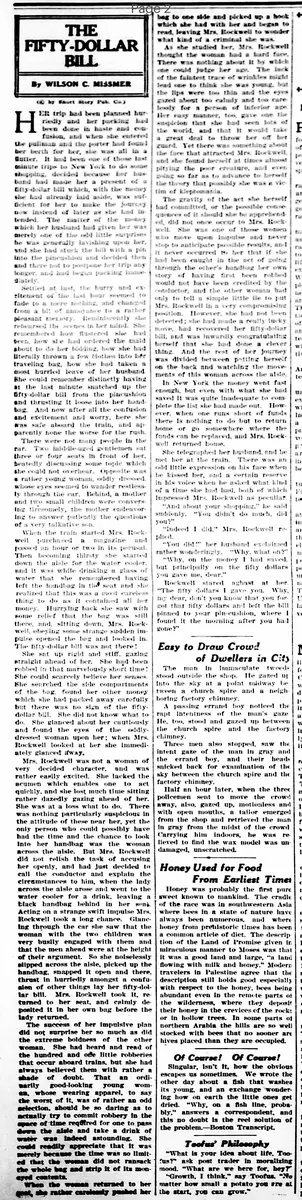
Her trip had been planned hurriedly and her packing had been done in haste and confusion. And when she entered the Pullman and the porter had found her berth for her, she was all in a flutter. It had been one of those last minute trips to New York to do some shopping, decided because her husband had made her a present of a fifty-dollar bill which, with the money she had already laid aside, was sufficient for her to make the journey now instead of later as she had intended. The matter of the money which her husband had given her was merely one of the odd little surprises he was generally lavishing upon her, and she had stuck the bill with a pin into the pincushion and decided then and there not to postpone her trip any longer, and had begun packing immediately.
Settled at last, the hurry and excitement of the last hour seemed to fade to a mere nothing, and changed from a bit of annoyance to a rather pleasant memory. Reminiscently she rehearsed the scenes in her mind. She remembered how flustered she had been, how she had ordered the maid about to do her bidding, how she had literally thrown a few clothes into her traveling bag, how she had taken a most hurried leave of her husband. She could remember distinctly having at the last minute snatched up the fifty-dollar bill from the pincushion and thrusting it loose into her handbag. And now after all the confusion and excitement and worry, here she was safe aboard the train, and apparently none the worse for the rush.
There were not many people in the car. Two middle-aged gentlemen sat three or four seats in front of her, heatedly discussing some topic which she could not overhear. Opposite was a rather young woman, oddly dressed, whose eyes seemed to wander restlessly through the car. Behind, a mother and two small children were conversing tiresomely, the mother endeavoring to answer patiently the questions of a very talkative son.
When the train started Mrs. Rockwell purchased a magazine and passed an hour or two in its perusal. Then becoming thirsty she started down the aisle for the water cooler and it was while drinking a glass of water that she remembered having left the handbag in the seat and she realized that this was a most careless thing to do as it contained all her money. Hurrying back she saw with some relief that the bag was still there, and sat down. Mrs. Rockwell, obeying some strange sudden impulse opened the bag and looked in. The fifty-dollar bill was not there!
She sat up rigid and stiff, gazing straight ahead of her. She had been robbed in that marvelously short time! She could scarcely believe her senses. She searched the side compartments of the bag, found her other money which she had packed away carefully but there was no sign of the fifty-dollar bill. She did not know what to do. She glanced about her cautiously and found the eyes of the oddly dressed woman upon her; when Mrs. Rockwell looked at her she immediately glanced away.
Mrs. Rockwell was not a woman of very decided character, and was rather easily excited. She lacked the acumen which enables one to act quickly, and she lost much time sitting rather dazedly gazing ahead of her. She was at a loss what to do. There was nothing particularly suspicious in the attitude of these near her, yet the only person who could possibly have had the time and the chance to look into her handbag was the woman across the aisle. But Mrs. Rockwell did not relish the task of accusing her openly, and had just decided to call the conductor and explain the circumstances to him, when the lady across the aisle arose and went to the water cooler for a drink, leaving a black handbag behind in her seat.
Acting on a strange swift impulse Mrs. Rockwell took a long chance. Glancing through the car she saw that the woman with the two children was very busily engaged with them and that the men ahead were at the height of their argument. So she noiselessly slipped across the aisle, picked up the handbag, snapped it open and there, thrust hurriedly amongst a confusion of other things lay her fifty-dollar bill. Mrs. Rockwell took it, returned to her seat, and calmly deposited it in her own bag before the lady returned.
The success of her impulsive plan did not surprise her so much as did the extreme boldness of the other woman. She had heard and read of the hundred and one little robberies that occur aboard trains, but she had always believed them with rather a shade of doubt. That an ordinarily good-looking young woman whose wearing apparel, to say the worst of it, was of rather an odd selection, should be so daring as to actually commit robbery in the time required for one to pass and take a drink of water was indeed astounding. She readily appreciated that it was because the time was so limited that she did not ransack the bag and strip it of its money to her berth.
She had passed to one side and picked up a book which she had with her and began to read, leaving Mrs. Rockwell to wonder what kind of a criminal she was. As she studied her, Mrs. Rockwell thought the woman had a hard face. There was nothing about it by which one could judge her age. The lack of the faintest trace of wrinkles might lead one to think she was young, but the lips were too thin and the eyes gazed about too calmly and too carelessly for a person of tender age. Her easy manner, too, gave one the suggestion that she had seen lots of the world, and that it would take a great deal to throw her off her guard. Yet there was something about the face that attracted Mrs. Rockwell and she found herself at times almost pitying the poor creature, and even going so far as to advance to herself the theory that possibly she was a victim of kleptomania.
The gravity of the act she herself had committed, or the possible consequences of it should she be apprehended, did not once occur to Mrs. Rockwell. She was one of those women who move upon impulse and never stop to anticipate possible results, and it never occurred to her that if she had been caught in the act of going through the other's handbag her own story of having first been robbed would not have been credited by the conductor, and the other woman had only to tell a simple tale to put Mrs. Rockwell in a very compromising position. However, she had not been detected; she had made a really lucky move, had recovered her fifty-dollar bill, and was inwardly congratulating herself that she had done a clever thing. And the rest of her journey was divided between patting herself on the back and watching the movements of this woman across the aisle.
In New York the money went fast enough, but even with what she had saved it was quite inadequate to complete the list she had made out. However, when one runs short of funds there is nothing to do but to return home or go somewhere where the funds can be replaced, and Mrs. Rockwell returned home.
She telegraphed her husband, and he met her at the train. There was an odd little expression on his face when he kissed her, and a certain reserve in his voice when he asked what kind of a time she had had, both of which impressed Mrs. Rockwell as peculiar.
"And about your shopping," he said suddenly. "You didn't do much, did you?"
"Indeed I did," Mrs. Rockwell replied.
"You did?" her husband exclaimed rather wonderingly. "Why, what on?"
"Why, on the money I had saved, but principally on the fifty dollars you gave me, dear."
Rockwell stared aghast at her.
"The fifty dollars I gave you? Why, my dear, don't you know that you forgot that fifty dollars and left the bill pinned to your pin-cushion, where I found it the morning after you had gone?"
FIFTY-DOLLAR
BILL
Wilson C. Missmer
Her trip had been planned hurriedly and her packing had been done in haste and confusion. And when she entered the Pullman and the porter had found her berth for her, she was all in a flutter. It had been one of those last minute trips to New York to do some shopping, decided because her husband had made her a present of a fifty-dollar bill which, with the money she had already laid aside, was sufficient for her to make the journey now instead of later as she had intended. The matter of the money which her husband had given her was merely one of the odd little surprises he was generally lavishing upon her, and she had stuck the bill with a pin into the pincushion and decided then and there not to postpone her trip any longer, and had begun packing immediately.
Settled at last, the hurry and excitement of the last hour seemed to fade to a mere nothing, and changed from a bit of annoyance to a rather pleasant memory. Reminiscently she rehearsed the scenes in her mind. She remembered how flustered she had been, how she had ordered the maid about to do her bidding, how she had literally thrown a few clothes into her traveling bag, how she had taken a most hurried leave of her husband. She could remember distinctly having at the last minute snatched up the fifty-dollar bill from the pincushion and thrusting it loose into her handbag. And now after all the confusion and excitement and worry, here she was safe aboard the train, and apparently none the worse for the rush.
There were not many people in the car. Two middle-aged gentlemen sat three or four seats in front of her, heatedly discussing some topic which she could not overhear. Opposite was a rather young woman, oddly dressed, whose eyes seemed to wander restlessly through the car. Behind, a mother and two small children were conversing tiresomely, the mother endeavoring to answer patiently the questions of a very talkative son.
When the train started Mrs. Rockwell purchased a magazine and passed an hour or two in its perusal. Then becoming thirsty she started down the aisle for the water cooler and it was while drinking a glass of water that she remembered having left the handbag in the seat and she realized that this was a most careless thing to do as it contained all her money. Hurrying back she saw with some relief that the bag was still there, and sat down. Mrs. Rockwell, obeying some strange sudden impulse opened the bag and looked in. The fifty-dollar bill was not there!
She sat up rigid and stiff, gazing straight ahead of her. She had been robbed in that marvelously short time! She could scarcely believe her senses. She searched the side compartments of the bag, found her other money which she had packed away carefully but there was no sign of the fifty-dollar bill. She did not know what to do. She glanced about her cautiously and found the eyes of the oddly dressed woman upon her; when Mrs. Rockwell looked at her she immediately glanced away.
Mrs. Rockwell was not a woman of very decided character, and was rather easily excited. She lacked the acumen which enables one to act quickly, and she lost much time sitting rather dazedly gazing ahead of her. She was at a loss what to do. There was nothing particularly suspicious in the attitude of these near her, yet the only person who could possibly have had the time and the chance to look into her handbag was the woman across the aisle. But Mrs. Rockwell did not relish the task of accusing her openly, and had just decided to call the conductor and explain the circumstances to him, when the lady across the aisle arose and went to the water cooler for a drink, leaving a black handbag behind in her seat.
Acting on a strange swift impulse Mrs. Rockwell took a long chance. Glancing through the car she saw that the woman with the two children was very busily engaged with them and that the men ahead were at the height of their argument. So she noiselessly slipped across the aisle, picked up the handbag, snapped it open and there, thrust hurriedly amongst a confusion of other things lay her fifty-dollar bill. Mrs. Rockwell took it, returned to her seat, and calmly deposited it in her own bag before the lady returned.
The success of her impulsive plan did not surprise her so much as did the extreme boldness of the other woman. She had heard and read of the hundred and one little robberies that occur aboard trains, but she had always believed them with rather a shade of doubt. That an ordinarily good-looking young woman whose wearing apparel, to say the worst of it, was of rather an odd selection, should be so daring as to actually commit robbery in the time required for one to pass and take a drink of water was indeed astounding. She readily appreciated that it was because the time was so limited that she did not ransack the bag and strip it of its money to her berth.
She had passed to one side and picked up a book which she had with her and began to read, leaving Mrs. Rockwell to wonder what kind of a criminal she was. As she studied her, Mrs. Rockwell thought the woman had a hard face. There was nothing about it by which one could judge her age. The lack of the faintest trace of wrinkles might lead one to think she was young, but the lips were too thin and the eyes gazed about too calmly and too carelessly for a person of tender age. Her easy manner, too, gave one the suggestion that she had seen lots of the world, and that it would take a great deal to throw her off her guard. Yet there was something about the face that attracted Mrs. Rockwell and she found herself at times almost pitying the poor creature, and even going so far as to advance to herself the theory that possibly she was a victim of kleptomania.
The gravity of the act she herself had committed, or the possible consequences of it should she be apprehended, did not once occur to Mrs. Rockwell. She was one of those women who move upon impulse and never stop to anticipate possible results, and it never occurred to her that if she had been caught in the act of going through the other's handbag her own story of having first been robbed would not have been credited by the conductor, and the other woman had only to tell a simple tale to put Mrs. Rockwell in a very compromising position. However, she had not been detected; she had made a really lucky move, had recovered her fifty-dollar bill, and was inwardly congratulating herself that she had done a clever thing. And the rest of her journey was divided between patting herself on the back and watching the movements of this woman across the aisle.
In New York the money went fast enough, but even with what she had saved it was quite inadequate to complete the list she had made out. However, when one runs short of funds there is nothing to do but to return home or go somewhere where the funds can be replaced, and Mrs. Rockwell returned home.
She telegraphed her husband, and he met her at the train. There was an odd little expression on his face when he kissed her, and a certain reserve in his voice when he asked what kind of a time she had had, both of which impressed Mrs. Rockwell as peculiar.
"And about your shopping," he said suddenly. "You didn't do much, did you?"
"Indeed I did," Mrs. Rockwell replied.
"You did?" her husband exclaimed rather wonderingly. "Why, what on?"
"Why, on the money I had saved, but principally on the fifty dollars you gave me, dear."
Rockwell stared aghast at her.
"The fifty dollars I gave you? Why, my dear, don't you know that you forgot that fifty dollars and left the bill pinned to your pin-cushion, where I found it the morning after you had gone?"
What sub-type of article is it?
Prose Fiction
What themes does it cover?
Moral Virtue
What keywords are associated?
Short Story
Train Theft
Ironic Twist
Forgotten Money
Impulse Action
What entities or persons were involved?
Wilson C. Missmer
Literary Details
Title
The Fifty Dollar Bill
Author
Wilson C. Missmer
Key Lines
"The Fifty Dollars I Gave You? Why, My Dear, Don't You Know That You Forgot That Fifty Dollars And Left The Bill Pinned To Your Pin Cushion, Where I Found It The Morning After You Had Gone?"