Thank you for visiting SNEWPapers!
Sign up free
Editorial
August 17, 1957
The Herald
Savannah, Chatham County, Georgia
What is this article about?
This editorial defends consumer credit buying as an integral part of American life, arguing it provides luxuries and comforts beyond immediate income, boosts the economy, and reflects honest repayment habits, despite contributing to inflation and high debt levels.
Clipping
OCR Quality
98%
Excellent
Full Text
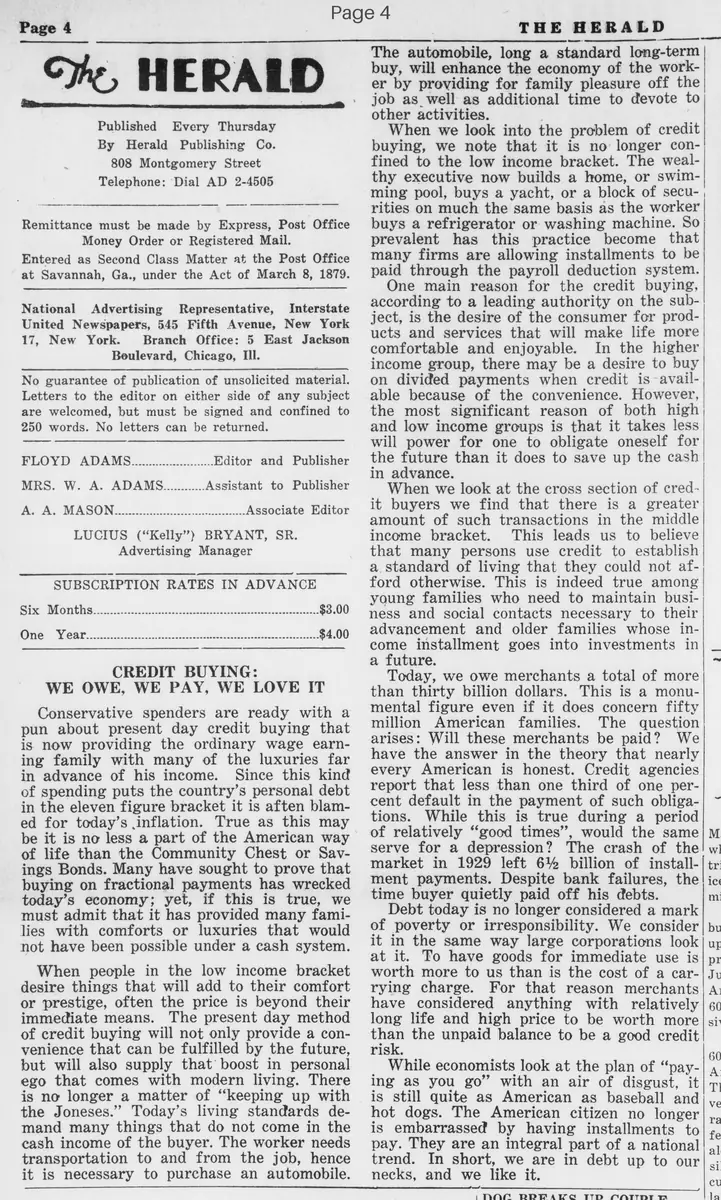
CREDIT BUYING:
WE OWE, WE PAY, WE LOVE IT
Conservative spenders are ready with a pun about present day credit buying that is now providing the ordinary wage earning family with many of the luxuries far in advance of his income. Since this kind of spending puts the country's personal debt in the eleven figure bracket it is often blamed for today's inflation. True as this may be it is no less a part of the American way of life than the Community Chest or Savings Bonds. Many have sought to prove that buying on fractional payments has wrecked today's economy; yet, if this is true, we must admit that it has provided many families with comforts or luxuries that would not have been possible under a cash system.
When people in the low income bracket desire things that will add to their comfort or prestige, often the price is beyond their immediate means. The present day method of credit buying will not only provide a convenience that can be fulfilled by the future, but will also supply that boost in personal ego that comes with modern living. There is no longer a matter of "keeping up with the Joneses." Today's living standards demand many things that do not come in the cash income of the buyer. The worker needs transportation to and from the job, hence it is necessary to purchase an automobile.
The automobile, long a standard long-term buy, will enhance the economy of the worker by providing for family pleasure off the job as well as additional time to devote to other activities.
When we look into the problem of credit buying, we note that it is no longer confined to the low income bracket. The wealthy executive now builds a home, or swimming pool, buys a yacht, or a block of securities on much the same basis as the worker buys a refrigerator or washing machine. So prevalent has this practice become that many firms are allowing installments to be paid through the payroll deduction system.
One main reason for the credit buying, according to a leading authority on the subject, is the desire of the consumer for products and services that will make life more comfortable and enjoyable. In the higher income group, there may be a desire to buy on divided payments when credit is available because of the convenience. However, the most significant reason of both high and low income groups is that it takes less will power for one to obligate oneself for the future than it does to save up the cash in advance.
When we look at the cross section of credit buyers we find that there is a greater amount of such transactions in the middle income bracket. This leads us to believe that many persons use credit to establish a standard of living that they could not afford otherwise. This is indeed true among young families who need to maintain business and social contacts necessary to their advancement and older families whose income installment goes into investments in a future.
Today, we owe merchants a total of more than thirty billion dollars. This is a monumental figure even if it does concern fifty million American families. The question arises: Will these merchants be paid? We have the answer in the theory that nearly every American is honest. Credit agencies report that less than one third of one per cent default in the payment of such obligations. While this is true during a period of relatively "good times" would the same serve for a depression? The crash of the market in 1929 left 61½ billion of installment payments. Despite bank failures, the time buyer quietly paid off his debts.
Debt today is no longer considered a mark of poverty or irresponsibility. We consider it in the same way large corporations look at it. To have goods for immediate use is worth more to us than is the cost of a carrying charge. For that reason merchants have considered anything with relatively long life and high price to be worth more than the unpaid balance to be a good credit risk.
While economists look at the plan of "paying as you go" with an air of disgust, it is still quite as American as baseball and hot dogs. The American citizen no longer is embarrassed by having installments to pay. They are an integral part of a national trend. In short, we are in debt up to our necks, and we like it.
WE OWE, WE PAY, WE LOVE IT
Conservative spenders are ready with a pun about present day credit buying that is now providing the ordinary wage earning family with many of the luxuries far in advance of his income. Since this kind of spending puts the country's personal debt in the eleven figure bracket it is often blamed for today's inflation. True as this may be it is no less a part of the American way of life than the Community Chest or Savings Bonds. Many have sought to prove that buying on fractional payments has wrecked today's economy; yet, if this is true, we must admit that it has provided many families with comforts or luxuries that would not have been possible under a cash system.
When people in the low income bracket desire things that will add to their comfort or prestige, often the price is beyond their immediate means. The present day method of credit buying will not only provide a convenience that can be fulfilled by the future, but will also supply that boost in personal ego that comes with modern living. There is no longer a matter of "keeping up with the Joneses." Today's living standards demand many things that do not come in the cash income of the buyer. The worker needs transportation to and from the job, hence it is necessary to purchase an automobile.
The automobile, long a standard long-term buy, will enhance the economy of the worker by providing for family pleasure off the job as well as additional time to devote to other activities.
When we look into the problem of credit buying, we note that it is no longer confined to the low income bracket. The wealthy executive now builds a home, or swimming pool, buys a yacht, or a block of securities on much the same basis as the worker buys a refrigerator or washing machine. So prevalent has this practice become that many firms are allowing installments to be paid through the payroll deduction system.
One main reason for the credit buying, according to a leading authority on the subject, is the desire of the consumer for products and services that will make life more comfortable and enjoyable. In the higher income group, there may be a desire to buy on divided payments when credit is available because of the convenience. However, the most significant reason of both high and low income groups is that it takes less will power for one to obligate oneself for the future than it does to save up the cash in advance.
When we look at the cross section of credit buyers we find that there is a greater amount of such transactions in the middle income bracket. This leads us to believe that many persons use credit to establish a standard of living that they could not afford otherwise. This is indeed true among young families who need to maintain business and social contacts necessary to their advancement and older families whose income installment goes into investments in a future.
Today, we owe merchants a total of more than thirty billion dollars. This is a monumental figure even if it does concern fifty million American families. The question arises: Will these merchants be paid? We have the answer in the theory that nearly every American is honest. Credit agencies report that less than one third of one per cent default in the payment of such obligations. While this is true during a period of relatively "good times" would the same serve for a depression? The crash of the market in 1929 left 61½ billion of installment payments. Despite bank failures, the time buyer quietly paid off his debts.
Debt today is no longer considered a mark of poverty or irresponsibility. We consider it in the same way large corporations look at it. To have goods for immediate use is worth more to us than is the cost of a carrying charge. For that reason merchants have considered anything with relatively long life and high price to be worth more than the unpaid balance to be a good credit risk.
While economists look at the plan of "paying as you go" with an air of disgust, it is still quite as American as baseball and hot dogs. The American citizen no longer is embarrassed by having installments to pay. They are an integral part of a national trend. In short, we are in debt up to our necks, and we like it.
What sub-type of article is it?
Economic Policy
What keywords are associated?
Credit Buying
Installment Payments
Consumer Debt
American Way Of Life
Inflation
Repayment Rates
Economic Impact
Editorial Details
Primary Topic
Defense Of Consumer Credit Buying
Stance / Tone
Supportive Of Credit Buying As American Way Of Life
Key Arguments
Credit Buying Provides Luxuries Beyond Income
Blamed For Inflation But Integral To American Life
Boosts Personal Ego And Meets Living Standards
Necessary For Workers' Transportation And Family Pleasure
Prevalent Across Income Levels Including Executives
Easier To Obligate Future Payments Than Save Cash
High Repayment Rates Even In Tough Times Like 1929
Debt Seen As Normal Like Corporate Practice
Worth Carrying Charges For Immediate Goods Use