Thank you for visiting SNEWPapers!
Sign up free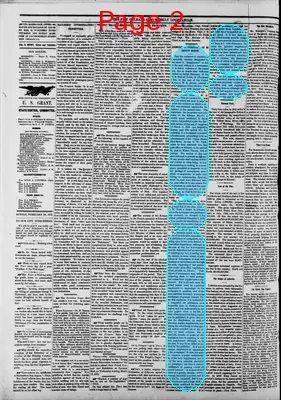
Story
February 25, 1872
Semi Weekly Louisianian
New Orleans, Orleans County, Louisiana
What is this article about?
U.S. District Court Judge Sherman rules that enclosing advertising hand-bills in newspapers violates postal law, in the case of United States vs. W. K. Brown, publisher of the Alliance Monitor, who mailed an ad for O. W. Nash's shoe store on December 1, 1870.
Clipping
OCR Quality
95%
Excellent
Full Text
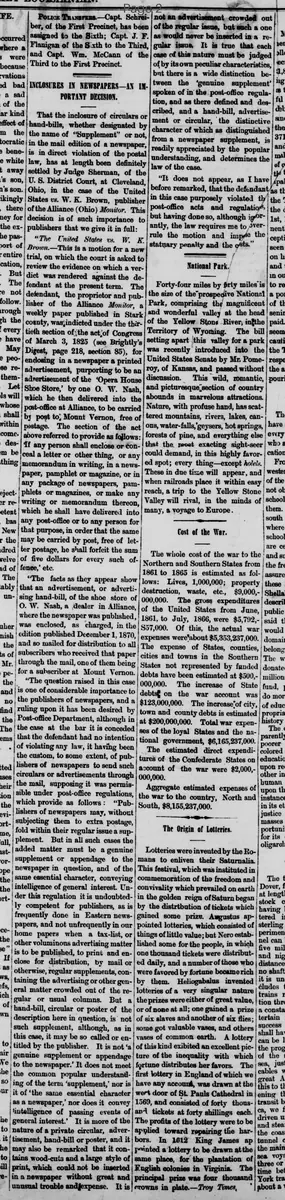
INCLOSURES IN NEWSPAPERS—AN IMPORTANT DECISION.
That the inclosure of circulars or hand-bills, whether designated by the name of "Supplement" or not, in the mail edition of a newspaper, is in direct violation of the postal law, has at length been definitely settled by Judge Sherman, of the U. S. District Court, at Cleveland, Ohio, in the case of the United States vs. W. K. Brown, publisher of the Alliance (Ohio) Monitor. This decision is of such importance to publishers that we give it in full:
"The United States vs. W. K. Brown.—This is a motion for a new trial, on which the court is asked to review the evidence on which a verdict was rendered against the defendant at the present term. The defendant, the proprietor and publisher of the Alliance Monitor, a weekly paper published in Stark county, was indicted under the thirteenth section of the act of Congress of March 3, 1825 (see Brightly's Digest, page 218, section 85), for enclosing in a newspaper a printed advertisement, purporting to be an advertisement of the 'Opera House Shoe Store,' by one O. W. Nash, which he then delivered into the post-office at Alliance, to be carried by post to Mount Vernon, free of postage.
The section of the act above referred to provide as follows: 'If any person shall enclose or conceal a letter or other thing, or any memorandum in writing, in a newspaper, pamphlet or magazine, or in any package of newspapers, pamphlets or magazines, or make any writing or memorandum thereon, which he shall have delivered into any post-office or to any person for that purpose, in order that the same may be carried by post, free of letter postage, he shall forfeit the sum of five dollars for every such offence,' etc.
The facts as they appear show that an advertisement, or advertising hand-bill, of the shoe store of O. W. Nash, a dealer in Alliance, where the newspaper was published, was enclosed, as charged, in the edition published December 1, 1870, and so mailed for distribution to all subscribers who received that paper through the mail, one of them being for a subscriber at Mount Vernon.
The question raised in this case is one of considerable importance to the publishers of newspapers, and a ruling upon it has been desired by Post-office Department, although in the case at the bar it is conceded that the defendant had no intention of violating any law, it having been the custom, to some extent, of publishers of newspapers to send such circulars or advertisements through the mail, supposing it was permissible under post-office regulations, which provide as follows:
"Publishers of newspapers may, without subjecting them to extra postage fold within their regular issue a supplement. But in all such cases the added matter must be a genuine supplement or appendage to the newspaper in question, and of the same essential character, conveying intelligence of general interest. Under this regulation it is undoubtedly competent for publishers, as is frequently done in Eastern newspapers, and not unfrequently in our home papers when a tax-list, or other voluminous advertising matter is to be published, to print and enclose for distribution, by mail or otherwise, regular supplements, containing the advertising or other general matter crowded out of the regular or usual columns. But a hand-bill, circular or poster of the description here in question, is not such supplement, although, as in this case, it may be so called or entitled by the publisher. It is not 'a genuine supplement or appendage to the newspaper.' It does not meet the common popular understanding of the term 'supplement,' nor is it of 'the same essential character as a newspaper,' nor does it convey 'intelligence of passing events of general interest.' It is more of the nature of a private circular, advertisement, hand-bill or poster, and it may also be remarked that it contains wood-cuts and a large style of print, which could not be inserted in a newspaper without great and unusual trouble and expense. It is not an advertisement crowded out of the regular issue, but such a one as would never be inserted in a regular issue. It is true that each case of this nature must be judged of by its own peculiar characteristics, but there is a wide distinction between the genuine 'supplement' spoken of in the post-office regulation, and as there defined and described, and a hand-bill, advertisement or circular, 'the distinctive character of which as distinguished from a newspaper supplement, is readily appreciated by the popular understanding, and determines the law of the case.'
It does not appear, as I have before remarked, that the defendant in this case purposely violated the post-office acts and regulations, but having done so, although ignorantly, the law requires me to overrule the motion and impose the statutory penalty and the costs."
That the inclosure of circulars or hand-bills, whether designated by the name of "Supplement" or not, in the mail edition of a newspaper, is in direct violation of the postal law, has at length been definitely settled by Judge Sherman, of the U. S. District Court, at Cleveland, Ohio, in the case of the United States vs. W. K. Brown, publisher of the Alliance (Ohio) Monitor. This decision is of such importance to publishers that we give it in full:
"The United States vs. W. K. Brown.—This is a motion for a new trial, on which the court is asked to review the evidence on which a verdict was rendered against the defendant at the present term. The defendant, the proprietor and publisher of the Alliance Monitor, a weekly paper published in Stark county, was indicted under the thirteenth section of the act of Congress of March 3, 1825 (see Brightly's Digest, page 218, section 85), for enclosing in a newspaper a printed advertisement, purporting to be an advertisement of the 'Opera House Shoe Store,' by one O. W. Nash, which he then delivered into the post-office at Alliance, to be carried by post to Mount Vernon, free of postage.
The section of the act above referred to provide as follows: 'If any person shall enclose or conceal a letter or other thing, or any memorandum in writing, in a newspaper, pamphlet or magazine, or in any package of newspapers, pamphlets or magazines, or make any writing or memorandum thereon, which he shall have delivered into any post-office or to any person for that purpose, in order that the same may be carried by post, free of letter postage, he shall forfeit the sum of five dollars for every such offence,' etc.
The facts as they appear show that an advertisement, or advertising hand-bill, of the shoe store of O. W. Nash, a dealer in Alliance, where the newspaper was published, was enclosed, as charged, in the edition published December 1, 1870, and so mailed for distribution to all subscribers who received that paper through the mail, one of them being for a subscriber at Mount Vernon.
The question raised in this case is one of considerable importance to the publishers of newspapers, and a ruling upon it has been desired by Post-office Department, although in the case at the bar it is conceded that the defendant had no intention of violating any law, it having been the custom, to some extent, of publishers of newspapers to send such circulars or advertisements through the mail, supposing it was permissible under post-office regulations, which provide as follows:
"Publishers of newspapers may, without subjecting them to extra postage fold within their regular issue a supplement. But in all such cases the added matter must be a genuine supplement or appendage to the newspaper in question, and of the same essential character, conveying intelligence of general interest. Under this regulation it is undoubtedly competent for publishers, as is frequently done in Eastern newspapers, and not unfrequently in our home papers when a tax-list, or other voluminous advertising matter is to be published, to print and enclose for distribution, by mail or otherwise, regular supplements, containing the advertising or other general matter crowded out of the regular or usual columns. But a hand-bill, circular or poster of the description here in question, is not such supplement, although, as in this case, it may be so called or entitled by the publisher. It is not 'a genuine supplement or appendage to the newspaper.' It does not meet the common popular understanding of the term 'supplement,' nor is it of 'the same essential character as a newspaper,' nor does it convey 'intelligence of passing events of general interest.' It is more of the nature of a private circular, advertisement, hand-bill or poster, and it may also be remarked that it contains wood-cuts and a large style of print, which could not be inserted in a newspaper without great and unusual trouble and expense. It is not an advertisement crowded out of the regular issue, but such a one as would never be inserted in a regular issue. It is true that each case of this nature must be judged of by its own peculiar characteristics, but there is a wide distinction between the genuine 'supplement' spoken of in the post-office regulation, and as there defined and described, and a hand-bill, advertisement or circular, 'the distinctive character of which as distinguished from a newspaper supplement, is readily appreciated by the popular understanding, and determines the law of the case.'
It does not appear, as I have before remarked, that the defendant in this case purposely violated the post-office acts and regulations, but having done so, although ignorantly, the law requires me to overrule the motion and impose the statutory penalty and the costs."
What sub-type of article is it?
Crime Story
Historical Event
What themes does it cover?
Crime Punishment
Justice
What keywords are associated?
Postal Law Violation
Newspaper Advertisement
Court Decision
Supplement Ruling
Publisher Indictment
What entities or persons were involved?
W. K. Brown
Judge Sherman
O. W. Nash
Where did it happen?
Cleveland, Ohio; Alliance, Ohio
Story Details
Key Persons
W. K. Brown
Judge Sherman
O. W. Nash
Location
Cleveland, Ohio; Alliance, Ohio
Event Date
December 1, 1870
Story Details
Publisher W. K. Brown indicted for enclosing an advertisement hand-bill for O. W. Nash's shoe store in the Alliance Monitor newspaper and mailing it free of postage, violating the 1825 postal act. Judge Sherman rules it is not a genuine supplement and imposes penalty despite lack of intent.