Thank you for visiting SNEWPapers!
Sign up free
Story
January 15, 1934
Henderson Daily Dispatch
Henderson, Vance County, North Carolina
What is this article about?
Dr. Logan Clendenning advises on treating chronic constipation, cautioning against frequent use of purgative drugs and promoting a roughage-rich diet including bran, fruits, and vegetables for natural bowel regulation.
Clipping
OCR Quality
98%
Excellent
Full Text
Effect of Drugs and Diet On Chronic Constipation
By LOGAN CLENDENING, M. D.
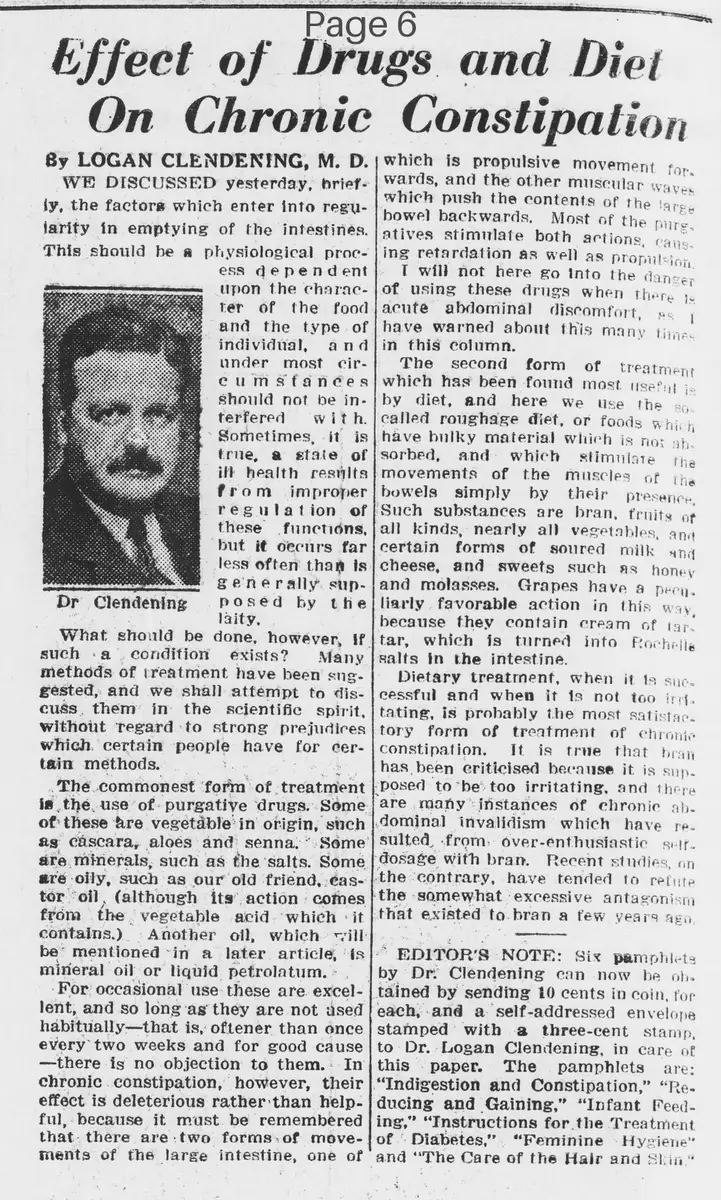
We discussed yesterday, briefly, the factors which enter into regularity in emptying of the intestines. This should be a physiological process dependent upon the character of the food and the type of individual, and under most circumstances should not be interfered with. Sometimes, it is true, a state of ill health results from improper regulation of these functions, but it occurs far less often than is generally supposed by the laity.
What should be done, however, if such a condition exists? Many methods of treatment have been suggested, and we shall attempt to discuss them in the scientific spirit, without regard to strong prejudices which certain people have for certain methods.
The commonest form of treatment is the use of purgative drugs. Some of these are vegetable in origin, such as cascara, aloes and senna. Some are minerals, such as the salts. Some are oily, such as our old friend, castor oil, (although its action comes from the vegetable acid which it contains.) Another oil, which will be mentioned in a later article, is mineral oil or liquid petrolatum. For occasional use these are excellent, and so long as they are not used habitually—that is, oftener than once every two weeks and for good cause—there is no objection to them. In chronic constipation, however, their effect is deleterious rather than helpful, because it must be remembered that there are two forms of movements of the large intestine, one of which is propulsive movement forwards, and the other muscular waves which push the contents of the large bowel backwards. Most of the purgatives stimulate both actions, causing retardation as well as propulsion. I will not here go into the danger of using these drugs when there is acute abdominal discomfort. I have warned about this many times in this column.
The second form of treatment which has been found most useful is by diet, and here we use the so-called roughage diet, or foods which have bulky material which is not absorbed, and which stimulate the movements of the muscles of the bowels simply by their presence. Such substances are bran, fruits of all kinds, nearly all vegetables, and certain forms of soured milk and cheese, and sweets such as honey and molasses. Grapes have a peculiarly favorable action in this way, because they contain cream of tartar, which is turned into Rochelle salts in the intestine.
Dietary treatment, when it is successful and when it is not too irritating, is probably the most satisfactory form of treatment of chronic constipation. It is true that bran has been criticised because it is supposed to be too irritating, and there are many instances of chronic abdominal invalidism which have resulted from over-enthusiastic self-dosage with bran. Recent studies, on the contrary, have tended to refute the somewhat excessive antagonism that existed to bran a few years ago.
EDITOR'S NOTE: Six pamphlets by Dr. Clendening can now be obtained by sending 10 cents in coin, for each, and a self-addressed envelope stamped with a three-cent stamp, to Dr. Logan Clendening, in care of this paper. The pamphlets are: "Indigestion and Constipation," "Reducing and Gaining," "Infant Feeding," "Instructions for the Treatment of Diabetes," "Feminine Hygiene" and "The Care of the Hair and Skin."
By LOGAN CLENDENING, M. D.
We discussed yesterday, briefly, the factors which enter into regularity in emptying of the intestines. This should be a physiological process dependent upon the character of the food and the type of individual, and under most circumstances should not be interfered with. Sometimes, it is true, a state of ill health results from improper regulation of these functions, but it occurs far less often than is generally supposed by the laity.
What should be done, however, if such a condition exists? Many methods of treatment have been suggested, and we shall attempt to discuss them in the scientific spirit, without regard to strong prejudices which certain people have for certain methods.
The commonest form of treatment is the use of purgative drugs. Some of these are vegetable in origin, such as cascara, aloes and senna. Some are minerals, such as the salts. Some are oily, such as our old friend, castor oil, (although its action comes from the vegetable acid which it contains.) Another oil, which will be mentioned in a later article, is mineral oil or liquid petrolatum. For occasional use these are excellent, and so long as they are not used habitually—that is, oftener than once every two weeks and for good cause—there is no objection to them. In chronic constipation, however, their effect is deleterious rather than helpful, because it must be remembered that there are two forms of movements of the large intestine, one of which is propulsive movement forwards, and the other muscular waves which push the contents of the large bowel backwards. Most of the purgatives stimulate both actions, causing retardation as well as propulsion. I will not here go into the danger of using these drugs when there is acute abdominal discomfort. I have warned about this many times in this column.
The second form of treatment which has been found most useful is by diet, and here we use the so-called roughage diet, or foods which have bulky material which is not absorbed, and which stimulate the movements of the muscles of the bowels simply by their presence. Such substances are bran, fruits of all kinds, nearly all vegetables, and certain forms of soured milk and cheese, and sweets such as honey and molasses. Grapes have a peculiarly favorable action in this way, because they contain cream of tartar, which is turned into Rochelle salts in the intestine.
Dietary treatment, when it is successful and when it is not too irritating, is probably the most satisfactory form of treatment of chronic constipation. It is true that bran has been criticised because it is supposed to be too irritating, and there are many instances of chronic abdominal invalidism which have resulted from over-enthusiastic self-dosage with bran. Recent studies, on the contrary, have tended to refute the somewhat excessive antagonism that existed to bran a few years ago.
EDITOR'S NOTE: Six pamphlets by Dr. Clendening can now be obtained by sending 10 cents in coin, for each, and a self-addressed envelope stamped with a three-cent stamp, to Dr. Logan Clendening, in care of this paper. The pamphlets are: "Indigestion and Constipation," "Reducing and Gaining," "Infant Feeding," "Instructions for the Treatment of Diabetes," "Feminine Hygiene" and "The Care of the Hair and Skin."
What sub-type of article is it?
Medical Advice
Health Column
What keywords are associated?
Chronic Constipation
Purgative Drugs
Roughage Diet
Bran
Fruits
Vegetables
What entities or persons were involved?
Logan Clendenning
Story Details
Key Persons
Logan Clendenning
Story Details
Article discusses treatment of chronic constipation, advising against habitual use of purgative drugs like cascara, aloes, senna, salts, and castor oil due to their potential to cause retardation. Recommends dietary approach with roughage foods such as bran, fruits, vegetables, soured milk, cheese, honey, molasses, and grapes for stimulating bowel movements.