Thank you for visiting SNEWPapers!
Sign up free
Literary
September 6, 1837
Danbury Times
Danbury, Fairfield County, Connecticut
What is this article about?
Argument from the Campbell-Owen debate asserting the apostles' unparalleled credibility as witnesses to Jesus' resurrection, highlighting their sensory proofs, sincerity, transformation from cowardice to boldness, and martyrdom for attesting the fact, not opinions.
Clipping
OCR Quality
98%
Excellent
Full Text
THE APOSTLES.
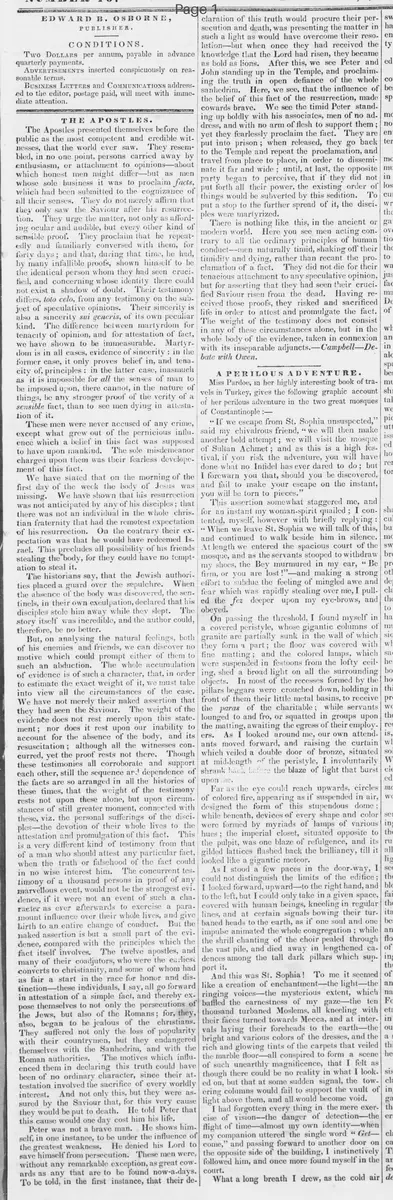
The Apostles presented themselves before the public as the most competent and credible witnesses, that the world ever saw. They resembled, in no one point, persons carried away by enthusiasm, or attachment to opinions—about which honest men might differ—but as men whose sole business it was to proclaim facts, which had been submitted to the cognizance of all their senses. They do not merely affirm that they only saw the Saviour after his resurrection. They urge the matter, not only as affording ocular and audible, but every other kind of sensible proof. They proclaim that he repeatedly and familiarly conversed with them, for forty days; and that, during that time, he had by many infallible proofs, shown himself to be the identical person whom they had seen crucified, and concerning whose identity there could not exist a shadow of doubt. Their testimony differs, toto coelo, from any testimony on the subject of speculative opinions. Their sincerity is also a sincerity sui generis, of its own peculiar kind. The difference between martyrdom for tenacity of opinion, and for attestation of fact we have shown to be immeasurable. Martyrdom is in all cases, evidence of sincerity: in the former case, it only proves belief in, and tenacity of, principles: in the latter case, inasmuch as it is impossible for all the senses of man to be imposed upon, there cannot, in the nature of things, be any stronger proof of the verity of a sensible fact, than to see men dying in attestation of it.
These men were never accused of any crime, except what grew out of the pernicious influence which a belief in this fact was supposed to have upon mankind. The sole misdemeanor charged upon them was their fearless development of this fact.
We have stated that on the morning of the first day of the week the body of Jesus was missing. We have shown that his resurrection was not anticipated by any of his disciples; that there was not an individual in the whole christian fraternity that had the remotest expectation of his resurrection. On the contrary their expectation was that he would have redeemed Israel. This precludes all possibility of his friends stealing the body, for they could have no temptation to steal it.
The historians say, that the Jewish authorities placed a guard over the sepulchre. When the absence of the body was discovered, the sentinels, in their own exculpation, declared that his disciples stole him away while they slept. The story itself was incredible, and the author could, therefore, be no better.
But, on analysing the natural feelings, both of his enemies and friends, we can discover no motive which could prompt either of them to such an abduction. The whole accumulation of evidence is of such a character, that, in order to estimate the exact weight of it, we must take into view all the circumstances of the case.
We have not merely their naked assertion that they had seen the Saviour. The weight of the evidence does not rest merely upon this statement; nor does it rest upon our inability to account for the absence of the body, and its resuscitation; although all the witnesses concurred, yet the proof rests not there. Though these testimonies all corroborate and support each other, still the sequence and dependence of the facts are so arranged in all the histories of these times, that the weight of the testimony rests not upon these alone, but upon circumstances of still greater moment, connected with these, viz. the personal sufferings of the disciples—the devotion of their whole lives to the attestation and promulgation of this fact. This is a very different kind of testimony from that of a man who should attest any particular fact when the truth or falsehood of the fact could in no wise interest him. The concurrent testimony of a thousand persons in proof of any marvellous event, would not be the strongest evidence, if it were not an event of such a character as ever afterwards to exercise a paramount influence over their whole lives, and give birth to an entire change of conduct. But the naked assertion is but a small part of the evidence, compared with the principles which the fact itself involves. The twelve apostles, and many of their coadjutors, who were the earliest converts to christianity, and some of whom had as fair a start in the race for honor and distinction—these individuals, I say, all go forward in attestation of a simple fact, and thereby expose themselves to not only the persecutions of the Jews, but also of the Romans; for, they, also, began to be jealous of the christians. They suffered not only the loss of popularity with their countrymen, but they endangered themselves with the Sanhedrim, and with the Roman authorities. The motives which influenced them in declaring this truth could have been of no ordinary character, since their attestation involved the sacrifice of every worldly interest. And not only this, but they were assured by the Saviour that, for this very cause they would be put to death. He told Peter that this cause would one day cost him his life.
Peter was not a brave man. He shows himself, in one instance, to be under the influence of the greatest weakness. He denied his Lord to save himself from persecution. These men were, without any remarkable exception, as great cowards as any that are to be found now-a-days.
To be told, in the first instance, that their declaration of this truth would procure their persecution and death, was presenting the matter in such a light as would have overcome their resolution but when once they had received the knowledge that the Lord had risen, they became as bold as lions. After this, we see Peter and John standing up in the Temple, and proclaiming the truth in open defiance of the whole sanhedrim. Here, we see, that the influence of the belief of this fact of the resurrection, made cowards brave. We see the timid Peter standing up boldly with his associates, men of no address, and with no arm of flesh to support them; yet they fearlessly proclaim the fact. They are put into prison; when released, they go back to the Temple and repeat the proclamation, and travel from place to place, in order to disseminate it far and wide; until, at last, the opposite party began to perceive, that if they did not put forth all their power, the existing order of things would be subverted by this sedition. To put a stop to the further spread of it, the disciples were martyrized.
There is nothing like this, in the ancient or modern world. Here you see men acting contrary to all the ordinary principles of human conduct—men naturally timid, shaking off their timidity and dying, rather than recant the proclamation of a fact. They did not die for their tenacious attachment to any speculative opinion. but for asserting that they had seen their crucified Saviour risen from the dead. Having received those proofs, they risked and sacrificed life in order to attest and promulgate the fact.
The weight of the testimony does not consist in any of these circumstances alone, but in the whole body of the evidence, taken in connexion with its inseparable adjuncts.—Campbell Debate with Owen.
The Apostles presented themselves before the public as the most competent and credible witnesses, that the world ever saw. They resembled, in no one point, persons carried away by enthusiasm, or attachment to opinions—about which honest men might differ—but as men whose sole business it was to proclaim facts, which had been submitted to the cognizance of all their senses. They do not merely affirm that they only saw the Saviour after his resurrection. They urge the matter, not only as affording ocular and audible, but every other kind of sensible proof. They proclaim that he repeatedly and familiarly conversed with them, for forty days; and that, during that time, he had by many infallible proofs, shown himself to be the identical person whom they had seen crucified, and concerning whose identity there could not exist a shadow of doubt. Their testimony differs, toto coelo, from any testimony on the subject of speculative opinions. Their sincerity is also a sincerity sui generis, of its own peculiar kind. The difference between martyrdom for tenacity of opinion, and for attestation of fact we have shown to be immeasurable. Martyrdom is in all cases, evidence of sincerity: in the former case, it only proves belief in, and tenacity of, principles: in the latter case, inasmuch as it is impossible for all the senses of man to be imposed upon, there cannot, in the nature of things, be any stronger proof of the verity of a sensible fact, than to see men dying in attestation of it.
These men were never accused of any crime, except what grew out of the pernicious influence which a belief in this fact was supposed to have upon mankind. The sole misdemeanor charged upon them was their fearless development of this fact.
We have stated that on the morning of the first day of the week the body of Jesus was missing. We have shown that his resurrection was not anticipated by any of his disciples; that there was not an individual in the whole christian fraternity that had the remotest expectation of his resurrection. On the contrary their expectation was that he would have redeemed Israel. This precludes all possibility of his friends stealing the body, for they could have no temptation to steal it.
The historians say, that the Jewish authorities placed a guard over the sepulchre. When the absence of the body was discovered, the sentinels, in their own exculpation, declared that his disciples stole him away while they slept. The story itself was incredible, and the author could, therefore, be no better.
But, on analysing the natural feelings, both of his enemies and friends, we can discover no motive which could prompt either of them to such an abduction. The whole accumulation of evidence is of such a character, that, in order to estimate the exact weight of it, we must take into view all the circumstances of the case.
We have not merely their naked assertion that they had seen the Saviour. The weight of the evidence does not rest merely upon this statement; nor does it rest upon our inability to account for the absence of the body, and its resuscitation; although all the witnesses concurred, yet the proof rests not there. Though these testimonies all corroborate and support each other, still the sequence and dependence of the facts are so arranged in all the histories of these times, that the weight of the testimony rests not upon these alone, but upon circumstances of still greater moment, connected with these, viz. the personal sufferings of the disciples—the devotion of their whole lives to the attestation and promulgation of this fact. This is a very different kind of testimony from that of a man who should attest any particular fact when the truth or falsehood of the fact could in no wise interest him. The concurrent testimony of a thousand persons in proof of any marvellous event, would not be the strongest evidence, if it were not an event of such a character as ever afterwards to exercise a paramount influence over their whole lives, and give birth to an entire change of conduct. But the naked assertion is but a small part of the evidence, compared with the principles which the fact itself involves. The twelve apostles, and many of their coadjutors, who were the earliest converts to christianity, and some of whom had as fair a start in the race for honor and distinction—these individuals, I say, all go forward in attestation of a simple fact, and thereby expose themselves to not only the persecutions of the Jews, but also of the Romans; for, they, also, began to be jealous of the christians. They suffered not only the loss of popularity with their countrymen, but they endangered themselves with the Sanhedrim, and with the Roman authorities. The motives which influenced them in declaring this truth could have been of no ordinary character, since their attestation involved the sacrifice of every worldly interest. And not only this, but they were assured by the Saviour that, for this very cause they would be put to death. He told Peter that this cause would one day cost him his life.
Peter was not a brave man. He shows himself, in one instance, to be under the influence of the greatest weakness. He denied his Lord to save himself from persecution. These men were, without any remarkable exception, as great cowards as any that are to be found now-a-days.
To be told, in the first instance, that their declaration of this truth would procure their persecution and death, was presenting the matter in such a light as would have overcome their resolution but when once they had received the knowledge that the Lord had risen, they became as bold as lions. After this, we see Peter and John standing up in the Temple, and proclaiming the truth in open defiance of the whole sanhedrim. Here, we see, that the influence of the belief of this fact of the resurrection, made cowards brave. We see the timid Peter standing up boldly with his associates, men of no address, and with no arm of flesh to support them; yet they fearlessly proclaim the fact. They are put into prison; when released, they go back to the Temple and repeat the proclamation, and travel from place to place, in order to disseminate it far and wide; until, at last, the opposite party began to perceive, that if they did not put forth all their power, the existing order of things would be subverted by this sedition. To put a stop to the further spread of it, the disciples were martyrized.
There is nothing like this, in the ancient or modern world. Here you see men acting contrary to all the ordinary principles of human conduct—men naturally timid, shaking off their timidity and dying, rather than recant the proclamation of a fact. They did not die for their tenacious attachment to any speculative opinion. but for asserting that they had seen their crucified Saviour risen from the dead. Having received those proofs, they risked and sacrificed life in order to attest and promulgate the fact.
The weight of the testimony does not consist in any of these circumstances alone, but in the whole body of the evidence, taken in connexion with its inseparable adjuncts.—Campbell Debate with Owen.
What sub-type of article is it?
Essay
What themes does it cover?
Religious
Moral Virtue
What keywords are associated?
Apostles
Resurrection
Testimony
Martyrdom
Sincerity
Disciples
Persecution
Christianity
What entities or persons were involved?
Campbell Debate With Owen
Literary Details
Title
The Apostles.
Author
Campbell Debate With Owen
Subject
Testimony Of The Apostles To The Resurrection Of Jesus
Key Lines
Their Testimony Differs, Toto Coelo, From Any Testimony On The Subject Of Speculative Opinions.
Martyrdom Is In All Cases, Evidence Of Sincerity: In The Former Case, It Only Proves Belief In, And Tenacity Of, Principles: In The Latter Case, Inasmuch As It Is Impossible For All The Senses Of Man To Be Imposed Upon, There Cannot, In The Nature Of Things, Be Any Stronger Proof Of The Verity Of A Sensible Fact, Than To See Men Dying In Attestation Of It.
Here, We See, That The Influence Of The Belief Of This Fact Of The Resurrection, Made Cowards Brave.
They Did Not Die For Their Tenacious Attachment To Any Speculative Opinion. But For Asserting That They Had Seen Their Crucified Saviour Risen From The Dead.