Thank you for visiting SNEWPapers!
Sign up free
Story
May 9, 1909
Blue Grass Blade
Lexington, Fayette County, Kentucky
What is this article about?
Opinion piece by Charles H. Schwartz defending Thomas Paine against Methodist preachers who misrepresent him as an atheist. Quotes extensively from 'The Age of Reason' to affirm Paine's Deism, belief in one God, and criticism of organized religion and the Bible.
Clipping
OCR Quality
95%
Excellent
Full Text
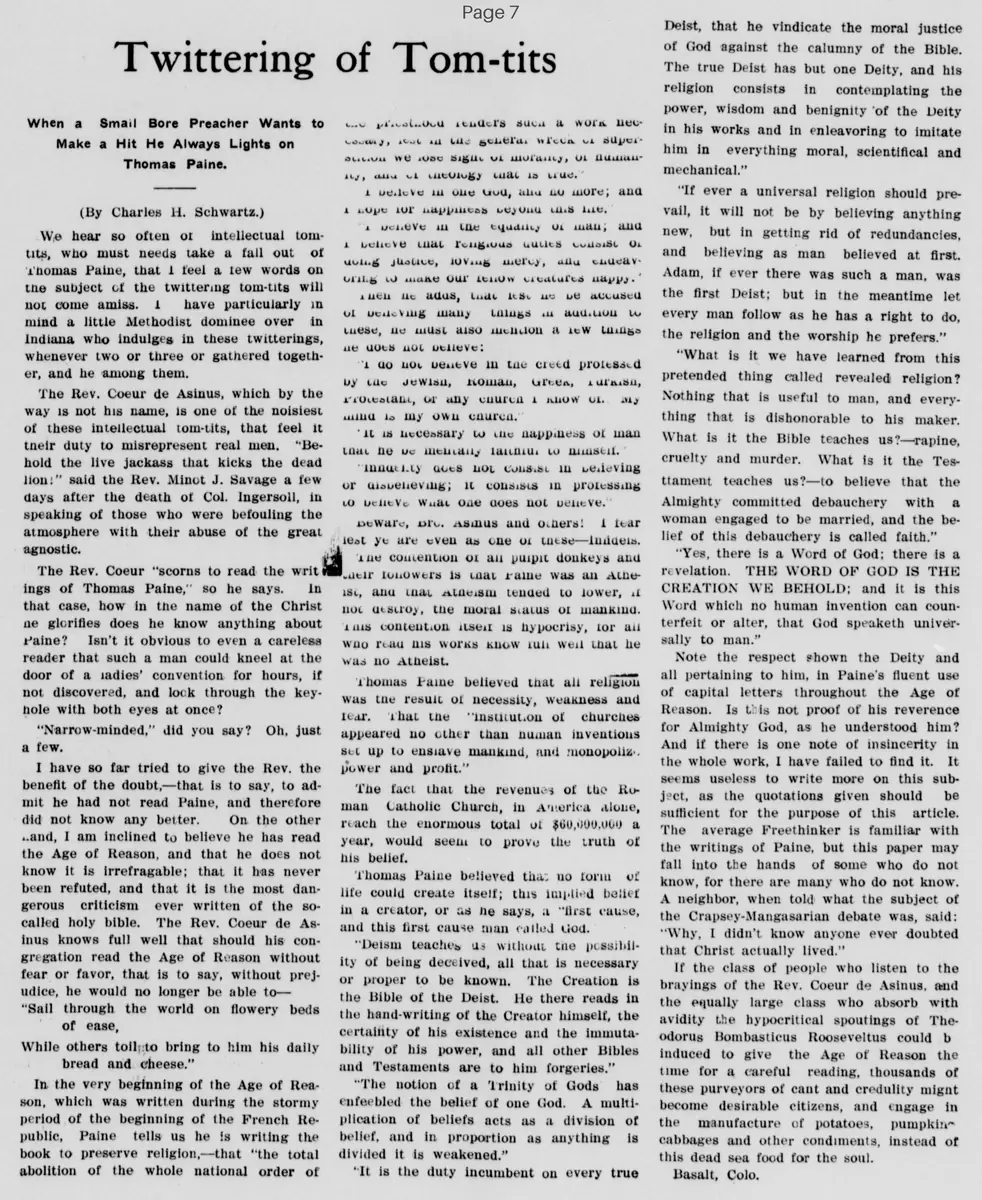
Twittering of Tom-tits
When a Small Bore Preacher Wants to Make a Hit He Always Lights on Thomas Paine.
(By Charles H. Schwartz.)
We hear so often of intellectual tom-tits, who must needs take a fall out of Thomas Paine, that I feel a few words on the subject of the twittering tom-tits will not come amiss. I have particularly in mind a little Methodist dominee over in Indiana who indulges in these twitterings, whenever two or three are gathered together, and he among them.
The Rev. Coeur de Asinus, which by the way is not his name, is one of the noisiest of these intellectual tom-tits, that feel it their duty to misrepresent real men.
"Behold the live jackass that kicks the dead lion!" said the Rev. Minot J. Savage a few days after the death of Col. Ingersoll, in speaking of those who were befouling the atmosphere with their abuse of the great agnostic.
The Rev. Coeur "scorns to read the writings of Thomas Paine," so he says. In that case, how in the name of the Christ he glorifies does he know anything about Paine? Isn't it obvious to even a careless reader that such a man could kneel at the door of a ladies' convention for hours, if not discovered, and look through the keyhole with both eyes at once?
"Narrow-minded," did you say? Oh, just a few.
I have so far tried to give the Rev. the benefit of the doubt,-that is to say, to admit he had not read Paine, and therefore did not know any better. On the other hand, I am inclined to believe he has read the Age of Reason, and that he does not know it is irrefragable; that it has never been refuted, and that it is the most dangerous criticism ever written of the so-called holy bible.
The Rev. Coeur de Asinus knows full well that should his congregation read the Age of Reason without fear or favor, that is to say, without prejudice, he would no longer be able to-
"Sail through the world on flowery beds of ease,
While others toil to bring to him his daily bread and cheese."
In the very beginning of the Age of Reason, which was written during the stormy period of the beginning of the French Republic, Paine tells us he is writing the book to preserve religion,--that "the total abolition of the whole national order of things. The clergy renders such a work necessary, lest the general when it supersedes superstition we lose sight of morality, or humanities, and of theology that is true.
I believe in one God, and no more; and I hope for happiness beyond this life.
I believe in the equality of man; and I believe that religious duties consist of Doing justice, loving mercy, and endeavoring to make our fellow creatures happy.
Then he adds, that if there be accused of believing many things according to these, he must also mention a few things he does not believe:
I do not believe in the creed professed by the Jewish, Roman, Greek, Turkish, Protestant, or any church I know of. My mind is my own church."
"It is necessary to the happiness of man that he be mentally faithful to himself.
"Infidelity does not consist in believing or disbelieving; it consists in professing to believe what one does not believe."
Beware, Rev. Asinus and others! I fear lest ye are even as one of these-infidel.
The contention of all pulpit donkeys and their followers is that Paine was an Atheist, and that Atheism tended to lower, if not destroy, the moral status of mankind.
This contention itself is hypocrisy, for all who read his works know full well that he was no Atheist.
Thomas Paine believed that all religion was the result of necessity, weakness and fear. That the "institution of churches appeared no other than human inventions set up to enslave mankind, and monopolize power : and profit."
The fact that the revenues of the Roman Catholic Church in America alone, reach the enormous total of $60,000,000 a year, would seem to prove the truth of his belief.
Thomas Paine believed that no form of life could create itself; this implied belief in a creator, or as he says, a "first cause, and this first cause man called God.
"Deism teaches us without the possibility of being deceived, all that is necessary or proper to be known. The Creation is the Bible of the Deist. He there reads in the hand-writing of the Creator himself, the certainty of his existence and the immutability of his power, and all other Bibles and Testaments are to him forgeries."
"The notion of a Trinity of Gods has enfeebled the belief of one God. A multiplication of beliefs acts as a division of belief, and in proportion as anything is divided it is weakened."
"It is the duty incumbent on every true Deist, that he vindicate the moral justice of God against the calumny of the Bible. The true Deist has but one Deity, and his religion consists in contemplating the power, wisdom and benignity of the Deity in his works and in endeavoring to imitate him in everything moral, scientifical and mechanical."
"If ever a universal religion should prevail, it will not be by believing anything new, but in getting rid of redundancies, and believing as man believed at first. Adam, if ever there was such a man, was the first Deist; but in the meantime let every man follow as he has a right to do, the religion and the worship he prefers."
"What is it we have learned from this pretended thing called revealed religion? Nothing that is useful to man, and everything that is dishonorable to his maker. What is it the Bible teaches us?-rapine, cruelty and murder. What is it the Testament teaches us?-to believe that the Almighty committed debauchery with a woman engaged to be married, and the belief of this debauchery is called faith."
"Yes, there is a Word of God; there is a revelation. THE WORD OF GOD IS THE CREATION WE BEHOLD: and it is this Word which no human invention can counterfeit or alter, that God speaketh universally to man."
Note the respect shown the Deity and all pertaining to him, in Paine's fluent use of capital letters throughout the Age of Reason. Is this not proof of his reverence for Almighty God, as he understood him?
And if there is one note of insincerity in the whole work, I have failed to find it. It seems useless to write more on this subject, as the quotations given should be sufficient for the purpose of this article.
The average Freethinker is familiar with the writings of Paine, but this paper may fall into the hands of some who do not know, for there are many who do not know.
A neighbor, when told what the subject of the Crapsey-Mangasarian debate was, said:
"Why, I didn't know anyone ever doubted that Christ actually lived."
If the class of people who listen to the brayings of the Rev. Coeur de Asinus, and the equally large class who absorb with avidity the hypocritical spoutings of Theodorus Bombasticus Rooseveltus could be induced to give the Age of Reason the time for a careful reading, thousands of these purveyors of cant and credulity might become desirable citizens, and engage in the manufacture of potatoes, pumpkins, cabbages and other condiments, instead of this dead sea food for the soul.
Basalt, Colo.
When a Small Bore Preacher Wants to Make a Hit He Always Lights on Thomas Paine.
(By Charles H. Schwartz.)
We hear so often of intellectual tom-tits, who must needs take a fall out of Thomas Paine, that I feel a few words on the subject of the twittering tom-tits will not come amiss. I have particularly in mind a little Methodist dominee over in Indiana who indulges in these twitterings, whenever two or three are gathered together, and he among them.
The Rev. Coeur de Asinus, which by the way is not his name, is one of the noisiest of these intellectual tom-tits, that feel it their duty to misrepresent real men.
"Behold the live jackass that kicks the dead lion!" said the Rev. Minot J. Savage a few days after the death of Col. Ingersoll, in speaking of those who were befouling the atmosphere with their abuse of the great agnostic.
The Rev. Coeur "scorns to read the writings of Thomas Paine," so he says. In that case, how in the name of the Christ he glorifies does he know anything about Paine? Isn't it obvious to even a careless reader that such a man could kneel at the door of a ladies' convention for hours, if not discovered, and look through the keyhole with both eyes at once?
"Narrow-minded," did you say? Oh, just a few.
I have so far tried to give the Rev. the benefit of the doubt,-that is to say, to admit he had not read Paine, and therefore did not know any better. On the other hand, I am inclined to believe he has read the Age of Reason, and that he does not know it is irrefragable; that it has never been refuted, and that it is the most dangerous criticism ever written of the so-called holy bible.
The Rev. Coeur de Asinus knows full well that should his congregation read the Age of Reason without fear or favor, that is to say, without prejudice, he would no longer be able to-
"Sail through the world on flowery beds of ease,
While others toil to bring to him his daily bread and cheese."
In the very beginning of the Age of Reason, which was written during the stormy period of the beginning of the French Republic, Paine tells us he is writing the book to preserve religion,--that "the total abolition of the whole national order of things. The clergy renders such a work necessary, lest the general when it supersedes superstition we lose sight of morality, or humanities, and of theology that is true.
I believe in one God, and no more; and I hope for happiness beyond this life.
I believe in the equality of man; and I believe that religious duties consist of Doing justice, loving mercy, and endeavoring to make our fellow creatures happy.
Then he adds, that if there be accused of believing many things according to these, he must also mention a few things he does not believe:
I do not believe in the creed professed by the Jewish, Roman, Greek, Turkish, Protestant, or any church I know of. My mind is my own church."
"It is necessary to the happiness of man that he be mentally faithful to himself.
"Infidelity does not consist in believing or disbelieving; it consists in professing to believe what one does not believe."
Beware, Rev. Asinus and others! I fear lest ye are even as one of these-infidel.
The contention of all pulpit donkeys and their followers is that Paine was an Atheist, and that Atheism tended to lower, if not destroy, the moral status of mankind.
This contention itself is hypocrisy, for all who read his works know full well that he was no Atheist.
Thomas Paine believed that all religion was the result of necessity, weakness and fear. That the "institution of churches appeared no other than human inventions set up to enslave mankind, and monopolize power : and profit."
The fact that the revenues of the Roman Catholic Church in America alone, reach the enormous total of $60,000,000 a year, would seem to prove the truth of his belief.
Thomas Paine believed that no form of life could create itself; this implied belief in a creator, or as he says, a "first cause, and this first cause man called God.
"Deism teaches us without the possibility of being deceived, all that is necessary or proper to be known. The Creation is the Bible of the Deist. He there reads in the hand-writing of the Creator himself, the certainty of his existence and the immutability of his power, and all other Bibles and Testaments are to him forgeries."
"The notion of a Trinity of Gods has enfeebled the belief of one God. A multiplication of beliefs acts as a division of belief, and in proportion as anything is divided it is weakened."
"It is the duty incumbent on every true Deist, that he vindicate the moral justice of God against the calumny of the Bible. The true Deist has but one Deity, and his religion consists in contemplating the power, wisdom and benignity of the Deity in his works and in endeavoring to imitate him in everything moral, scientifical and mechanical."
"If ever a universal religion should prevail, it will not be by believing anything new, but in getting rid of redundancies, and believing as man believed at first. Adam, if ever there was such a man, was the first Deist; but in the meantime let every man follow as he has a right to do, the religion and the worship he prefers."
"What is it we have learned from this pretended thing called revealed religion? Nothing that is useful to man, and everything that is dishonorable to his maker. What is it the Bible teaches us?-rapine, cruelty and murder. What is it the Testament teaches us?-to believe that the Almighty committed debauchery with a woman engaged to be married, and the belief of this debauchery is called faith."
"Yes, there is a Word of God; there is a revelation. THE WORD OF GOD IS THE CREATION WE BEHOLD: and it is this Word which no human invention can counterfeit or alter, that God speaketh universally to man."
Note the respect shown the Deity and all pertaining to him, in Paine's fluent use of capital letters throughout the Age of Reason. Is this not proof of his reverence for Almighty God, as he understood him?
And if there is one note of insincerity in the whole work, I have failed to find it. It seems useless to write more on this subject, as the quotations given should be sufficient for the purpose of this article.
The average Freethinker is familiar with the writings of Paine, but this paper may fall into the hands of some who do not know, for there are many who do not know.
A neighbor, when told what the subject of the Crapsey-Mangasarian debate was, said:
"Why, I didn't know anyone ever doubted that Christ actually lived."
If the class of people who listen to the brayings of the Rev. Coeur de Asinus, and the equally large class who absorb with avidity the hypocritical spoutings of Theodorus Bombasticus Rooseveltus could be induced to give the Age of Reason the time for a careful reading, thousands of these purveyors of cant and credulity might become desirable citizens, and engage in the manufacture of potatoes, pumpkins, cabbages and other condiments, instead of this dead sea food for the soul.
Basalt, Colo.
What sub-type of article is it?
Biography
Historical Event
What themes does it cover?
Moral Virtue
Justice
Deception
What keywords are associated?
Thomas Paine
Age Of Reason
Deism
Religious Criticism
Methodist Preacher
Freethought
What entities or persons were involved?
Thomas Paine
Rev. Coeur De Asinus
Charles H. Schwartz
Where did it happen?
Indiana
Story Details
Key Persons
Thomas Paine
Rev. Coeur De Asinus
Charles H. Schwartz
Location
Indiana
Story Details
Defense of Thomas Paine's Deism in 'The Age of Reason' against clerical misrepresentation as atheism, with quotes emphasizing belief in one God, criticism of churches and Bible, and call for unprejudiced reading.