Thank you for visiting SNEWPapers!
Sign up free
Editorial
November 4, 1800
Gazette Of The United States, & Daily Advertiser
Philadelphia, Philadelphia County, Pennsylvania
What is this article about?
An anonymous 1800 letter signed 'CUSTOS' attacks Tench Coxe's political integrity, detailing his alleged desertion from the American army in 1776, multiple shifts in allegiance during the Revolution and early republic, and hypocrisy in criticizing John Adams amid the presidential election.
Clipping
OCR Quality
98%
Excellent
Full Text
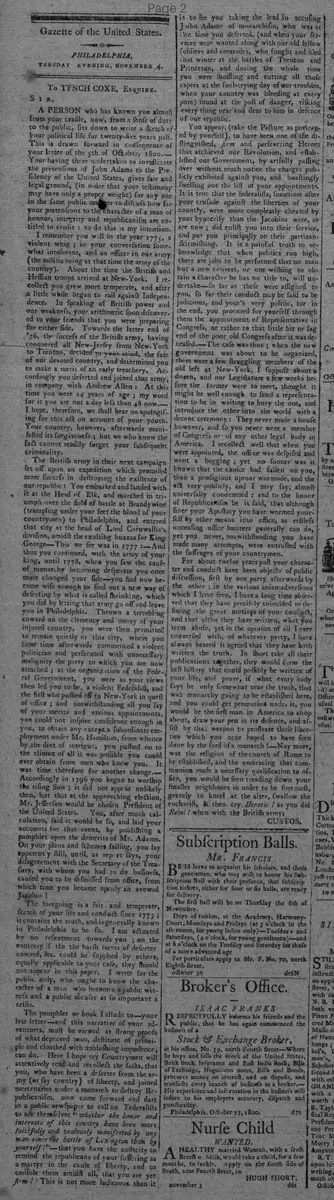
To TENCH COXE, Esquire.
SIR,
A PERSON who has known you almost from your cradle, now, from a sense of duty to the public, sits down to write a sketch of your political life for twenty-five years past. This is drawn forward in consequence of your letter of the 5th of October, 1800. Your having there undertaken to investigate the pretensions of John Adams to the Presidency of the United States, gives fair and legal ground, (in order that your testimony may have only a proper weight) for any one in the same public manner to discuss how far your pretensions to the character of a man of honour, integrity and republicanism are entitled to credit: to do this is my intention.
I remember you well in the year 1775, a violent whig; in your conversation somewhat intolerant, and an officer in our army (the militia being at that time the army of the country). About the time the British and Hessian troops arrived at New-York, I recollect you grew more temperate, and after a little while began to rail against Independence. In speaking of British power and our weakness, your arithmetic soon discovered to your friends that you were preparing for either side. Towards the latter end of '76, the success of the British army, having conquered all New-Jersey from New-York to Trenton, decided in your mind, the fate of our devoted country, and determined you to make a merit of an early treachery. Accordingly you deserted and joined that army, in company with Andrew Allen: At this time you were 24 years of age; my word for it you are not a day less than 48 now. I hope, therefore, we shall hear no apologizing for this act on account of your youth. Your country, however, afterwards manifested its forgiveness; but we who know the fact cannot readily forget your ubiquitous criminality.
The British army in their next campaign set off upon an expedition which promised more success in destroying the existence of our republic: You embarked and landed with it at the Head of Elk, and marched in triumph over the field of battle at Brandywine (trampling under your feet the blood of your countrymen) to Philadelphia, and entered that city at the head of Lord Cornwallis's division, amidst the exulting buzzas for King George. This we see was in 1777: And thus you continued, with the army of your king, until 1778, when you saw the cause of monarchy becoming desperate you once more changed your side. you had now become wise enough to find out a new way of deserting by what is called shrinking, which you did by letting that army go off and leave you in Philadelphia. Thrown a trembling coward on the clemency and mercy of your injured country, you were then permitted to remain quietly in this city, where you some time afterwards commenced a violent politician and persecuted with unnecessary malignity the party to which you are now attached; at the organization of the Federal Government, you were as your views then led you to be, a violent Federalist, and the first who pushed off to New-York in quest of office; and notwithstanding all you say of your merits and various appointments, you could not inspire confidence enough in you, to obtain any except a subordinate employment under Mr. Hamilton, from whence by the dint of intrigue, you pushed on to the climax of all it was possible you could ever obtain from men who knew you. It was time therefore for another change. Accordingly in 1796 you began to worship the rising Sun; it did not appear unlikely then, but that at the approaching election, Mr. Jefferson would be chosen President of the United States. You, after much calculation, said it would be so, and laid your accounts for that event, by publishing a pamphlet upon the demerits of Mr. Adams. On your plans and schemes failing, you lay apparently still, until, as report says, your disagreement with the Secretary of the Treasury, with whom you had to do business, caused you to be dismissed from office, from which time you became openly an avowed Jacobin!
The foregoing is a fair and temperate sketch of your life and conduct since 1775; it contains the truth, and is generally known in Philadelphia to be so. I am actuated by no resentment towards you; on the contrary if the harsh terms of deserter coward, &c. could be supplied by others, equally applicable to your case, they should not appear in this paper. I write for the public only, who ought to know the character of a man who becomes a public witness and a public accuser at so important a crisis.
The pamphlet or book I allude to—your late letter—and this narrative of your adventures, must be viewed as strong proofs of what depraved man, destitute of principle and clothed with unblushing impudence, can do. Here I hope my Countrymen will attentively read and recollect the facts, that you, who have been a deserter from the army (or say country) of liberty, and joined mercenaries under a monarch to destroy Republicanism, now come forward and dare in a public newspaper to call on Federalists to ask themselves "whether the honor and interests of this country have been more faithfully and zealously manifested by any man since the battle of Lexington than by yourself!"—that you have the audacity to remind the republicans of your suffering as a martyr in the cause of liberty, and to console them amidst all, that you are yet firm! This is not more ludicrous than it is to see you taking the lead in accusing John Adams of monarchism, who was at the time you deserted, (and when your services were wanted along with our old fellow soldiers and comrades, who fought and bled that winter at the battles of Trenton and Princeton, and during the whole time you were hustling and cutting all those capers at the darkest day of our troubles, when your country was bleeding at every pore) found at the post of danger, risking everything near and dear to him in defence of our republic.
You appear, (take the Picture as portrayed by yourself), to have been one of the distinguished, firm and persevering Heroes that achieved our Revolution, and established our Government, by artfully passing over without much notice the charges publicly exhibited against you, and boastingly swelling out the list of your appointments. It is true that the federalists, sometime after your crusade against the liberties of your country, were more completely cheated by your hypocrisy than the Jacobins were, or are now; did enlist you into their service, and put you principally on their partizan-skirmishing. It is a painful truth to acknowledge that when politics run high, there are jobs to be performed that no man but a new convert, or one wishing to obtain a character he has no title to, will undertake—so far as these were assigned to you, so far their conduct may be said to be judicious, and yours very politic, for in the end, you procured for yourself through them the appointment of Representative in Congress, or rather to that little bit or fag end of the poor old Congress after it was deceased. The case was thus; when the new government was about to be organized, there were a few straggling members of the old left at New-York, I suppose about a dozen, and our Legislature a few weeks before the former were to meet, thought it might be well enough to send a representation to be in waiting to bury the one, and introduce the other into the world with a decent ceremony: They never made a house however, and so you never were a member of Congress or of any other legal body in America. I recollect well that when you were appointed, the office was despised and went a begging; yet no sooner was it known that the choice had fallen on you, than a prodigious uproar was made, and the act very publicly, and I may say, almost universally condemned: and to the honor of Republicanism be it said, that although since your Apostasy you have wormed yourself by other means into office, as restless unceasing office hunters generally can do, yet you never, notwithstanding you have made many attempts, were entrusted with the suffrages of your countrymen.
For about twelve years past your character and conduct have been objects of public discussion, first by one party afterwards by the other: in the various animadversions which I have seen, I have a long time observed that they have precisely coincided in defining the great motives of your conduct, and that although they have written, what you term abuse, yet in the opinion of all I ever conversed with, of whatever party, I have always heard it agreed that they have both written the truth. In short take all their publications together, they would form the best history that could possibly be written of your life, and prove, if what every body says be only somewhat near the truth, that was monarchy going to be established here, and you could get promotion under it, you would be the first man in America to chop about, draw your pen in its defence, and aid by that weapon to prostrate those liberties which you once hoped to have seen done by the sword of a monarch! Nay more, was the religion of the church of Rome to be established, and the embracing that communion made a necessary qualification to office, you would be seen treading down your smaller neighbours in order to be foremost, gravely to kneel at the altar, swallow the eucharist, & then cry Heretic! as you did Rebel! when with the British army:
CUSTOS.
SIR,
A PERSON who has known you almost from your cradle, now, from a sense of duty to the public, sits down to write a sketch of your political life for twenty-five years past. This is drawn forward in consequence of your letter of the 5th of October, 1800. Your having there undertaken to investigate the pretensions of John Adams to the Presidency of the United States, gives fair and legal ground, (in order that your testimony may have only a proper weight) for any one in the same public manner to discuss how far your pretensions to the character of a man of honour, integrity and republicanism are entitled to credit: to do this is my intention.
I remember you well in the year 1775, a violent whig; in your conversation somewhat intolerant, and an officer in our army (the militia being at that time the army of the country). About the time the British and Hessian troops arrived at New-York, I recollect you grew more temperate, and after a little while began to rail against Independence. In speaking of British power and our weakness, your arithmetic soon discovered to your friends that you were preparing for either side. Towards the latter end of '76, the success of the British army, having conquered all New-Jersey from New-York to Trenton, decided in your mind, the fate of our devoted country, and determined you to make a merit of an early treachery. Accordingly you deserted and joined that army, in company with Andrew Allen: At this time you were 24 years of age; my word for it you are not a day less than 48 now. I hope, therefore, we shall hear no apologizing for this act on account of your youth. Your country, however, afterwards manifested its forgiveness; but we who know the fact cannot readily forget your ubiquitous criminality.
The British army in their next campaign set off upon an expedition which promised more success in destroying the existence of our republic: You embarked and landed with it at the Head of Elk, and marched in triumph over the field of battle at Brandywine (trampling under your feet the blood of your countrymen) to Philadelphia, and entered that city at the head of Lord Cornwallis's division, amidst the exulting buzzas for King George. This we see was in 1777: And thus you continued, with the army of your king, until 1778, when you saw the cause of monarchy becoming desperate you once more changed your side. you had now become wise enough to find out a new way of deserting by what is called shrinking, which you did by letting that army go off and leave you in Philadelphia. Thrown a trembling coward on the clemency and mercy of your injured country, you were then permitted to remain quietly in this city, where you some time afterwards commenced a violent politician and persecuted with unnecessary malignity the party to which you are now attached; at the organization of the Federal Government, you were as your views then led you to be, a violent Federalist, and the first who pushed off to New-York in quest of office; and notwithstanding all you say of your merits and various appointments, you could not inspire confidence enough in you, to obtain any except a subordinate employment under Mr. Hamilton, from whence by the dint of intrigue, you pushed on to the climax of all it was possible you could ever obtain from men who knew you. It was time therefore for another change. Accordingly in 1796 you began to worship the rising Sun; it did not appear unlikely then, but that at the approaching election, Mr. Jefferson would be chosen President of the United States. You, after much calculation, said it would be so, and laid your accounts for that event, by publishing a pamphlet upon the demerits of Mr. Adams. On your plans and schemes failing, you lay apparently still, until, as report says, your disagreement with the Secretary of the Treasury, with whom you had to do business, caused you to be dismissed from office, from which time you became openly an avowed Jacobin!
The foregoing is a fair and temperate sketch of your life and conduct since 1775; it contains the truth, and is generally known in Philadelphia to be so. I am actuated by no resentment towards you; on the contrary if the harsh terms of deserter coward, &c. could be supplied by others, equally applicable to your case, they should not appear in this paper. I write for the public only, who ought to know the character of a man who becomes a public witness and a public accuser at so important a crisis.
The pamphlet or book I allude to—your late letter—and this narrative of your adventures, must be viewed as strong proofs of what depraved man, destitute of principle and clothed with unblushing impudence, can do. Here I hope my Countrymen will attentively read and recollect the facts, that you, who have been a deserter from the army (or say country) of liberty, and joined mercenaries under a monarch to destroy Republicanism, now come forward and dare in a public newspaper to call on Federalists to ask themselves "whether the honor and interests of this country have been more faithfully and zealously manifested by any man since the battle of Lexington than by yourself!"—that you have the audacity to remind the republicans of your suffering as a martyr in the cause of liberty, and to console them amidst all, that you are yet firm! This is not more ludicrous than it is to see you taking the lead in accusing John Adams of monarchism, who was at the time you deserted, (and when your services were wanted along with our old fellow soldiers and comrades, who fought and bled that winter at the battles of Trenton and Princeton, and during the whole time you were hustling and cutting all those capers at the darkest day of our troubles, when your country was bleeding at every pore) found at the post of danger, risking everything near and dear to him in defence of our republic.
You appear, (take the Picture as portrayed by yourself), to have been one of the distinguished, firm and persevering Heroes that achieved our Revolution, and established our Government, by artfully passing over without much notice the charges publicly exhibited against you, and boastingly swelling out the list of your appointments. It is true that the federalists, sometime after your crusade against the liberties of your country, were more completely cheated by your hypocrisy than the Jacobins were, or are now; did enlist you into their service, and put you principally on their partizan-skirmishing. It is a painful truth to acknowledge that when politics run high, there are jobs to be performed that no man but a new convert, or one wishing to obtain a character he has no title to, will undertake—so far as these were assigned to you, so far their conduct may be said to be judicious, and yours very politic, for in the end, you procured for yourself through them the appointment of Representative in Congress, or rather to that little bit or fag end of the poor old Congress after it was deceased. The case was thus; when the new government was about to be organized, there were a few straggling members of the old left at New-York, I suppose about a dozen, and our Legislature a few weeks before the former were to meet, thought it might be well enough to send a representation to be in waiting to bury the one, and introduce the other into the world with a decent ceremony: They never made a house however, and so you never were a member of Congress or of any other legal body in America. I recollect well that when you were appointed, the office was despised and went a begging; yet no sooner was it known that the choice had fallen on you, than a prodigious uproar was made, and the act very publicly, and I may say, almost universally condemned: and to the honor of Republicanism be it said, that although since your Apostasy you have wormed yourself by other means into office, as restless unceasing office hunters generally can do, yet you never, notwithstanding you have made many attempts, were entrusted with the suffrages of your countrymen.
For about twelve years past your character and conduct have been objects of public discussion, first by one party afterwards by the other: in the various animadversions which I have seen, I have a long time observed that they have precisely coincided in defining the great motives of your conduct, and that although they have written, what you term abuse, yet in the opinion of all I ever conversed with, of whatever party, I have always heard it agreed that they have both written the truth. In short take all their publications together, they would form the best history that could possibly be written of your life, and prove, if what every body says be only somewhat near the truth, that was monarchy going to be established here, and you could get promotion under it, you would be the first man in America to chop about, draw your pen in its defence, and aid by that weapon to prostrate those liberties which you once hoped to have seen done by the sword of a monarch! Nay more, was the religion of the church of Rome to be established, and the embracing that communion made a necessary qualification to office, you would be seen treading down your smaller neighbours in order to be foremost, gravely to kneel at the altar, swallow the eucharist, & then cry Heretic! as you did Rebel! when with the British army:
CUSTOS.
What sub-type of article is it?
Partisan Politics
Moral Or Religious
What keywords are associated?
Tench Coxe
Political Desertion
Revolutionary War
Federalist
Jacobin
John Adams
Philadelphia
Treason
What entities or persons were involved?
Tench Coxe
John Adams
Andrew Allen
Lord Cornwallis
Mr. Hamilton
Mr. Jefferson
Editorial Details
Primary Topic
Critique Of Tench Coxe's Political Opportunism And Desertion
Stance / Tone
Strongly Accusatory And Critical
Key Figures
Tench Coxe
John Adams
Andrew Allen
Lord Cornwallis
Mr. Hamilton
Mr. Jefferson
Key Arguments
Deserted American Army In 1776 To Join British Forces
Changed Sides Again In 1778 By Remaining In Philadelphia
Served As Federalist Then Switched To Support Jefferson In 1796
Lacks Integrity And Honor In Attacking Adams
Hypocritically Claims Heroism Despite Treasonous Acts
Repeatedly Sought Office Through Intrigue And Hypocrisy