Thank you for visiting SNEWPapers!
Sign up free
The New Hampshire Gazette And General Advertiser
Portsmouth, Rockingham County, New Hampshire
What is this article about?
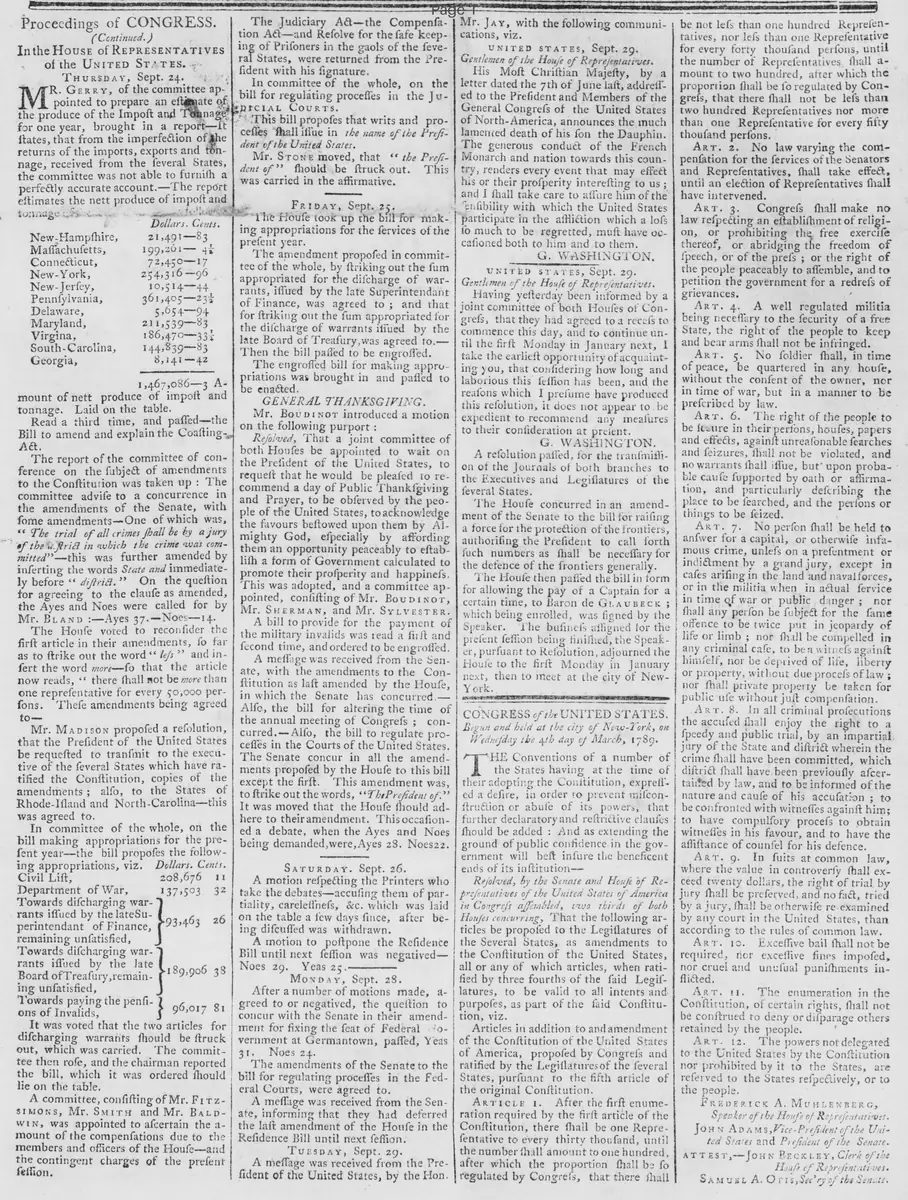
Proceedings of the U.S. House of Representatives in New York, September 1789, covering impost and tonnage estimates by state, bill passages on appropriations and judiciary, constitutional amendments including jury trials and representation ratios, a thanksgiving resolution, and the proposed first 12 amendments to the Constitution.
Merged-components note: The table provides the detailed state-by-state breakdown of the nett produce of impost and tonnage estimates explicitly referenced in the congressional proceedings story.
Clipping
OCR Quality
Full Text
| Dollars. Cents. | |
| New-Hampshire, | 21,491 83 |
| Massachusetts, | 199,261 42 |
| Connecticut, | 72,450 17 |
| New-York, | 254,316 96 |
| New-Jersey, | 10,514 44 |
| Pennsylvania, | 361,405 232 |
| Delaware, | 5,654 94 |
| Maryland, | 211,539 83 |
| Virginia, | 186,470 332 |
| South-Carolina, | 144,839 83 |
| Georgia, | 8,141 42 |
Proceedings of CONGRESS.
(Continued.)
In the House of Representatives
of the United States.
Thursday, Sept. 24.
Mr. Gerry, of the committee appointed to prepare an estimate of the produce of the Impost and Tonnage for one year, brought in a report--it states, that from the imperfection of the returns of the imports, exports and tonnage, received from the several States, the committee was not able to furnish a perfectly accurate account.--The report estimates the nett produce of impost and tonnage for 1,467,086 3 1/4 amount of nett produce of impost and tonnage.
Laid on the table.
Read a third time, and passed--the Bill to amend and explain the Coasting-Act.
The report of the committee of conference on the subject of amendments to the Constitution was taken up : The committee advise to a concurrence in the amendments of the Senate, with some amendments--One of which was, "The trial of all crimes shall be by a jury of the district in which the crime was committed"-this was further amended by inserting the words State and immediately before "district." On the question for agreeing to the clause as amended, the Ayes and Noes were called for by Mr. BLAND :-Ayes 37.-Noes--14.
The House voted to reconsider the first article in their amendments, so far as to strike out the word "less" and insert the word more--so that the article now reads, "there shall not be more than one representative for every 50,000 persons. These amendments being agreed to
Mr. Madison proposed a resolution, that the President of the United States be requested to transmit to the executive of the several States which have ratified the Constitution, copies of the amendments; also, to the States of Rhode-Island and North-Carolina--this was agreed to.
In committee of the whole, on the bill making appropriations for the present year--the bill proposes the following appropriations, viz. Dollars. Cents.
Civil List,
208,676 11
Department of War.
137,503 32
Towards discharging warrants issued by the late Superintendent of Finance,
93,463 26 remaining unsatisfied,
Towards discharging warrants issued by the late Board of Treasury, remaining
189,906 33 unsatisfied,
Towards paying the pensions of Invalids,
96,017 81
It was voted that the two articles for discharging warrants should be struck out, which was carried. The committee then rose, and the chairman reported the bill, which it was ordered should lie on the table.
A committee, consisting of Mr. Fitzsimons, Mr. Smith and Mr. Baldwin, was appointed to ascertain the amount of the compensations due to the members and officers of the House--and the contingent charges of the present session.
The Judiciary Act-the Compensation Act-and Resolve for the safe keeping of Prisoners in the gaols of the several States, were returned from the President with his signature.
In committee of the whole, on the bill for regulating processes in the Judicial Courts.
This bill proposes that writs and processes shall issue in the name of the President of the United States.
Mr. Stone moved, that "the President of" should be struck out. This was carried in the affirmative.
Friday, Sept. 25.
The House took up the bill for making appropriations for the services of the present year.
The amendment proposed in committee of the whole, by striking out the sum appropriated for the discharge of warrants, issued by the late Superintendant of Finance, was agreed to ; and that for striking out the sum appropriated for the discharge of warrants issued by the late Board of Treasury, was agreed to.--
Then the bill passed to be engrossed.
The engrossed bill for making appropriations was brought in and passed to be enacted.
GENERAL THANKSGIVING.
Mr. Boudinot introduced a motion on the following purport :
Resolved, That a joint committee of both Houses be appointed to wait on the President of the United States, to request that he would be pleased to recommend a day of Public Thanksgiving and Prayer, to be observed by the people of the United States, to acknowledge the favours bestowed upon them by Almighty God, especially by affording them an opportunity peaceably to establish a form of Government calculated to promote their prosperity and happiness.
This was adopted, and a committee appointed, consisting of Mr. Boudinot, Mr. Sherman, and Mr. Sylvester.
A bill to provide for the payment of the military invalids was read a first and second time, and ordered to be engrossed.
A message was received from the Senate, with the amendments to the Constitution as last amended by the House, in which the Senate has concurred.-- Also, the bill for altering the time of the annual meeting of Congress ; concurred.-Also, the bill to regulate processes in the Courts of the United States.
The Senate concur in all the amendments proposed by the House to this bill except the first. This amendment was, to strike out the words, "The President of."
It was moved that the House should adhere to their amendment. This occasioned a debate, when the Ayes and Noes being demanded, were, Ayes 28. Noes 22.
Saturday. Sept. 26.
A motion respecting the Printers who take the debates--accusing them of partiality, carelessness, &c. which was laid on the table a few days since, after being discussed was withdrawn.
A motion to postpone the Residence Bill until next session was negatived-- Noes 29. Yeas 25.
Monday, Sept. 28.
After a number of motions made, agreed to or negatived, the question to concur with the Senate in their amendment for fixing the seat of Federal Government at Germantown, passed, Yeas 31. Noes 24.
The amendments of the Senate to the bill for regulating processes in the Federal Courts, were agreed to.
A message was received from the Senate, informing that they had deferred the last amendment of the House in the Residence Bill until next session.
Tuesday, Sept. 29.
A message was received from the President of the United States, by the Hon. Mr. Jay, with the following communications, viz.
UNITED STATES, Sept. 29.
Gentlemen of the House of Representatives.
His Most Christian Majesty, by a letter dated the 7th of June last, addressed to the President and Members of the General Congress of the United States of North-America, announces the much lamented death of his son the Dauphin.
The generous conduct of the French Monarch and nation towards this country, renders every event that may affect his or their prosperity interesting to us; and I shall take care to assure him of the sensibility with which the United States participate in the affliction which a loss so much to be regretted, must have occasioned both to him and to them.
G. WASHINGTON.
UNITED STATES, Sept. 29.
Gentlemen of the House of Representatives.
Having yesterday been informed by a joint committee of both Houses of Congress, that they had agreed to a recess to commence this day, and to continue until the first Monday in January next, I take the earliest opportunity of acquainting you, that considering how long and laborious this session has been, and the reasons which I presume have produced this resolution, it does not appear to be expedient to recommend any measures to their consideration at present.
G. WASHINGTON.
A resolution passed, for the transmission of the Journals of both branches to the Executives and Legislatures of the several States.
The House concurred in an amendment of the Senate to the bill for raising a force for the protection of the frontiers, authorising the President to call forth such numbers as shall be necessary for the defence of the frontiers generally.
The House then passed the bill in form for allowing the pay of a Captain for a certain time, to Baron de GLAUBECK ; which being enrolled, was signed by the Speaker. The business assigned for the present session being finished, the Speaker, pursuant to Resolution, adjourned the House to the first Monday in January next, then to meet at the city of New-York.
CONGRESS of the UNITED STATES.
Begun and held at the city of New-York, on Wednesday the 4th day of March, 1789.
The Conventions of a number of the States having at the time of their adopting the Constitution, expressed a desire, in order to prevent misconstruction or abuse of its powers, that further declaratory and restrictive clauses should be added : And as extending the ground of public confidence in the government will best insure the beneficent ends of its institution-
Resolved, by the Senate and House of Representatives of the United States of America in Congress assembled, two thirds of both Houses concurring, That the following articles be proposed to the Legislatures of the Several States, as amendments to the Constitution of the United States, all or any of which articles, when ratified by three fourths of the said Legislatures, to be valid to all intents and purposes, as part of the said Constitution, viz.
Articles in addition to and amendment of the Constitution of the United States of America, proposed by Congress and ratified by the Legislatures of the several States, pursuant to the fifth article of the original Constitution.
ARTICLE I. After the first enumeration required by the first article of the Constitution, there shall be one Representative to every thirty thousand, until the number shall amount to one hundred, after which the proportion shall be so regulated by Congress, that there shall be not less than one hundred Representatives, nor less than one Representative for every forty thousand persons, until the number of Representatives shall amount to two hundred. after which the proportion shall be so regulated by Congress, that there shall not be less than two hundred Representatives nor more than one Representative for every fifty thousand persons.
Art. 2. No law varying the compensation for the services of the Senators and Representatives, shall take effect, until an election of Representatives shall have intervened.
Art. 3. Congress shall make no law respecting an establishment of religion, or prohibiting the free exercise thereof, or abridging the freedom of speech, or of the press : or the right of the people peaceably to assemble, and to petition the government for a redress of grievances.
Art. 4. A well regulated militia being necessary to the security of a free State, the right of the people to keep and bear arms shall not be infringed.
Art. 5. No soldier shall, in time of peace, be quartered in any house, without the consent of the owner, nor in time of war, but in a manner to be prescribed by law.
Art. 6. The right of the people to be secure in their persons, houses, papers and effects, against unreasonable searches and seizures, shall not be violated, and no warrants shall issue, but upon probable cause supported by oath or affirmation, and particularly describing the place to be searched, and the persons or things to be seized.
Art. 7. No person shall be held to answer for a capital, or otherwise infamous crime, unless on a presentment or indictment by a grand jury, except in cases arising in the land and naval forces, or in the militia when in actual service in time of war or public danger ; nor shall any person be subject for the same offence to be twice put in jeopardy of life or limb : nor shall be compelled in any criminal case, to be a witness against himself, nor be deprived of life, liberty or property, without due process of law ; nor shall private property be taken for public use without just compensation.
Art. 8. In all criminal prosecutions the accused shall enjoy the right to a speedy and public trial, by an impartial jury of the State and district wherein the crime shall have been committed, which district shall have been previously ascertained by law, and to be informed of the nature and cause of his accusation ; to be confronted with witnesses against him; to have compulsory process to obtain witnesses in his favour, and to have the assistance of counsel for his defence.
Art. 9. In suits at common law, where the value in controversy shall exceed twenty dollars, the right of trial by jury shall be preserved, and no fact, tried by a jury, shall be otherwise re-examined by any court in the United States, than according to the rules of common law.
Art. 10. Excessive bail shall not be required, nor excessive fines imposed, nor cruel and unusual punishments inflicted.
Art. 11. The enumeration in the Constitution, of certain rights, shall not be construed to deny or disparage others retained by the people.
Art. 12. The powers not delegated to the United States by the Constitution nor prohibited by it to the States, are reserved to the States respectively, or to the people.
FREDERICK A. MUHLENBERG,
Speaker of the House of Representatives.
JOHN ADAMS, Vice-President of the United States and President of the Senate.
ATTEST,--John Beckley, Clerk of the House of Representatives.
Samuel A. Otis, Sec'ry of the Senate.
What sub-type of article is it?
What themes does it cover?
What keywords are associated?
What entities or persons were involved?
Where did it happen?
Story Details
Key Persons
Location
City Of New York
Event Date
September 1789
Story Details
The House receives a report on impost and tonnage estimates totaling 1,467,086 dollars and 3 1/4 cents. Various bills are passed, including appropriations after striking warrant discharges, judiciary processes without naming the President, and military invalids pay. Amendments to the Constitution are concurred upon, including representation ratios and rights like jury trials, free speech, arms, searches, due process. A resolution for public thanksgiving is adopted. Messages from President Washington on French Dauphin's death and recess. Congress adjourns to January. The proposed 12 amendments are detailed.