Thank you for visiting SNEWPapers!
Sign up free
Literary
September 14, 1944
The Camas Hot Springs Exchange
Hot Springs, Camas, Sanders County, Montana
What is this article about?
First-person narrative of a WWII fighter pilot instructor's frustration with training duties, desperate efforts to join combat after Pearl Harbor, bittersweet farewell to family, and assignment to a long-range bombing mission to Japan aboard a B-17 Flying Fortress.
Merged-components note: Merging image with the 'God is My Co-Pilot' serialized literary excerpt due to spatial overlap.
Clipping
OCR Quality
85%
Good
Full Text
GOD IS MY
CO-PILOT
By this time, war with certain countries appeared imminent. I had always believed that we would fight Japan, and had always believed that Japan would make the first thrust. And I tried to "figure out" every cadet that came through our school - tried by talking to him to find out whether or not he had the urge for combat, for I knew that the urge was positively necessary. Not only did a man have to have that certain incentive to fly and keep on flying, until flying became second nature, but he had to have the definite urge for combat. When he learned to fly automatically he would control the ship without thinking about the controls and have his mind free to concentrate on navigation and the aiming of his guns - besides watching his tail for the enemy.
From Ontario I went to Lemoore, in the San Joaquin Valley of California, and there I went through one of the low periods of my life. It was not that Lemoore was bad, for the people were wonderful - but war was getting closer and closer, and I was getting farther from combat duty. Finally, after war had opened on December 7, I began to write Generals all over the country in an effort to get out of the Training Center. After all, I had been an instructor for nearly four years and it was pretty monotonous. I knew that instructors were necessary, but I wanted to fight, and I thought that if I could get out to fight with my experience, I could come back later on and be even more valuable as an instructor of fighter pilots.
At last things began to happen. On December 10, I was hurriedly ordered to report to March Field. When these secret orders came, I thought the day for my active entry into the real war was near. Hardly taking time to get my toothbrush - the radiogram said, "immediately" - I jumped into a car and drove madly through the Valley and over the pass of Tejon through the snow at the summit at nearly ninety miles an hour, to March Field. I arrived there in a blackout, and though I was to see plenty of combat later on, I'll take an oath that the nearest I've been to death in this war was when I rode into March Field with my lights out, trying to follow the line in the highway that was not there. Army trucks went by with dim, pin-point blue lights, and as I looked out of my car the trucks would almost hit me.
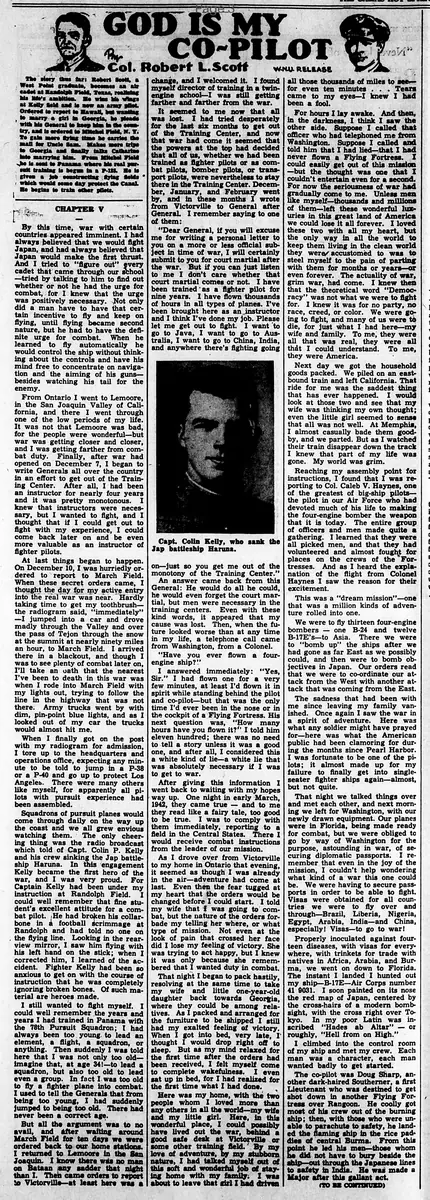
When I finally got on the post with my radiogram for admission, I tore up to the headquarters and operations office, expecting any minute to be told to jump in a P-38 or a P-40 and go up to protect Los Angeles. There were many others like myself, for apparently all pilots with pursuit experience had been assembled. Squadrons of pursuit planes would come through daily on the way up the coast and we all grew envious watching them. The only cheering thing was the radio broadcast which told of Capt. Colin P. Kelly and his crew sinking the Jap battleship Haruna. In this engagement Kelly became the first hero of the war, and I was very proud. For Captain Kelly had been under my instruction at Randolph Field. I could well remember that fine student's excellent attitude for a combat pilot. He had broken his collarbone in a football scrimmage at Randolph and had told no one on the flying line. Looking in the rear-view mirror, I saw him flying with his left hand on the stick; when I corrected him, I learned of the accident. Fighter Kelly had been so anxious to get on with the course of instruction that he was completely ignoring broken bones. Of such material are heroes made.
I still wanted to fight myself. I could well remember the years and years I had trained in Panama with the 78th Pursuit Squadron; I had always been too young to lead an element, a flight, a squadron, or anything. Then suddenly I was told here that I was not only too old - imagine that, at age 34! - to lead a squadron, but also too old to lead even a group. In fact I was too old to fly a fighter plane into combat. I used to tell the Generals that from being too young, I had suddenly jumped to being too old. There had never been a correct age.
But all the argument was to no avail, and after waiting around March Field for ten days we were ordered back to our home stations. I returned to Lemoore in the San Joaquin. I know there was no man on Bataan any sadder that night than I. Then came orders to report to Victorville - at least here was a change, and I welcomed it. I found myself director of training in a twin-engine school - I was still getting farther and farther from the war. It seemed to me now that all was lost. I had tried desperately for the last six months to get out of the Training Center, and now that war had come it seemed that the powers at the top had decided that all of us, whether we had been trained as fighter pilots or as combat pilots, bomber pilots, or transport pilots, were nevertheless to stay there in the Training Center. December, January, and February went by, and in these months I wrote from Victorville to General after General. I remember saying to one of them:
"Dear General, if you will excuse me for writing a personal letter to you on a more or less official subject in time of war, I will certainly submit to you for court martial after the war. But if you can just listen to me I don't care whether that court martial comes or not. I have been trained as a fighter pilot for nine years. I have flown thousands of hours in all types of planes. I've been brought here as an instructor and I think I've done my job. Please let me get out to fight. I want to go to Java, I want to go to Australia, I want to go to China, India, and anywhere there's fighting going on - just so you get me out of the monotony of the Training Center."
An answer came back from this General: He would do all he could, he would even forget the court martial, but men were necessary in the training centers. Even with these kind words, it appeared that my cause was lost. Then, when the future looked worse than at any time in my life, a telephone call came from Washington, from a Colonel.
"Have you ever flown a four-engine ship?"
I answered immediately: "Yes, Sir." I had flown one for a very few minutes, at least I'd flown it in spirit while standing behind the pilot and co-pilot - but that was the only time I'd ever been in the nose or in the cockpit of a Flying Fortress. His next question was, "How many hours have you flown it?" I told him eleven hundred; there was no need to tell a story unless it was a good one, and after all, I considered this a white kind of lie - a white lie that was absolutely necessary if I was to get to war.
After giving this information I went back to waiting with my hopes way up. One night in early March, 1942, they came true - and to me they read like a fairy tale, too good to be true. I was to comply with them immediately, reporting to a field in the Central States. There I would receive combat instructions from the leader of our mission. As I drove over from Victorville to my home in Ontario that evening, it seemed as though I was already in the air - adventure had come at last. Even then the fear tugged at my heart that the orders would be changed before I could start. I told my wife that I was going to combat, but the nature of the orders forbade my telling her where, or what type of mission. Not even at the look of pain that crossed her face did I lose my feeling of victory. She was trying to act happy, but I knew it was only because she remembered that I wanted duty in combat.
That night I began to pack hastily, resolving at the same time to take my wife and little one-year-old daughter back towards Georgia, where they could be among relatives. As I packed and arranged for the furniture to be shipped I still had my exalted feeling of victory. When I got into bed, very late, I thought I would drop right off to sleep. But as my mind relaxed for the first time after the orders had been received, I felt myself come to complete wakefulness. I even sat up in bed, for I had realized for the first time what I had done. Here was my home, with the two people whom I loved more than any others in all the world - my wife and my little girl. Here, in this wonderful place, I could possibly have lived out the war, behind a good safe desk at Victorville or some other training field. By my love of adventure, by my stubborn nature, I had talked myself out of this soft and wonderful job of staying home with my family. I was about to leave that girl I had driven all those thousands of miles to see for even ten minutes... Tears came to my eyes - I knew I had been a fool.
For hours I lay awake. And then in the darkness, I think I saw the other side. Suppose I called that officer who had telephoned me from Washington. Suppose I called and told him that I had lied that I had never flown a Flying Fortress. I could easily get out of this mission - but the thought was one that I couldn't entertain even for a second. For now the seriousness of war had gradually come to me. Unless men like myself - thousands and millions of them - left these wonderful luxuries in this great land of America we could lose it all forever. I loved these two with all my heart, but the only way in all the world to keep them living in the clean world they were accustomed to was to steel myself to the pain of parting with them for months or years or even forever. The actuality of war, grim war, had come. I knew then that the theoretical word "Democracy" was not what we were to fight for. I knew it was for no party, no race, creed, or color. We were going to fight, and many of us were to die, for just what I had here - my wife and family. To me, they were all that was real, they were all that I could understand. To me, they were America.
Next day we got the household goods packed. We piled on an east-bound train and left California. That ride for me was the saddest thing that has ever happened. I would look at those two and see that my wife was thinking my own thought; even the little girl seemed to sense that all was not well. At Memphis, I almost casually bade them good-by, and we parted. But as I watched their train disappear down the track I knew that part of my life was gone. My world was grim.
Reaching my assembly point for instructions, I found that I was reporting to Col. Caleb V. Haynes, one of the greatest of big-ship pilots - the pilot in our Air Force who had devoted much of his life to making the four-engine bomber the weapon that it is today. The entire group of officers and men made quite a gathering. I learned that they were all picked men, and that they had volunteered and almost fought for places on the crews of the Fortresses. And as I heard the explanation of the flight from Colonel Haynes I saw the reason for their excitement.
This was a "dream mission" - one that was a million kinds of adventure rolled into one. We were to fly thirteen four-engine bombers - one B-24 and twelve B-17E's - to Asia. There we were to "bomb up" the ships after we had gone as far East as we possibly could, and then were to bomb objectives in Japan. Our orders read that we were to co-ordinate our attack from the West with another attack that was coming from the East. The sadness that had been with me since leaving my family vanished. Once again I saw the war in a spirit of adventure. Here was what any soldier might have prayed for - here was what the American public had been clamoring for during the months since Pearl Harbor. I was fortunate to be one of the pilots; it almost made up for my failure to finally get into single-seater fighter ships again - almost, but not quite.
That night we talked things over and met each other, and next morning we left for Washington, with our newly drawn equipment. Our planes were in Florida, being made ready for combat, but we were obliged to go by way of Washington for the purpose, astounding in war, of securing diplomatic passports. I remember that even in the joy of the mission, I couldn't help wondering what kind of a war this one could be. We were having to secure passports in order to be able to fight. Visas were obtained for all countries we were to fly over and through - Brazil, Liberia, Nigeria, Egypt, Arabia, India - and China, especially! Visas - to go to war! Properly inoculated against fourteen diseases, with visas for everywhere, with trinkets for trade with natives in Africa, Arabia, and Burma, we went on down to Florida.
The instant I landed I hunted out my ship - B-17E - Air Corps number 41-9031. I soon painted on its nose the red map of Japan, centered by the cross-hairs of a modern bomb sight, with the cross right over Tokyo. In my poor Latin was inscribed "Hades ab Altar" or roughly, "Hell from on High."
I climbed into the control room of my ship and met my crew. Each man was a character, each man wanted badly to get started. The co-pilot was Doug Sharp, another dark-haired Southerner, a First Lieutenant who was destined to get shot down in another Flying Fortress over Rangoon. He coolly got most of his crew out of the burning ship; then, with those who were unable to parachute to safety, he landed the flaming ship in the rice paddies of central Burma. From this point he led his men - those whom he did not have to bury beside the ship - out through the Japanese lines to safety in India. He was made a Major after this gallant act.
*Capt. Colin Kelly, who sank the Jap battleship Haruna.
CO-PILOT
By this time, war with certain countries appeared imminent. I had always believed that we would fight Japan, and had always believed that Japan would make the first thrust. And I tried to "figure out" every cadet that came through our school - tried by talking to him to find out whether or not he had the urge for combat, for I knew that the urge was positively necessary. Not only did a man have to have that certain incentive to fly and keep on flying, until flying became second nature, but he had to have the definite urge for combat. When he learned to fly automatically he would control the ship without thinking about the controls and have his mind free to concentrate on navigation and the aiming of his guns - besides watching his tail for the enemy.
From Ontario I went to Lemoore, in the San Joaquin Valley of California, and there I went through one of the low periods of my life. It was not that Lemoore was bad, for the people were wonderful - but war was getting closer and closer, and I was getting farther from combat duty. Finally, after war had opened on December 7, I began to write Generals all over the country in an effort to get out of the Training Center. After all, I had been an instructor for nearly four years and it was pretty monotonous. I knew that instructors were necessary, but I wanted to fight, and I thought that if I could get out to fight with my experience, I could come back later on and be even more valuable as an instructor of fighter pilots.
At last things began to happen. On December 10, I was hurriedly ordered to report to March Field. When these secret orders came, I thought the day for my active entry into the real war was near. Hardly taking time to get my toothbrush - the radiogram said, "immediately" - I jumped into a car and drove madly through the Valley and over the pass of Tejon through the snow at the summit at nearly ninety miles an hour, to March Field. I arrived there in a blackout, and though I was to see plenty of combat later on, I'll take an oath that the nearest I've been to death in this war was when I rode into March Field with my lights out, trying to follow the line in the highway that was not there. Army trucks went by with dim, pin-point blue lights, and as I looked out of my car the trucks would almost hit me.
When I finally got on the post with my radiogram for admission, I tore up to the headquarters and operations office, expecting any minute to be told to jump in a P-38 or a P-40 and go up to protect Los Angeles. There were many others like myself, for apparently all pilots with pursuit experience had been assembled. Squadrons of pursuit planes would come through daily on the way up the coast and we all grew envious watching them. The only cheering thing was the radio broadcast which told of Capt. Colin P. Kelly and his crew sinking the Jap battleship Haruna. In this engagement Kelly became the first hero of the war, and I was very proud. For Captain Kelly had been under my instruction at Randolph Field. I could well remember that fine student's excellent attitude for a combat pilot. He had broken his collarbone in a football scrimmage at Randolph and had told no one on the flying line. Looking in the rear-view mirror, I saw him flying with his left hand on the stick; when I corrected him, I learned of the accident. Fighter Kelly had been so anxious to get on with the course of instruction that he was completely ignoring broken bones. Of such material are heroes made.
I still wanted to fight myself. I could well remember the years and years I had trained in Panama with the 78th Pursuit Squadron; I had always been too young to lead an element, a flight, a squadron, or anything. Then suddenly I was told here that I was not only too old - imagine that, at age 34! - to lead a squadron, but also too old to lead even a group. In fact I was too old to fly a fighter plane into combat. I used to tell the Generals that from being too young, I had suddenly jumped to being too old. There had never been a correct age.
But all the argument was to no avail, and after waiting around March Field for ten days we were ordered back to our home stations. I returned to Lemoore in the San Joaquin. I know there was no man on Bataan any sadder that night than I. Then came orders to report to Victorville - at least here was a change, and I welcomed it. I found myself director of training in a twin-engine school - I was still getting farther and farther from the war. It seemed to me now that all was lost. I had tried desperately for the last six months to get out of the Training Center, and now that war had come it seemed that the powers at the top had decided that all of us, whether we had been trained as fighter pilots or as combat pilots, bomber pilots, or transport pilots, were nevertheless to stay there in the Training Center. December, January, and February went by, and in these months I wrote from Victorville to General after General. I remember saying to one of them:
"Dear General, if you will excuse me for writing a personal letter to you on a more or less official subject in time of war, I will certainly submit to you for court martial after the war. But if you can just listen to me I don't care whether that court martial comes or not. I have been trained as a fighter pilot for nine years. I have flown thousands of hours in all types of planes. I've been brought here as an instructor and I think I've done my job. Please let me get out to fight. I want to go to Java, I want to go to Australia, I want to go to China, India, and anywhere there's fighting going on - just so you get me out of the monotony of the Training Center."
An answer came back from this General: He would do all he could, he would even forget the court martial, but men were necessary in the training centers. Even with these kind words, it appeared that my cause was lost. Then, when the future looked worse than at any time in my life, a telephone call came from Washington, from a Colonel.
"Have you ever flown a four-engine ship?"
I answered immediately: "Yes, Sir." I had flown one for a very few minutes, at least I'd flown it in spirit while standing behind the pilot and co-pilot - but that was the only time I'd ever been in the nose or in the cockpit of a Flying Fortress. His next question was, "How many hours have you flown it?" I told him eleven hundred; there was no need to tell a story unless it was a good one, and after all, I considered this a white kind of lie - a white lie that was absolutely necessary if I was to get to war.
After giving this information I went back to waiting with my hopes way up. One night in early March, 1942, they came true - and to me they read like a fairy tale, too good to be true. I was to comply with them immediately, reporting to a field in the Central States. There I would receive combat instructions from the leader of our mission. As I drove over from Victorville to my home in Ontario that evening, it seemed as though I was already in the air - adventure had come at last. Even then the fear tugged at my heart that the orders would be changed before I could start. I told my wife that I was going to combat, but the nature of the orders forbade my telling her where, or what type of mission. Not even at the look of pain that crossed her face did I lose my feeling of victory. She was trying to act happy, but I knew it was only because she remembered that I wanted duty in combat.
That night I began to pack hastily, resolving at the same time to take my wife and little one-year-old daughter back towards Georgia, where they could be among relatives. As I packed and arranged for the furniture to be shipped I still had my exalted feeling of victory. When I got into bed, very late, I thought I would drop right off to sleep. But as my mind relaxed for the first time after the orders had been received, I felt myself come to complete wakefulness. I even sat up in bed, for I had realized for the first time what I had done. Here was my home, with the two people whom I loved more than any others in all the world - my wife and my little girl. Here, in this wonderful place, I could possibly have lived out the war, behind a good safe desk at Victorville or some other training field. By my love of adventure, by my stubborn nature, I had talked myself out of this soft and wonderful job of staying home with my family. I was about to leave that girl I had driven all those thousands of miles to see for even ten minutes... Tears came to my eyes - I knew I had been a fool.
For hours I lay awake. And then in the darkness, I think I saw the other side. Suppose I called that officer who had telephoned me from Washington. Suppose I called and told him that I had lied that I had never flown a Flying Fortress. I could easily get out of this mission - but the thought was one that I couldn't entertain even for a second. For now the seriousness of war had gradually come to me. Unless men like myself - thousands and millions of them - left these wonderful luxuries in this great land of America we could lose it all forever. I loved these two with all my heart, but the only way in all the world to keep them living in the clean world they were accustomed to was to steel myself to the pain of parting with them for months or years or even forever. The actuality of war, grim war, had come. I knew then that the theoretical word "Democracy" was not what we were to fight for. I knew it was for no party, no race, creed, or color. We were going to fight, and many of us were to die, for just what I had here - my wife and family. To me, they were all that was real, they were all that I could understand. To me, they were America.
Next day we got the household goods packed. We piled on an east-bound train and left California. That ride for me was the saddest thing that has ever happened. I would look at those two and see that my wife was thinking my own thought; even the little girl seemed to sense that all was not well. At Memphis, I almost casually bade them good-by, and we parted. But as I watched their train disappear down the track I knew that part of my life was gone. My world was grim.
Reaching my assembly point for instructions, I found that I was reporting to Col. Caleb V. Haynes, one of the greatest of big-ship pilots - the pilot in our Air Force who had devoted much of his life to making the four-engine bomber the weapon that it is today. The entire group of officers and men made quite a gathering. I learned that they were all picked men, and that they had volunteered and almost fought for places on the crews of the Fortresses. And as I heard the explanation of the flight from Colonel Haynes I saw the reason for their excitement.
This was a "dream mission" - one that was a million kinds of adventure rolled into one. We were to fly thirteen four-engine bombers - one B-24 and twelve B-17E's - to Asia. There we were to "bomb up" the ships after we had gone as far East as we possibly could, and then were to bomb objectives in Japan. Our orders read that we were to co-ordinate our attack from the West with another attack that was coming from the East. The sadness that had been with me since leaving my family vanished. Once again I saw the war in a spirit of adventure. Here was what any soldier might have prayed for - here was what the American public had been clamoring for during the months since Pearl Harbor. I was fortunate to be one of the pilots; it almost made up for my failure to finally get into single-seater fighter ships again - almost, but not quite.
That night we talked things over and met each other, and next morning we left for Washington, with our newly drawn equipment. Our planes were in Florida, being made ready for combat, but we were obliged to go by way of Washington for the purpose, astounding in war, of securing diplomatic passports. I remember that even in the joy of the mission, I couldn't help wondering what kind of a war this one could be. We were having to secure passports in order to be able to fight. Visas were obtained for all countries we were to fly over and through - Brazil, Liberia, Nigeria, Egypt, Arabia, India - and China, especially! Visas - to go to war! Properly inoculated against fourteen diseases, with visas for everywhere, with trinkets for trade with natives in Africa, Arabia, and Burma, we went on down to Florida.
The instant I landed I hunted out my ship - B-17E - Air Corps number 41-9031. I soon painted on its nose the red map of Japan, centered by the cross-hairs of a modern bomb sight, with the cross right over Tokyo. In my poor Latin was inscribed "Hades ab Altar" or roughly, "Hell from on High."
I climbed into the control room of my ship and met my crew. Each man was a character, each man wanted badly to get started. The co-pilot was Doug Sharp, another dark-haired Southerner, a First Lieutenant who was destined to get shot down in another Flying Fortress over Rangoon. He coolly got most of his crew out of the burning ship; then, with those who were unable to parachute to safety, he landed the flaming ship in the rice paddies of central Burma. From this point he led his men - those whom he did not have to bury beside the ship - out through the Japanese lines to safety in India. He was made a Major after this gallant act.
*Capt. Colin Kelly, who sank the Jap battleship Haruna.
What sub-type of article is it?
Prose Fiction
Journey Narrative
What themes does it cover?
War Peace
Patriotism
Liberty Freedom
What keywords are associated?
Wwii Pilot
Combat Training
Family Farewell
Bombing Mission
Pearl Harbor
Flying Fortress
American Heroism
Literary Details
Title
God Is My Co Pilot
Subject
A Pilot's Quest For Combat Duty In Wwii
Key Lines
"Dear General, If You Will Excuse Me For Writing A Personal Letter To You On A More Or Less Official Subject In Time Of War, I Will Certainly Submit To You For Court Martial After The War. But If You Can Just Listen To Me I Don't Care Whether That Court Martial Comes Or Not."
We Were Going To Fight, And Many Of Us Were To Die, For Just What I Had Here My Wife And Family. To Me, They Were All That Was Real, They Were All That I Could Understand. To Me, They Were America.
This Was A "Dream Mission" One That Was A Million Kinds Of Adventure Rolled Into One.