Thank you for visiting SNEWPapers!
Sign up free
Domestic News
October 24, 1920
Bisbee Daily Review
Bisbee, Cochise County, Arizona
What is this article about?
U.S. Department of Agriculture experiments at Arlington, Va., aim to produce gasoline from straw, corncobs, and farm waste to alleviate the gasoline shortage, potentially providing farm energy needs.
Clipping
OCR Quality
98%
Excellent
Full Text
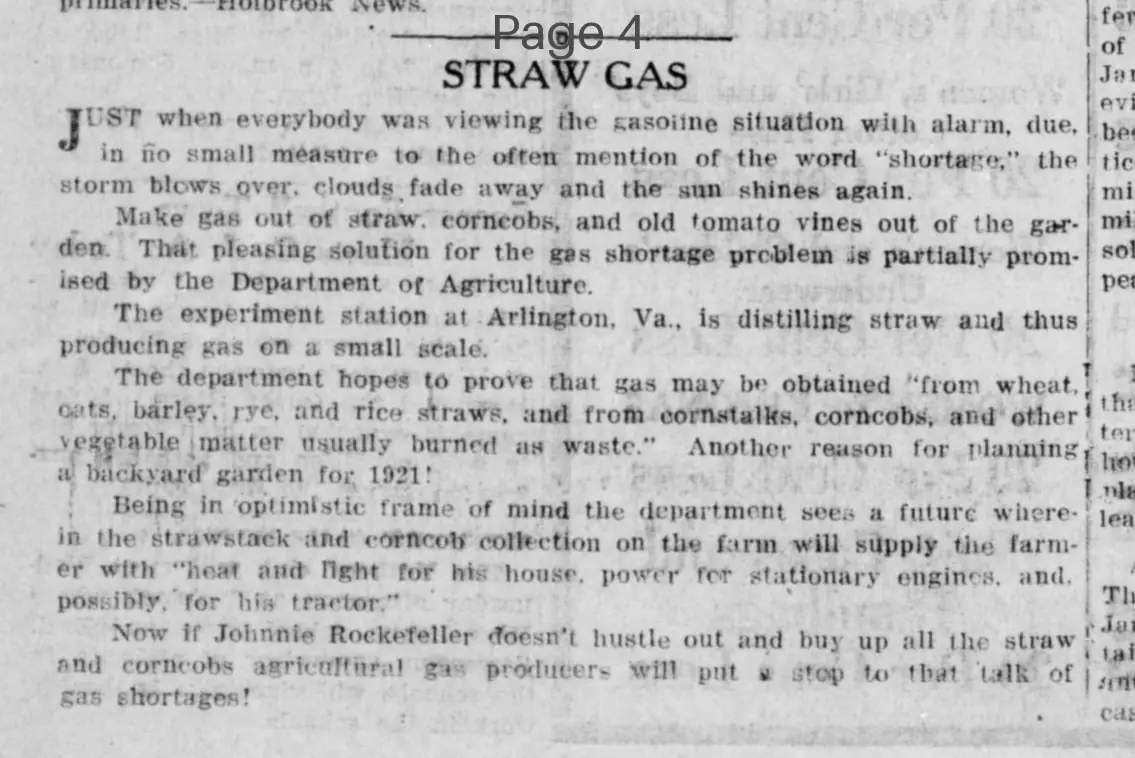
STRAW GAS
JUST when everybody was viewing the gasoline situation with alarm, due, in no small measure to the often mention of the word "shortage," the storm blows over, clouds fade away and the sun shines again.
Make gas out of straw, corncobs, and old tomato vines out of the garden. That pleasing solution for the gas shortage problem is partially promised by the Department of Agriculture.
The experiment station at Arlington, Va., is distilling straw and thus producing gas on a small scale.
The department hopes to prove that gas may be obtained "from wheat, oats, barley, rye, and rice straws, and from cornstalks, corncobs, and other vegetable matter usually burned as waste." Another reason for planning a backyard garden for 1921!
Being in optimistic frame of mind the department sees a future wherein the strawstack and corncob collection on the farm will supply the farmer with "heat and light for his house, power for stationary engines, and, possibly, for his tractor."
Now if Johnnie Rockefeller doesn't hustle out and buy up all the straw and corncobs agricultural gas producers will put a stop to that talk of gas shortages!
JUST when everybody was viewing the gasoline situation with alarm, due, in no small measure to the often mention of the word "shortage," the storm blows over, clouds fade away and the sun shines again.
Make gas out of straw, corncobs, and old tomato vines out of the garden. That pleasing solution for the gas shortage problem is partially promised by the Department of Agriculture.
The experiment station at Arlington, Va., is distilling straw and thus producing gas on a small scale.
The department hopes to prove that gas may be obtained "from wheat, oats, barley, rye, and rice straws, and from cornstalks, corncobs, and other vegetable matter usually burned as waste." Another reason for planning a backyard garden for 1921!
Being in optimistic frame of mind the department sees a future wherein the strawstack and corncob collection on the farm will supply the farmer with "heat and light for his house, power for stationary engines, and, possibly, for his tractor."
Now if Johnnie Rockefeller doesn't hustle out and buy up all the straw and corncobs agricultural gas producers will put a stop to that talk of gas shortages!
What sub-type of article is it?
Agriculture
Economic
What keywords are associated?
Gasoline Shortage
Straw Gas
Corncobs
Department Of Agriculture
Farm Waste Fuel
What entities or persons were involved?
Johnnie Rockefeller
Where did it happen?
Arlington, Va.
Domestic News Details
Primary Location
Arlington, Va.
Event Date
1921
Key Persons
Johnnie Rockefeller
Event Details
The Department of Agriculture is experimenting at the Arlington, Va. station to distill straw and produce gas from wheat, oats, barley, rye, rice straws, cornstalks, corncobs, and other vegetable waste to address the gasoline shortage. The department envisions farm strawstacks and corncob collections supplying heat, light, and power for farms.