Thank you for visiting SNEWPapers!
Sign up free
Story
February 7, 1858
The Washington Union
Washington, District Of Columbia
What is this article about?
Various U.S. newspapers, mostly Democratic, endorse President Buchanan's message urging Congress to admit Kansas as a state under the Lecompton constitution, arguing it upholds law, ends national strife, and affirms self-government principles. (187 chars)
Clipping
OCR Quality
95%
Excellent
Full Text
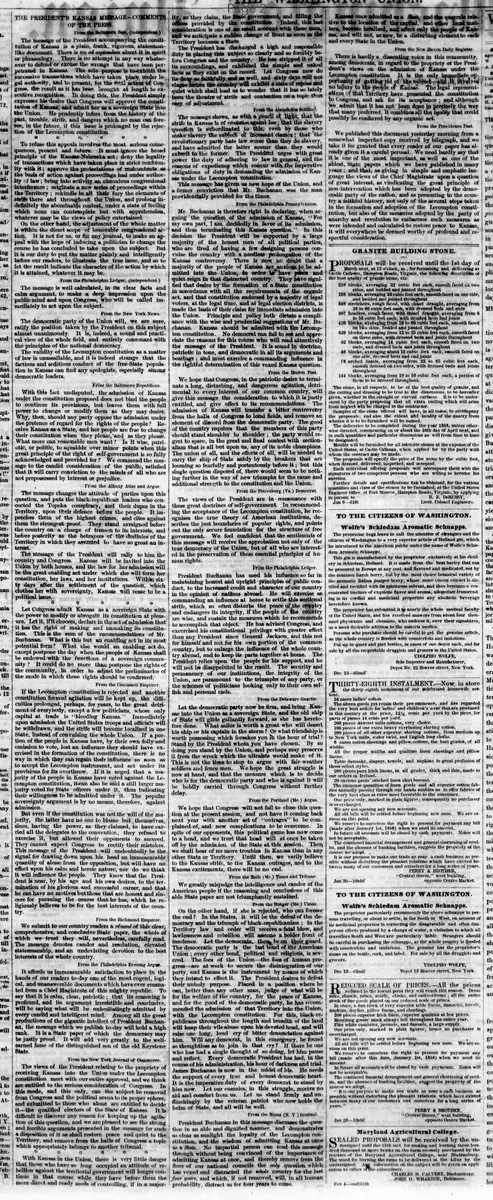
THE PRESIDENT'S KANSAS MESSAGE—COMMENTS OF THE PRESS.
From the Baltimore Sun.
The message of the President accompanying the constitution of Kansas is a plain, frank, vigorous, statesmanlike document. There is no ad captandum about it in spirit or phraseology. There is no attempt in any way whatever to defend or excuse the wrongs that have been perpetrated in Kansas. The sole purpose is to exhibit the successive transactions which have taken place under legal authority, and to present, for the final action of Congress, the result as it has been brought at length to executive recognition. In doing this, the President simply expresses his desire that Congress will approve the constitution of Kansas, and admit her as a sovereign State into the Union. He prudently infers from the history of the past, trouble, strife, and dangers which no man can foresee, in the future, if this issue is prolonged by the rejection of the Lecompton constitution.
To refuse this appeals involves the most serious consequences, present and future. It must ignore the broad principle of the Kansas-Nebraska act; deny the legality of transactions which have taken place in strict conformity with it; approve the protestations of malcontents as the basis of action against proceedings had under authority of law; bring into activity an obnoxious congressional interference; originate a new series of proceedings within the Territory; rekindle in all their fury the elements of strife there and throughout the Union, and prolong indefinitely the abominable contest, under a state of feeling which none can contemplate but with apprehension whatever may be the views of policy entertained.
On the other hand, the adjustment of the whole matter is within the direct scope of honorable congressional action. It is not for us, or for any journal, to make an appeal with the hope of inducing a politician to change the course he has concluded to take upon the subject. But it is our duty to put the matter plainly and intelligently before our readers, to illustrate the true issue, and so to let the result indicate the character of the action by which it is attained, whatever it may be.
From the Philadelphia Ledger, (independent.)
The message is well calculated, in its clear facts and calm argument, to make a deep impression upon the public mind and upon Congress, who will be called immediately to act upon the subject.
From the New York News.
The democratic party of the Union will, we are sure, ratify the position taken by the President on this subject almost unanimously. It is, indeed, a sound and practical view of the whole field, and entirely consonant with the principles of the national democracy.
The validity of the Lecompton constitution as a matter of law is unassailable, and it is indeed strange that the factious and seditious conduct of the free-State population in Kansas can find any apologists, especially among democratic leaders.
From the Baltimore Republican.
With this fact undisputed, the admission of Kansas under the constitution proposed does not bind the people to continue its provisions, but leaves them with full power to change or modify them as they may desire.
Why, then, should any party oppose the admission under the pretence of regard for the rights of the people? Receive Kansas as a State, and her people are free to change their constitution when they please, and as they please.
What more can reasonable men want? Is it wise, patriotic, or politic, to squabble over minor points when this great principle of the right of self-government is so fully acknowledged and provided for? We commend the message to the candid consideration of the public, satisfied that it will carry conviction to the minds of all who are not prepossessed by interest or prejudice.
From the Albany Atlas and Argus.
The message changes the attitude of parties upon this question, and puts the black-republican leaders who concocted the Topeka conspiracy, and their dupes in the Territory, upon their defence before the people. It impeaches them of the highest crimes, and cites against them the strongest proof. They stand arraigned before the country on a charge of treason to its interests, and before posterity as the betrayers of the destinies of the Territory in which they assumed to have so great an interest.
The message of the President will rally to him the country and Congress. Kansas will be invited into the Union by both houses, and the law for her admission will be the great enabling act under which she will form her constitution, her laws, and her institutions. Within sixty days after the settlement of the question, which clothes her with sovereignty, Kansas will cease to be a political issue.
Let Congress admit Kansas as a sovereign State with the power to modify or abrogate its constitution at pleasure. Let it, if it chooses, declare in the act of admission that it has the right of making and unmaking its constitution. This is the sum of the recommendations of Mr. Buchanan. What is this but an enabling act in its most potential form? What else would an enabling act do, except postpone the day when the people of Kansas shall be endowed with the functions of a sovereign community? It could do no more than postpone the rights of the community, in order to adjust the preliminaries of the mode in which those rights should be confirmed.
From the Cincinnati Enquirer.
If the Lecompton constitution is rejected and another constitution formed agitation will be kept up, the difficulties prolonged, perhaps, for years, to the great detriment of everybody, except a few politicians, whose only capital at trade is "bleeding Kansas." Immediately upon admission the United States troops and officials will be withdrawn, and the strife will become localized in one State, instead of convulsing the whole Union. If a portion of the people in Kansas have, by their own folly and omission to vote, lost an influence they should have exercised in the formation of the constitution, there is no way in which they can regain their influence so soon as to accept the Lecompton instrument, and act under its provisions for its overthrow. If it is urged that a majority of the people in Kansas have voted against the Lecompton constitution, it can also be said a still larger majority voted for State officers under it, thus indicating their willingness to be admitted under it. The popular sovereignty argument is by no means, therefore, against admission.
But even if the constitution was not the will of the majority, the latter have no one to blame but themselves, since, having the power, as they claimed, to have carried all the delegates to the convention, they refused to exercise it, but allowed their opponents to succeed.
They cannot expect Congress to rectify their mistakes.
This message of the President will undoubtedly be the signal for drawing down upon his head an immeasurable quantity of abuse from the opposition, but will have no effect upon his calm and heroic nature, nor do we think it will influence the people. They know that the President is near, by his age and his own desires, to the termination of his glorious and successful career, and that he can have no motives but those that are honest and sincere for pursuing the course that he has, which he religiously believes to be for the best interests of the country.
From the Richmond Enquirer.
We submit to our country readers a résumé of this clear, comprehensive, and conclusive State paper, the whole of which we trust they will, nevertheless, carefully read.
The message denotes candor and resolution, elevated statesmanship, and an undividing devotion to the best interests of the whole country.
From the Philadelphia Evening Argus.
It affords us immeasurable satisfaction to place in the hands of our readers to-day one of the most cogent, logical, and unanswerable documents which have ever emanated from a Chief Magistrate of this mighty republic. To say that it is calm, clear, patriotic; that its reasoning is profound, and its argument irresistible and conclusive, will be saying what will be unhesitatingly admitted by every candid and intelligent mind. Among all the great productions of the gigantic intellect of President Buchanan, the message which we publish to-day will hold a high rank. It is a State paper of which the democracy may be justly proud. It will add very greatly to the well-earned fame of the distinguished son of the old Keystone State.
From the New York Journal of Commerce.
The views of the President relating to the propriety of receiving Kansas into the Union under the Lecompton constitution meet with our entire approval, and we think are entitled to the serious consideration of Congress. In this mode, and this only, can the subject be removed from Congress and the political arena to its proper sphere, and submitted to those who alone are entitled to decide it—the qualified electors of the State of Kansas. It is difficult to discover any reason for keeping up the agitation of this question, and we are pleased to see the strong and forcible arguments presented in the message for such a disposition of it as shall restore peace and quiet to the Territory, and remove from the halls of Congress a topic which appropriately belongs to another tribunal.
With Kansas in the Union, there is very little danger that those who have so long occupied an attitude of rebellion against the territorial government will longer continue in that course while they have before them the more direct and ready mode of controlling, if in a majority, the State government, and filling the offices provided by the constitution. Indeed, this last consideration is one of no small account with these men, and we anticipate a sudden change of front as soon as the Territory becomes a State.
The President has discharged a high and responsible duty in placing this subject so clearly and so forcibly before Congress and the country. He has stripped it of all its surroundings, and exhibited the simple and naked facts as they exist on the record. Let Congress now do its duty as faithfully and as well, and sixty days will not elapse before the country will exhibit a state of repose and quiet which shall lead us to wonder that it has so lately been the theatre of strife and contention on a topic thus easy of adjustment.
From the Alexandria Sentinel.
The message shows, as with a pencil of light, that the strife in Kansas is of revolution against law; that the slavery question is subordinated to this, even by those who make slavery the subject of incessant clamor; that the revolutionary party hate law worse than they do slavery, and have admitted the latter sooner than they would submit to the former. The President urges with great power the duty of adhering to law in general, and the reasons of expediency which concur with the imperative obligations of duty in demanding the admission of Kansas under the Lecompton constitution.
This message has given us new hope of the Union, and a firmer conviction that Mr. Buchanan was the man providentially provided for the times.
From the Philadelphia Pennsylvanian.
Mr. Buchanan is therefore right in declaring, when arguing the question of the admission of Kansas, "For my own part, I am decidedly in favor of its admission, and thus terminating this Kansas question." In this decision the President will be supported by a large majority of the honest men of all political parties, who are tired of having a few designing persons convulse the country with a needless prolongation of the Kansas controversy. There is now no doubt that a majority of the people of Kansas are anxious to be admitted into the Union, in order to have peace and quiet reign in that distracted country. They have signified that desire by the formation of a State constitution in accordance with all the requirements of the organic act, and that constitution endorsed by a majority of legal voters, at the legal time, and at legal election districts, is made the basis of their claim for immediate admission into the Union. Principle and policy both dictate a compliance with the wise and prudential suggestions of Mr. Buchanan. Kansas should be admitted with the Lecompton constitution. No democrat can fail to see and appreciate the reasons for this course who will read attentively the message of the President. It is sound in doctrine, patriotic in tone, and democratic in all its arguments and bearings; and must exercise a commanding influence in the rightful determination of this vexed Kansas question.
From the Boston Post.
We hope that Congress, in the patriotic desire to terminate a long, disturbing, and dangerous agitation, detrimental to every interest of our common country, will give this message the consideration to which it is justly entitled, and give effect to its recommendations. The admission of Kansas will transfer a bitter controversy from the halls of Congress to local fields, and remove an element of discord from the democratic party. The good of the country requires that the members of this party should stand shoulder to shoulder; the party would regret to spare, in the great and final contest with sectionalism that is all but upon us, any of its noble champions. The union of all, and the efforts of all, will be needed to carry the ship of State safely by the breakers that are looming so fearfully and portentously before it; but this single question disposed of, there would seem to be nothing further in the way of new triumphs for the cause and additional strength to the constitution and the Union.
From the Petersburg (Va.) Democrat.
The views of the President are in consonance with these great doctrines of self-government. In recommending the acceptance of the Lecompton constitution, he recognises the true theory of American institutions, describes the just boundaries of popular rights, and points out the only secure foundation for the structure of free government. We feel confident that the sentiments of this message will receive the approbation not only of the true democracy of the Union, but of all who are interested in the preservation of these essential principles of human rights.
From the Philadelphia Ledger.
President Buchanan has used his influence so far in maintaining honest and upright principles of public conduct, to the increased credit and character of our country in the opinion of nations abroad. He will exercise as commanding an influence at home to settle this sectional strife, which so often disturbs the peace of the country and endangers its integrity, if the people of the country are wise, and sustain the measures which he recommends to accomplish that object. He has advised Congress, and exercised his constitutional privilege with greater effect than any President since General Jackson, and this not for himself and not for his own portion of the common country, but to enlarge the influence of the whole country abroad, and to keep its parts together at home. The President relies upon the people for his support, and he will not be disappointed in the result. The security and permanency of our institutions, the integrity of the Union, are paramount to the triumphs of any party, or the schemes of politicians looking only to their own selfish and personal ends.
From the Delaware Gazette.
Let the democratic party now be firm, and bring Kansas into the Union as a sovereign State, and the old ship of State will glide gallantly forward, as she has heretofore done. What sailor is worth a groat who will desert his ship or his captain in the storm? Or what friendship is worth possessing which forsakes you in the hour of trial? Stand by the President whom you have chosen. By so doing you stand by the Union, and perhaps may preserve it from the wreck which the ultraists would make of it.
This is not the time to stop to argue with fair-weather soldiers and sense men. We hope the great struggle is now at hand, and that the measure which is to decide who is for the democratic party and who is against it will be boldly carried through Congress without further delay.
From the Portland (Me.) Argus.
We hope that Congress will not fail to close this question at the present session, and not have it coming back next year with another set of "outrages" to be complained of, and new complications to be overcome. In spite of our opponents, this political game has now come to a head, and we trust that head will at once be taken off by the admission of the State at this session. Then we shall hear of no more troubles in Kansas than in any other State or Territory. Until then, we verily believe to the Kansas strife, to the Kansas outrages, and to the Kansas excitements, there will be no end.
From the Bath (Me.) Times and Tribune.
We greatly misjudge the intelligence and candor of the American people if the reasoning and conclusions of this able State paper are not triumphantly sustained.
From the Bangor (Me.) Union.
On the other hand, if she is rejected, who can foresee the end? In the States, it will be the defeat of the democracy and the triumph of black-republicanism; in the Territory law and order will receive a fatal blow, and lawlessness and rebellion will assume a bolder front of insolence. Let the democrats, then, be on their guard.
The democratic party is the last bond of the American Union; every other bond, political and religious, is severed. The foes of the Union—the foes of human progress—are at work to secure the disintegration of our party, and Kansas is the instrument by means of which they intend to effect it. The President desires to defeat their unholy purpose. Placed in a position where he can, better than any other man, judge of what will be for the welfare of the country, for the peace of Kansas, and for the good of the democratic party, he has recommended the admission of that Territory into the Union, with the Lecompton constitution. For this, black-republicans throughout the length and breadth of the land will heap their vile abuse upon his devoted head, and will raise one long, loud cry of bitter denunciation against him. Will any democrat, in this emergency, be found so thoughtless as to join in that cry? If there be one who has had a single thought of so doing, let him pause and reflect. Every democratic President has had, in the course of his administration, his hour of darkness and trial. James Buchanan is now in the midst of his. He needs the support of every true and honest democratic heart. It is the imperative duty of every democrat to stand by him now. Let our enemies, in this struggle, receive no aid and comfort from us. Let us stand firmly and unflinchingly by the veteran patriot who now holds the helm of State, and all will be well.
From the Rome (N. Y.) Sentinel.
President Buchanan in this message discusses the question in an able and dignified manner, and demonstrates as clear as sunlight the loyalty of the Lecompton constitution, and the wisdom of admitting Kansas at once as a State. No impartial person can read this message through without being convinced of the importance of admitting Kansas at once, and thereby remove from the floor of our national councils the only question which has vexed and distracted the whole country for the last four years, and which, if not removed, will, in all human probability, distract us for four years to come.
Kansas once admitted as a State, and the quarrels relative to the location of the capital, and other local matters, become localized, and affect only the people of Kansas, and will not, as now, be a disturbing element to each and every State in the Union.
From the New Haven Daily Register.
There is hardly a dissenting voice in this community, among democrats, in regard to the propriety of the President's views on the admission of Kansas under the Lecompton constitution. It is the only immediate opportunity of getting rid of the subject, and it involves no injury to the people of Kansas. The legal representatives of that Territory have presented the constitution to Congress, and ask for its acceptance; and although we admit that it has not been done in precisely the way that many preferred, it combines all the legality that could possibly be conferred by any organic act.
From the Providence Post.
We published this document yesterday morning from a somewhat imperfect copy received by telegraph, and we take it for granted that every reader of our paper has already given it a careful perusal. We need hardly say that it is one of the most important, as well as one of the ablest, State papers which we have published in many years; and that, as giving in simple and emphatic language the views of the Chief Magistrate upon a question of great interest, as vindicating the great principle of non-intervention which has been adopted by the democratic party of the nation, and as presenting to the country a faithful history, not only of the several steps taken in the formation and adoption of the Lecompton constitution, but also of the measures adopted by the party of anarchy and revolution to embarrass such measures as were intended and calculated to restore peace to Kansas, it will everywhere be deemed worthy of profound and respectful consideration.
From the Baltimore Sun.
The message of the President accompanying the constitution of Kansas is a plain, frank, vigorous, statesmanlike document. There is no ad captandum about it in spirit or phraseology. There is no attempt in any way whatever to defend or excuse the wrongs that have been perpetrated in Kansas. The sole purpose is to exhibit the successive transactions which have taken place under legal authority, and to present, for the final action of Congress, the result as it has been brought at length to executive recognition. In doing this, the President simply expresses his desire that Congress will approve the constitution of Kansas, and admit her as a sovereign State into the Union. He prudently infers from the history of the past, trouble, strife, and dangers which no man can foresee, in the future, if this issue is prolonged by the rejection of the Lecompton constitution.
To refuse this appeals involves the most serious consequences, present and future. It must ignore the broad principle of the Kansas-Nebraska act; deny the legality of transactions which have taken place in strict conformity with it; approve the protestations of malcontents as the basis of action against proceedings had under authority of law; bring into activity an obnoxious congressional interference; originate a new series of proceedings within the Territory; rekindle in all their fury the elements of strife there and throughout the Union, and prolong indefinitely the abominable contest, under a state of feeling which none can contemplate but with apprehension whatever may be the views of policy entertained.
On the other hand, the adjustment of the whole matter is within the direct scope of honorable congressional action. It is not for us, or for any journal, to make an appeal with the hope of inducing a politician to change the course he has concluded to take upon the subject. But it is our duty to put the matter plainly and intelligently before our readers, to illustrate the true issue, and so to let the result indicate the character of the action by which it is attained, whatever it may be.
From the Philadelphia Ledger, (independent.)
The message is well calculated, in its clear facts and calm argument, to make a deep impression upon the public mind and upon Congress, who will be called immediately to act upon the subject.
From the New York News.
The democratic party of the Union will, we are sure, ratify the position taken by the President on this subject almost unanimously. It is, indeed, a sound and practical view of the whole field, and entirely consonant with the principles of the national democracy.
The validity of the Lecompton constitution as a matter of law is unassailable, and it is indeed strange that the factious and seditious conduct of the free-State population in Kansas can find any apologists, especially among democratic leaders.
From the Baltimore Republican.
With this fact undisputed, the admission of Kansas under the constitution proposed does not bind the people to continue its provisions, but leaves them with full power to change or modify them as they may desire.
Why, then, should any party oppose the admission under the pretence of regard for the rights of the people? Receive Kansas as a State, and her people are free to change their constitution when they please, and as they please.
What more can reasonable men want? Is it wise, patriotic, or politic, to squabble over minor points when this great principle of the right of self-government is so fully acknowledged and provided for? We commend the message to the candid consideration of the public, satisfied that it will carry conviction to the minds of all who are not prepossessed by interest or prejudice.
From the Albany Atlas and Argus.
The message changes the attitude of parties upon this question, and puts the black-republican leaders who concocted the Topeka conspiracy, and their dupes in the Territory, upon their defence before the people. It impeaches them of the highest crimes, and cites against them the strongest proof. They stand arraigned before the country on a charge of treason to its interests, and before posterity as the betrayers of the destinies of the Territory in which they assumed to have so great an interest.
The message of the President will rally to him the country and Congress. Kansas will be invited into the Union by both houses, and the law for her admission will be the great enabling act under which she will form her constitution, her laws, and her institutions. Within sixty days after the settlement of the question, which clothes her with sovereignty, Kansas will cease to be a political issue.
Let Congress admit Kansas as a sovereign State with the power to modify or abrogate its constitution at pleasure. Let it, if it chooses, declare in the act of admission that it has the right of making and unmaking its constitution. This is the sum of the recommendations of Mr. Buchanan. What is this but an enabling act in its most potential form? What else would an enabling act do, except postpone the day when the people of Kansas shall be endowed with the functions of a sovereign community? It could do no more than postpone the rights of the community, in order to adjust the preliminaries of the mode in which those rights should be confirmed.
From the Cincinnati Enquirer.
If the Lecompton constitution is rejected and another constitution formed agitation will be kept up, the difficulties prolonged, perhaps, for years, to the great detriment of everybody, except a few politicians, whose only capital at trade is "bleeding Kansas." Immediately upon admission the United States troops and officials will be withdrawn, and the strife will become localized in one State, instead of convulsing the whole Union. If a portion of the people in Kansas have, by their own folly and omission to vote, lost an influence they should have exercised in the formation of the constitution, there is no way in which they can regain their influence so soon as to accept the Lecompton instrument, and act under its provisions for its overthrow. If it is urged that a majority of the people in Kansas have voted against the Lecompton constitution, it can also be said a still larger majority voted for State officers under it, thus indicating their willingness to be admitted under it. The popular sovereignty argument is by no means, therefore, against admission.
But even if the constitution was not the will of the majority, the latter have no one to blame but themselves, since, having the power, as they claimed, to have carried all the delegates to the convention, they refused to exercise it, but allowed their opponents to succeed.
They cannot expect Congress to rectify their mistakes.
This message of the President will undoubtedly be the signal for drawing down upon his head an immeasurable quantity of abuse from the opposition, but will have no effect upon his calm and heroic nature, nor do we think it will influence the people. They know that the President is near, by his age and his own desires, to the termination of his glorious and successful career, and that he can have no motives but those that are honest and sincere for pursuing the course that he has, which he religiously believes to be for the best interests of the country.
From the Richmond Enquirer.
We submit to our country readers a résumé of this clear, comprehensive, and conclusive State paper, the whole of which we trust they will, nevertheless, carefully read.
The message denotes candor and resolution, elevated statesmanship, and an undividing devotion to the best interests of the whole country.
From the Philadelphia Evening Argus.
It affords us immeasurable satisfaction to place in the hands of our readers to-day one of the most cogent, logical, and unanswerable documents which have ever emanated from a Chief Magistrate of this mighty republic. To say that it is calm, clear, patriotic; that its reasoning is profound, and its argument irresistible and conclusive, will be saying what will be unhesitatingly admitted by every candid and intelligent mind. Among all the great productions of the gigantic intellect of President Buchanan, the message which we publish to-day will hold a high rank. It is a State paper of which the democracy may be justly proud. It will add very greatly to the well-earned fame of the distinguished son of the old Keystone State.
From the New York Journal of Commerce.
The views of the President relating to the propriety of receiving Kansas into the Union under the Lecompton constitution meet with our entire approval, and we think are entitled to the serious consideration of Congress. In this mode, and this only, can the subject be removed from Congress and the political arena to its proper sphere, and submitted to those who alone are entitled to decide it—the qualified electors of the State of Kansas. It is difficult to discover any reason for keeping up the agitation of this question, and we are pleased to see the strong and forcible arguments presented in the message for such a disposition of it as shall restore peace and quiet to the Territory, and remove from the halls of Congress a topic which appropriately belongs to another tribunal.
With Kansas in the Union, there is very little danger that those who have so long occupied an attitude of rebellion against the territorial government will longer continue in that course while they have before them the more direct and ready mode of controlling, if in a majority, the State government, and filling the offices provided by the constitution. Indeed, this last consideration is one of no small account with these men, and we anticipate a sudden change of front as soon as the Territory becomes a State.
The President has discharged a high and responsible duty in placing this subject so clearly and so forcibly before Congress and the country. He has stripped it of all its surroundings, and exhibited the simple and naked facts as they exist on the record. Let Congress now do its duty as faithfully and as well, and sixty days will not elapse before the country will exhibit a state of repose and quiet which shall lead us to wonder that it has so lately been the theatre of strife and contention on a topic thus easy of adjustment.
From the Alexandria Sentinel.
The message shows, as with a pencil of light, that the strife in Kansas is of revolution against law; that the slavery question is subordinated to this, even by those who make slavery the subject of incessant clamor; that the revolutionary party hate law worse than they do slavery, and have admitted the latter sooner than they would submit to the former. The President urges with great power the duty of adhering to law in general, and the reasons of expediency which concur with the imperative obligations of duty in demanding the admission of Kansas under the Lecompton constitution.
This message has given us new hope of the Union, and a firmer conviction that Mr. Buchanan was the man providentially provided for the times.
From the Philadelphia Pennsylvanian.
Mr. Buchanan is therefore right in declaring, when arguing the question of the admission of Kansas, "For my own part, I am decidedly in favor of its admission, and thus terminating this Kansas question." In this decision the President will be supported by a large majority of the honest men of all political parties, who are tired of having a few designing persons convulse the country with a needless prolongation of the Kansas controversy. There is now no doubt that a majority of the people of Kansas are anxious to be admitted into the Union, in order to have peace and quiet reign in that distracted country. They have signified that desire by the formation of a State constitution in accordance with all the requirements of the organic act, and that constitution endorsed by a majority of legal voters, at the legal time, and at legal election districts, is made the basis of their claim for immediate admission into the Union. Principle and policy both dictate a compliance with the wise and prudential suggestions of Mr. Buchanan. Kansas should be admitted with the Lecompton constitution. No democrat can fail to see and appreciate the reasons for this course who will read attentively the message of the President. It is sound in doctrine, patriotic in tone, and democratic in all its arguments and bearings; and must exercise a commanding influence in the rightful determination of this vexed Kansas question.
From the Boston Post.
We hope that Congress, in the patriotic desire to terminate a long, disturbing, and dangerous agitation, detrimental to every interest of our common country, will give this message the consideration to which it is justly entitled, and give effect to its recommendations. The admission of Kansas will transfer a bitter controversy from the halls of Congress to local fields, and remove an element of discord from the democratic party. The good of the country requires that the members of this party should stand shoulder to shoulder; the party would regret to spare, in the great and final contest with sectionalism that is all but upon us, any of its noble champions. The union of all, and the efforts of all, will be needed to carry the ship of State safely by the breakers that are looming so fearfully and portentously before it; but this single question disposed of, there would seem to be nothing further in the way of new triumphs for the cause and additional strength to the constitution and the Union.
From the Petersburg (Va.) Democrat.
The views of the President are in consonance with these great doctrines of self-government. In recommending the acceptance of the Lecompton constitution, he recognises the true theory of American institutions, describes the just boundaries of popular rights, and points out the only secure foundation for the structure of free government. We feel confident that the sentiments of this message will receive the approbation not only of the true democracy of the Union, but of all who are interested in the preservation of these essential principles of human rights.
From the Philadelphia Ledger.
President Buchanan has used his influence so far in maintaining honest and upright principles of public conduct, to the increased credit and character of our country in the opinion of nations abroad. He will exercise as commanding an influence at home to settle this sectional strife, which so often disturbs the peace of the country and endangers its integrity, if the people of the country are wise, and sustain the measures which he recommends to accomplish that object. He has advised Congress, and exercised his constitutional privilege with greater effect than any President since General Jackson, and this not for himself and not for his own portion of the common country, but to enlarge the influence of the whole country abroad, and to keep its parts together at home. The President relies upon the people for his support, and he will not be disappointed in the result. The security and permanency of our institutions, the integrity of the Union, are paramount to the triumphs of any party, or the schemes of politicians looking only to their own selfish and personal ends.
From the Delaware Gazette.
Let the democratic party now be firm, and bring Kansas into the Union as a sovereign State, and the old ship of State will glide gallantly forward, as she has heretofore done. What sailor is worth a groat who will desert his ship or his captain in the storm? Or what friendship is worth possessing which forsakes you in the hour of trial? Stand by the President whom you have chosen. By so doing you stand by the Union, and perhaps may preserve it from the wreck which the ultraists would make of it.
This is not the time to stop to argue with fair-weather soldiers and sense men. We hope the great struggle is now at hand, and that the measure which is to decide who is for the democratic party and who is against it will be boldly carried through Congress without further delay.
From the Portland (Me.) Argus.
We hope that Congress will not fail to close this question at the present session, and not have it coming back next year with another set of "outrages" to be complained of, and new complications to be overcome. In spite of our opponents, this political game has now come to a head, and we trust that head will at once be taken off by the admission of the State at this session. Then we shall hear of no more troubles in Kansas than in any other State or Territory. Until then, we verily believe to the Kansas strife, to the Kansas outrages, and to the Kansas excitements, there will be no end.
From the Bath (Me.) Times and Tribune.
We greatly misjudge the intelligence and candor of the American people if the reasoning and conclusions of this able State paper are not triumphantly sustained.
From the Bangor (Me.) Union.
On the other hand, if she is rejected, who can foresee the end? In the States, it will be the defeat of the democracy and the triumph of black-republicanism; in the Territory law and order will receive a fatal blow, and lawlessness and rebellion will assume a bolder front of insolence. Let the democrats, then, be on their guard.
The democratic party is the last bond of the American Union; every other bond, political and religious, is severed. The foes of the Union—the foes of human progress—are at work to secure the disintegration of our party, and Kansas is the instrument by means of which they intend to effect it. The President desires to defeat their unholy purpose. Placed in a position where he can, better than any other man, judge of what will be for the welfare of the country, for the peace of Kansas, and for the good of the democratic party, he has recommended the admission of that Territory into the Union, with the Lecompton constitution. For this, black-republicans throughout the length and breadth of the land will heap their vile abuse upon his devoted head, and will raise one long, loud cry of bitter denunciation against him. Will any democrat, in this emergency, be found so thoughtless as to join in that cry? If there be one who has had a single thought of so doing, let him pause and reflect. Every democratic President has had, in the course of his administration, his hour of darkness and trial. James Buchanan is now in the midst of his. He needs the support of every true and honest democratic heart. It is the imperative duty of every democrat to stand by him now. Let our enemies, in this struggle, receive no aid and comfort from us. Let us stand firmly and unflinchingly by the veteran patriot who now holds the helm of State, and all will be well.
From the Rome (N. Y.) Sentinel.
President Buchanan in this message discusses the question in an able and dignified manner, and demonstrates as clear as sunlight the loyalty of the Lecompton constitution, and the wisdom of admitting Kansas at once as a State. No impartial person can read this message through without being convinced of the importance of admitting Kansas at once, and thereby remove from the floor of our national councils the only question which has vexed and distracted the whole country for the last four years, and which, if not removed, will, in all human probability, distract us for four years to come.
Kansas once admitted as a State, and the quarrels relative to the location of the capital, and other local matters, become localized, and affect only the people of Kansas, and will not, as now, be a disturbing element to each and every State in the Union.
From the New Haven Daily Register.
There is hardly a dissenting voice in this community, among democrats, in regard to the propriety of the President's views on the admission of Kansas under the Lecompton constitution. It is the only immediate opportunity of getting rid of the subject, and it involves no injury to the people of Kansas. The legal representatives of that Territory have presented the constitution to Congress, and ask for its acceptance; and although we admit that it has not been done in precisely the way that many preferred, it combines all the legality that could possibly be conferred by any organic act.
From the Providence Post.
We published this document yesterday morning from a somewhat imperfect copy received by telegraph, and we take it for granted that every reader of our paper has already given it a careful perusal. We need hardly say that it is one of the most important, as well as one of the ablest, State papers which we have published in many years; and that, as giving in simple and emphatic language the views of the Chief Magistrate upon a question of great interest, as vindicating the great principle of non-intervention which has been adopted by the democratic party of the nation, and as presenting to the country a faithful history, not only of the several steps taken in the formation and adoption of the Lecompton constitution, but also of the measures adopted by the party of anarchy and revolution to embarrass such measures as were intended and calculated to restore peace to Kansas, it will everywhere be deemed worthy of profound and respectful consideration.
What sub-type of article is it?
Historical Event
What themes does it cover?
Justice
Survival
What keywords are associated?
Kansas Admission
Lecompton Constitution
Buchanan Message
Press Comments
Democratic Support
What entities or persons were involved?
President Buchanan
Where did it happen?
Kansas
Story Details
Key Persons
President Buchanan
Location
Kansas
Story Details
Compilation of newspaper editorials praising President Buchanan's message recommending admission of Kansas under the Lecompton constitution to end strife and uphold legal processes.