Thank you for visiting SNEWPapers!
Sign up free
The Enquirer
Richmond, Henrico County, Virginia
What is this article about?
South Carolina House of Representatives reconvenes on June 20, 1808, in Columbia, passing a resolution to consider public matters. Governor Charles Pinckney delivers a message on June 21 urging attention to national crises including the Chesapeake attack, British impressment, embargo effects, militia organization, and Charleston fortifications amid war threats.
Merged-components note: Continuation of the South Carolina Legislature message from the Governor, sequential reading order.
Clipping
OCR Quality
Full Text
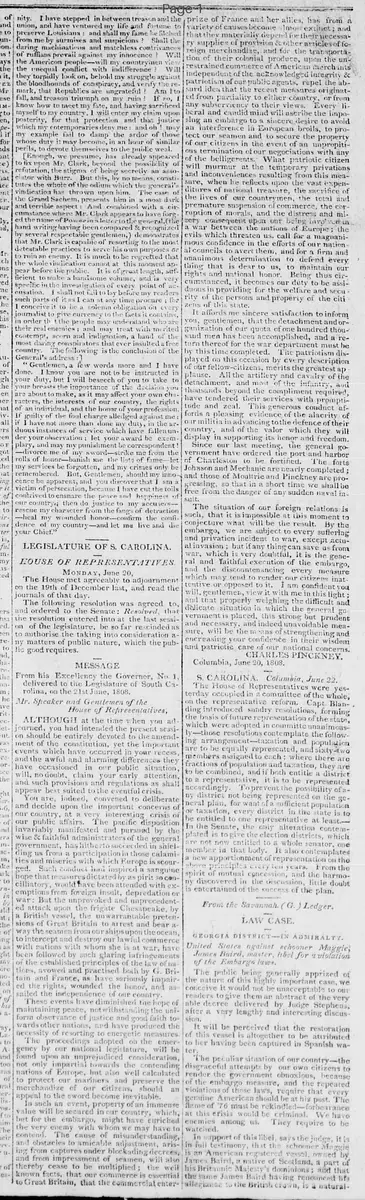
HOUSE OF REPRESENTATIVES.
Monday, June 20,
The House met agreeably to adjournment on the 19th of December last, and read the journals of that day.
The following resolution was agreed to, and ordered to the Senate: Resolved, that the resolution entered into at the last session of the legislature, be so far rescinded as to authorise the taking into consideration any matters of public nature, which the public good requires.
MESSAGE
From his Excellency the Governor, No. 1, delivered to the Legislature of South Carolina, on the 21st June, 1808.
Mr. Speaker and Gentlemen of the House of Representatives,
ALTHOUGH at the time when you adjourned, you had intended the present session should be entirely devoted to the amendment of the constitution, yet the important events which have occurred in your recess, and the awful and alarming differences they have occasioned in our public situation, will, no doubt, claim your early attention, and such provisions and regulations as shall appear best suited to the eventful crisis.
You are, indeed, convened to deliberate and decide upon the important concerns of our country, at a very interesting crisis of our public affairs. The pacific disposition invariably manifested and pursued by the wise & faithful administrators of the general government, has hitherto succeeded in shielding us from a participation in those calamities and miseries with which Europe is scourged. Such conduct had inspired a sanguine hope that measures dictated by a spirit so conciliatory, would have been attended with exemption from foreign insult, depredation or war: But the unprovoked and unprecedented attack upon the frigate Chesapeake, by a British vessel, the unwarrantable pretensions of Great Britain to arrest and bear away the seamen from our ships upon the ocean, to intercept and destroy our lawful commerce with nations with whom she is at war, have been followed by such glaring infringements of the established principles of the law of nations, avowed and practised both by G. Britain and France, as have seriously impaired the rights, wounded the honor, and assailed the independence of our country.
These events have diminished the hope of maintaining peace, notwithstanding the uniform observance of justice and good faith towards other nations, and have produced the necessity of resorting to energetic measures. The proceedings adopted on the emergency by our national legislature, will be found upon an unprejudiced consideration, not only impartial towards the contending nations of Europe, but also well calculated to protect our mariners and preserve the merchandise of our citizens, should an appeal to the sword become inevitable.
In such an event, property of an immense value will be secured in our country, which, but for the embargo, might have enriched the very enemy with whom we may have to contend. The cause of misunderstanding, and obstacles to amicable adjustment, arising from captures under blockading decrees, and from impressment of seamen, will also thereby cease to be multiplied: the well known facts, that our commerce is essential to Great Britain, that the commercial enterprise of France and her allies has from a variety of causes become almost extinct; and that they materially depend for their necessary supplies of provision & other articles of foreign merchandise, and for the transportation of their colonial produce, upon the unrestrained commerce of American merchants independent of the acknowledged integrity & patriotism of our public agents, dispel the absurd idea that the recent measures originated from partiality to either country, or from any subserviency to their views. Every liberal and candid mind will ascribe the imposing an embargo to a sincere desire to avoid an interference in European broils, to protect our seamen and to secure the property of our citizens in the event of an unpropitious termination of our negotiations with any of the belligerents. What patriotic citizen will murmur at the temporary privations and inconveniences resulting from this measure, when he reflects upon the vast expenditures of national treasure, the sacrifice of the lives of our countrymen, the total and premature suspension of commerce, the corruption of morals, and the distress and misery consequent upon our being involved in a war between the nations of Europe; the evils which threaten us, call for a magnanimous confidence in the efforts of our national councils to avert them, and for a firm and unanimous determination to defend every thing that is dear to us, to maintain our rights and national honor. Being thus circumstanced, it becomes our duty to be assiduous in providing for the welfare and security of the persons and property of the citizens of this state.
It affords me sincere satisfaction to inform you, gentlemen, that the detachment and organization of our quota of one hundred thousand men has been accomplished, and a return thereof for the war department must be by this time completed. The patriotism displayed on this occasion by every description of our fellow-citizens, merits the greatest applause. All the artillery and cavalry of the detachment, and most of the infantry, and thousands beyond the complement required, have tendered their services with promptitude and zeal. This generous conduct affords a pleasing evidence of the alacrity of our militia in advancing to the defence of their country, and of the valor which they will display in supporting its honor and freedom.
Since our last meeting, the general government have ordered the port and harbor of Charleston to be fortified. The forts Johnson and Mechanic are nearly completed; and those of Moultrie and Pinckney are progressing, so that in a short time we shall be free from the danger of any sudden naval insult.
The situation of our foreign relations is such, that it is impossible at this moment to conjecture what will be the result. By the embargo, we are subject to every suffering and privation incident to war, except actual invasion; but if any thing can save us from war, which is very doubtful, it is the general and faithful execution of the embargo, and the discountenancing every measure which may tend to render our citizens inattentive or opposed to it. I am confident you will, gentlemen, view it with me in this light; and that properly weighing the difficult and delicate situation in which the general government is placed, this strong but prudent and necessary, and indeed unavoidable measure, will be the means of strengthening and increasing your confidence in their wisdom and patriotic care of our national concerns.
CHARLES PINCKNEY.
Columbia, June 20, 1808.
What sub-type of article is it?
What keywords are associated?
What entities or persons were involved?
Where did it happen?
Domestic News Details
Primary Location
Columbia, South Carolina
Event Date
June 20, 1808
Key Persons
Outcome
militia quota of 100,000 men organized; fortifications at charleston progressing; embargo enforced to avert war.
Event Details
House of Representatives meets after December adjournment, reads journals, passes resolution rescinding prior limit to consider public matters. Governor's message addresses national crises including Chesapeake attack, impressment, embargo, praises militia patriotism, reports on fortifications.