Thank you for visiting SNEWPapers!
Sign up free
Editorial
March 4, 1912
Evening Journal
Wilmington, New Castle County, Delaware
What is this article about?
Editorial criticizes how J.P. Morgan's syndicate profited excessively from organizing the U.S. Steel Company, inflating its capitalization by hundreds of millions beyond actual property values, thereby burdening the public with higher costs.
Clipping
OCR Quality
98%
Excellent
Full Text
FINANCING BY BIG BUSINESS.
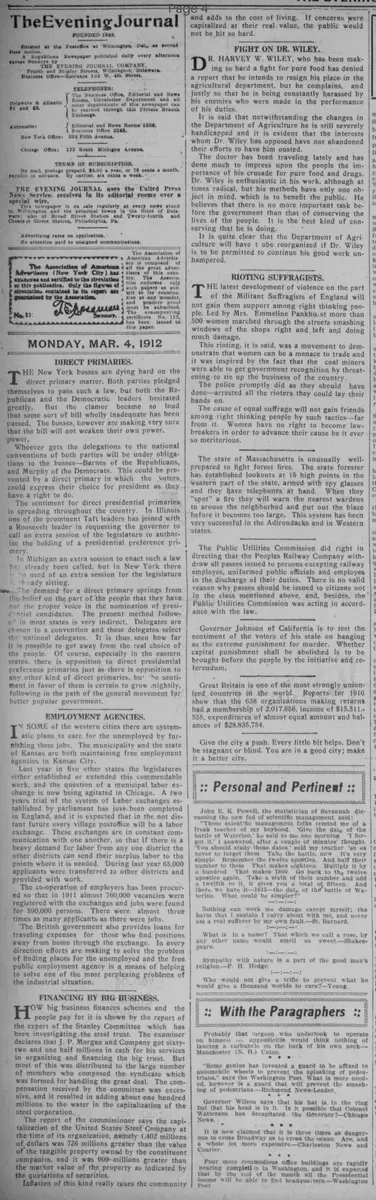
How big business finances schemes and the people pay for it is shown by the report of the expert of the Stanley Committee which has been investigating the steel trust. The examiner declares that J. P. Morgan and Company got sixty-two and one half millions in cash for his services in organizing and financing the big trust. But most of this was distributed to the large number of members who composed the syndicate which was formed for handling the great deal. The compensation received by the committee was excessive, and it resulted in adding about one hundred millions to the water in the capitalization of the steel corporation.
The report of the commissioner says the capitalization of the United States Steel Company at the time of its organization, namely 1,402 millions of dollars was 726 millions greater than the value of the tangible property owned by the constituent companies, and it was 609 millions greater than the market value of the property as indicated by the quotations of securities.
Inflation of this kind really taxes the community and adds to the cost of living. If concerns were capitalized at their real value, the public would not be hit so hard.
How big business finances schemes and the people pay for it is shown by the report of the expert of the Stanley Committee which has been investigating the steel trust. The examiner declares that J. P. Morgan and Company got sixty-two and one half millions in cash for his services in organizing and financing the big trust. But most of this was distributed to the large number of members who composed the syndicate which was formed for handling the great deal. The compensation received by the committee was excessive, and it resulted in adding about one hundred millions to the water in the capitalization of the steel corporation.
The report of the commissioner says the capitalization of the United States Steel Company at the time of its organization, namely 1,402 millions of dollars was 726 millions greater than the value of the tangible property owned by the constituent companies, and it was 609 millions greater than the market value of the property as indicated by the quotations of securities.
Inflation of this kind really taxes the community and adds to the cost of living. If concerns were capitalized at their real value, the public would not be hit so hard.
What sub-type of article is it?
Economic Policy
What keywords are associated?
Steel Trust
Corporate Financing
Capitalization Inflation
J.P. Morgan
Cost Of Living
What entities or persons were involved?
J. P. Morgan And Company
Stanley Committee
United States Steel Company
Steel Trust
Editorial Details
Primary Topic
Critique Of Steel Trust Financing And Capitalization Inflation
Stance / Tone
Critical Of Big Business Practices
Key Figures
J. P. Morgan And Company
Stanley Committee
United States Steel Company
Steel Trust
Key Arguments
J. P. Morgan And Company Received 62.5 Million Dollars For Organizing And Financing The Steel Trust
Excessive Compensation Added About 100 Million Dollars To The Water In Capitalization
Capitalization Of 1,402 Million Dollars Was 726 Million Greater Than Tangible Property Value
Capitalization Was 609 Million Greater Than Market Value Of Securities
Inflation Of Capitalization Taxes The Community And Increases Cost Of Living
Public Would Benefit If Concerns Were Capitalized At Real Value