Thank you for visiting SNEWPapers!
Sign up free
Daily National Intelligencer
Washington, District Of Columbia
What is this article about?
Discussion of Mr. Ransom's unresolved case on forged bank notes, criticizing banks' authority to mark notes as forged without due process. The trial may lead to legal scrutiny of bank clerks' rights to deface notes in the United States.
Clipping
OCR Quality
Full Text
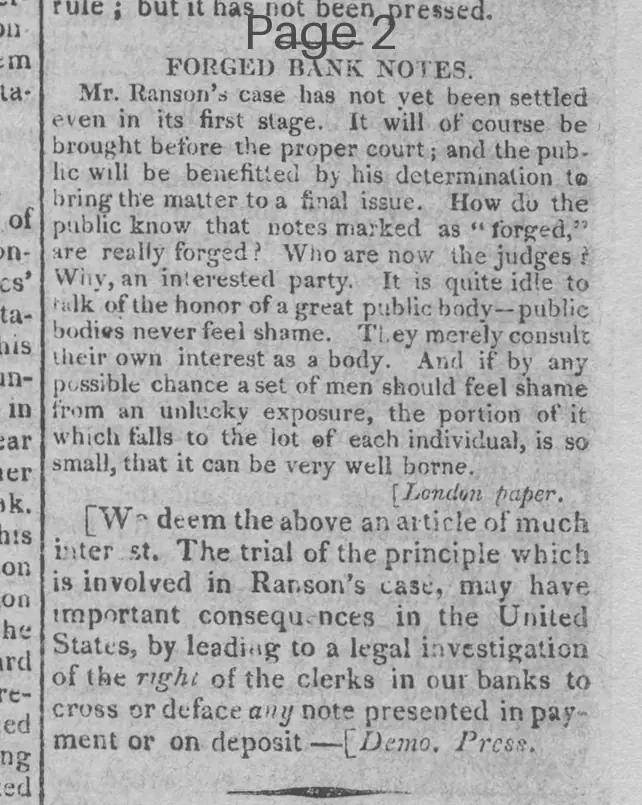
Mr. Ransom's case has not yet been settled even in its first stage. It will of course be brought before the proper court; and the public will be benefitted by his determination to bring the matter to a final issue. How do the public know that notes marked as "forged," are really forged? Who are now the judges? Why, an interested party. It is quite idle to talk of the honor of a great public body—public bodies never feel shame. They merely consult their own interest as a body. And if by any possible chance a set of men should feel shame from an unlucky exposure, the portion of it which falls to the lot of each individual, is so small, that it can be very well borne.
London paper.
We deem the above an article of much interest. The trial of the principle which is involved in Ransom's case, may have important consequences in the United States, by leading to a legal investigation of the right of the clerks in our banks to cross or deface any note presented in payment or on deposit—Demo. Press.
What sub-type of article is it?
What keywords are associated?
What entities or persons were involved?
Domestic News Details
Key Persons
Outcome
case to be brought before proper court for final issue
Event Details
Mr. Ransom's case on forged bank notes remains unsettled and will proceed to court. Questions raised about public verification of forged notes and banks' authority as interested judges. Commentary from London paper on public bodies' lack of shame. US press notes potential important consequences for legal investigation of bank clerks' rights to deface notes.