Thank you for visiting SNEWPapers!
Sign up free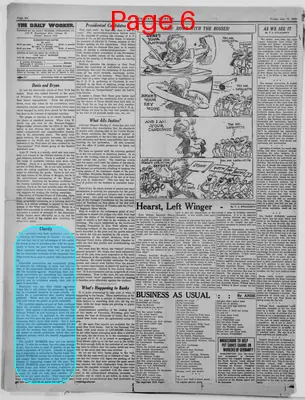
Editorial
July 11, 1924
The Daily Worker
Chicago, Cook County, Illinois
What is this article about?
This editorial criticizes charity as a tool that masks the inequalities of capitalism, arguing it fails to address poverty's root causes. It praises The DAILY WORKER for advocating worker organization, higher wages, and better conditions over charitable appeals, asserting workers seek justice and control of production.
Clipping
OCR Quality
98%
Excellent
Full Text
Charity
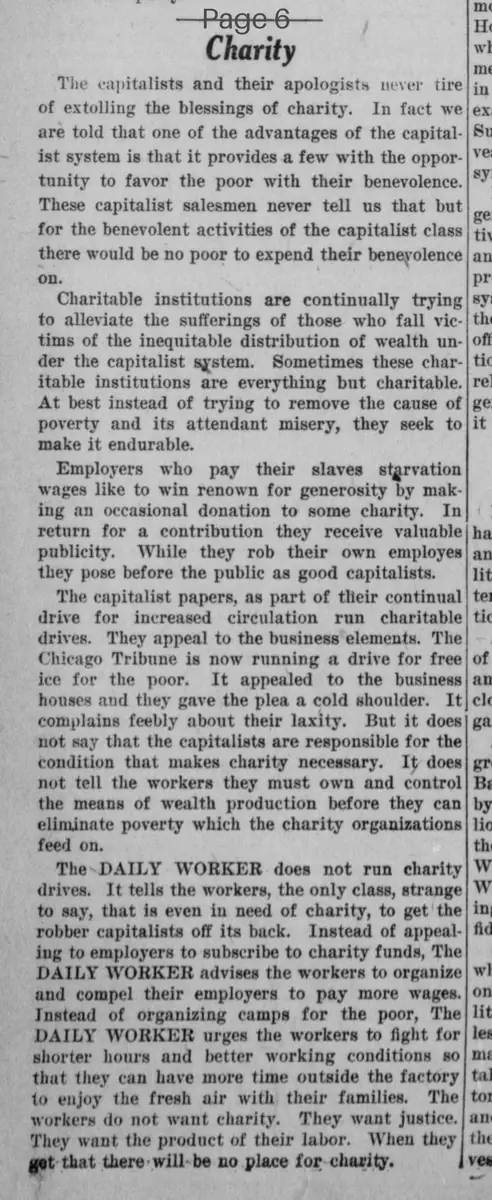
The capitalists and their apologists never tire of extolling the blessings of charity. In fact we are told that one of the advantages of the capitalist system is that it provides a few with the opportunity to favor the poor with their benevolence. These capitalist salesmen never tell us that but for the benevolent activities of the capitalist class there would be no poor to expend their benevolence on.
Charitable institutions are continually trying to alleviate the sufferings of those who fall victims of the inequitable distribution of wealth under the capitalist system. Sometimes these charitable institutions are everything but charitable. At best instead of trying to remove the cause of poverty and its attendant misery, they seek to make it endurable.
Employers who pay their slaves starvation wages like to win renown for generosity by making an occasional donation to some charity. In return for a contribution they receive valuable publicity. While they rob their own employees they pose before the public as good capitalists.
The capitalist papers, as part of their continual drive for increased circulation run charitable drives. They appeal to the business elements. The Chicago Tribune is now running a drive for free ice for the poor. It appealed to the business houses and they gave the plea a cold shoulder. It complains feebly about their laxity. But it does not say that the capitalists are responsible for the condition that makes charity necessary. It does not tell the workers they must own and control the means of wealth production before they can eliminate poverty which the charity organizations feed on.
The DAILY WORKER does not run charity drives. It tells the workers, the only class, strange to say, that is even in need of charity, to get the robber capitalists off its back. Instead of appealing to employers to subscribe to charity funds, The DAILY WORKER advises the workers to organize and compel their employers to pay more wages. Instead of organizing camps for the poor, The DAILY WORKER urges the workers to fight for shorter hours and better working conditions so that they can have more time outside the factory to enjoy the fresh air with their families. The workers do not want charity. They want justice. They want the product of their labor. When they get that there will be no place for charity.
The capitalists and their apologists never tire of extolling the blessings of charity. In fact we are told that one of the advantages of the capitalist system is that it provides a few with the opportunity to favor the poor with their benevolence. These capitalist salesmen never tell us that but for the benevolent activities of the capitalist class there would be no poor to expend their benevolence on.
Charitable institutions are continually trying to alleviate the sufferings of those who fall victims of the inequitable distribution of wealth under the capitalist system. Sometimes these charitable institutions are everything but charitable. At best instead of trying to remove the cause of poverty and its attendant misery, they seek to make it endurable.
Employers who pay their slaves starvation wages like to win renown for generosity by making an occasional donation to some charity. In return for a contribution they receive valuable publicity. While they rob their own employees they pose before the public as good capitalists.
The capitalist papers, as part of their continual drive for increased circulation run charitable drives. They appeal to the business elements. The Chicago Tribune is now running a drive for free ice for the poor. It appealed to the business houses and they gave the plea a cold shoulder. It complains feebly about their laxity. But it does not say that the capitalists are responsible for the condition that makes charity necessary. It does not tell the workers they must own and control the means of wealth production before they can eliminate poverty which the charity organizations feed on.
The DAILY WORKER does not run charity drives. It tells the workers, the only class, strange to say, that is even in need of charity, to get the robber capitalists off its back. Instead of appealing to employers to subscribe to charity funds, The DAILY WORKER advises the workers to organize and compel their employers to pay more wages. Instead of organizing camps for the poor, The DAILY WORKER urges the workers to fight for shorter hours and better working conditions so that they can have more time outside the factory to enjoy the fresh air with their families. The workers do not want charity. They want justice. They want the product of their labor. When they get that there will be no place for charity.
What sub-type of article is it?
Labor
Economic Policy
Social Reform
What keywords are associated?
Charity
Capitalism
Workers Rights
Poverty
Wages
Daily Worker
Social Justice
What entities or persons were involved?
Capitalists
The Daily Worker
Chicago Tribune
Workers
Employers
Editorial Details
Primary Topic
Critique Of Charity In Capitalist System
Stance / Tone
Anti Capitalist Advocacy For Worker Justice
Key Figures
Capitalists
The Daily Worker
Chicago Tribune
Workers
Employers
Key Arguments
Charity Benefits From Poverty Created By Capitalism
Charitable Institutions Alleviate Symptoms But Not Causes Of Poverty
Employers Use Donations For Publicity While Paying Low Wages
Capitalist Papers Run Charity Drives Without Addressing Systemic Issues
Workers Should Organize For Higher Wages And Better Conditions Instead Of Relying On Charity
True Solution Is Workers Owning Means Of Production To Eliminate Poverty