Thank you for visiting SNEWPapers!
Sign up free
Genius Of Liberty
Lowell, La Salle County, Illinois
What is this article about?
Article from Cincinnati Gazette reviews historical legal cases in England and US where slaves brought to free territories gained freedom, citing Somersett (1772), Butler v. Hopper (1806), and others through 1837, emphasizing principles of natural rights and state laws.
Clipping
OCR Quality
Full Text
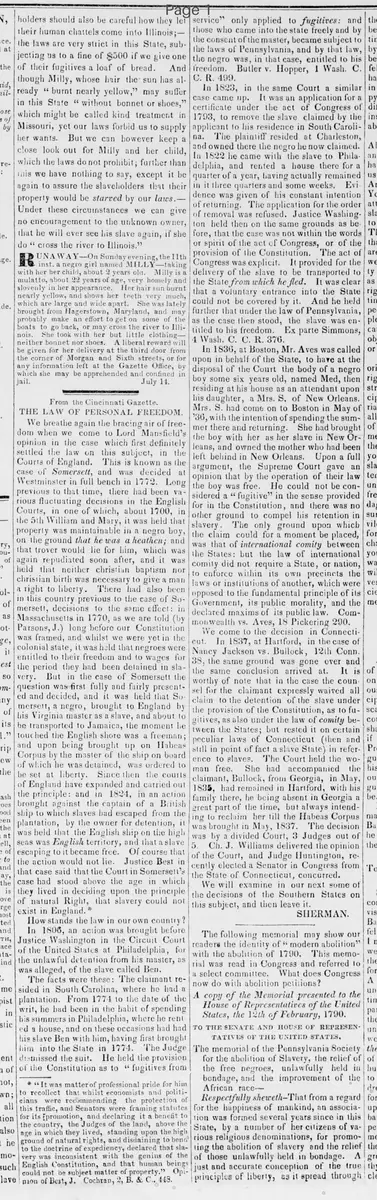
THE LAW OF PERSONAL FREEDOM.
We breathe again the bracing air of freedom when we come to Lord Mansfield's opinion in the case which first definitely settled the law on this subject, in the Courts of England. This is known as the case of Somersett, and was decided at Westminster in full bench in 1772. Long previous to that time, there had been various fluctuating decisions in the English Courts, in one of which, about 1700, in the 5th William and Mary, it was held that property was maintainable in a negro boy, on the ground that he was a heathen; and that trover would lie for him, which was again repudiated soon after, and it was held that neither christian baptism nor christian birth was necessary to give a man a right to liberty. There had also been in this country previous to the case of Somersett, decisions to the same effect: in Massachusetts in 1770, as we are told (by Parsons, J.) long before our Constitution was framed, and whilst we were yet in the colonial state, it was held that negroes were entitled to their freedom and to wages for the period they had been detained in slavery. But in the case of Somersett the question was first fully and fairly presented and decided, and it was held that Somersett, a negro, brought to England by his Virginia master as a slave, and about to be transported to Jamaica, the moment he touched the English shore was a freeman; and upon being brought up on Habeas Corpus by the master of the ship on board of which he was detained, was ordered to be set at liberty. Since then the courts of England have expanded and carried out the principle: and in 1824, in an action brought against the captain of a British ship to which slaves had escaped from the plantation, by the owner for detention, it was held that the English ship on the high seas was English territory, and that a slave escaping to it became free. Of course that the action would not lie. Justice Best in that case said that the Court in Somersett's case had stood above the age in which they lived in deciding upon the principle of natural Right, that slavery could not exist in England.*
How stands the law in our own country? In 1806, an action was brought before Justice Washington in the Circuit Court of the United States at Philadelphia, for the unlawful detention from his master, as was alleged, of the slave called Ben. The facts were these: The claimant resided in South Carolina, where he had a plantation. From 1774 to the date of the writ, he had been in the habit of spending his summers in Philadelphia, where he rented a house, and on these occasions had had his slave Ben with him, having first brought him into the State in 1774. The Judge dismissed the suit. He held the provision of the Constitution as to "fugitives from service" only applied to fugitives: and those who came into the state freely and by the consent of the master, became subject to the laws of Pennsylvania, and by that law, the negro was, in that case, entitled to his freedom. Butler v. Hopper, 1 Wash. C. C. R. 499.
In 1823, in the same Court a similar case came up. It was an application for a certificate under the act of Congress of 1793, to remove the slave claimed by the applicant to his residence in South Carolina. The plaintiff resided at Charleston, and owned there the negro he now claimed. In 1822 he came with the slave to Philadelphia, and rented a house there for a quarter of a year, having actually remained in it three quarters and some weeks. Evidence was given of his constant intention of returning. The application for the order of removal was refused. Justice Washington held then on the same grounds as before, that the case was not within the words or spirit of the act of Congress, or of the provision of the Constitution. The act of Congress was explicit. It provided for the delivery of the slave to be transported to the State from which he fled. It was clear that a voluntary entrance into the State could not be covered by it. And he held further that under the law of Pennsylvania, as the case then stood, the slave was entitled to his freedom. Ex parte Simmons, 4 Wash. C. C. R. 376.
In 1836, at Boston, Mr. Aves was called upon in behalf of the State, to have at the disposal of the Court the body of a negro boy some six years old, named Med, then residing at his house as an attendant upon his daughter, a Mrs. S. of New Orleans. Mrs. S. had come on to Boston in May of '36, with the intention of spending the summer there and returning. She had brought the boy with her as her slave in New Orleans, and owned the mother who had been left behind in New Orleans. Upon a full argument, the Supreme Court gave an opinion that by the operation of their law the boy was free. He could not be considered a "fugitive" in the sense provided for in the Constitution, and there was no other ground to compel his retention in slavery. The only ground upon which the claim could for a moment be placed, was that of international comity between the States: but the law of international comity did not require a State, or nation, to enforce within its own precincts the laws or institutions of another, which were opposed to the fundamental principle of its Government, its public morality, and the declared maxims of its public law. Commonwealth vs. Aves, 18 Pickering 290.
We come to the decision in Connecticut. In 1837, at Hartford, in the case of Nancy Jackson vs. Bullock, 12th Conn. 38, the same ground was gone over and the same conclusion arrived at. It is worthy of note that in the case the counsel for the claimant expressly waived all claim to the detention of the slave under the provision of the Constitution, as to fugitives, as also under the law of comity between the States; but rested it on certain peculiar laws of Connecticut (then and still in point of fact a slave State) in reference to slaves. The Court held the woman free. She had accompanied the claimant, Bullock, from Georgia, in May, 1835, had remained in Hartford, with his family there, he being absent in Georgia a great part of the time, but always intending to reclaim her till the Habeas Corpus was brought in May, 1837. The decision was by a divided Court, 3 Judges out of 5. Ch. J. Williams delivered the opinion of the Court, and Judge Huntington, recently elected a Senator in Congress from the State of Connecticut, concurred.
We will examine in our next some of the decisions of the Southern States on this subject, and then leave it.
SHERMAN.
* "It was matter of professional pride for him to recollect that whilst economists and politicians were recommending the protection of this traffic, and Senators were framing statutes for its promotion, and declaring it a benefit to the country, the Judges of the land, above the age in which they lived, standing upon the high ground of natural rights, and disdaining to bend to the doctrine of expediency, declared that slavery was inconsistent with the genius of the English Constitution, and that human beings could not be subject matter of property." Opinion of Best, J. Cochran, 2. B. & C., 448.
What sub-type of article is it?
What themes does it cover?
What keywords are associated?
What entities or persons were involved?
Where did it happen?
Story Details
Key Persons
Location
England, United States (Philadelphia, Boston, Hartford, Etc.)
Event Date
1772 1837
Story Details
The article recounts key legal cases in England and the US where slaves voluntarily brought to free territories were declared free upon arrival, highlighting principles of natural rights and state laws, including Somersett's case (1772), Butler v. Hopper (1806), Ex parte Simmons (1823), Commonwealth vs. Aves (1836), and Nancy Jackson vs. Bullock (1837).